
The Cold War was the forty-six-year contest between the United States and the Soviet Union that began when the Second World War ended and finished when the Soviet Union did. It was fought with alliances, spies, rockets, proxy wars in Korea, Vietnam and Afghanistan, and the threat of nuclear weapons that were never used. It divided Germany, Korea and the world, and it ended in 1991 without the war everyone had feared.
The Cold War ran from 1945 to 1991. This timeline covers 1945 to 1991, from the last wartime summit at Yalta to the night the Soviet flag came down.
The Cold War ran from the end of the Second World War to the end of the Soviet Union, forty-six years in which the two strongest countries on earth never fought each other and never stopped preparing to. The events below run from the Yalta Conference in February 1945 to the night in December 1991 when the red flag came down over the Kremlin. Most of them are the result of something earlier on the list: a promise about Poland, a bomb tested in the desert, a line drawn across Korea in an evening, a wall built in a night.
Europe was where the Cold War began and where it was decided. This timeline follows the line Winston Churchill named in 1946 from the moment it was drawn, through the blockade, the alliances, the two Germanies and the Wall, to the risings that tested it in Hungary and Prague and the year, 1989, when it came down. It ends with one Germany and no Warsaw Pact.
The Cold War was fought with weapons that were never used and rockets that were. This timeline follows both races as one, because they were: the missile that put Sputnik in orbit was built to carry a hydrogen bomb. It runs from the first atomic test in the New Mexico desert to the treaty that scrapped a whole class of missiles, by way of the Moon.
The superpowers never fought each other; they fought in Asia instead, through other people and sometimes with their own soldiers. This timeline keeps the moments that changed the Cold War: two Koreas and a war that ended where it began, China going communist, a French defeat that became an American war, Tet, Saigon, and the Soviet Union's own Vietnam in Afghanistan. The Korean War and Vietnam War timelines tell the wars themselves.
The Cold War came to America's own hemisphere in 1959, when Fidel Castro took Cuba, and it produced the most dangerous thirteen days of the whole contest. This timeline follows the CIA's first coup in Guatemala, the revolution in the Sierra Maestra, the invasion that failed, the missiles that were found and withdrawn, and the guerrilla who tried to do it all again in Bolivia.
This timeline is about what the Cold War did to the United States itself: the hunt for spies that found some and ruined many more, the senator with the list, the couple in the electric chair, the kitchen in Moscow, the students on the campus, the papers in the newspaper, the president who resigned. It is the American classroom's Cold War, and it runs from the Hollywood hearings to the Olympic boycotts.
For every crisis on this timeline there was a table somewhere with two flags on it. This view follows the Cold War's diplomacy from Kennan's telegram to Malta: the doctrine that named the policy, the summits that collapsed, the ones that held, the treaties that capped the missiles and the one that scrapped them, and the strange partnership of Reagan and Gorbachev that ended the whole thing without a shot.
Nine American presidents and six Soviet leaders ran the Cold War, and every one of them has a biography on this site. This view follows them through the decisions that were theirs: Harry Truman's doctrine and Stalin's blockade, Dwight Eisenhower's warning, Khrushchev's speech and his missiles, Kennedy's thirteen days, Johnson's war, Nixon in China, Reagan at the Wall, and Gorbachev, who chose not to shoot.
The Cold War ended faster than anyone had planned, in six years from Gorbachev's election to the flag coming down. This timeline follows the ending in order: the reforms, the summits, the treaty, the retreat from Afghanistan, the year 1989 country by country, the Wall, the reunification of Germany, the coup that failed and the three men in a forest who signed the Soviet Union away.
In 1945 the Allies had won the war together. Four years later Europe had two alliances, two Germanies and a wall of barbed wire between them. How?
The division of Europe ran from the Yalta Conference of February 1945 to the founding of the two German states in 1949, and it was the work of both sides: Soviet control of the countries the Red Army held, and American money and alliances for the countries it did not.
A city a hundred miles inside the Soviet zone produced a blockade, an airlift, an ultimatum, a wall and the most famous speeches of the Cold War. Why Berlin?
Berlin, divided into four sectors in 1945, was the one place where the two sides met face to face for forty-four years; it was blockaded in 1948, walled in 1961 and opened in 1989.
Hungary in 1956 and Czechoslovakia in 1968 were crushed by Soviet tanks. Poland in 1989 was not. What changed?
The risings against Soviet control in Eastern Europe ran from Budapest in 1956 through Prague in 1968 to Solidarity in Poland, and their fate depended on one thing: whether Moscow would send the tanks.
In 1945 one country had one bomb. How did the world get to 70,000 warheads, and how did it start to come back down?
The nuclear arms race ran from the Trinity test of July 1945 through the Soviet bomb of 1949 and the hydrogen bombs of 1952 and 1953 to the INF Treaty of 1987, the first agreement to destroy a class of nuclear weapons.
The Soviet Union won every first in space for four years. Why did the United States win the race?
The Space Race ran from Sputnik in October 1957 to Apollo 11 in July 1969, and it was fought with the same rockets built to carry hydrogen bombs.
If both sides could destroy the other, why did they keep building? And how did they start to stop?
Mutual assured destruction was the doctrine, in place by the 1960s, that neither superpower could attack because both would be destroyed; the arms control treaties from 1963 to 1987 were attempts to make that balance safer without giving it up.
In 1983 the two sides nearly went to war by mistake. Four years later they were destroying missiles together. What happened?
The arms race ended between the war scare of 1983 and the INF Treaty of 1987, in four summits between Ronald Reagan and Mikhail Gorbachev.
A line drawn across Korea in an evening in 1945 is still there. How did it become the Cold War's first war?
The Korean War ran from June 25th, 1950 to the armistice of July 27th, 1953, and it began with a line two American officers drew at the 38th parallel in August 1945 to separate Soviet and American occupation zones.
The United States sent 700 advisers to Vietnam in 1960 and 536,000 soldiers by 1968. How did it happen, and how did it end?
American involvement in Vietnam ran from the French defeat at Dien Bien Phu in 1954 to the fall of Saigon in 1975, through the Gulf of Tonkin Resolution of 1964, the escalation of 1965, the Tet Offensive of 1968 and the Paris Peace Accords of 1973.
In 1949 China went communist and fought American troops a year later. In 1972 an American president was in Beijing. What changed?
China's Cold War ran from Mao Zedong's victory in October 1949, through the Korean War and the Cultural Revolution, to Richard Nixon's visit in February 1972 that turned the two communist giants against each other.
The Soviet Union sent an army into Afghanistan in 1979 expecting a short war. Why did it last nine years, and what did it cost?
The Soviet war in Afghanistan ran from the invasion of December 1979 to the withdrawal of February 1989, killed about 15,000 Soviet soldiers and a million Afghans, ended detente, and drained the Soviet Union in its last decade.
The Cold War is told as two superpowers. Most of the world's people lived in countries that belonged to neither. What did it look like from there?
Coups, proxy wars and the countries that tried to stay out.
For thirteen days in October 1962 the world waited to see whether two men would start a nuclear war. How did it start, and how did it stop?
The Cuban Missile Crisis ran from October 16th, 1962, when John F. Kennedy was shown photographs of Soviet missile sites in Cuba, to October 28th, when Nikita Khrushchev agreed to remove them.
Two men who met in Mexico in 1955 took an island in 1959 and tried to take a continent. What did they achieve?
The Cuban Revolution ran from the Moncada attack of 1953 to Batista's flight on January 1st, 1959, and its leaders, Fidel Castro and Che Guevara, spent the next decade trying to export it, until Che's death in Bolivia in 1967.
The two sides nearly destroyed each other in October 1962. What did they do differently afterward?
The aftermath of the Cuban Missile Crisis produced the hotline of June 1963 and the Test Ban Treaty of August 1963, the first arms control agreements of the Cold War, and began the road to detente.
Between 1947 and 1954 Americans hunted communists in Hollywood, the State Department and the Army. Why then, and why did it stop?
The second Red Scare ran from the HUAC hearings of 1947 through the Hiss case, McCarthy's speech of 1950 and the Rosenberg executions to McCarthy's fall on television in 1954.
The Vietnam War was fought 8,000 miles away. How did it change the United States?
The war's effect on the United States ran from the Gulf of Tonkin Resolution of 1964 through Tet, Kent State, the Pentagon Papers and the 26th Amendment to Richard Nixon's resignation in 1974.
Radio, comic books, a kitchen in Moscow, a farewell speech and the Olympics: how did the Cold War reach ordinary Americans?
The Cold War at home ran through radio and television, from Radio Free Europe in 1950 and the Kitchen Debate of 1959 to Eisenhower's farewell warning of 1961 and the Olympic boycotts of 1980 and 1984.
Both sides ran enormous intelligence operations for forty years. Did any of it alter the outcome, or was it mostly two governments watching each other?
From the atomic secrets to the satellite that could read a runway.
One diplomat's telegram became the policy that ran American foreign relations for forty years. How did an idea turn into alliances, money and armies?
Containment was the American policy, named by George Kennan in 1946 and 1947, of holding Soviet power where it stood and waiting for the Soviet system to fail; it produced the Truman Doctrine, the Marshall Plan, NATO and the war in Korea.
In the 1970s the two enemies signed treaties, traded, and met in each other's capitals. Why did it start, and why did it end?
Detente, the easing of tension between the superpowers, ran from the hotline and Test Ban Treaty of 1963 through Nixon's visits to Beijing and Moscow in 1972, SALT I and the Helsinki Accords of 1975 to SALT II in 1979, and it ended with the Soviet invasion of Afghanistan that December.
Potsdam, Paris, Vienna, Geneva, Malta: what made a Cold War summit succeed or collapse?
The Cold War summits ran from Potsdam in 1945 to Malta in 1989; some collapsed, like Paris in 1960 and Vienna in 1961, and some changed the world, like Geneva in 1985 and Malta.
A president who called the Soviet Union an evil empire and the last Soviet leader ended the Cold War together. How?
Ronald Reagan and Mikhail Gorbachev met four times between 1985 and 1988, signed the INF Treaty in 1987, and turned the coldest years of the Cold War into its ending.
Truman had been vice president for 82 days and had not been told about the bomb. How did he end up setting the Cold War's course?
Harry Truman was president from April 1945 to January 1953, and in those eight years he used the atomic bomb, announced the Truman Doctrine, ran the Berlin Airlift, founded NATO, fought the Korean War and fired Douglas MacArthur.
Kennedy was president for a thousand days that held the Bay of Pigs, the Wall and the missile crisis. What did he learn, and what did he leave?
John F. Kennedy was president from January 1961 to November 1963, the most dangerous years of the Cold War, and his record runs from the failure at the Bay of Pigs through the Berlin Wall and the Cuban Missile Crisis to the Test Ban Treaty.
Six men led the Soviet Union in the Cold War. How did the country go from Stalin's terror to Gorbachev's resignation?
The Soviet leaders of the Cold War were Joseph Stalin to 1953, Nikita Khrushchev to 1964, Leonid Brezhnev to 1982, Yuri Andropov and Konstantin Chernenko for three years between them, and Mikhail Gorbachev from 1985 to the end in 1991.
Nixon built his career on the Hiss case and the Kitchen Debate, and then made peace with China and Moscow. Was he the same man?
Richard Nixon's Cold War ran from the Hiss case of 1948, through the Kitchen Debate of 1959 and the lost election of 1960, to the opening to China and SALT I in 1972, the Paris Peace Accords of 1973 and his resignation over Watergate in 1974.
In January 1989 every country in Eastern Europe was communist. By New Year's Day 1990 none was. How did it happen so fast?
The revolutions of 1989 ran from Hungary cutting its border fence in May and Poland's election in June, through the Leipzig marches and the fall of the Berlin Wall in November, to the Velvet Revolution in Prague and the execution of Ceausescu on Christmas Day, and ended with German reunification in October 1990.
For forty years people expected the Cold War to end in a war or never. It ended in six years without one. Why?
The end of the Cold War ran from the Soviet invasion of Afghanistan in 1979 and Reagan's build-up, through Gorbachev's reforms from 1985, the INF Treaty and the revolutions of 1989, to the failed coup and the dissolution of the Soviet Union in 1991.
The bloc fell in 1989. The Soviet Union itself lasted two more years. How did the union of fifteen republics dissolve?
The dissolution of the Soviet Union ran from Lithuania's declaration of independence in March 1990 through the August coup of 1991 to the Belavezha Accords of December 8th and Gorbachev's resignation on December 25th, 1991.
The United States and the Soviet Union had fought Hitler together for four years, and within a year of his death they were enemies. At the Yalta and Potsdam conferences the leaders argued over Poland and Germany while the Red Army held everything east of the Elbe River; the atomic bomb was tested, used and kept secret from an ally who already knew; and in 1946 a diplomat in Moscow and a former prime minister in Missouri told Americans what they were facing. Nobody called it a cold war yet.
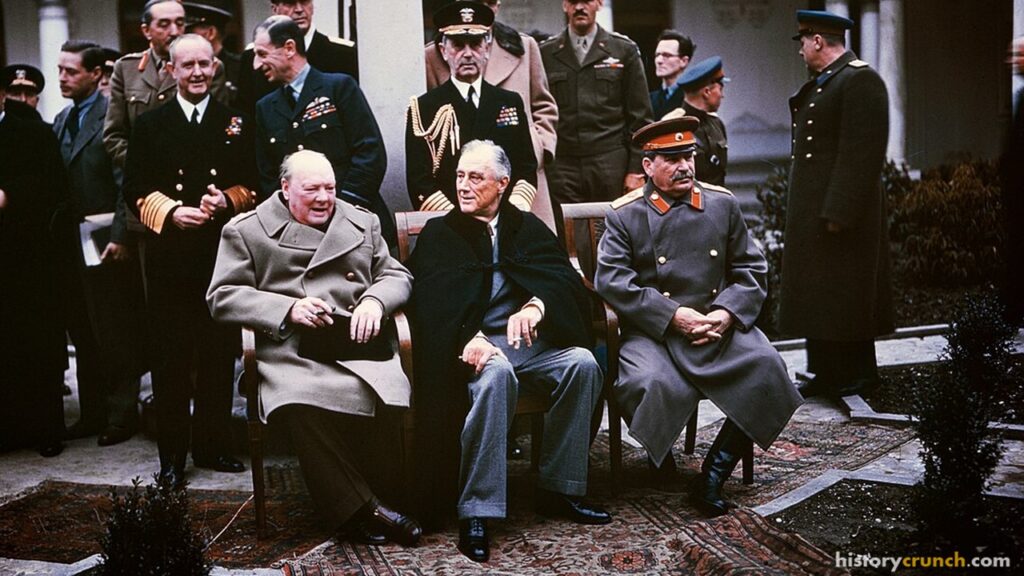
From February 4th to 11th, 1945, with the Red Army forty miles from Berlin, Franklin Roosevelt, Winston Churchill and Joseph Stalin met at Yalta in the Crimea to plan the peace. They agreed to split Germany into four occupation zones, to found the United Nations, and that Stalin would join the war against Japan. Stalin promised free elections in Poland, which his army already held. Roosevelt, two months from death, believed him.
LEARN MORESHOW LESSwhy it matters · key numbers · a debatePOLITICALYalta is where the Cold War starts, because it is where the promises were made that were not kept. Within a year Poland had a communist government chosen in Moscow, and Americans who had cheered the Grand Alliance began to ask what the war had been for. For forty years Yalta was a word for giving Eastern Europe away.
The World War II timeline covers Yalta as the last wartime summit; this card is about what it left behind.
Did Roosevelt give Eastern Europe away at Yalta?
Yes. He took Stalin's word on Poland when the Red Army was already there, and the elections never came. Critics called it a sellout for the next forty years.
No. The Red Army held Eastern Europe before the conference began, and nothing signed at Yalta could have moved it. Roosevelt got the United Nations and Soviet help against Japan for promises that cost Stalin nothing to break.
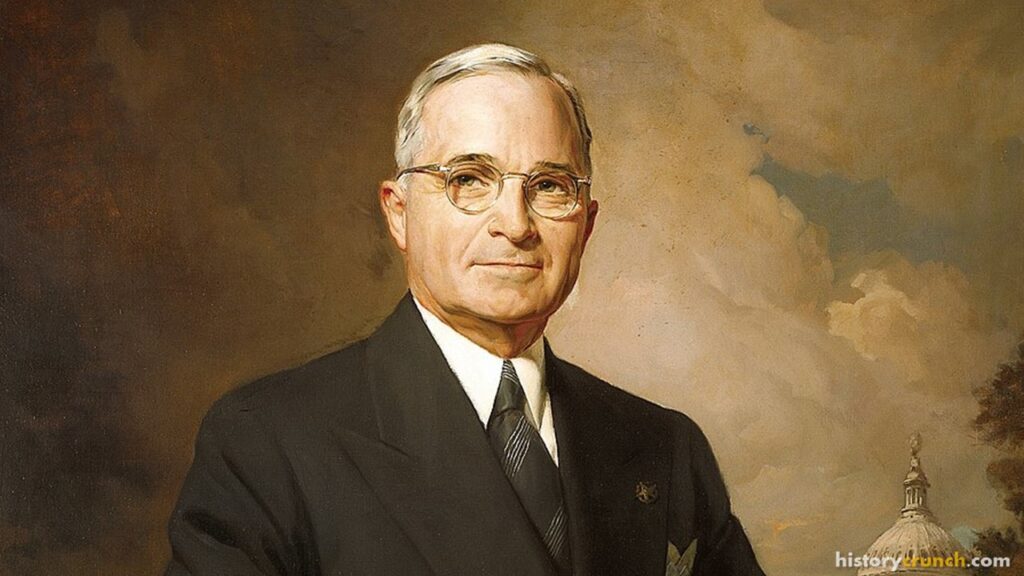
Franklin Roosevelt died at Warm Springs, Georgia, on April 12th, 1945, and Harry Truman, a former senator from Missouri who had been vice president for 82 days, was sworn in that evening. Roosevelt had never told him about the atomic bomb. Truman learned of it the next day, and within four months he would decide to use it and would meet Stalin at the Potsdam Conference.
LEARN MORESHOW LESSwhy it matters · key numbers · a sourcePOLITICALThe Cold War was Truman's war to begin. In eight years he set the policies that ran it for forty: containment, the Truman Doctrine, the Marshall Plan, NATO, the hydrogen bomb and the war in Korea. He was a plain man who had not been told the secrets, and he made the largest decisions of the century in his first months.
IN THEIR OWN WORDS“Boys, if you ever pray, pray for me now.”
Harry Truman to reporters, April 13th, 1945
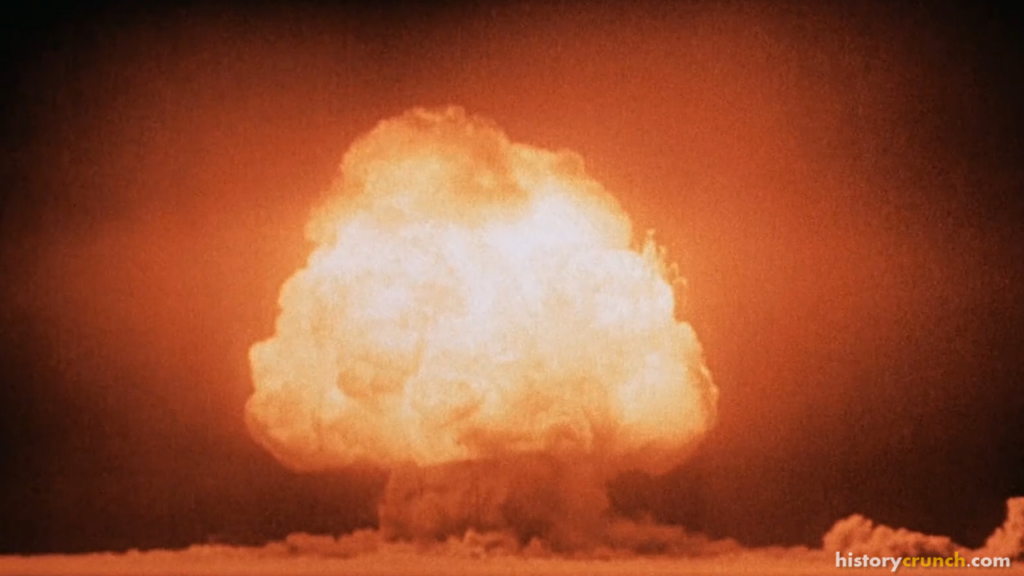
At 5:29 in the morning on July 16th, 1945, the Manhattan Project detonated the first atomic bomb on a tower in the desert near Alamogordo, New Mexico. The plutonium device, nicknamed the Gadget, released the force of about 20,000 tons of TNT and lit the mountains brighter than day. Robert Oppenheimer, the scientific director, watched from ten thousand yards away. Harry Truman was told at the Potsdam Conference the same day.
LEARN MORESHOW LESSwhy it matters · key numbers · a sourceSCIENCEThe bomb changed what a war between great powers would mean, and it did so before the Cold War had a name. For four years the United States was the only country that had it. The Soviet Union already knew the secret from its spies, and the race to match it began here.
IN THEIR OWN WORDS“Now I am become Death, the destroyer of worlds.”
Robert Oppenheimer, recalling the Bhagavad Gita after the Trinity test
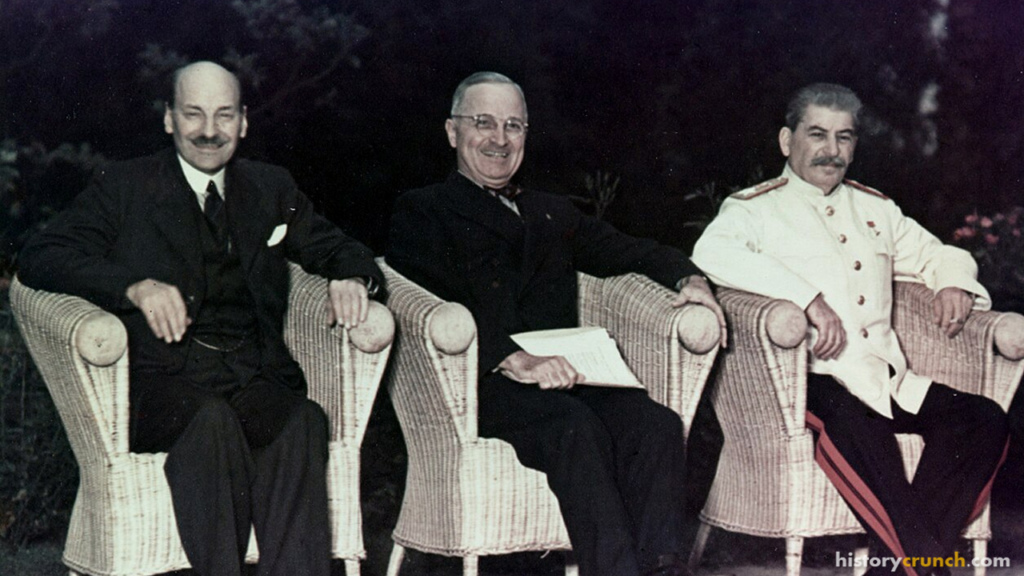
From July 17th to August 2nd, 1945, Harry Truman, Winston Churchill and Joseph Stalin met at Potsdam outside ruined Berlin, with Germany surrendered and the Red Army in control of everything east of the Elbe River. Halfway through, Churchill lost the British election and Clement Attlee took his chair. On July 24th Truman mentioned to Stalin that America had a new weapon of unusual destructive force. Stalin, who knew about it from his spies, said he hoped it would be used against Japan.
LEARN MORESHOW LESSwhy it matters · key numbers · elsewherePOLITICALPotsdam was the last meeting of the wartime allies, and the first where they were rivals. Stalin arrived from a decade of purges that had killed or imprisoned much of his own party and officer corps. They agreed on how to occupy Germany and disagreed on almost everything else, from Poland's borders to reparations. Truman left believing Stalin could be handled; within two years he was building alliances against him.
The Nazi Germany timeline ends with the surrender and the four zones; the World War II timeline covers Potsdam as the end of the war.
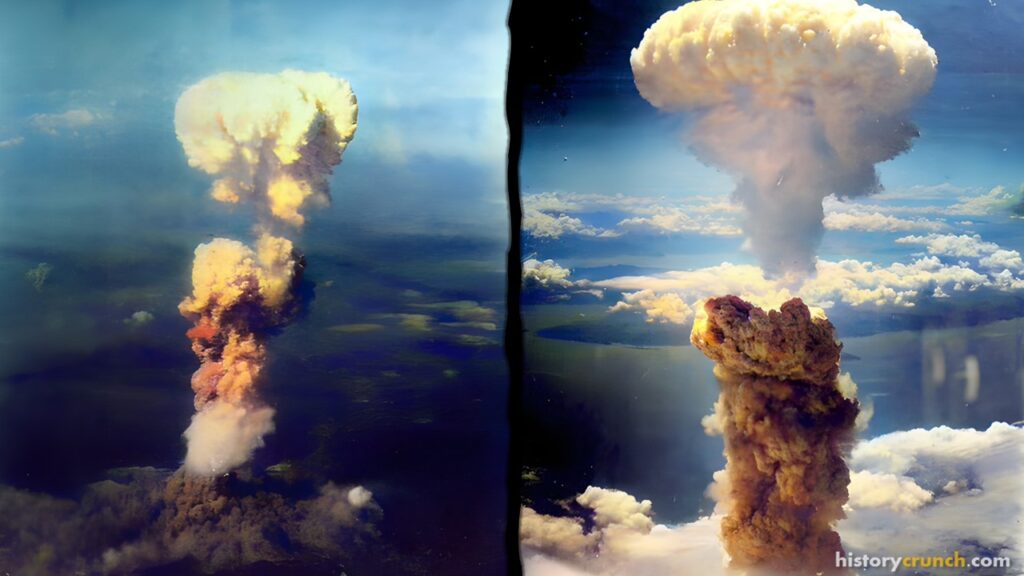
On August 6th, 1945 an American B-29 dropped a uranium bomb called Little Boy on Hiroshima, killing about 80,000 people at once and tens of thousands more from burns and radiation by the end of the year. A second bomb destroyed Nagasaki on August 9th. Japan surrendered on August 15th. Harry Truman had ordered the attacks to end the war without an invasion.
LEARN MORESHOW LESSwhy it matters · key numbers · a debateMILITARYThe bombs ended one war and set the terms of the next. Every crisis of the Cold War, from Berlin to Cuba, was fought in the knowledge of what one bomb had done to one city, and the Soviet Union's first task after 1945 was to build its own. Historians still argue whether the bombs were also a message to Moscow.
The World War II timeline covers the bombings as the end of the Pacific war; here they are the start of the arms race.
Was the bomb dropped to beat Japan or to warn the Soviet Union?
To beat Japan. Truman and his generals expected an invasion to cost hundreds of thousands of American lives, and the bomb ended the war in nine days.
Both. Japan was already near collapse, the Soviet Union was about to enter the war, and some of Truman's advisers saw the bomb as a way to end the war before Stalin could claim a share of Japan and to show Moscow what America had.
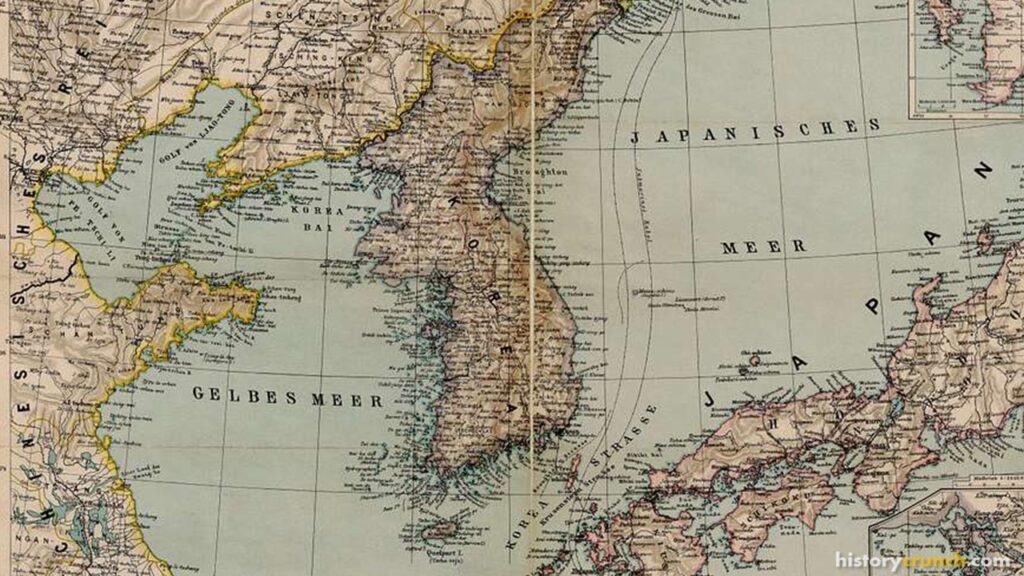
Japan had ruled Korea as a colony since 1910. When it surrendered in August 1945, Soviet troops were already in the north and American troops landed in the south, and two young officers in Washington drew a line across the map at the 38th parallel to separate the zones. It was meant to last months. The American military government ran the south from September 9th, 1945; the Soviets built a communist state in the north around a guerrilla named Kim Il-Sung.
LEARN MORESHOW LESSwhy it matters · key numbers · 2 key figuresPOLITICALThe line drawn in an evening became the most dangerous border in the world. Two Koreas were founded in 1948, went to war in 1950, and are still divided along almost the same line today. The Korean War timeline tells the war itself; this card is where the Cold War arrived in Asia.
On February 22nd, 1946 George Kennan, the second-ranking American diplomat in Moscow, answered a routine question from Washington with a 5,000-word telegram explaining why the Soviet Union could not be treated as a normal ally. Soviet leaders, he wrote, needed a hostile outside world to justify their rule, would push wherever they met no resistance, and would stop wherever they met firm resistance. The answer was patient, long-term containment of Soviet power.
LEARN MORESHOW LESSwhy it matters · key numbersIDEASKennan's telegram gave the Cold War its strategy. Containment, the idea that America should hold the line everywhere and wait for the Soviet system to fail from within, ran American policy from the Truman Doctrine to the fall of the Wall. Kennan spent the rest of his long life complaining that it had been turned into a military doctrine he never intended.
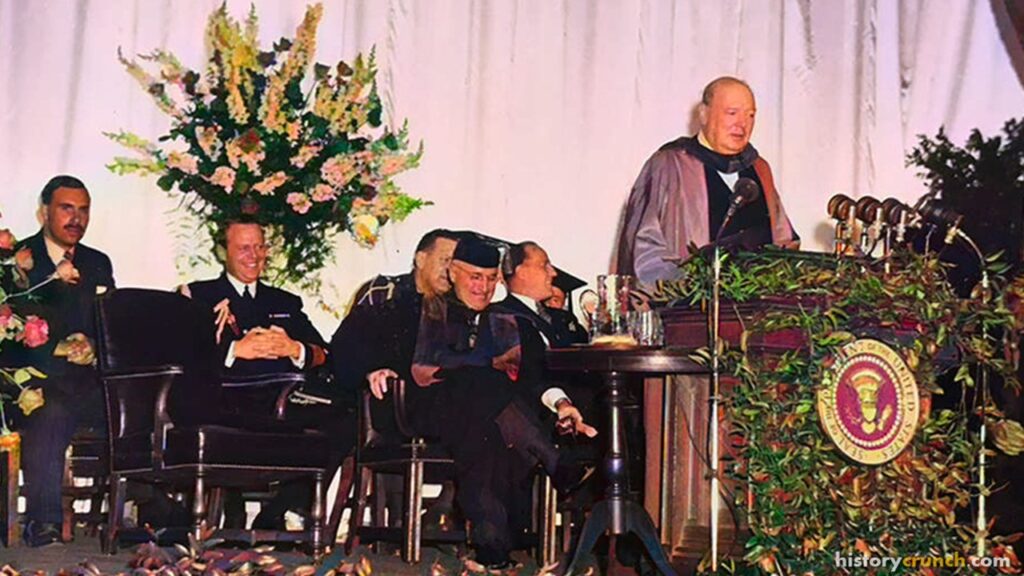
On March 5th, 1946 Winston Churchill, out of office for seven months, spoke at Westminster College in Fulton, Missouri, with Harry Truman on the platform beside him. From Stettin in the Baltic to Trieste in the Adriatic, he said, an iron curtain had descended across the continent, and behind it the capitals of Eastern Europe lay under Moscow's control. He called for the English-speaking peoples to stand together.
LEARN MORESHOW LESSwhy it matters · key numbers · a sourceIDEASThe speech gave the division of Europe its name, and the countries behind the line became satellite states with their own governments and Moscow's orders. It told Americans, in the words of the war's most famous ally, that the alliance with Stalin was over. Stalin called it a declaration of war. A year later the Truman Doctrine made Churchill's warning American policy.
IN THEIR OWN WORDS“From Stettin in the Baltic to Trieste in the Adriatic, an iron curtain has descended across the Continent.”
Winston Churchill, Westminster College, March 5th, 1946
In three years the map was drawn. Harry Truman promised to support free peoples everywhere, George Marshall offered to rebuild any country that asked, and Joseph Stalin answered by seizing Czechoslovakia and blockading Berlin. The airlift held the city, twelve nations signed the North Atlantic Treaty, and Germany became two countries. Then, in the autumn of 1949, the Soviet Union tested a bomb and China went communist, and the Cold War stopped being a European argument.
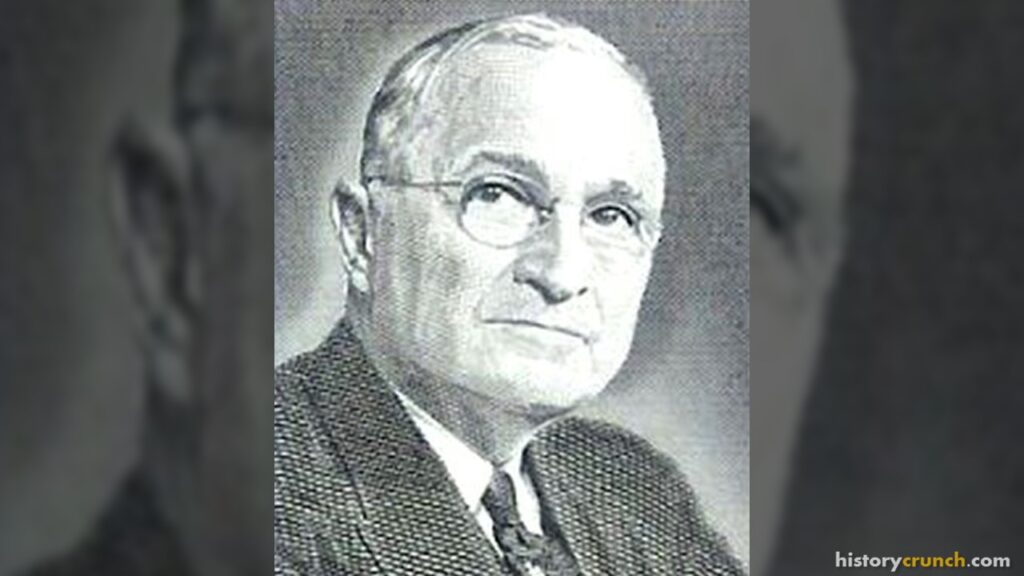
On March 12th, 1947 Harry Truman asked Congress for $400 million to help Greece, where a communist rebellion was being fought, and Turkey, which the Soviet Union was pressing for bases. Britain, broke after the war, had said it could no longer pay. Truman put the request in the largest terms: it must be the policy of the United States to support free peoples who were resisting attempted subjugation by armed minorities or by outside pressures.
LEARN MORESHOW LESSwhy it matters · key numbers · a sourcePOLITICALThe speech turned Kennan's containment into a promise to the whole world, and it is where the superpowers' habit of fighting each other through a proxy war in somebody else's country begins. Congress voted the money by large majorities. Historians date the Cold War as an American commitment from this day. Every intervention of the next forty years, from Korea to Vietnam to Afghanistan, was argued in Truman's words.
IN THEIR OWN WORDS“It must be the policy of the United States to support free peoples who are resisting attempted subjugation by armed minorities or by outside pressures.”
Harry Truman to Congress, March 12th, 1947
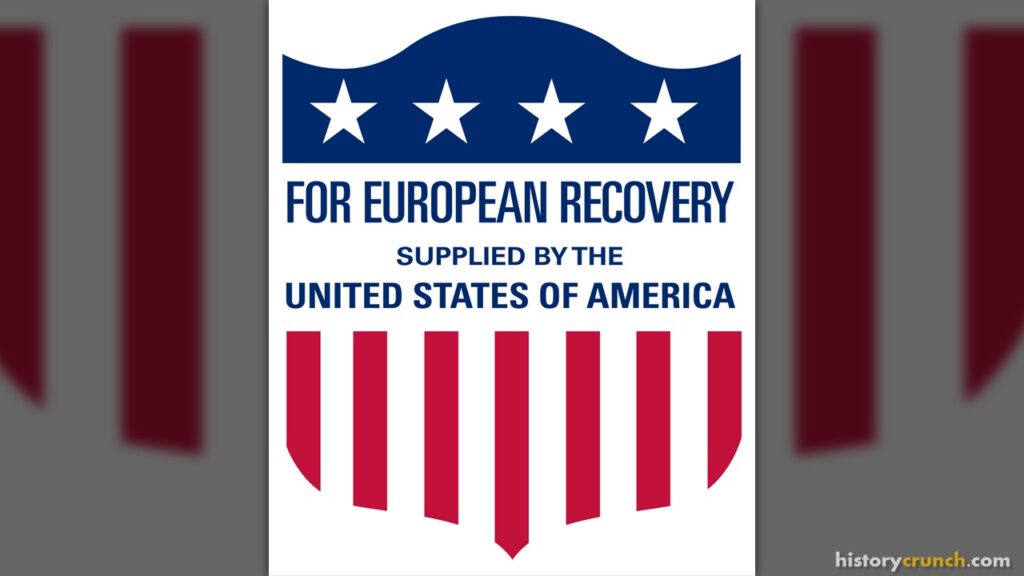
Speaking at Harvard's commencement on June 5th, 1947, Secretary of State George Marshall offered American money to rebuild any European country that asked, including the Soviet Union and its neighbors. Stalin refused for himself and forbade Poland and Czechoslovakia to accept. Harry Truman signed the plan into law on April 3rd, 1948, and over four years the United States gave Western Europe about $12 billion, some $120 billion in today's money.
LEARN MORESHOW LESSwhy it matters · key numbers · 2 key figuresECONOMICThe Marshall Plan rebuilt Western Europe's factories, fed its cities and kept its voters from turning to communist parties that were strong in France and Italy. It also drew the line: the countries that took the money became the West, and the ones Stalin kept out became the East. Stalin answered with a blockade a year later.
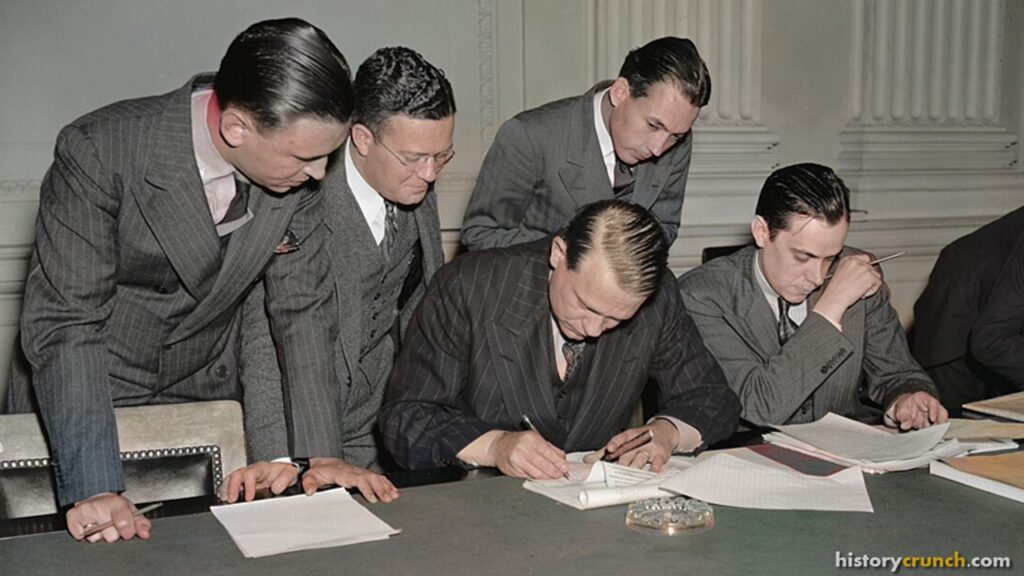
In October 1947 the House Un-American Activities Committee, founded in 1938 to hunt Nazi sympathizers, called Hollywood writers and directors to Washington to ask whether they were or had ever been members of the Communist Party. Ten refused to answer, citing the First Amendment, and were jailed for contempt of Congress. The studios agreed the next month to hire no communists, and the blacklist began.
LEARN MORESHOW LESSwhy it matters · key numbersCULTUREThe Hollywood hearings were the first public show of the Red Scare, two years before the Soviet bomb and three before Joseph McCarthy. Hundreds of writers, actors and directors lost their careers over the next decade for their politics, and the fear of being named ran through American life until the mid-1950s.
Czechoslovakia was the last democracy east of the Iron Curtain, with a communist prime minister governing in coalition with democratic parties. In February 1948 the communists, backed by armed workers' militias and Soviet pressure, forced President Edvard Benes to accept an all-communist government on February 25th. The foreign minister, Jan Masaryk, was found dead beneath his window two weeks later.
LEARN MORESHOW LESSwhy it matters · key numbers · 1 key figurePOLITICALThe coup shocked the West as no event since the war had. Stalin had taken by force what he could not win by votes; the coup gave Congress the push to pass the Marshall Plan, and it turned talk of a Western alliance into the North Atlantic Treaty a year later. Prague would try again in 1968.
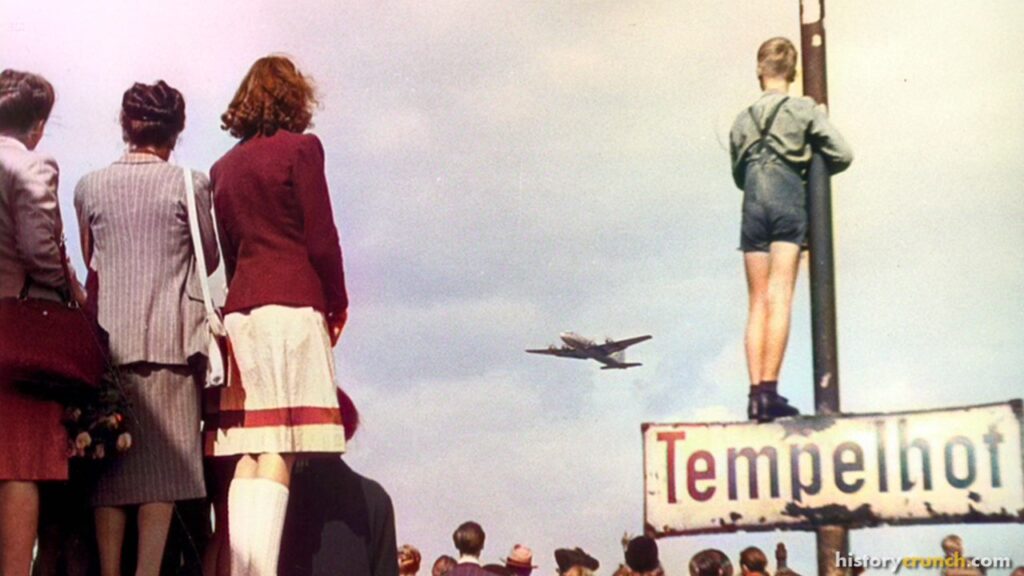
Berlin lay a hundred miles inside the Soviet zone of Germany, divided like the country into four sectors. When the Western allies introduced a new currency in their zones in June 1948, Joseph Stalin answered on June 24th by cutting every road, railway and canal into West Berlin. Two million people had food for about a month. Stalin expected the Americans, British and French to leave.
LEARN MORESHOW LESSwhy it matters · key numbers · 2 key figuresMILITARYThe blockade was the first direct confrontation of the Cold War, and the first test of whether the West would hold a position it could not defend by force. Harry Truman's answer, to fly the city's food in rather than fight or leave, set the pattern for forty years: stand firm, avoid the shot.
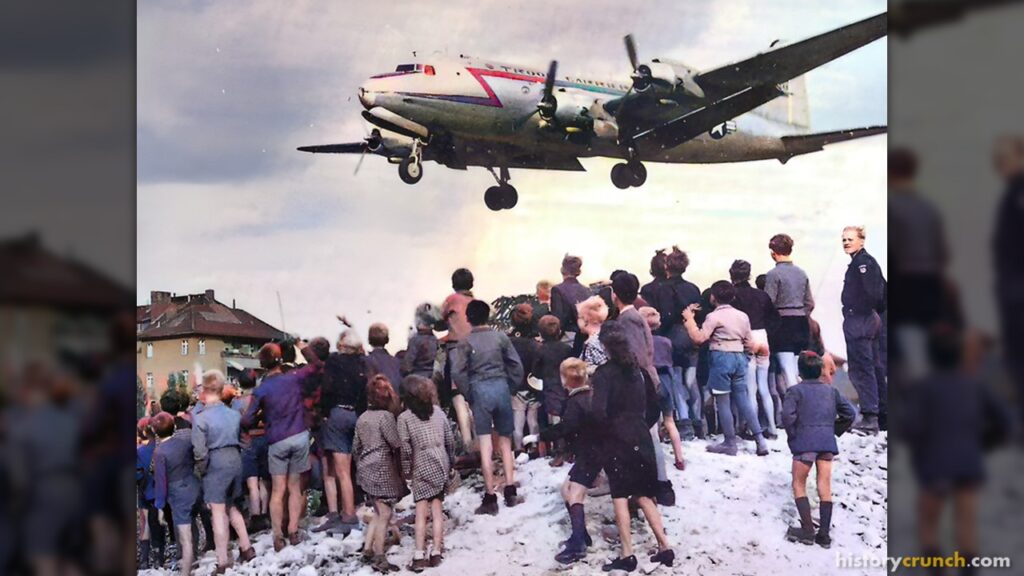
The first American cargo planes landed at Tempelhof on June 26th, 1948, two days after the blockade began. By the spring of 1949 American and British aircraft were landing every ninety seconds, day and night, carrying coal, flour, dried potatoes and candy on tiny parachutes for the children. In eleven months they flew 277,000 flights and delivered 2.3 million tons. Stalin lifted the blockade on May 12th, 1949.
LEARN MORESHOW LESSwhy it matters · key numbers · 2 key figuresMILITARYThe airlift won the Cold War's first battle without a shot, turned the Germans who had been enemies three years before into allies, and made West Berlin the symbol of the West's promise to stay. It also proved Stalin would back down when the cost of pressing on was a war he did not want.
On August 3rd, 1948 Whittaker Chambers, a former communist and an editor at Time magazine, told the House Un-American Activities Committee that Alger Hiss, a former State Department official who had been at the Yalta Conference and had helped found the United Nations, had been a communist and a Soviet spy in the 1930s. Hiss denied it under oath. A young congressman from California, Richard Nixon, pressed the case, and in January 1950 Hiss was convicted of perjury.
LEARN MORESHOW LESSwhy it matters · key numbers · a debatePOLITICALThe Hiss case convinced millions of Americans that Soviet espionage had reached the top of their government, made Nixon famous, and set the stage for Joseph McCarthy's list a month after the verdict. Whether Hiss was guilty was argued for fifty years; Soviet cables decoded after the Cold War point to yes.
Was Alger Hiss a spy?
Yes. Chambers produced typed copies of State Department documents, the Venona decrypts released in 1995 describe an agent who matches Hiss, and a jury convicted him.
The case was never proven. Hiss was convicted of perjury, not espionage, on the word of a confessed liar, and defenders argued for decades that the evidence was manufactured in the panic of 1948.
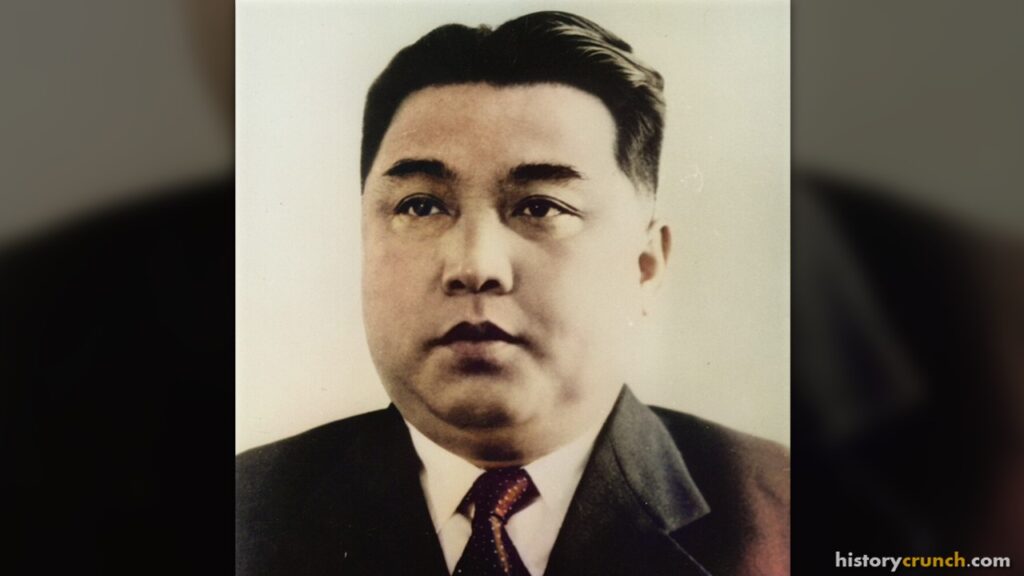
The temporary line of 1945 hardened into two states in 1948. On August 15th the Republic of Korea was proclaimed in Seoul under Syngman Rhee, after elections in the south that the north refused to join; on September 9th the Democratic People's Republic of Korea was proclaimed in Pyongyang under Kim Il-Sung. Each claimed the whole peninsula. Soviet troops left the north in 1948 and American troops left the south in 1949.
LEARN MORESHOW LESSwhy it matters · key numbers · 1 key figurePOLITICALTwo governments, each calling the other illegitimate and each backed by a superpower, made war almost certain. Raids across the parallel began in 1949, and in June 1950 Kim asked Stalin for permission to end the argument by force.
On April 4th, 1949, with the airlift still flying, the United States, Canada, Britain, France and eight other Western European nations signed the North Atlantic Treaty in Washington. Article 5 said that an armed attack on any one of them would be treated as an attack on all. It was the first peacetime military alliance the United States had joined since 1800. Greece and Turkey joined in 1952 and West Germany in 1955.
LEARN MORESHOW LESSwhy it matters · key numbers · elsewherePOLITICALNATO put American soldiers in Europe for good and put the atomic bomb behind the promise. It was the answer to the Czech coup and the blockade, and it is the reason no Soviet tank ever crossed the line Winston Churchill drew. The Soviet Union answered with the Warsaw Pact in 1955. NATO is still there; the Warsaw Pact is not.
Canada was a founding member and has been in every NATO mission since; Britain's alliance with America, promised at Fulton, was signed here.
On May 23rd, 1949 the American, British and French zones became the Federal Republic of Germany, with its capital at Bonn and a constitution written to make another Hitler impossible. On October 7th the Soviet zone became the German Democratic Republic, a communist state with its capital in East Berlin. The temporary occupation of 1945 had become two countries, and the border between them was the front line of the Cold War for forty-one years.
LEARN MORESHOW LESSwhy it matters · key numbers · elsewherePOLITICALGermany was the prize both sides wanted and neither could have, so it was cut in two. The West Germans got the Marshall Plan, NATO and an economic miracle; the East Germans got the Stasi, the Wall and a state that had to fence its people in. The Nazi Germany timeline ends here; the story of the two Germanies is this one.
The Nazi Germany timeline ends with the two Germanies; the Cold War timeline follows them to reunification in 1990.
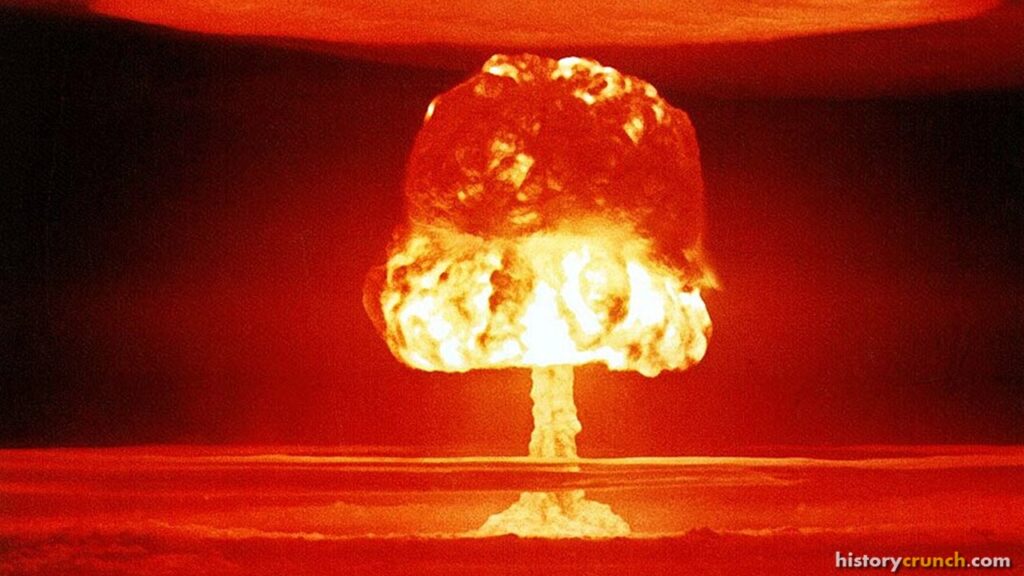
On August 29th, 1949 the Soviet Union exploded its first atomic bomb, codenamed First Lightning, at a test site in Kazakhstan. American aircraft picked up the radioactive dust over the Pacific a few days later, and Harry Truman announced it to a stunned country on September 23rd. American experts had expected the Soviets to need until the mid-1950s. Spies inside the Manhattan Project, above all the physicist Klaus Fuchs, had saved them years.
LEARN MORESHOW LESSwhy it matters · key numbers · 2 key figuresSCIENCEThe American monopoly was over after four years, and with it the sense of safety that had let the United States demobilize after 1945. Within five months Truman ordered the hydrogen bomb, and within a year the fear of spies had a name: McCarthyism. From here on, every Cold War crisis was a crisis between two nuclear powers.
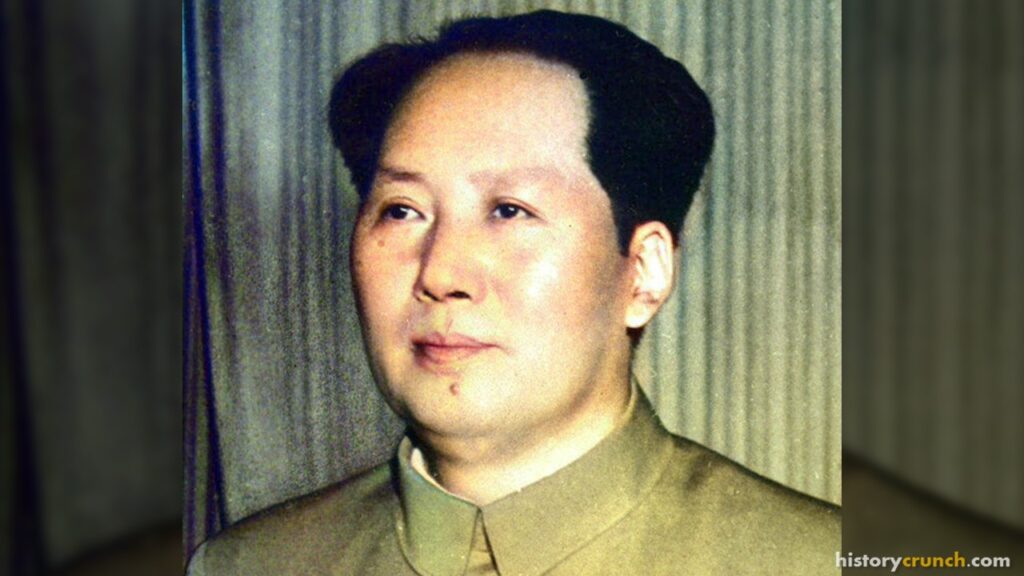
On October 1st, 1949 Mao Zedong stood on the Tiananmen Gate in Beijing and proclaimed the People's Republic of China, ending a civil war that had run, with a pause to fight Japan, since 1927. Chiang Kai-shek's Nationalists, whom the United States had backed with billions, fled to Taiwan. A quarter of the human race was now under communist rule, and in February 1950 Mao signed an alliance with Stalin.
LEARN MORESHOW LESSwhy it matters · key numbers · 2 key figuresPOLITICALIn one year the United States had lost its atomic monopoly and, as its critics put it, lost China. The two shocks together made 1949 the year the Cold War became a world contest rather than a European one, and they made Korea, where the two communist giants now met the American line, the place it would turn hot.
In June 1950 North Korea crossed the 38th parallel and the Cold War turned hot. Harry Truman sent an army without asking Congress, Douglas MacArthur landed at Inchon, China poured across the Yalu, and three years of fighting ended where it began. At home the fear of spies found its senator in Joseph McCarthy and its victims in the Rosenbergs, and both sides built the hydrogen bomb. Stalin's death in March 1953 opened the first crack in the ice.
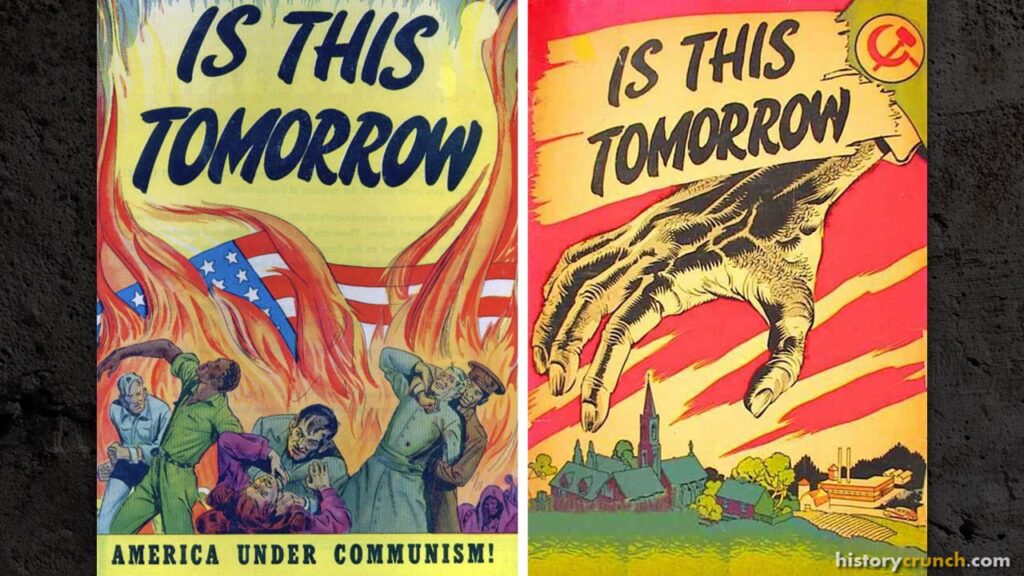
In 1950 the United States set up Radio Free Europe to broadcast news and commentary in the languages of Eastern Europe, alongside the Voice of America, which had been on the air since the war. Radio Free Europe was paid for in secret by the CIA until 1971. The Soviet Union and its allies spent heavily jamming the signals, and listening was a crime in several countries. At home, comic books like Is This Tomorrow: America Under Communism warned children what the enemy wanted.
LEARN MORESHOW LESSwhy it matters · key numbersCULTUREThe Cold War was an argument between communism and capitalism about which system worked, fought with words as much as weapons, and the radios were the West's longest campaign. People behind the Iron Curtain learned from them what their own newspapers would not print, from the Secret Speech to Solidarity. Dissidents in 1989 said the broadcasts had kept them going.
Five months after the Soviet test, on January 31st, 1950, Harry Truman ordered work to begin on the hydrogen bomb, a weapon that would use an atomic explosion to set off nuclear fusion and could be hundreds of times more powerful than the bomb that destroyed Hiroshima. Robert Oppenheimer and the government's own scientific advisers had argued against it as a weapon of genocide. Truman's decision took seven minutes.
LEARN MORESHOW LESSwhy it matters · key numbers · 2 key figuresSCIENCEThe hydrogen bomb turned the arms race from a contest in bombs to a contest in the end of the world. Within four years both sides had it, and the doctrine of mutual assured destruction, that neither could strike without being destroyed, became the strange peace of the next forty years.
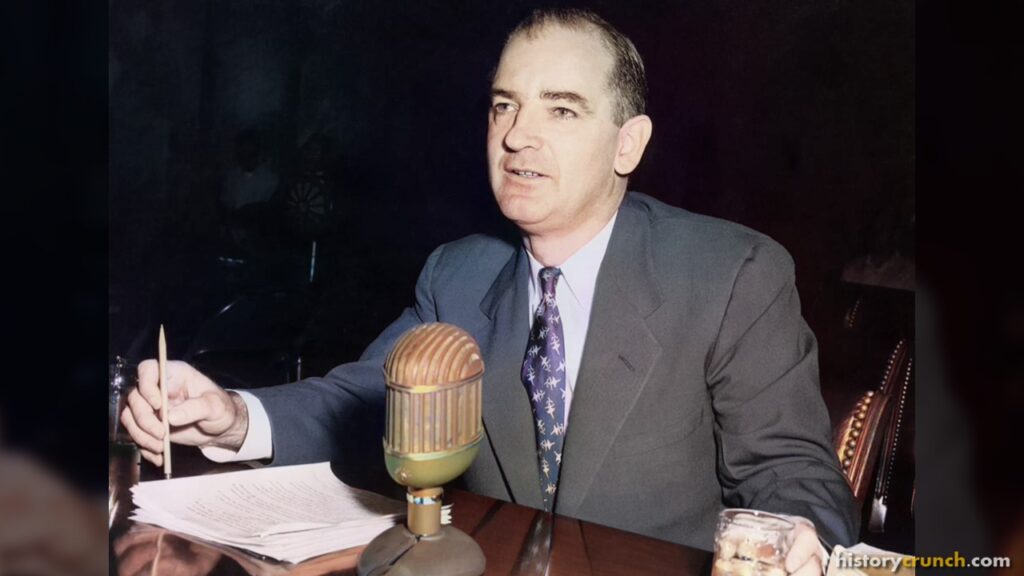
On February 9th, 1950, at a Republican dinner in Wheeling, West Virginia, Senator Joseph McCarthy of Wisconsin held up a piece of paper and said he had the names of 205 communists working in the State Department. He had no list. The number changed with each telling, but the charge came three weeks after Alger Hiss was convicted and four months after the Soviet bomb, and the country believed him.
LEARN MORESHOW LESSwhy it matters · key numbers · a sourcePOLITICALMcCarthy gave the Red Scare its name and its worst four years. Thousands of government workers, teachers, union officials and entertainers lost their jobs on accusations they could not answer, and McCarthyism became the word for smearing an opponent as disloyal. He was undone on television in 1954.
IN THEIR OWN WORDS“I have here in my hand a list of 205 names that were made known to the Secretary of State as being members of the Communist Party.”
Joseph McCarthy, Wheeling, West Virginia, February 9th, 1950, as reported in the Wheeling Intelligencer
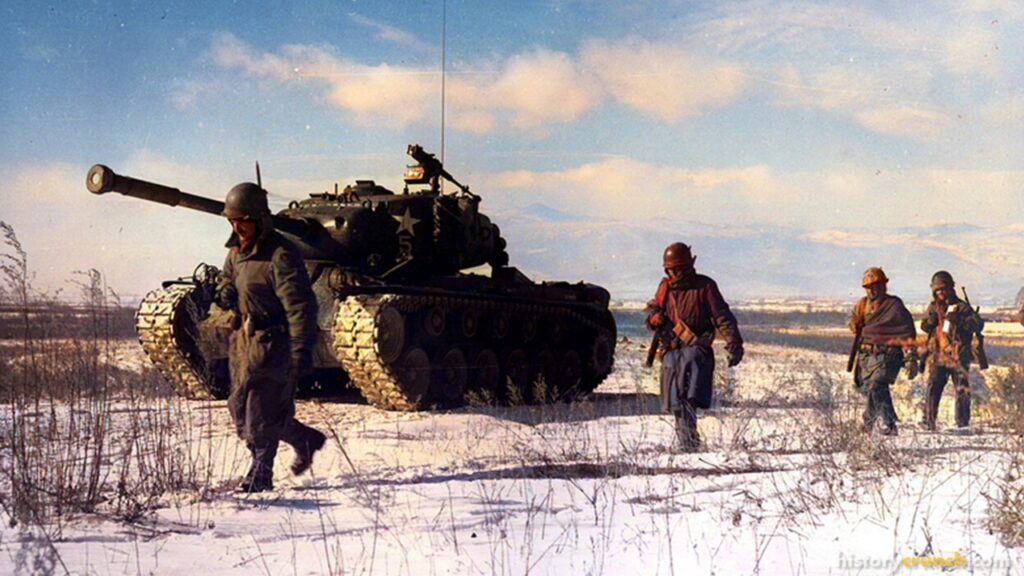
At dawn on June 25th, 1950 about 90,000 North Korean troops with Soviet tanks crossed the 38th parallel. Kim Il-Sung had won Joseph Stalin's permission in the spring by promising a quick victory. Seoul fell in three days. Harry Truman, without asking Congress, sent American forces under a United Nations flag, which the Security Council had approved because the Soviet delegate was boycotting it. Within weeks the Americans held only a corner of the peninsula around Pusan.
LEARN MORESHOW LESSwhy it matters · key numbers · 3 key figuresMILITARYKorea was the first shooting war of the Cold War and the test of containment: Truman decided in a weekend that the line would be held with American soldiers. It tripled the American defense budget, put troops in Europe and Asia for good, and killed about three million people in three years. The Korean War timeline tells the war itself.
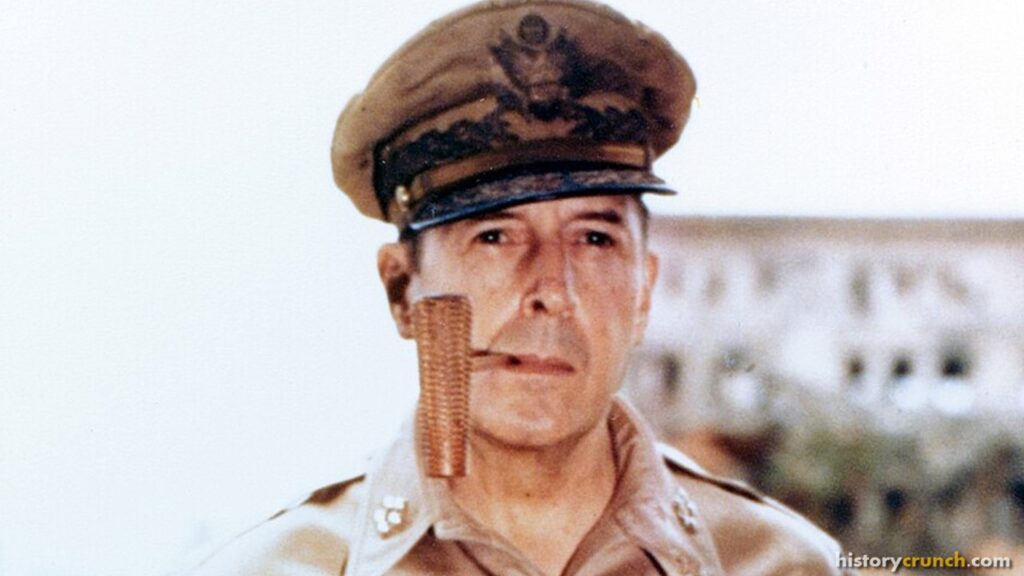
On September 15th, 1950 General Douglas MacArthur landed 75,000 troops at Inchon, the port of Seoul, 150 miles behind the North Korean lines, on a coast with thirty-foot tides that his own staff had called impossible. The North Korean army, cut off from its supplies, collapsed. Seoul was retaken by the end of the month and UN forces crossed the 38th parallel on October 7th, captured Pyongyang on October 19th and drove toward the Chinese border.
LEARN MORESHOW LESSwhy it matters · key numbers · 2 key figuresMILITARYInchon was the most daring operation of the war and its most dangerous success. Having saved South Korea, Harry Truman and MacArthur decided to conquer the North, and the advance to the Yalu River brought China into the war.
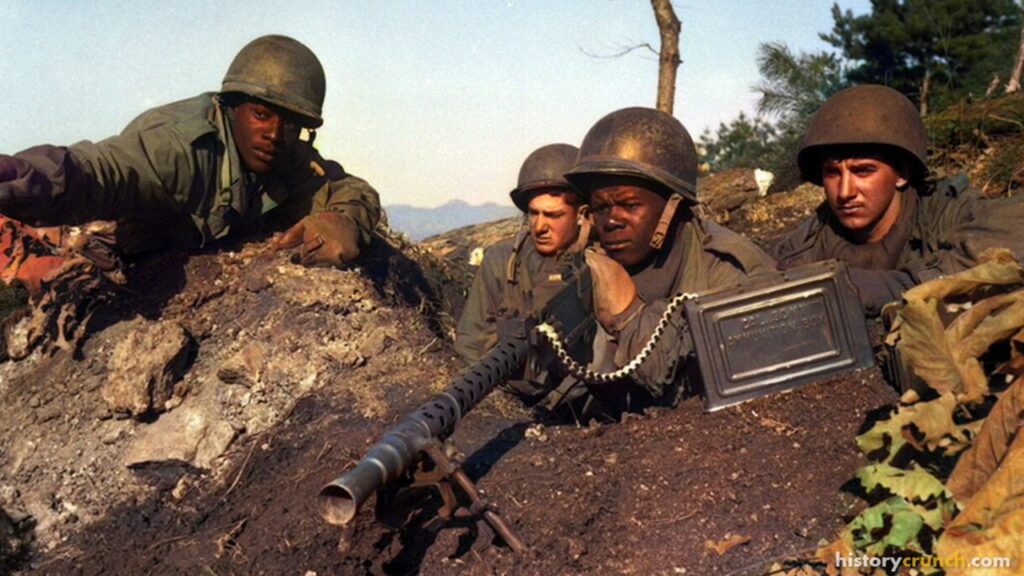
As UN troops neared the Yalu River in late October 1950, about 300,000 Chinese soldiers who had crossed into Korea in secret attacked on October 25th. Mao Zedong had decided, at Stalin's urging and against most of his own generals, that he could not have an American army on his border. By December the UN forces were in full retreat through the winter, and Seoul fell again on January 4th, 1951. The line settled near the 38th parallel by the spring.
LEARN MORESHOW LESSwhy it matters · key numbers · 2 key figuresMILITARYChina's entry turned a won war into a stalemate and nearly into a world war. Douglas MacArthur wanted to bomb China and use Nationalist troops from Taiwan; Harry Truman refused, and fired him for saying so in public. The Cold War now had a second communist great power in it.
On April 11th, 1951 Harry Truman took the Korea and Japan commands away from General Douglas MacArthur for insubordination, after the general had publicly demanded the right to attack China and had written to a congressman that there was no substitute for victory. MacArthur came home to ticker-tape parades and addressed Congress; Truman's approval rating fell to 22 percent. The Senate held hearings and sided, in the end, with the president.
LEARN MORESHOW LESSwhy it matters · key numbers · a sourcePOLITICALThe firing settled that a general could not make war policy, and that the United States would fight the Cold War as a limited war rather than risk a general one with China and the Soviet Union. Limited war, fought for a line rather than a victory, became the pattern for Korea, Vietnam and every conflict after.
IN THEIR OWN WORDS“Old soldiers never die; they just fade away.”
Douglas MacArthur to Congress, April 19th, 1951
On November 1st, 1952 the United States exploded the first hydrogen device, Ivy Mike, on the island of Elugelab in the Pacific. The island disappeared. The explosion was about 700 times the size of Hiroshima's and left a crater a mile wide. The Soviet Union tested its own hydrogen bomb on August 12th, 1953, and in March 1954 the American Castle Bravo test poisoned a Japanese fishing boat with fallout 80 miles away.
LEARN MORESHOW LESSwhy it matters · key numbersSCIENCEWithin two years of Ivy Mike both sides could destroy cities by the dozen, and the arms race moved to the rockets that would carry the bombs. Fallout from the tests fell on the whole world and made the first movement to ban them, which won the Test Ban Treaty in 1963.
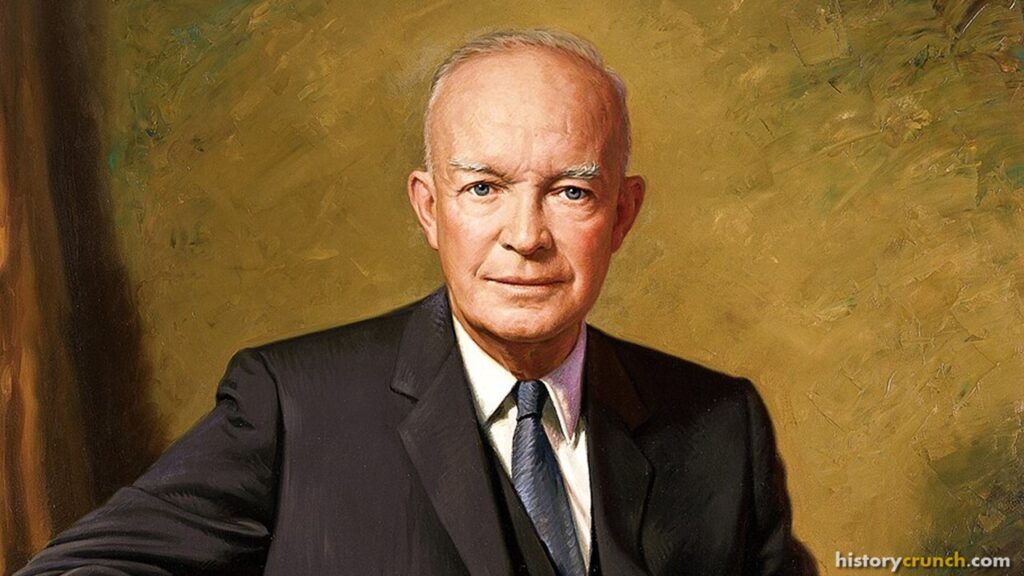
Dwight Eisenhower, the general who had commanded the invasion of Normandy and then NATO, won the presidency on November 4th, 1952 against Adlai Stevenson, with a promise to go to Korea and end the war. Richard Nixon was his running mate. He was the first Republican president in twenty years, and he governed the Cold War for eight: the armistice, the Suez crisis, Sputnik, the U-2, and the warning about the military-industrial complex.
LEARN MORESHOW LESSwhy it matters · key numbers · 2 key figuresPOLITICALEisenhower believed the Cold War would be long and that America could lose it by bankrupting itself, so he relied on nuclear weapons and the CIA rather than armies. His years were the ones in which the contest settled into its shape: two blocs, two alliances, two bombs, and crises that stopped short of war.
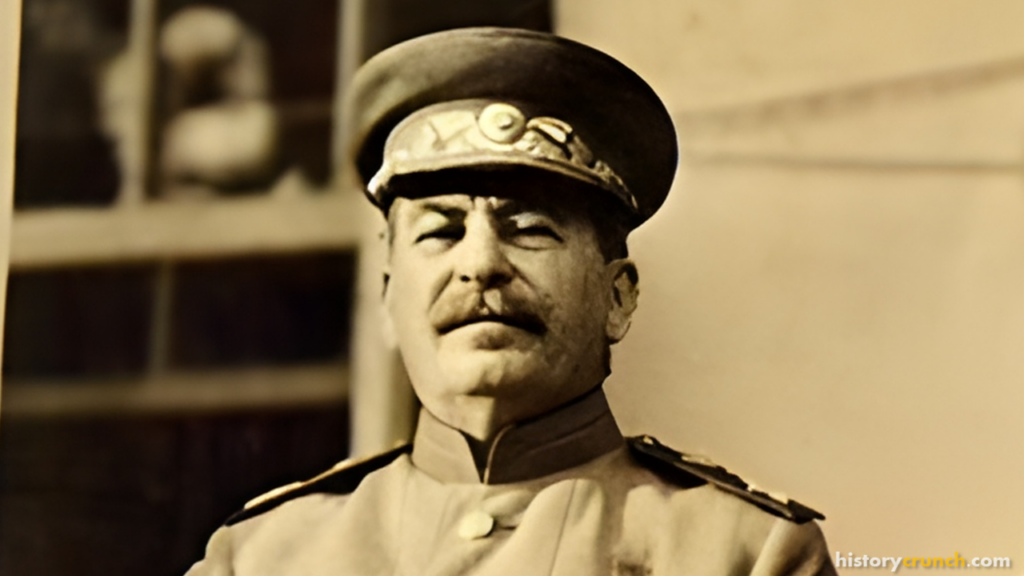
Joseph Stalin, ruler of the Soviet Union since 1924, suffered a stroke at his dacha outside Moscow and died on March 5th, 1953, aged 74. His guards had been afraid to enter his room for hours. His lieutenants divided power among themselves and, in June, arrested and shot the secret police chief, Lavrentiy Beria, whom they feared most. Within two years Nikita Khrushchev had come out on top.
LEARN MORESHOW LESSwhy it matters · key numbers · 2 key figuresPOLITICALStalin's death opened the first thaw. The new leaders wanted the Korean War over, and it was in four months; they freed a million prisoners from the camps; and in 1956 Khrushchev told the party the truth about the man they had all served. The Cold War went on, but it was no longer run by the man who had started it on the Soviet side.
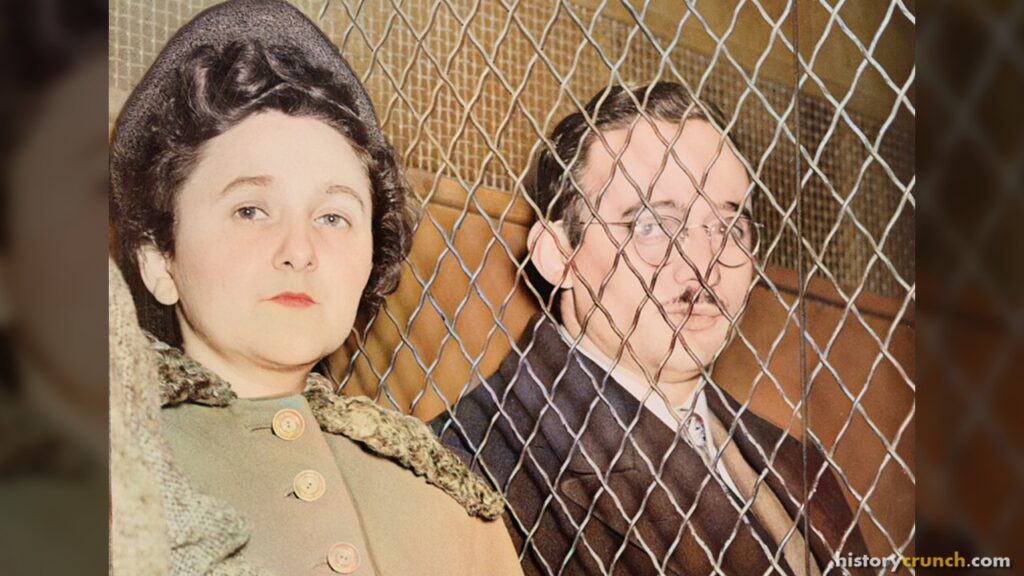
Julius and Ethel Rosenberg, a New York couple, were convicted in March 1951 of passing atomic secrets to the Soviet Union, on the evidence of Ethel's brother, who had worked at Los Alamos. The judge sentenced both to death. Appeals and pleas from around the world, including the Pope, failed, and they were electrocuted at Sing Sing prison on June 19th, 1953, the only Americans executed for spying in the Cold War. They left two sons.
LEARN MORESHOW LESSwhy it matters · key numbers · a debatePOLITICALThe Rosenbergs were the human face of the spy scare, and their case has been argued ever since. Soviet cables decoded in 1995 show Julius ran a spy ring; Ethel's part was small and the case against her thin. The execution showed how far the fear of 1950 could go.
Did the Rosenbergs deserve to die?
Julius was a Soviet agent, as the decoded cables prove, and he gave Moscow military secrets in the middle of a war. The law allowed death and the jury chose it.
No other Cold War spy was executed, Ethel was convicted mainly to pressure her husband, and the atomic information Julius passed was of little value. The sentence was the fear of 1953, not justice.
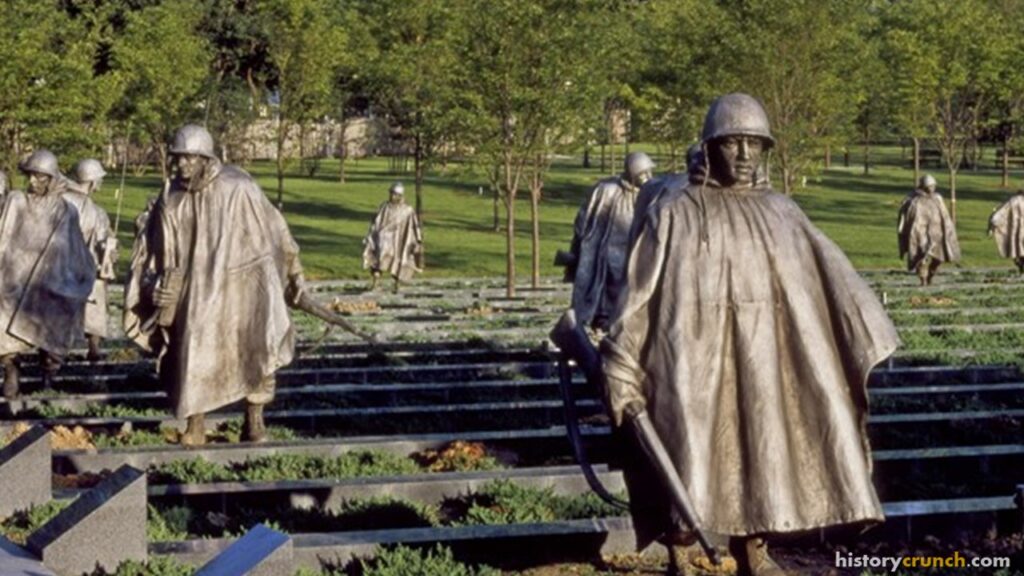
On July 27th, 1953, after two years of talks and two more years of fighting along a fixed line, an armistice was signed at Panmunjom. The border was drawn where the armies stood, close to the 38th parallel where the war had begun, with a demilitarized zone two and a half miles wide between them. About 36,000 Americans, some 600,000 Chinese and Korean soldiers and two million Korean civilians had died. No peace treaty was ever signed.
LEARN MORESHOW LESSwhy it matters · key numbers · 2 key figuresMILITARYKorea ended where it started, and that was the point: containment had held. It also left the United States with a permanent army in Asia, a treaty with South Korea, and a habit of fighting communism with American troops that led to Vietnam. The two Koreas are still technically at war.
Nikita Khrushchev buried Stalin's memory, then sent tanks into Hungary; he promised peaceful coexistence, then put a satellite over America's head and a wall through Berlin. Fidel Castro took Cuba, the CIA failed at the Bay of Pigs, and Yuri Gagarin beat the Americans into space. In October 1962 the two sides came closer to nuclear war than they ever had, over missiles ninety miles from Florida, and stepped back. These were the Cold War's most dangerous nine years.
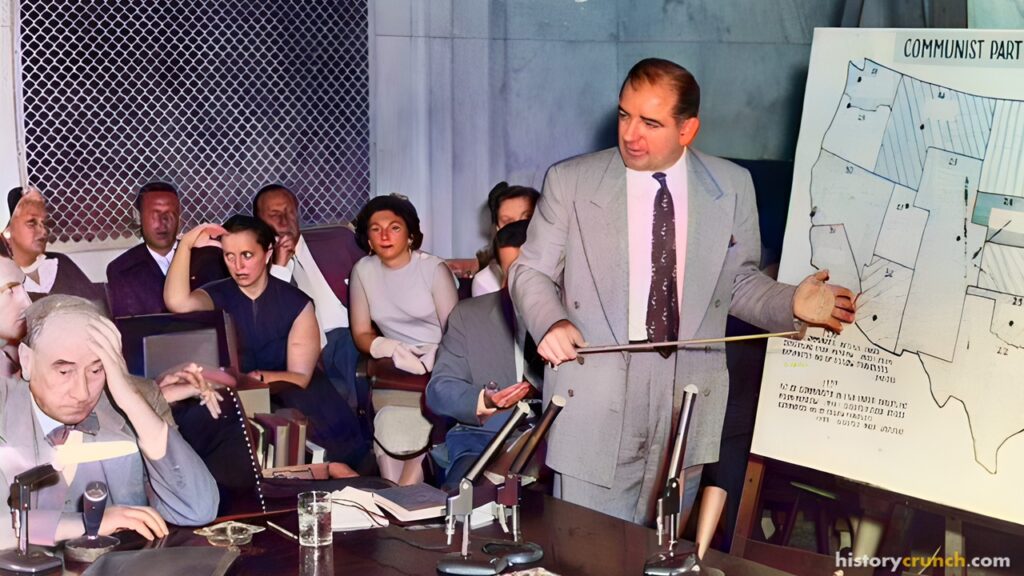
From April 22nd to June 17th, 1954, 20 million Americans watched Joseph McCarthy on live television as he accused the United States Army of harboring communists. On June 9th the Army's lawyer, Joseph Welch, answered one smear with the question the country remembered: have you no sense of decency, sir? The Senate censured McCarthy in December 1954. He died in 1957, aged 48.
LEARN MORESHOW LESSwhy it matters · key numbers · a sourcePOLITICALTelevision did what no senator had dared: it showed McCarthy at work. His fall ended the worst of the Red Scare, though the blacklists lasted years longer. The same spring, Robert Oppenheimer lost his security clearance in a hearing over his loyalty, the scare's last famous victim.
IN THEIR OWN WORDS“Have you no sense of decency, sir, at long last? Have you left no sense of decency?”
Joseph Welch to Joseph McCarthy, June 9th, 1954
On May 7th, 1954 the French garrison at Dien Bien Phu, in the hills of northern Vietnam, surrendered to Ho Chi Minh's Viet Minh after a 56-day siege. France had been fighting to keep its colony since 1946 with American money paying most of the bill. At Geneva that summer Vietnam was divided at the 17th parallel, communist in the north and anti-communist in the south, with elections promised for 1956 that never came.
LEARN MORESHOW LESSwhy it matters · key numbers · elsewhereMILITARYThe French defeat handed Vietnam to the United States. Dwight Eisenhower explained the stakes with a row of dominoes: if one country fell to communism, the next would follow. By 1960 there were 700 American advisers in the south, and the Vietnam War timeline takes the story from there.
The Vietnam War timeline covers the war itself; this timeline keeps the moments that changed the Cold War.
In June 1954 the CIA armed and paid a small force of exiles to overthrow Jacobo Arbenz, the president Guatemalans had voted in, whose land reform had taken unused estates from the United Fruit Company. Arbenz resigned on June 27th. Among the foreigners in Guatemala City that month was a 26-year-old Argentine doctor, Ernesto Guevara, who left convinced that only armed revolution could stand against the United States. The next year in Mexico he met Fidel Castro.
LEARN MORESHOW LESSwhy it matters · key numbers · 2 key figuresPOLITICALGuatemala was the model for what the CIA would try in Cuba in 1961, and Cuba was where it failed. It also made Che. The Americas were the Cold War's back yard, and the United States treated any left-wing government there as a Soviet foothold for the next thirty years.
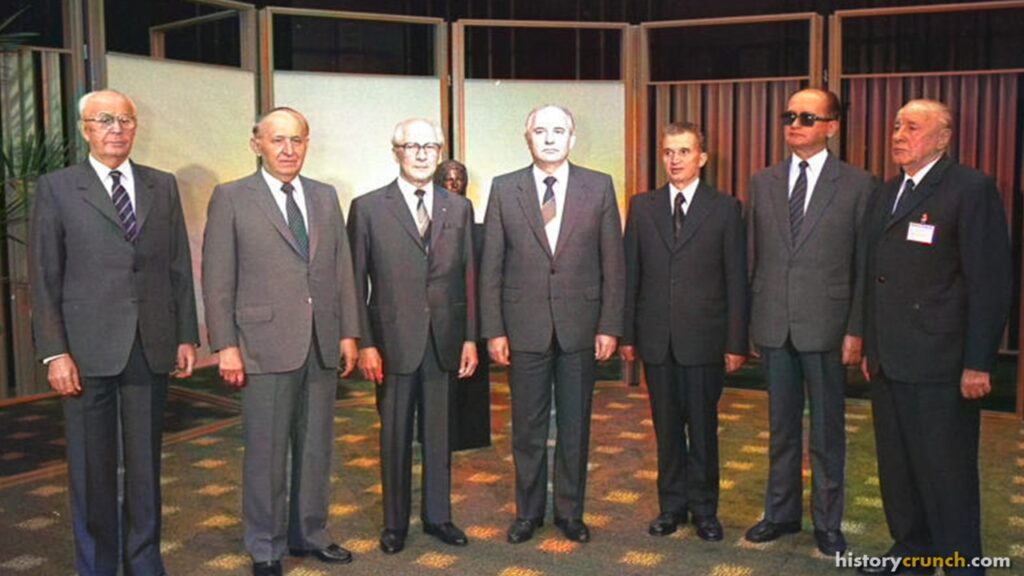
On May 14th, 1955, nine days after West Germany joined NATO and began to rearm, the Soviet Union and seven Eastern European states signed a treaty of friendship, cooperation and mutual assistance in Warsaw. The Warsaw Pact put the armies of Poland, East Germany, Czechoslovakia, Hungary, Romania, Bulgaria and Albania under Soviet command. Its troops were used only twice: against Hungary in 1956 and Czechoslovakia in 1968, both its own members.
LEARN MORESHOW LESSwhy it matters · key numbersMILITARYThe pact completed the map: two Germanies, two alliances, two armies facing each other across the Iron Curtain for the next thirty-six years. It was less an alliance than a lock on Eastern Europe, and when Mikhail Gorbachev unlocked it in 1989 it dissolved within two years.
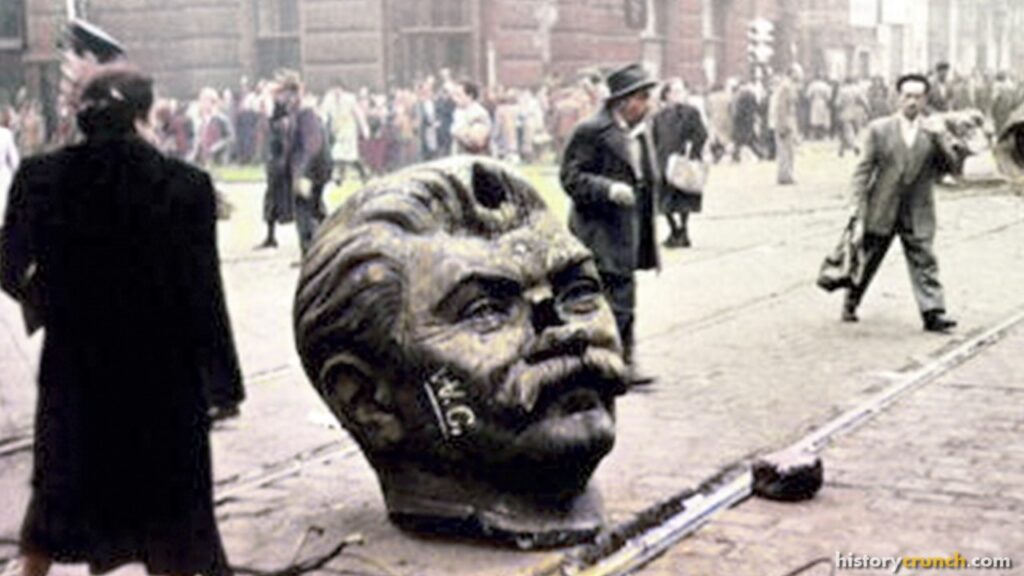
On February 25th, 1956, at a closed session of the 20th Party Congress in Moscow, Nikita Khrushchev spoke for four hours about the man he had served for thirty years. Stalin, he said, had tortured and shot loyal communists by the hundred thousand, purged the army before the war, built a cult of himself and ruled by terror. Delegates fainted. The speech was secret for a month and then leaked around the world; the CIA published it in June.
LEARN MORESHOW LESSwhy it matters · key numbers · 2 key figuresIDEASKhrushchev freed the camps, took Stalin's body out of Lenin's tomb and let Solzhenitsyn print One Day in the Life of Ivan Denisovich. He also told the Soviet bloc that the old rules were gone, and within eight months Poland and Hungary tested how far that went. Khrushchev ran the Soviet Union until his own colleagues removed him in 1964.
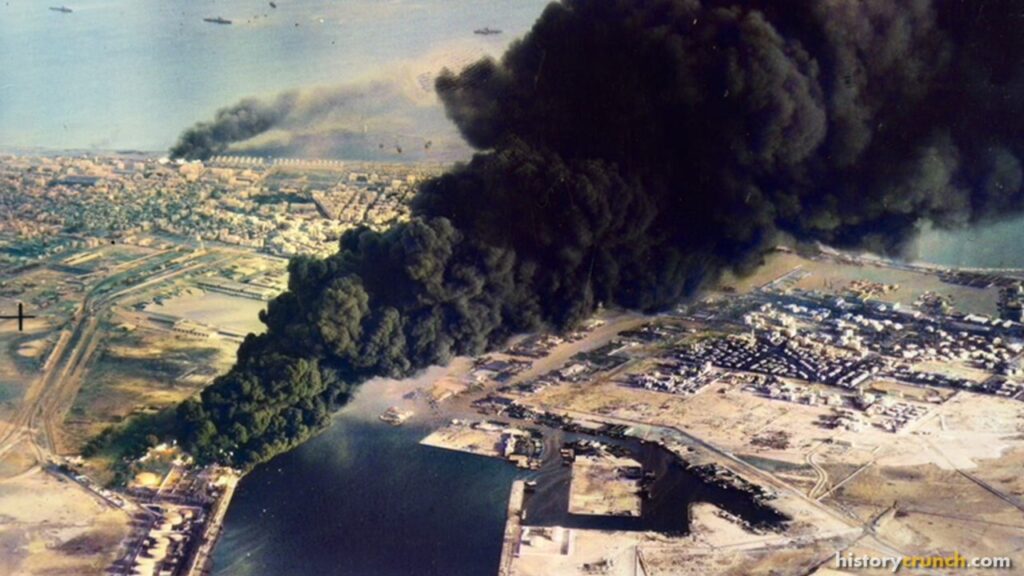
On July 26th, 1956 Egypt's president, Gamal Abdel Nasser, nationalized the Suez Canal after the United States withdrew its offer to fund the Aswan Dam. Britain, France and Israel secretly agreed to invade; Israel attacked on October 29th and British and French troops landed a week later. Dwight Eisenhower, furious that his allies had acted behind his back while Soviet tanks were in Budapest, forced them out with a run on the pound, and Britain accepted a ceasefire on November 6th.
LEARN MORESHOW LESSwhy it matters · key numbers · elsewherePOLITICALSuez ended Britain's time as a great power and proved the United States would restrain its friends as well as its enemies. Nasser became a hero across the Arab world, Egypt turned to the Soviet Union for arms, and Eisenhower promised in January 1957 to defend the Middle East against communism. The Cold War had reached the oil.
The British view of Suez, the moment the empire ended, is the reverse of the American one told here.
On October 23rd, 1956 a student march in Budapest grew into a revolution. Crowds pulled down the giant statue of Stalin, fought Soviet tanks with rifles and gasoline bombs, and forced the communist leadership to make the reformer Imre Nagy prime minister the next day. On November 1st Nagy announced that Hungary was leaving the Warsaw Pact and would be neutral. For twelve days Hungary was free.
LEARN MORESHOW LESSwhy it matters · key numbers · 1 key figurePOLITICALHungary was the first country to try to leave the Soviet bloc, and it did so eight months after the Secret Speech had told it the old terror was over. Radio Free Europe encouraged the rising; the West, busy with Suez, did nothing to help it. The answer to Nagy's neutrality came on November 4th.
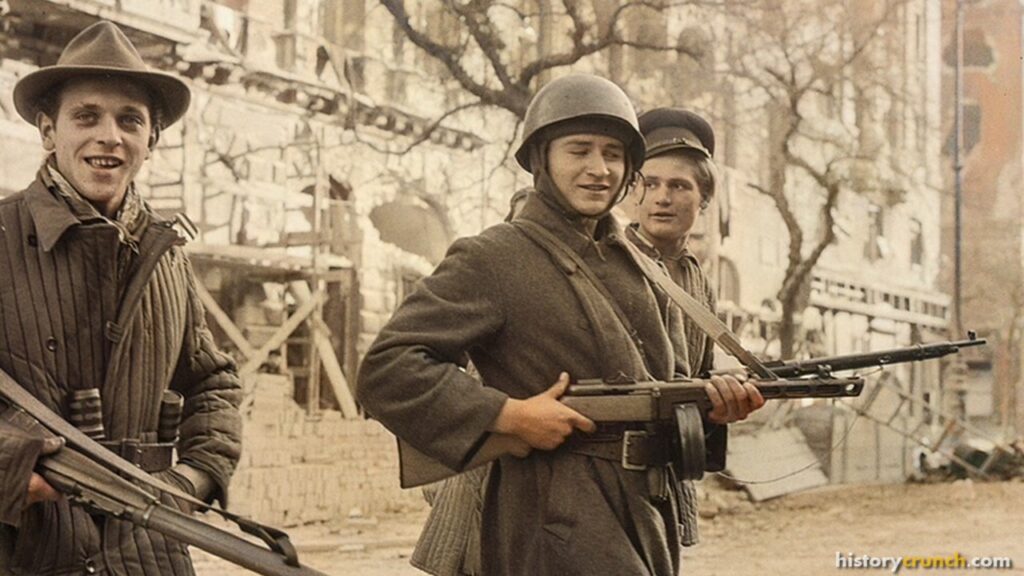
At dawn on November 4th, 1956 about 60,000 Soviet troops and more than a thousand tanks attacked Budapest. The Hungarians fought for a week with what they had; about 2,500 were killed and 200,000 fled to Austria before the border closed. Imre Nagy took refuge in the Yugoslav embassy, was lured out with a promise of safety, and was tried in secret and hanged on June 16th, 1958. The United States protested and did nothing else.
LEARN MORESHOW LESSwhy it matters · key numbers · 2 key figuresMILITARYHungary showed what the Iron Curtain meant: a country could not leave, and the West would not fight to let it. The rule was repeated in Prague in 1968 and given a name, the Brezhnev Doctrine. It held until Mikhail Gorbachev gave it up in 1989, and Hungary, fittingly, was the first to cut the wire.
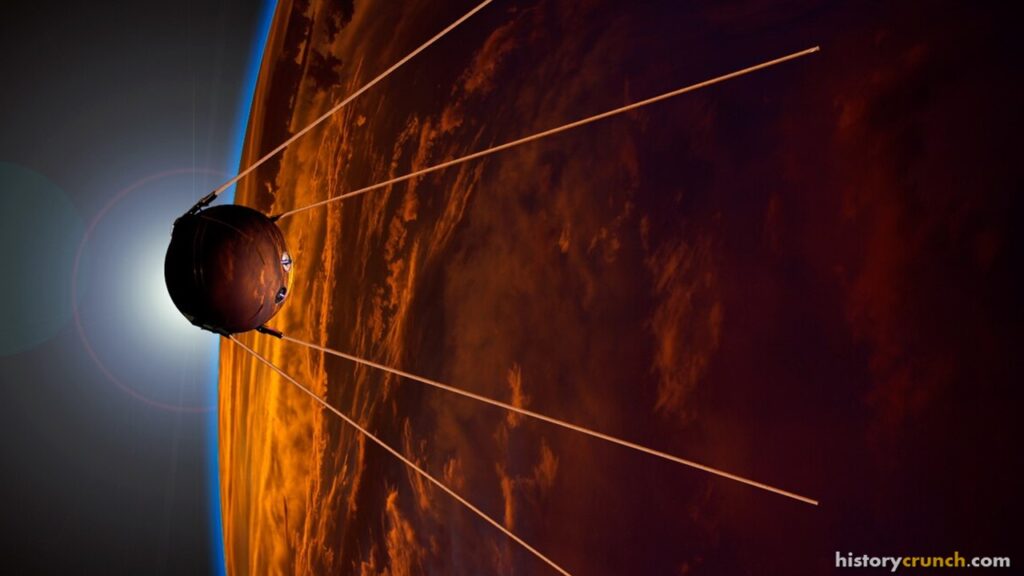
On October 4th, 1957 a Soviet R-7 rocket launched Sputnik 1, a polished metal sphere 23 inches across, into orbit from Baikonur in Kazakhstan. It circled the Earth every 96 minutes and beeped on a frequency any radio ham could hear. A month later Sputnik 2 carried a dog named Laika. In December the American answer, Vanguard, rose four feet off its pad at Cape Canaveral and exploded on live television.
LEARN MORESHOW LESSwhy it matters · key numbers · 2 key figuresSCIENCESputnik terrified Americans, because a rocket that could put a satellite over their heads was an ICBM in all but name and could carry a hydrogen bomb instead, and it launched the Space Race. Congress created NASA within a year and poured money into science teaching, and the next twelve years of the Cold War were scored by who was ahead in space.
On January 31st, 1958 the United States launched its first satellite, Explorer 1, from Cape Canaveral on a rocket built by Wernher von Braun's army team, four months after Sputnik. It found the belts of radiation around the Earth that were named for the scientist James Van Allen. Dwight Eisenhower created NASA on October 1st, 1958 to run a civilian space program, and Congress passed the National Defense Education Act to train the scientists it would need.
LEARN MORESHOW LESSwhy it matters · key numbers · 1 key figureSCIENCEExplorer restored some American pride and set the terms of the race: the Soviets would keep winning firsts for four years, and the United States would build the organization that eventually won the one that mattered. The National Defense Education Act changed American schools for a generation.
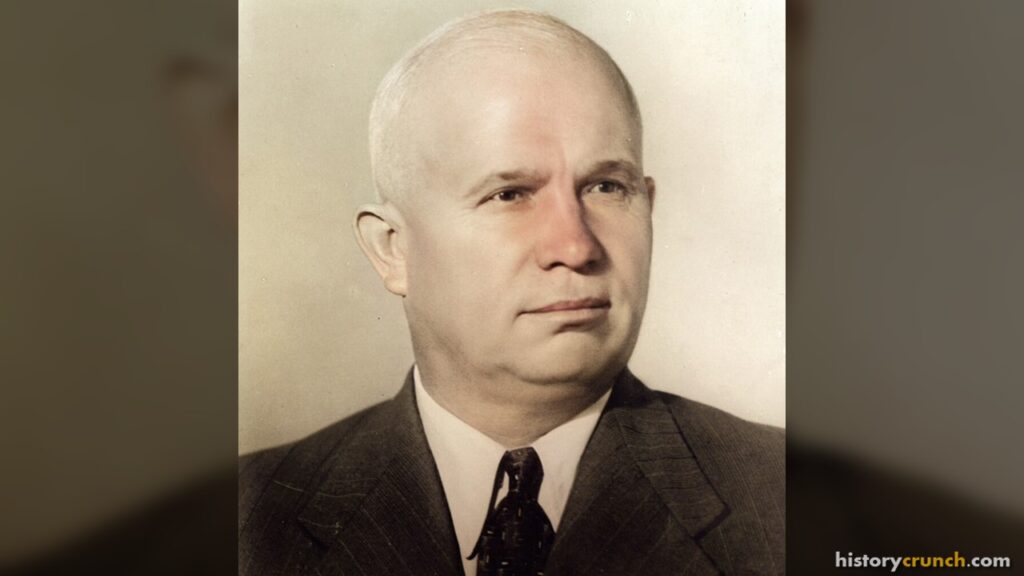
On November 10th, 1958 Nikita Khrushchev demanded that the Western powers withdraw from West Berlin within six months and threatened to hand control of the access routes to East Germany, which the West did not recognize. West Berlin was an open door through which three million East Germans had already left; Khrushchev called it a bone in his throat. Dwight Eisenhower refused, the deadline passed, and the crisis dragged on for three years.
LEARN MORESHOW LESSwhy it matters · key numbers · 2 key figuresPOLITICALBerlin was the place where the two armies stood closest, and Khrushchev's ultimatum began the longest crisis of the Cold War. It passed through the U-2 incident and the Vienna summit before ending, in August 1961, with a wall.
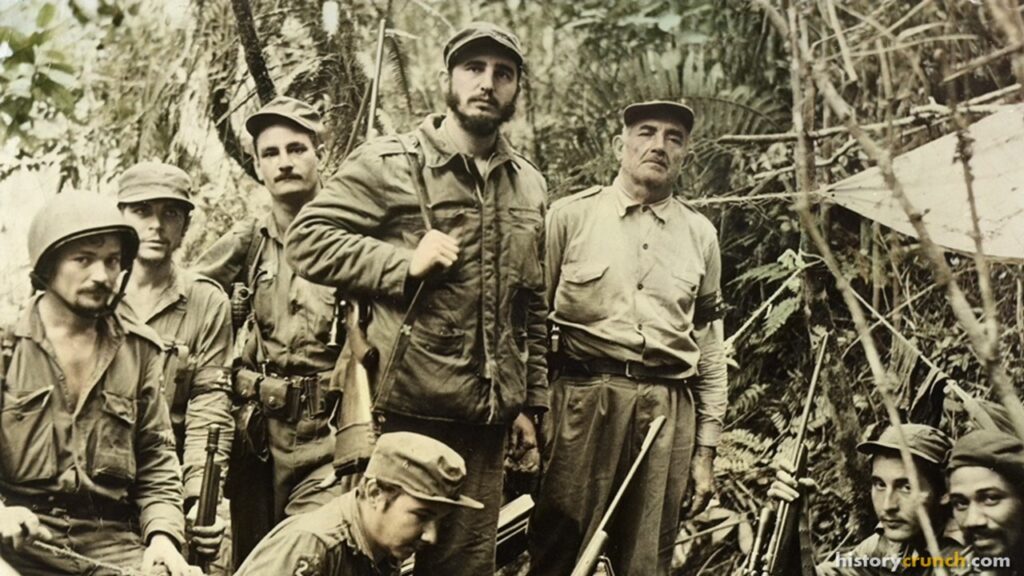
In the early hours of January 1st, 1959 the dictator Fulgencio Batista flew out of Havana, and Fidel Castro's guerrillas, who had landed from the yacht Granma in 1956 with 82 men and had fought from the Sierra Maestra ever since, took the island. Castro entered Havana on January 8th and became prime minister in February. Within two years he had seized American-owned companies, the United States had cut off trade, and Cuba had turned to the Soviet Union.
LEARN MORESHOW LESSwhy it matters · key numbers · 2 key figuresPOLITICALA communist state ninety miles from Florida changed the Cold War's geography. Cuba brought the CIA's invasion of 1961 and the missiles of 1962, made Castro the longest-serving leader of the contest, and sent Che Guevara out to start revolutions across Latin America and Africa. Castro outlasted ten American presidents.
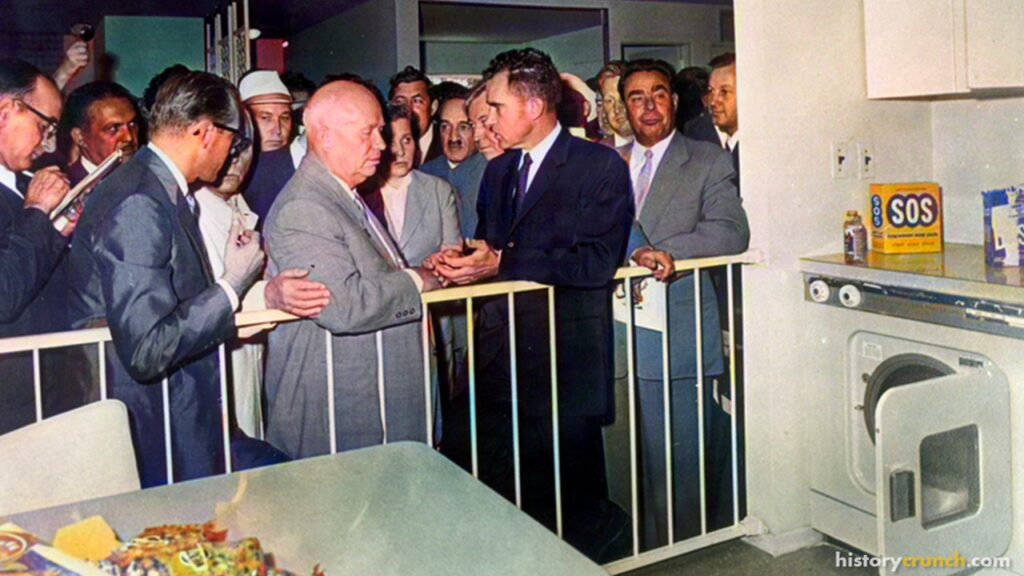
On July 24th, 1959 Vice President Richard Nixon opened an American exhibition in Moscow, a showcase of suburban life with a model house full of appliances, and Nikita Khrushchev walked through it with him. In the kitchen, in front of the cameras, the two men argued about washing machines, rockets and which system would bury the other. The exchange was shown on all three American networks the next day.
LEARN MORESHOW LESSwhy it matters · key numbers · 2 key figuresCULTUREThe Kitchen Debate was the Cold War as a contest of ways to live, and it was the first time Americans saw the two sides argue face to face. It made Nixon a national figure, and the Soviet leader, for all his threats, had accepted the argument on American ground: who had the better kitchen.
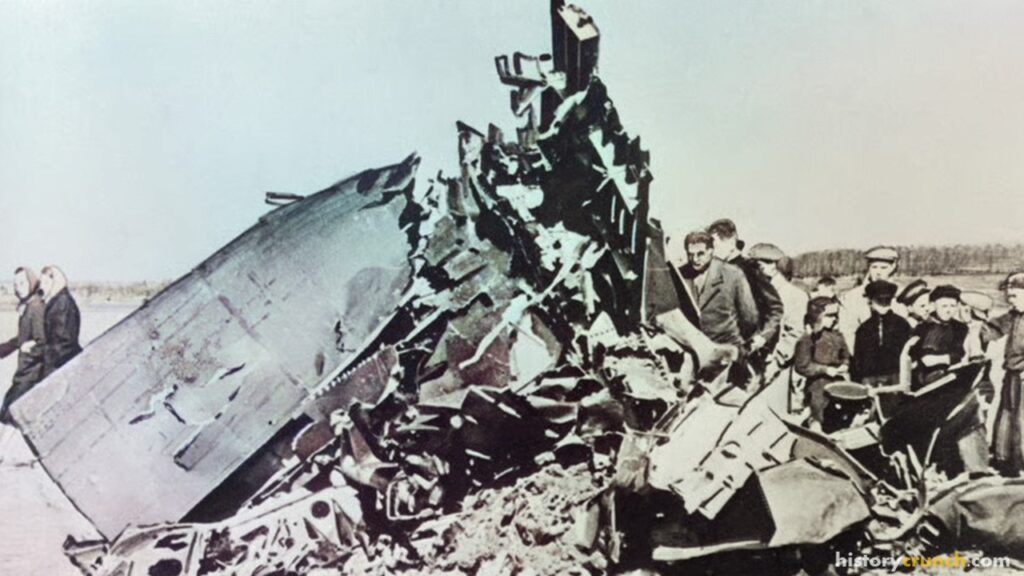
On May 1st, 1960 a Soviet missile brought down an American U-2 spy plane 70,000 feet over Sverdlovsk, and its pilot, Francis Gary Powers, was captured alive. Dwight Eisenhower, told the plane and pilot were lost, said it was a weather flight; Nikita Khrushchev then produced the pilot and the wreckage. Two weeks later, at a summit in Paris that was meant to ease the Berlin crisis, Khrushchev demanded an apology, did not get one, and walked out.
LEARN MORESHOW LESSwhy it matters · key numbers · 2 key figuresMILITARYThe U-2 affair ended the thaw of the late 1950s and caught an American president in a lie before the world. Powers was traded for a Soviet spy on a Berlin bridge in 1962. The photographs from planes like his would find the missiles in Cuba the same year.
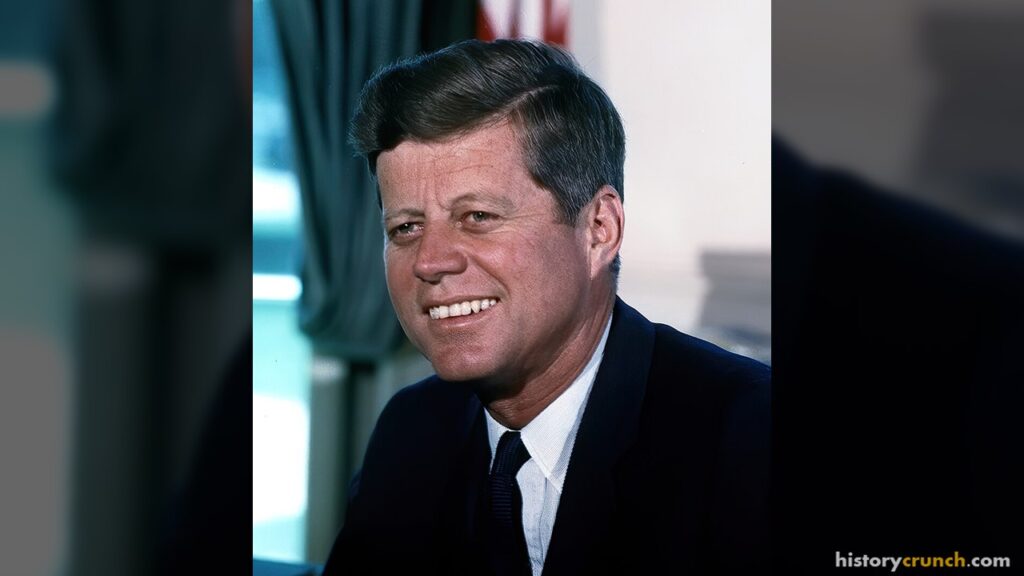
John F. Kennedy, a 43-year-old senator from Massachusetts, beat Vice President Richard Nixon on November 8th, 1960 by about 110,000 votes out of 68 million, after the first televised presidential debates. He had campaigned on a missile gap that did not exist and on getting the country moving again. His inaugural address on January 20th, 1961 promised to pay any price and bear any burden in the defense of liberty.
LEARN MORESHOW LESSwhy it matters · key numbers · a sourcePOLITICALKennedy's thousand days held the most dangerous years of the Cold War: the Bay of Pigs, the Vienna summit, the Wall, the missile crisis, the first advisers dying in Vietnam. He also began the race to the Moon and signed the first treaty to limit nuclear tests.
IN THEIR OWN WORDS“Let every nation know, whether it wishes us well or ill, that we shall pay any price, bear any burden, meet any hardship, support any friend, oppose any foe, in order to assure the survival and the success of liberty.”
John F. Kennedy, inaugural address, January 20th, 1961
Three days before leaving office, on January 17th, 1961, Dwight Eisenhower gave a farewell address on television. The general who had commanded the largest army in American history warned that the Cold War had created something new: a permanent arms industry and a permanent military whose combined influence, he said, the country must guard against. He called it the military-industrial complex.
LEARN MORESHOW LESSwhy it matters · key numbers · a sourceIDEASThe phrase outlived every other line of his presidency. Eisenhower had spent eight years trying to fight the Cold War without turning America into a garrison state, and his warning is quoted every time a defense budget is argued.
IN THEIR OWN WORDS“We must guard against the acquisition of unwarranted influence, whether sought or unsought, by the military-industrial complex.”
Dwight Eisenhower, farewell address, January 17th, 1961
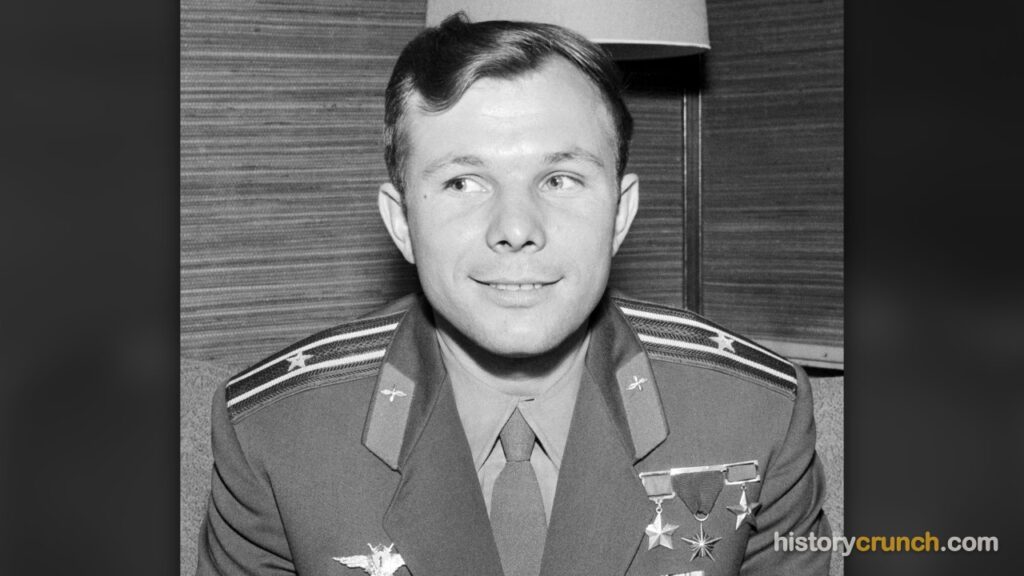
On April 12th, 1961 Yuri Gagarin, a 27-year-old Soviet fighter pilot, orbited the Earth once in the capsule Vostok 1 and parachuted into a field near the Volga 108 minutes after launch. He was the first human being in space. Alan Shepard made America's first flight on May 5th, fifteen minutes up and down, and John Glenn orbited on February 20th, 1962. Gagarin died in a training jet in 1968.
LEARN MORESHOW LESSwhy it matters · key numbers · 2 key figuresSCIENCEGagarin's flight was the Soviet Union's greatest propaganda victory and the second shock, after Sputnik, that pushed John F. Kennedy to aim for the Moon six weeks later. For a decade the Soviet Union looked like the future; it was the last first it would win.
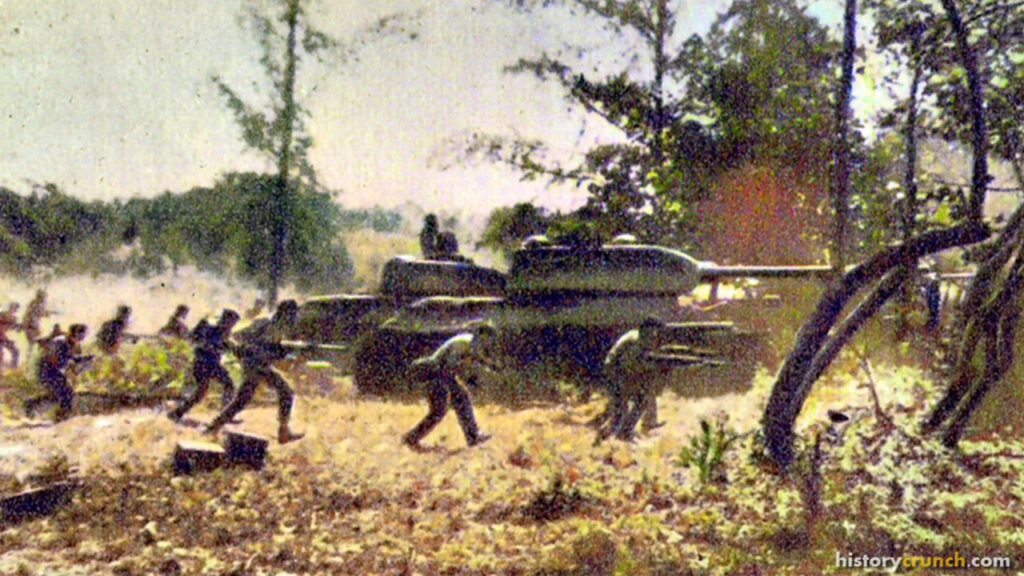
On April 17th, 1961 about 1,400 Cuban exiles trained and armed by the CIA landed at the Bay of Pigs on Cuba's south coast, expecting the people to rise against Fidel Castro. Nobody rose. John F. Kennedy, who had approved the plan he inherited from Dwight Eisenhower, refused to send American planes, and Castro's forces killed or captured the whole brigade in three days. The prisoners were ransomed in December 1962 for $53 million in food and medicine.
LEARN MORESHOW LESSwhy it matters · key numbers · 3 key figuresMILITARYThe Bay of Pigs was Kennedy's worst humiliation, three months into his presidency, and it made Castro stronger, pushed Cuba into the Soviet camp, and convinced Nikita Khrushchev that the young president could be pushed. Eighteen months later Khrushchev tried, with missiles.
On May 25th, 1961, six weeks after Gagarin's flight and five after the Bay of Pigs, John F. Kennedy told a joint session of Congress that the United States should commit itself, before the decade was out, to landing a man on the Moon and returning him safely to Earth. The United States had at that point flown one man for fifteen minutes. Congress voted the money; the Apollo program would cost $25 billion.
LEARN MORESHOW LESSwhy it matters · key numbers · a sourceSCIENCEKennedy chose the Moon because it was far enough away that the Soviet lead did not matter, and because it was the one race the richer country was sure to win. The pledge set a deadline that outlived him, and it was met with five months to spare.
IN THEIR OWN WORDS“I believe that this nation should commit itself to achieving the goal, before this decade is out, of landing a man on the Moon and returning him safely to the Earth.”
John F. Kennedy to Congress, May 25th, 1961
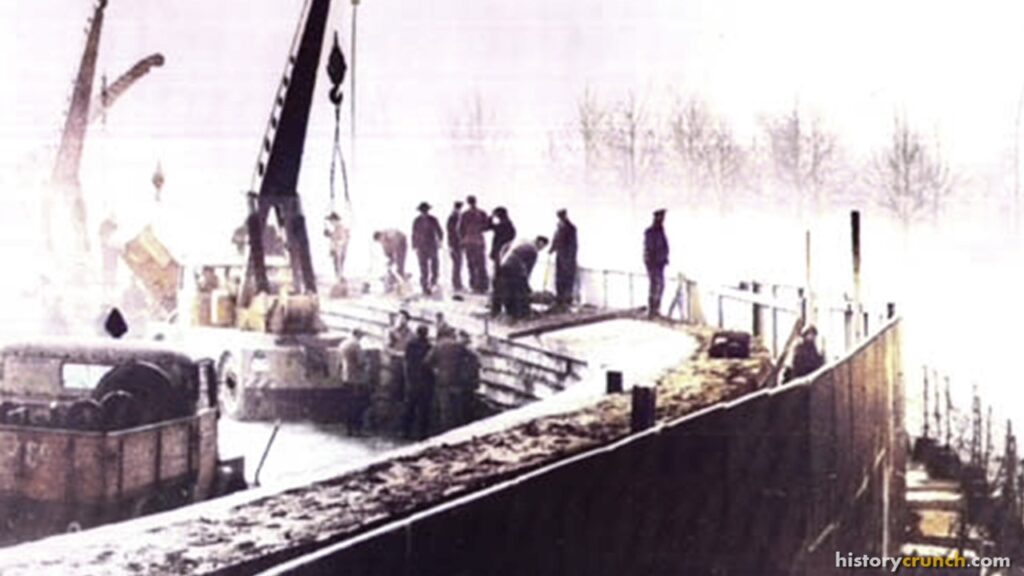
In June 1961 John F. Kennedy and Nikita Khrushchev met in Vienna and Khrushchev renewed his threat to Berlin; Kennedy went home and called up 150,000 reservists. East Germans, sensing the door was closing, left through West Berlin at 2,000 a day. In the night of August 12th to 13th, 1961 East German troops and police strung barbed wire around the whole of West Berlin, and within days the wire became concrete. Families, streets and subway lines were cut in two.
LEARN MORESHOW LESSwhy it matters · key numbers · a sourcePOLITICALThe Berlin Wall was an admission that the East could keep its people only by imprisoning them, and it stood for twenty-eight years as the Cold War's plainest symbol. Kennedy, privately relieved that a wall was better than a war, sent tanks and a vice president to show West Berlin it was not abandoned. About 140 people died trying to cross.
IN THEIR OWN WORDS“A wall is a hell of a lot better than a war.”
John F. Kennedy to his aides, August 1961
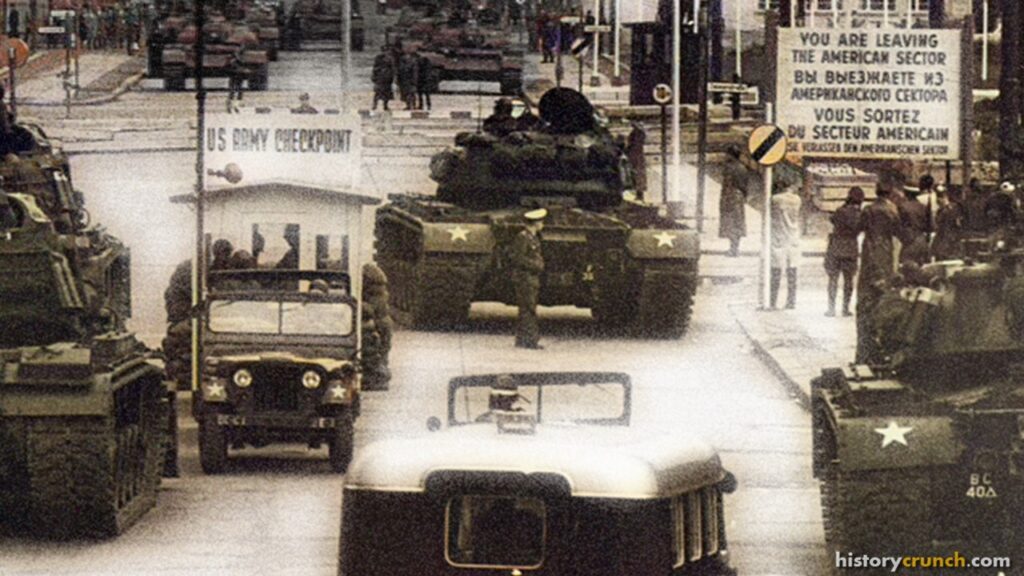
On October 22nd, 1961 East German guards stopped an American diplomat at Checkpoint Charlie, the crossing reserved for Allied officials, and demanded his papers. The Americans answered with tanks at the checkpoint; the Soviets brought up tanks of their own, and on October 27th ten American and ten Soviet tanks stood a hundred yards apart with their guns loaded for sixteen hours. John F. Kennedy and Nikita Khrushchev, through a back channel, agreed to pull back one tank at a time.
LEARN MORESHOW LESSwhy it matters · key numbers · 2 key figuresMILITARYCheckpoint Charlie was the only time in the Cold War that American and Soviet soldiers faced each other with loaded guns at point-blank range. It ended the Berlin crisis with the Wall standing and the Allies still in the city, and it taught both leaders they needed a way to talk faster than a telegram. The hotline came in 1963.
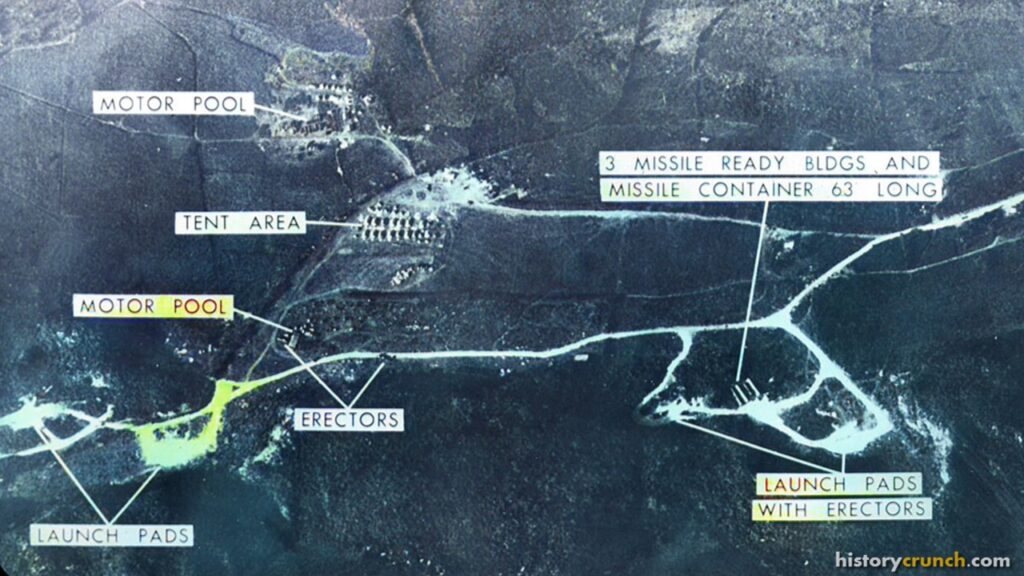
On October 14th, 1962 a U-2 flight over Cuba photographed launch sites for Soviet medium-range missiles that could reach Washington in minutes. John F. Kennedy was shown the pictures on the morning of October 16th and gathered a small group of advisers, the ExComm, in secret. For six days they argued between an air strike, an invasion and a naval blockade. On October 22nd Kennedy went on television, told the world what the Soviets had done, and announced a quarantine of Cuba.
LEARN MORESHOW LESSwhy it matters · key numbers · 3 key figuresMILITARYNikita Khrushchev had sent the missiles to protect Cuba after the Bay of Pigs and to match the American missiles in Turkey; he expected Kennedy to accept them once they were in place. Instead the world got the closest it has come to nuclear war. The thirteen days are counted from this morning.
On October 27th, 1962 a Soviet missile crew in Cuba shot down an American U-2 and killed its pilot, Major Rudolf Anderson; another U-2 strayed over Siberia; American destroyers dropped depth charges on a Soviet submarine whose captain had a nuclear torpedo and, its officers later said, nearly used it. Nikita Khrushchev had sent two letters, one offering to withdraw for a no-invasion pledge and a harder one demanding the missiles in Turkey too. John F. Kennedy answered the first and, through his brother Robert, secretly promised the second.
LEARN MORESHOW LESSwhy it matters · key numbers · 2 key figuresMILITARYThis was the day the Cold War came nearest to ending in war. The people who lived it, on both sides, said afterward that luck had as much to do with the outcome as judgment. The next morning Khrushchev accepted.
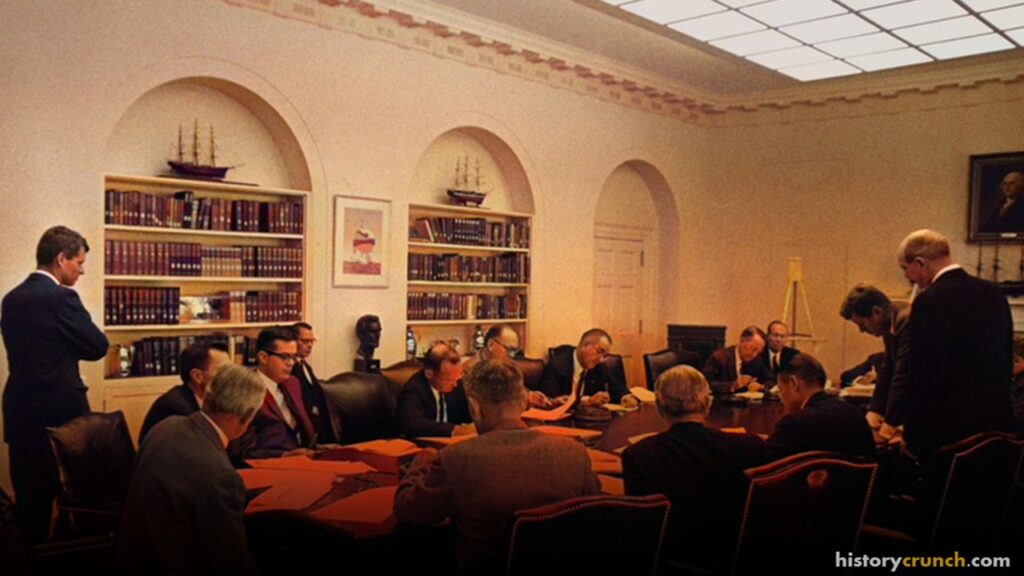
On Sunday morning, October 28th, 1962 Radio Moscow announced that the Soviet Union would dismantle its missiles in Cuba and ship them home in return for an American promise not to invade the island. The secret part of the bargain, that the American missiles in Turkey would go within months, stayed secret for decades. The naval quarantine ended on November 20th. Fidel Castro, who had not been consulted, was furious.
LEARN MORESHOW LESSwhy it matters · key numbers · a debatePOLITICALThe crisis was the turning point of the whole Cold War. Brinkmanship had worked exactly once too often: both sides had looked at nuclear war and stepped back, and within a year they had a hotline and a treaty banning tests in the air. Nikita Khrushchev's retreat cost him his job in 1964; John F. Kennedy's firmness is the reason his thousand days are remembered as they are.
Who won the Cuban Missile Crisis?
Kennedy. He forced the missiles out in public without firing a shot, and the world saw the Soviet Union back down.
Khrushchev got what he said he wanted: Cuba was never invaded, and the American missiles in Turkey were quietly removed. He lost the appearance and won the substance, and it still cost him his job.
After Cuba the two sides learned to talk: a hotline, a test ban, and in the 1970s the treaties and summits called detente, with Richard Nixon in Beijing and Moscow in the same year. Underneath ran the war that broke America's confidence, from the Gulf of Tonkin to the helicopters on the embassy roof in Saigon. The Moon was won, Prague was lost, Nixon fell to Watergate, and in 1979 detente died in Afghanistan.
During the missile crisis a message from Moscow had taken twelve hours to reach the White House, decoded by hand. On June 20th, 1963 the two governments agreed to a direct teleprinter link between the Kremlin and the Pentagon, the hotline, and it went into service on August 30th. It was never a red telephone; the first test message was the typist's line about the quick brown fox. It was used in earnest during the Six-Day War of 1967.
LEARN MORESHOW LESSwhy it matters · key numbersPOLITICALThe hotline was the first of the small agreements that followed Cuba, when both sides accepted that the danger was not only what Moscow or Washington intended but accident and delay. It is still there, upgraded, and it has been used in every crisis since.
On June 26th, 1963 John F. Kennedy stood on the steps of West Berlin's city hall before a crowd of about 120,000, with the Wall two years old and a few miles away, and told them that all free men, wherever they lived, were citizens of Berlin, and that as a free man he took pride in the words Ich bin ein Berliner. He had seen the Wall that morning and thrown away his prepared speech.
LEARN MORESHOW LESSwhy it matters · key numbers · a sourcePOLITICALThe speech made West Berlin's survival a promise the United States could not break, and it was the high point of Kennedy's presidency abroad. Five months later he was dead. Ronald Reagan came to the same wall in 1987 with a different sentence.
IN THEIR OWN WORDS“All free men, wherever they may live, are citizens of Berlin, and therefore, as a free man, I take pride in the words Ich bin ein Berliner.”
John F. Kennedy, West Berlin, June 26th, 1963
On August 5th, 1963 the United States, the Soviet Union and Britain signed a treaty in Moscow banning nuclear tests in the atmosphere, in space and under water. Tests underground went on. Fallout from the hundreds of tests since 1945 had put strontium-90 into milk around the world, and John F. Kennedy had called for the treaty in a speech at American University in June. The Senate approved it 80 to 19.
LEARN MORESHOW LESSwhy it matters · key numbers · 2 key figuresPOLITICALThe treaty was the first arms control agreement of the Cold War and the first sign that the missile crisis had changed something. It did not slow the arms race, which moved underground and grew, but it ended the poisoning of the air and began the habit of negotiating that led to SALT.
On November 22nd, 1963 John F. Kennedy was shot dead in an open car in Dealey Plaza, Dallas, by Lee Harvey Oswald, a former Marine who had lived in the Soviet Union and had tried to reach Cuba. Lyndon Johnson was sworn in on the plane home. Kennedy left 16,000 American advisers in South Vietnam, whose president, Ngo Dinh Diem, had been overthrown and killed in a coup Kennedy had approved three weeks earlier.
LEARN MORESHOW LESSwhy it matters · key numbers · 2 key figuresPOLITICALKennedy's death handed the Cold War to a president whose gifts were domestic, and the war he had kept small became Lyndon Johnson's to grow. Oswald's Soviet and Cuban connections fed fifty years of suspicion, though no inquiry has found that either government was behind him.
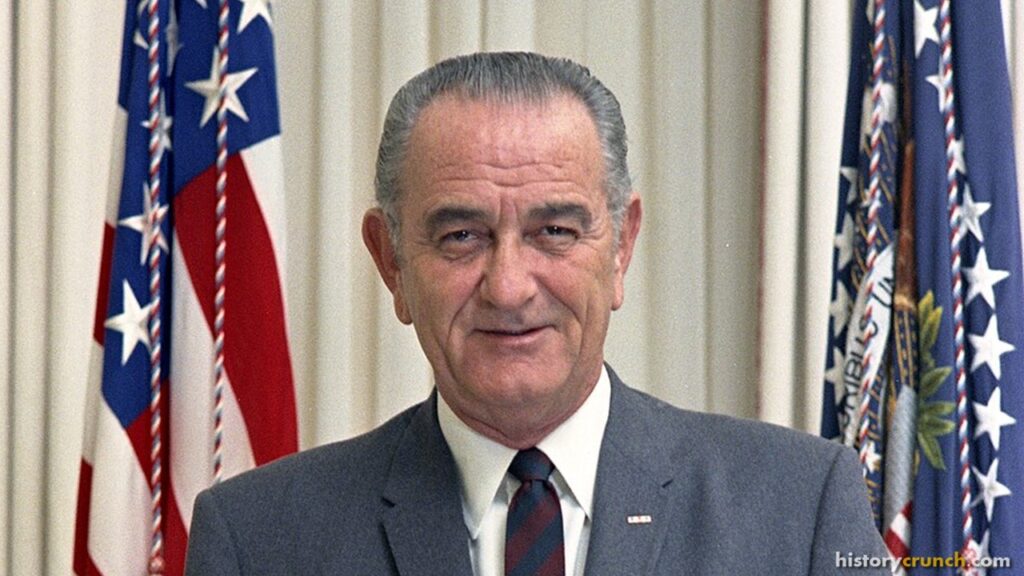
On August 2nd, 1964 North Vietnamese torpedo boats attacked the American destroyer Maddox in the Gulf of Tonkin; on August 4th the navy reported a second attack that, the records later showed, had not happened. On August 7th Congress passed the Gulf of Tonkin Resolution, 416 to 0 in the House and 88 to 2 in the Senate, authorizing Lyndon Johnson to take all necessary measures in Southeast Asia. It was the closest thing to a declaration of war Vietnam ever had.
LEARN MORESHOW LESSwhy it matters · key numbers · elsewherePOLITICALThe resolution let Johnson fight a war without asking Congress again, and he used it to send half a million men. When the Pentagon Papers showed in 1971 how the second attack had been reported, the resolution became the symbol of a war begun on a false story. Congress repealed it that year and passed the War Powers Act in 1973.
The Vietnam War timeline covers the fighting; this card is the Cold War decision behind it.
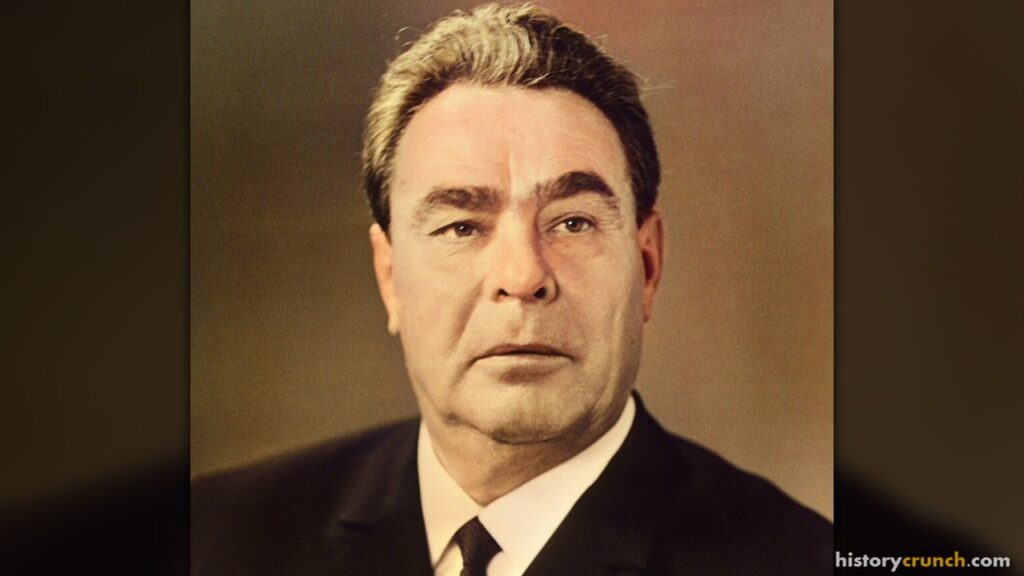
On October 14th, 1964 Nikita Khrushchev was called back from holiday to a meeting of the Presidium and told he was retiring for reasons of health. His colleagues blamed the Cuban retreat, the failed harvests and his temper. Leonid Brezhnev became first secretary the next day. Khrushchev lived quietly outside Moscow until 1971; Brezhnev ruled for eighteen years, longer than anyone but Stalin.
LEARN MORESHOW LESSwhy it matters · key numbers · 2 key figuresPOLITICALBrezhnev gave the Soviet Union stability, a military build-up that took its missile force from a third of America's to equal, and a slow economic decline that his successors inherited. His name is on the doctrine that sent tanks into Prague and on the treaties of detente; the two together are the Cold War of the 1970s.
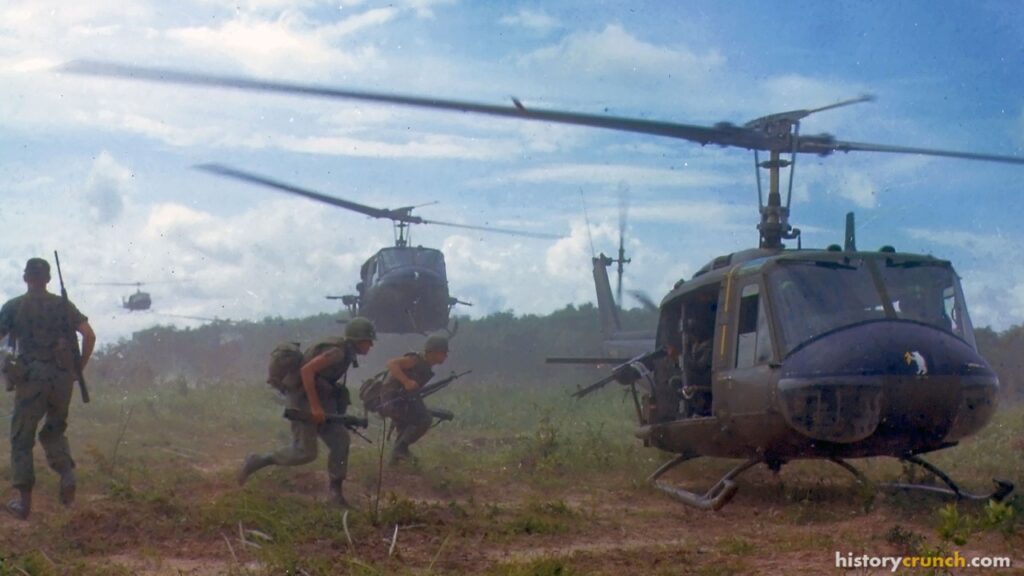
On March 2nd, 1965 American aircraft began Operation Rolling Thunder, a bombing campaign against North Vietnam that lasted three and a half years and dropped more bombs than the Allies dropped on Germany in the Second World War. On March 8th the first American combat troops, 3,500 Marines, landed at Da Nang. By the end of the year there were 184,000 American soldiers in Vietnam, and by 1968 more than 500,000.
LEARN MORESHOW LESSwhy it matters · key numbers · elsewhereMILITARY1965 is the year Vietnam became an American war. Lyndon Johnson believed the domino theory and feared being the president who lost Southeast Asia as Harry Truman had been blamed for losing China; he also feared that a full war would bring in China as Korea had. The result was a war fought to not lose, and 58,000 Americans died in it.
The Vietnam War timeline tells the war; here it is the Cold War's longest proxy fight.
In May 1966 Mao Zedong, whose Great Leap Forward had starved between 15 and 55 million people between 1959 and 1961, called on China's students to attack his rivals in the party and everything old. Gangs of Red Guards beat teachers, burned books and paraded officials in dunce caps; the country's schools closed for years and hundreds of thousands died. The chaos lasted until Mao's death on September 9th, 1976.
LEARN MORESHOW LESSwhy it matters · key numbers · 1 key figurePOLITICALThe Cultural Revolution turned China inward and broke its alliance with the Soviet Union, which Mao now called revisionist; Chinese and Soviet troops fought on their border in 1969. That split is what let Richard Nixon go to Beijing in 1972 and play the two communist powers against each other.
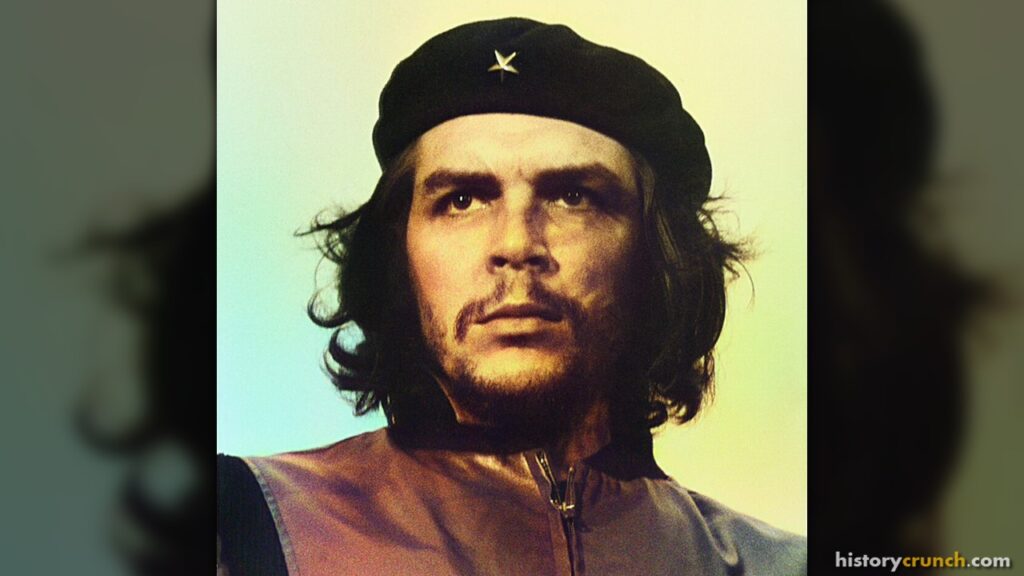
Che Guevara left Cuba in 1965 to start revolutions elsewhere, failed in the Congo, and in 1966 took a band of fifty guerrillas into the mountains of Bolivia. Bolivian rangers trained by the CIA captured him on October 8th, 1967, and a sergeant shot him the next day in the schoolhouse of La Higuera. He was 39. The photograph of his body was printed around the world, and the one taken by Alberto Korda in 1960 became the most reproduced portrait of the century.
LEARN MORESHOW LESSwhy it matters · key numbers · 2 key figuresPOLITICALChe's death ended the hope, or fear, that Cuba's revolution could be copied across Latin America by a few men with rifles. It also made him a legend. The Cold War in the Americas went on through coups and death squads instead of guerrilla bands, from Chile in 1973 to Central America in the 1980s.
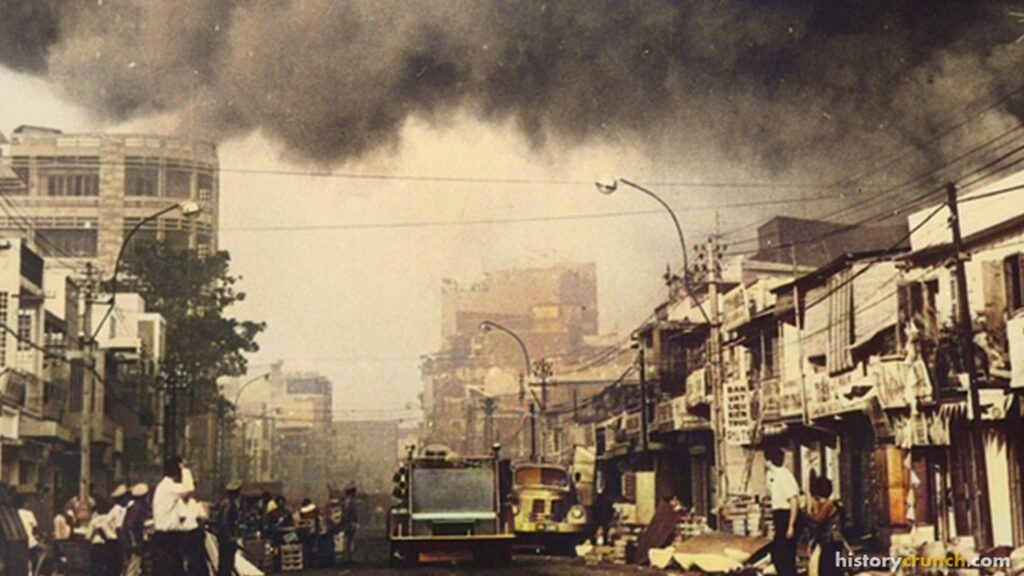
On January 30th, 1968, during the Tet holiday truce, about 80,000 Viet Cong and North Vietnamese troops attacked more than a hundred towns and cities across South Vietnam at once. A squad broke into the American embassy compound in Saigon; the old capital of Hue was held for a month. The attackers were beaten back everywhere and lost perhaps 40,000 men, but Americans watched the embassy fight on television after three years of being told the war was nearly won.
LEARN MORESHOW LESSwhy it matters · key numbers · 1 key figureMILITARYTet was a military defeat for the North and a political defeat for Lyndon Johnson. Walter Cronkite told his audience the war was a stalemate; Johnson's approval fell to 36 percent, and on March 31st he announced he would not run again. From Tet on, the American question in Vietnam was how to leave.
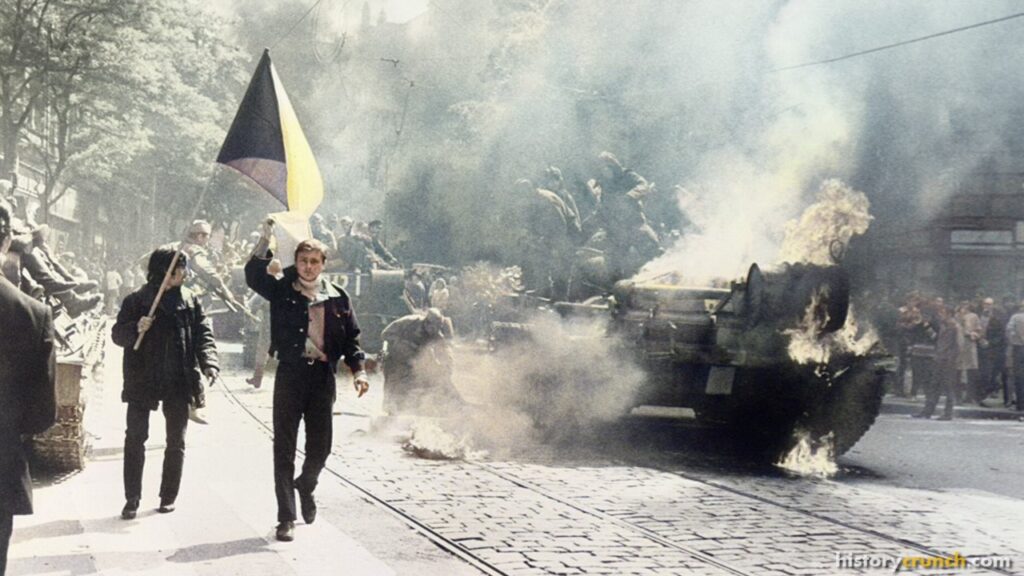
In January 1968 Alexander Dubcek became leader of Czechoslovakia's Communist Party and set out to build what he called socialism with a human face: an end to censorship, freedom to travel, and a loosening of the party's grip. In the night of August 20th to 21st, 1968 about 250,000 Soviet, Polish, Hungarian, Bulgarian and East German troops invaded. The Czechs did not fight; they argued with the tank crews and painted over the road signs. Dubcek was flown to Moscow, sent back to undo his reforms, and removed in April 1969.
LEARN MORESHOW LESSwhy it matters · key numbers · 1 key figureMILITARYPrague repeated Hungary's lesson a dozen years on: the Soviet bloc could not reform from within while Moscow held the tanks. Leonid Brezhnev made it a doctrine, that the Soviet Union would intervene wherever socialism was threatened. The men who had painted the road signs led the Velvet Revolution in 1989.
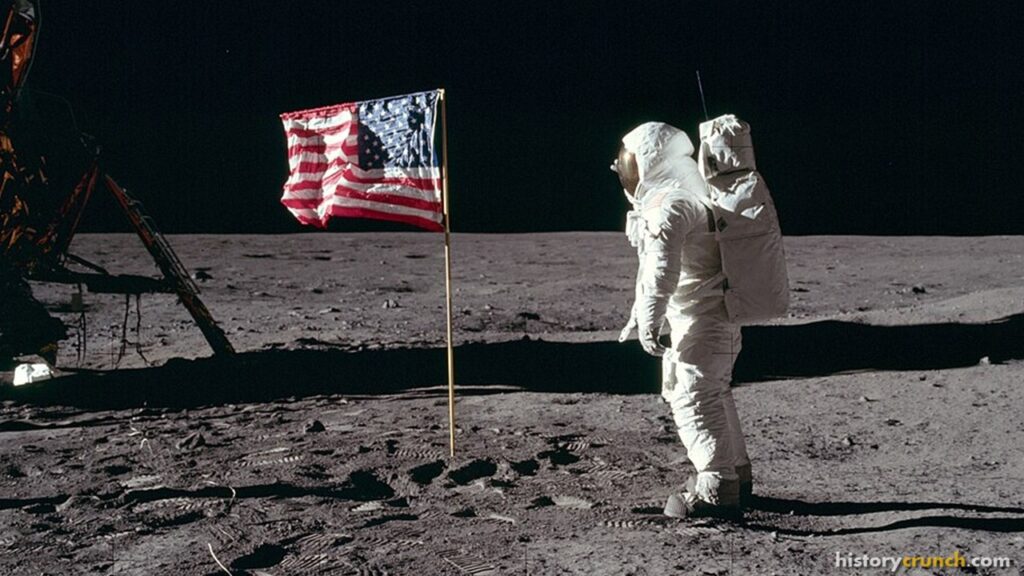
On July 20th, 1969 the lunar module Eagle landed in the Sea of Tranquility at 4:17 in the afternoon Eastern time, and at 10:56 that night Neil Armstrong stepped onto the Moon while about 600 million people watched. Buzz Aldrin followed him; Michael Collins circled above. They planted a flag and a plaque that said they came in peace for all mankind, and splashed down in the Pacific on July 24th. John F. Kennedy's deadline had been met with five months to spare.
LEARN MORESHOW LESSwhy it matters · key numbers · a sourceSCIENCEThe Moon landing was the victory the Space Race had been for, and the Soviet program, which had lost its chief designer and blown up its giant rocket, quietly gave up the race. It was the Cold War's one contest that ended without a loser being punished, and the picture of the Earth from the Moon changed how people thought about the planet the two sides were threatening.
IN THEIR OWN WORDS“That's one small step for man, one giant leap for mankind.”
Neil Armstrong, July 20th, 1969
On April 30th, 1970 Richard Nixon announced that American troops had entered Cambodia, and campuses across the country erupted. At Kent State University in Ohio on May 4th, Ohio National Guardsmen fired into a crowd of protesters and killed four students, two of whom were walking to class. Four million students went on strike and hundreds of colleges closed for the rest of the term.
LEARN MORESHOW LESSwhy it matters · key numbers · 1 key figureSOCIALKent State was the moment the war came home. Photographs of a girl kneeling over a dead student became the image of a country divided against itself, and the killings hardened both sides: polls showed most Americans blamed the students. The draft ended in 1973, in part because of what the campuses had become.
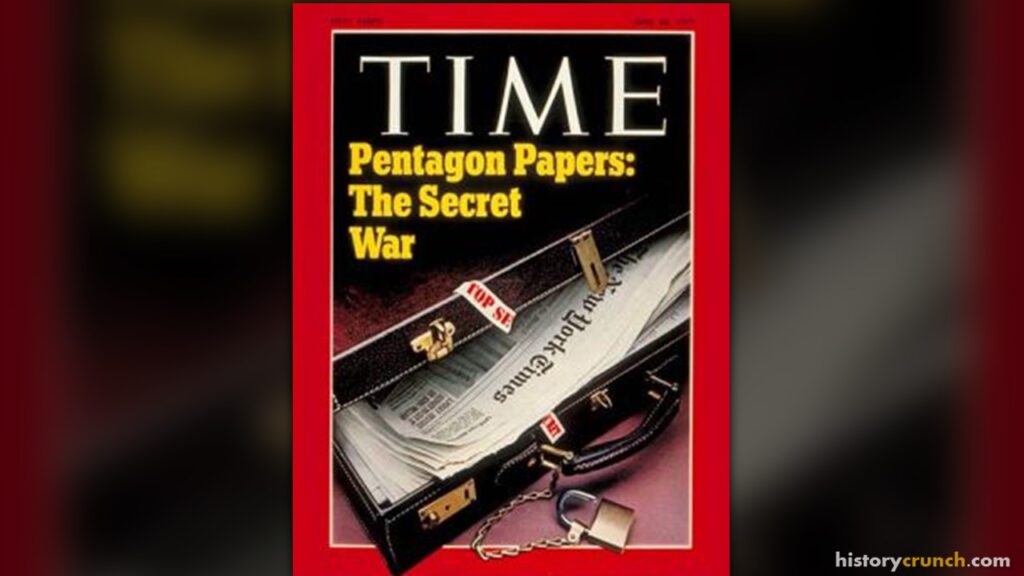
On June 13th, 1971 the New York Times began printing a secret Defense Department history of the Vietnam War, 7,000 pages copied by an analyst named Daniel Ellsberg. It recorded four presidents misleading the public about the war, from Harry Truman's aid to the French to the Gulf of Tonkin. Richard Nixon's government got a court order to stop the presses; on June 30th the Supreme Court ruled 6 to 3 that the newspapers could publish.
LEARN MORESHOW LESSwhy it matters · key numbers · 2 key figuresPOLITICALThe Pentagon Papers broke the trust between the government and the public that the Cold War had rested on, and the Supreme Court's ruling is the reason a president cannot stop a newspaper. Nixon's answer, a secret unit called the Plumbers that burgled Ellsberg's psychiatrist, led straight to Watergate.
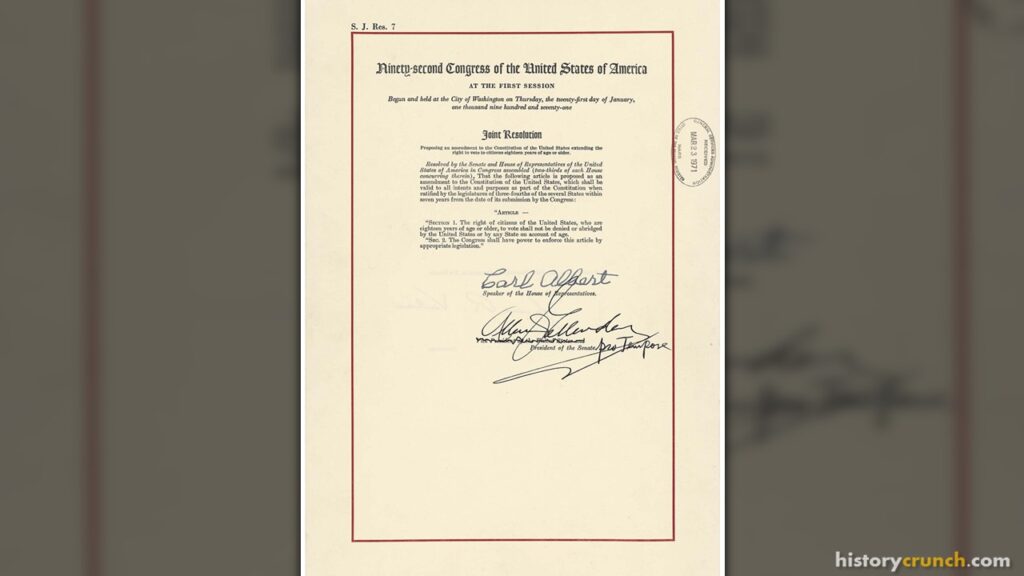
With 18-year-olds being drafted for Vietnam and forbidden to vote against the men who sent them, Congress passed a constitutional amendment lowering the voting age from 21 to 18 in March 1971, 94 to 0 in the Senate and 401 to 19 in the House. The states ratified it in 100 days, faster than any amendment before or since, and it took effect on July 1st, 1971. Eleven million new voters were eligible for the 1972 election.
LEARN MORESHOW LESSwhy it matters · key numbers · 1 key figurePOLITICALThe amendment is the Cold War's lasting mark on the Constitution. The slogan had been used since the draft age was lowered in 1942, but it took Vietnam and the campuses to make it law. The new voters did not vote as a block; Richard Nixon won 49 states the next year.
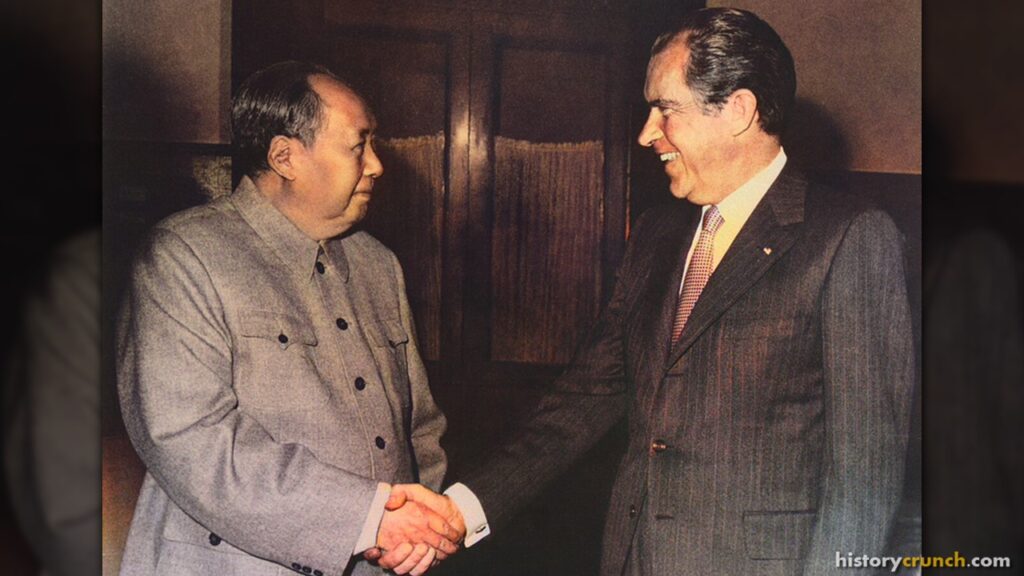
On February 21st, 1972 Richard Nixon, who had built his career hunting communists, landed in Beijing and shook Zhou Enlai's hand at the foot of the aircraft steps. Henry Kissinger had prepared the visit with a secret trip in July 1971, after an American ping-pong team had been invited to China that spring. Nixon met Mao Zedong for an hour, and the two countries agreed to disagree about Taiwan and to work together against the Soviet Union.
LEARN MORESHOW LESSwhy it matters · key numbers · 3 key figuresPOLITICALThe opening to China was the boldest move of the Cold War's middle years. It ended twenty-three years of silence between the two countries, gave the Soviet Union a second front to worry about, and pushed Leonid Brezhnev to the table for SALT three months later. Nixon called it the week that changed the world, and for once the phrase was fair.
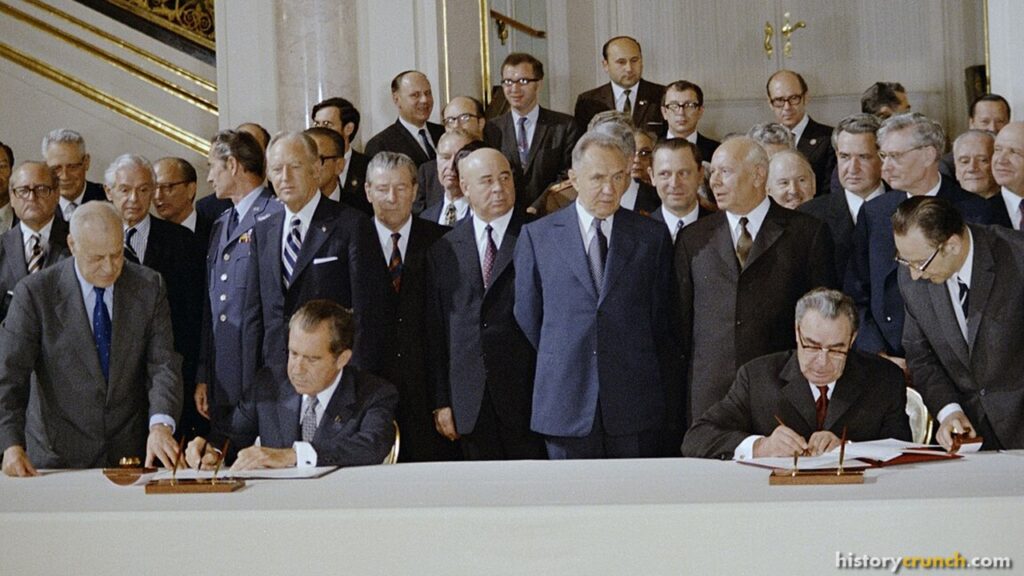
On May 26th, 1972 Richard Nixon and Leonid Brezhnev signed two agreements in Moscow: a five-year freeze on the number of missile launchers each side could have, and the Anti-Ballistic Missile Treaty, which limited each to two defensive missile sites so that neither could hope to survive a first strike. Nixon was the first American president to visit Moscow. Talks had begun in Helsinki in November 1969.
LEARN MORESHOW LESSwhy it matters · key numbers · 3 key figuresPOLITICALSALT I was the heart of detente, the idea that the two sides could manage their rivalry with rules. It did not reduce a single warhead, and both sides kept building, but it accepted that each could destroy the other and that this was, strangely, the safest arrangement. Reagan's Star Wars was an attack on the ABM Treaty's logic.
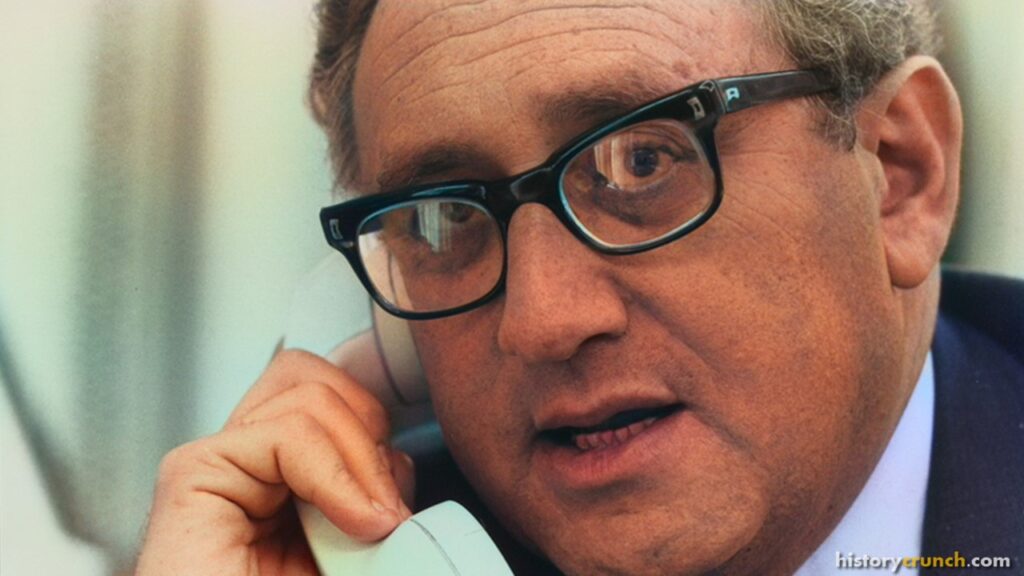
On January 27th, 1973, after four years of talks and a final Christmas bombing of Hanoi, Henry Kissinger and Le Duc Tho signed the Paris Peace Accords. American troops would leave within sixty days, prisoners would be exchanged, and North Vietnamese troops would stay where they were in the South. The last American soldiers left on March 29th. Kissinger and Tho were awarded the Nobel Peace Prize; Tho refused it.
LEARN MORESHOW LESSwhy it matters · key numbers · 2 key figuresPOLITICALThe accords gave Richard Nixon his peace with honor and South Vietnam two years of life. Congress cut off money for the war, Nixon fell to Watergate, and when the North attacked in 1975 there was no one to stop it. Fifty-eight thousand Americans and perhaps two million Vietnamese had died.
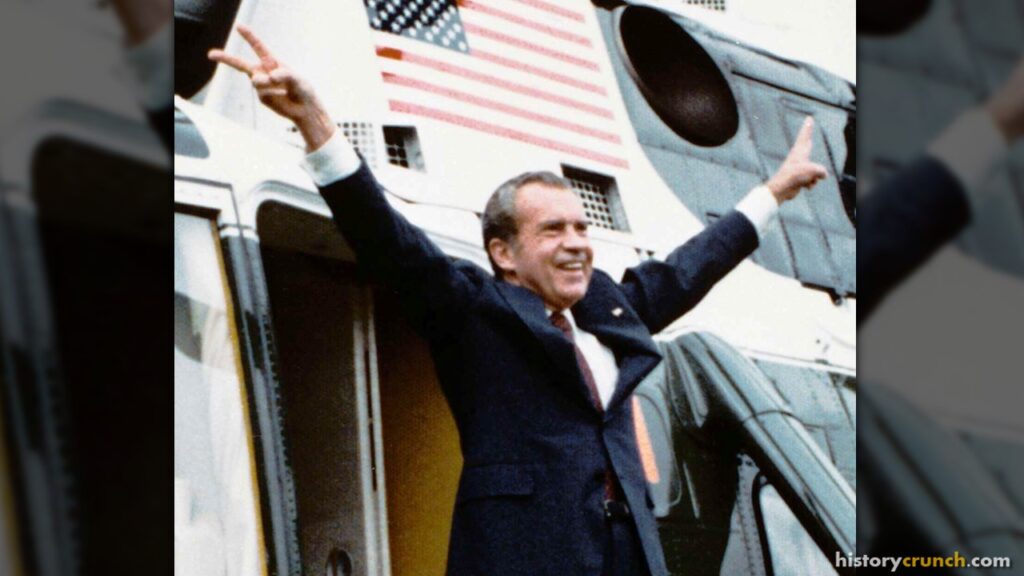
Five men working for Richard Nixon's re-election campaign were caught breaking into the Democratic headquarters at the Watergate building on June 17th, 1972. Nixon won 49 states that November, but two years of investigation, televised Senate hearings and a fight over the White House tapes proved he had ordered the cover-up from the first week. Facing impeachment, he announced his resignation on August 8th, 1974 and left the next morning. Gerald Ford pardoned him a month later.
LEARN MORESHOW LESSwhy it matters · key numbers · 3 key figuresPOLITICALWatergate cost detente its author, and with Nixon went the authority to defend it. Congress cut off Vietnam, blocked aid to allies, and put the CIA under investigation; the Soviet Union read the confusion as weakness. The scandal is on this timeline because it changed how the Cold War was fought at home as much as abroad.
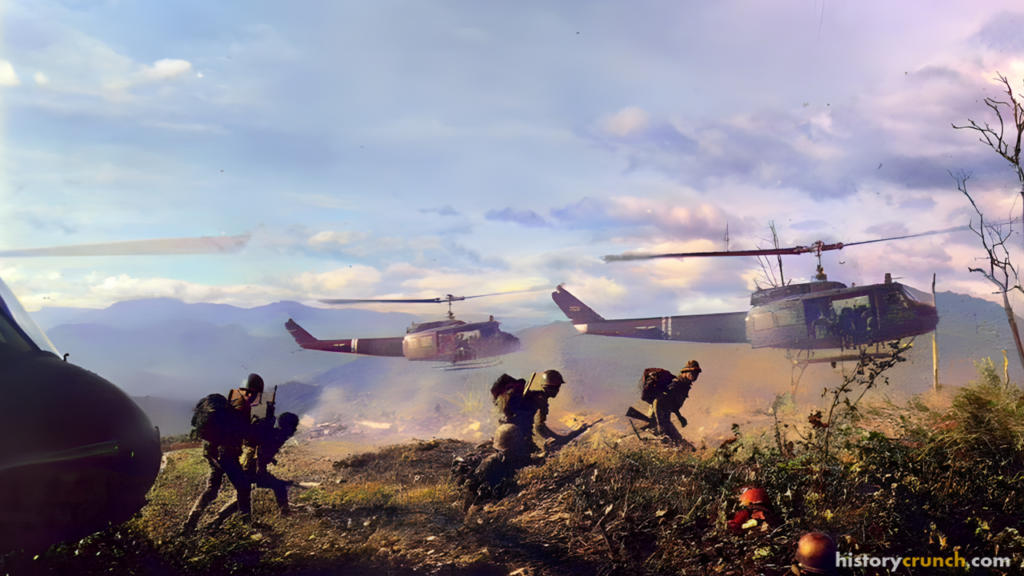
On April 30th, 1975 North Vietnamese tanks crashed through the gates of the presidential palace in Saigon, two years after the last American troops had left. The final Americans and a few thousand Vietnamese had been lifted by helicopter from the embassy roof the night before, about 7,000 people in eighteen hours. South Vietnam surrendered, and the city was renamed Ho Chi Minh City.
LEARN MORESHOW LESSwhy it matters · key numbers · elsewhereMILITARYVietnam was the first war the United States lost, and the loss settled into the country's politics for a generation as a lesson about limits. Communist governments took Cambodia and Laos the same year, and the dominoes seemed to fall; but they stopped there, and Vietnam was fighting China within four years. The Cold War went on, and America's part in it shrank for the rest of the decade.
The Vietnam War timeline covers the fall in full.
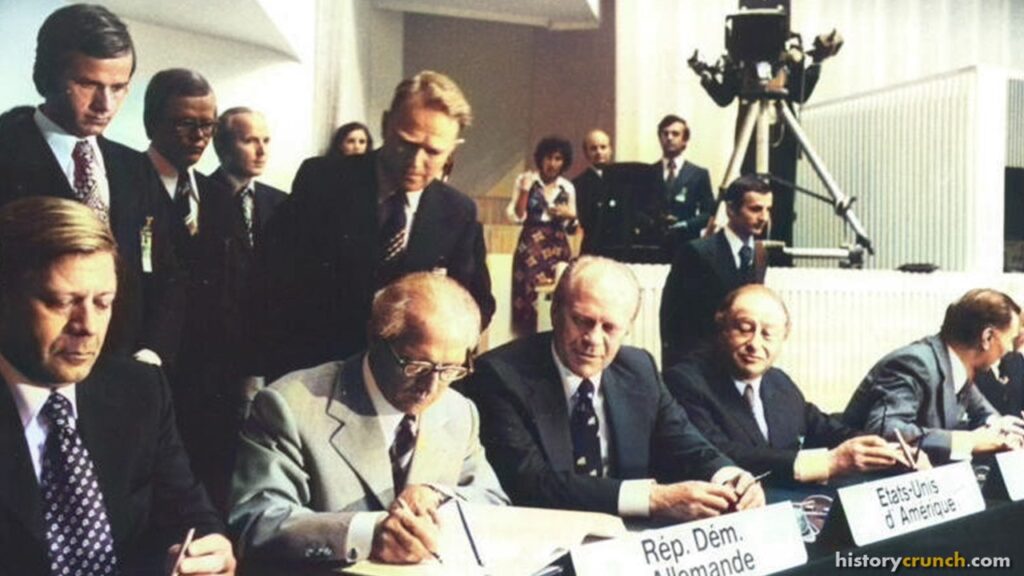
On August 1st, 1975 the leaders of 35 countries, including Gerald Ford and Leonid Brezhnev, signed the Helsinki Final Act. The West accepted Europe's postwar borders, which was what the Soviet Union had wanted since 1945; in return the Soviet bloc signed a promise to respect human rights, freedom of thought and the free movement of people. Brezhnev thought the third part was words. Dissidents in Moscow, Prague and Warsaw took it as a contract.
LEARN MORESHOW LESSwhy it matters · key numbers · 3 key figuresPOLITICALHelsinki was the high point of detente and, without anyone intending it, the beginning of the end. Groups formed across the bloc to monitor the human rights promise, from Helsinki Watch to Charter 77, and the Soviet Union found itself measured against a document it had signed. The Iron Curtain had a crack in it.
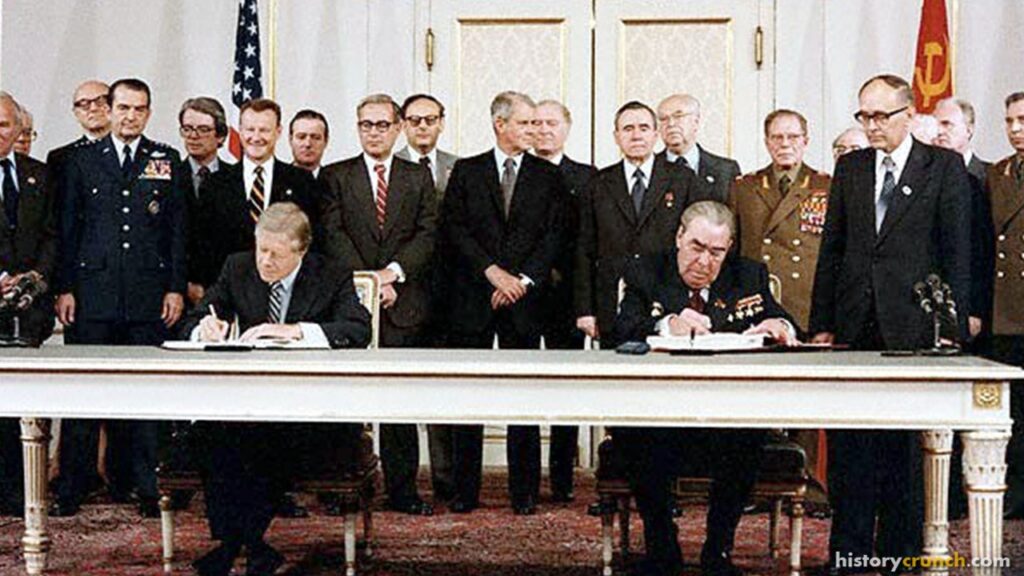
On June 18th, 1979 Jimmy Carter and Leonid Brezhnev signed SALT II in Vienna, seven years after SALT I, setting equal ceilings on the missiles and bombers each side could keep. The Senate was already doubtful, and six months later, when Soviet troops entered Afghanistan, Carter withdrew the treaty rather than see it defeated. Both sides kept to its limits anyway for most of the 1980s.
LEARN MORESHOW LESSwhy it matters · key numbers · 2 key figuresPOLITICALSALT II was the last act of detente, and Afghanistan killed it. The treaty's fate proved that arms control depended on trust the two sides no longer had, and the next agreement to be signed, the INF Treaty of 1987, came from a different Soviet leader in a different world.
The Soviet invasion of Afghanistan ended detente in a week, and Ronald Reagan came to office to win the Cold War, not manage it. He called the Soviet Union an evil empire, proposed a shield against its missiles, and armed its enemies; Moscow, led by three dying old men in three years, shot down an airliner and briefly believed an attack was coming. In Poland a shipyard electrician had founded a union that would outlive the bloc.
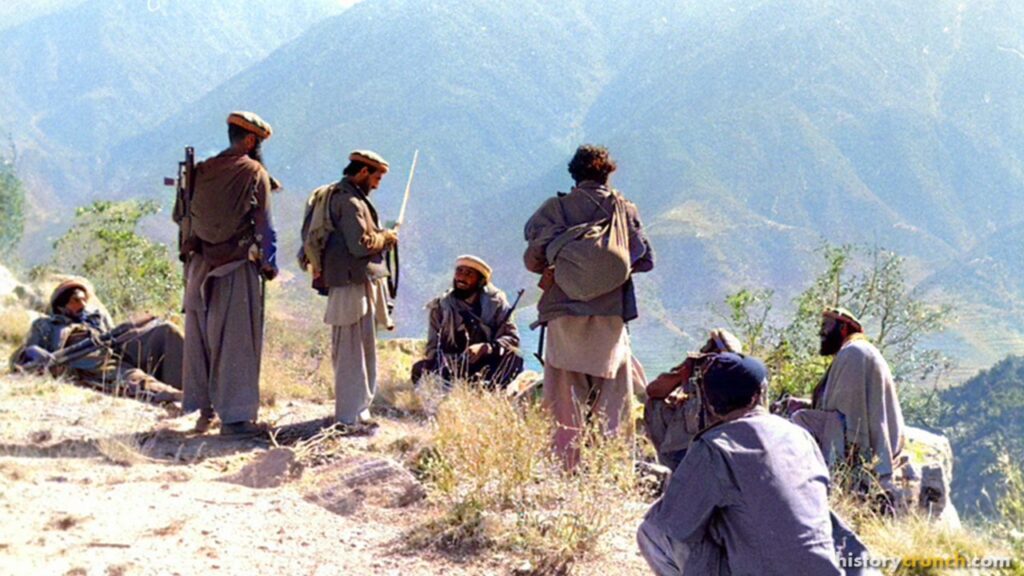
A communist coup had taken Afghanistan in April 1978, and by 1979 its government was losing a civil war against Islamic rebels and killing its own leaders. In the night of December 24th, 1979 Soviet airborne troops landed in Kabul, shot the president, installed a new one and were followed by 80,000 soldiers. Leonid Brezhnev expected a short campaign. It lasted nine years, killed about 15,000 Soviet soldiers and a million Afghans, and sent five million refugees into Pakistan and Iran.
LEARN MORESHOW LESSwhy it matters · key numbers · 2 key figuresMILITARYAfghanistan ended detente in a week. Jimmy Carter withdrew SALT II, embargoed grain, boycotted the Moscow Olympics and began arming the mujahideen; Ronald Reagan poured in billions more. The war drained the Soviet treasury and its army's confidence, and Mikhail Gorbachev called it the bleeding wound. The Soviet Union's Vietnam helped end the Soviet Union.
On March 21st, 1980 Jimmy Carter told American athletes that the United States would not go to the Moscow Olympics that summer unless Soviet troops left Afghanistan. Sixty-five countries stayed away. Four years later the Soviet Union and fourteen of its allies boycotted the Los Angeles Games in return, citing security. The two boycotts cost a generation of athletes their one chance at the Games.
LEARN MORESHOW LESSwhy it matters · key numbers · 1 key figureCULTUREThe boycotts were the Cold War at its pettiest and most visible: the one contest between the two systems that was supposed to be above politics, closed to each other in turn. The Olympics have not been used as a weapon that way since.
In August 1980 workers at the Lenin Shipyard in Gdansk, led by an electrician named Lech Walesa, struck against food price rises and demanded the right to a union free of the Communist Party. On August 31st the government signed. Within a year Solidarity had ten million members, a quarter of the Polish population. In December 1981 the army declared martial law, jailed its leaders and drove it underground, where it lived for seven years.
LEARN MORESHOW LESSwhy it matters · key numbersSOCIALSolidarity was the first independent mass movement in the Soviet bloc since 1945, and the first the tanks did not crush, because the Polish army did the job itself and Moscow, bogged down in Afghanistan, stayed home. When the union came back to the table in 1989 it won the first free election in the bloc, and 1989 began in Gdansk.
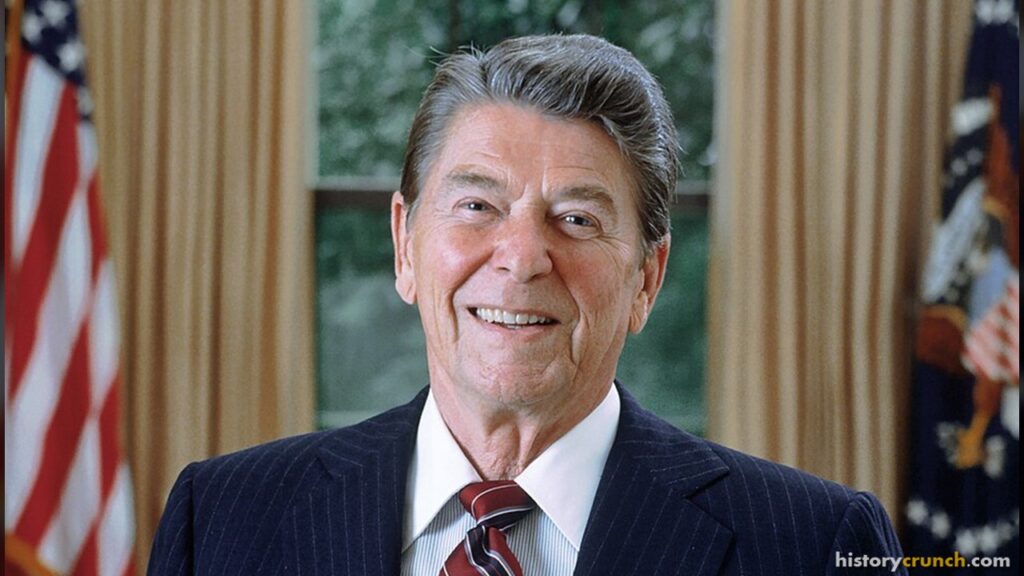
Ronald Reagan, a former actor and governor of California, beat Jimmy Carter on November 4th, 1980 by 489 electoral votes to 49, with American hostages still held in Iran and Soviet troops in Afghanistan. He took office on January 20th, 1981, the day the hostages were freed, and was shot and nearly killed on March 30th. He called the Soviet Union an evil empire, doubled defense spending, and armed anti-communist fighters from Afghanistan to Nicaragua.
LEARN MORESHOW LESSwhy it matters · key numbers · a debatePOLITICALReagan set out to win the Cold War rather than manage it, and the early 1980s were the most dangerous years since Cuba. Then, with Mikhail Gorbachev, he negotiated the first treaty that scrapped nuclear weapons. Whether he ended the Cold War or Gorbachev did is the argument of this era.
Did Reagan win the Cold War?
Yes. His arms build-up and Star Wars forced the Soviet Union into a race it could not afford, and his willingness to deal with Gorbachev ended it on Western terms.
The Soviet Union collapsed from within, under an economy that had stopped working and a leader who chose not to shoot. Reagan's build-up was matched by Moscow for years; what changed was Gorbachev.
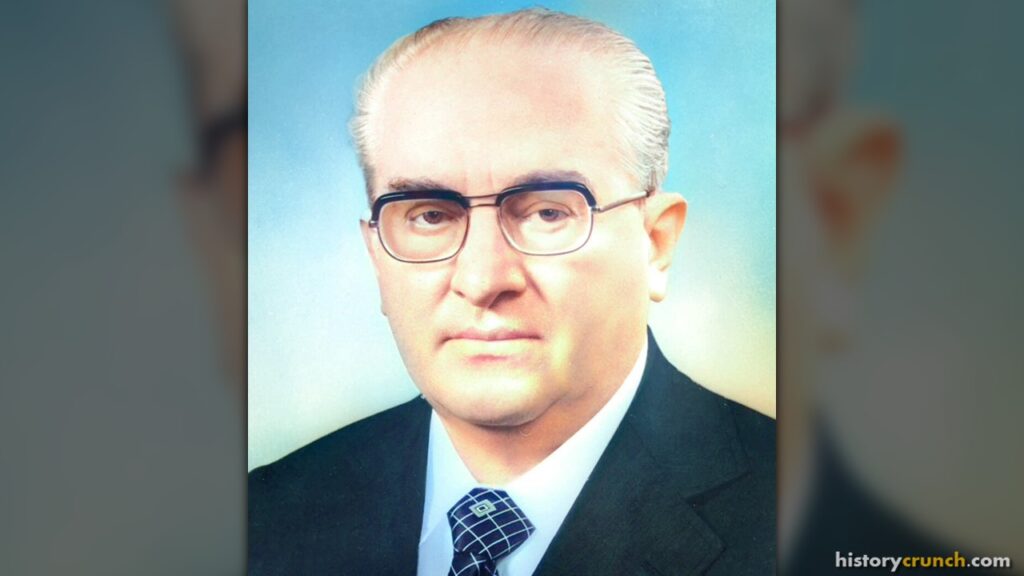
Leonid Brezhnev died on November 10th, 1982 after eighteen years in power, the last of them spent visibly ill. Yuri Andropov, who had run the KGB for fifteen years, took over two days later, tried to restore discipline, and died of kidney failure on February 9th, 1984. Konstantin Chernenko, 72 and breathless with emphysema, lasted thirteen months and died on March 10th, 1985. Three funerals in twenty-eight months told the world the Soviet leadership was as old as its system.
LEARN MORESHOW LESSwhy it matters · key numbers · 3 key figuresPOLITICALThe years of the dying leaders were the Cold War's coldest since Cuba: the Korean airliner, Able Archer, the missiles in Europe, no summits at all. They also cleared the way. When Chernenko died, the Politburo chose the youngest man in the room, and he was 54.
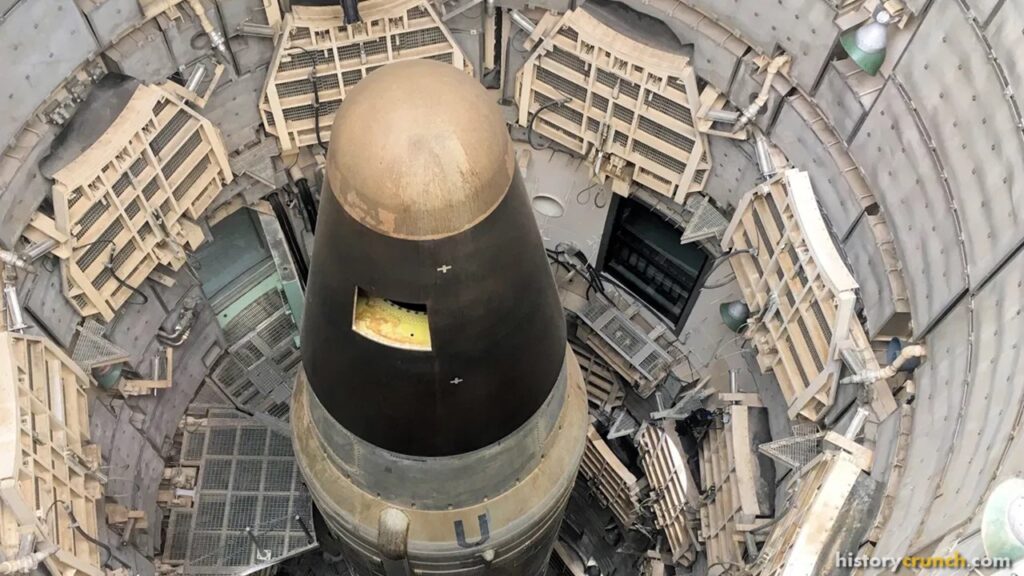
On March 23rd, 1983, two weeks after calling the Soviet Union an evil empire, Ronald Reagan proposed a shield of satellites and lasers that would shoot down missiles before they landed, and make nuclear weapons, he said, impotent and obsolete. The press called it Star Wars. Most scientists said it could not be built. The Soviet leadership feared that it could, and that it would let America strike first without fear of reply.
LEARN MORESHOW LESSwhy it matters · key numbers · 2 key figuresSCIENCEStar Wars broke the logic of mutual assured destruction that SALT had rested on, and it frightened Moscow more than anything since Cuba. It also became Reagan's bargaining chip: Mikhail Gorbachev spent the Reykjavik summit of 1986 trying to trade the whole Soviet arsenal for it, and Reagan would not give it up.
On September 1st, 1983 a Korean Air Lines Boeing 747 flying from Anchorage to Seoul strayed into Soviet airspace over Sakhalin, and a Soviet fighter shot it down, killing all 269 people on board, including a member of Congress. The Soviet Union denied it for days, then said the plane had been spying. Two months later a NATO exercise called Able Archer rehearsed a nuclear launch so realistically that Soviet intelligence briefly believed an attack was coming.
LEARN MORESHOW LESSwhy it matters · key numbers · 2 key figuresMILITARY1983 was the most dangerous year since 1962, and the airliner was its symbol: a superpower that shot down civilians and lied about it. Ronald Reagan, shaken by how close Able Archer had come, began to say in 1984 that a nuclear war could not be won and must never be fought. The words were the first thaw.
In March 1985 the Politburo chose the youngest man in the room, and Mikhail Gorbachev set out to save the Soviet Union by opening it. He met Reagan, scrapped a class of missiles, left Afghanistan and told Eastern Europe the tanks would not come. In 1989 Poland voted, Hungary cut the wire, Leipzig marched and the Wall fell; in 1990 Germany was one country; in 1991 a coup failed, the republics left, and on Christmas night the red flag came down over the Kremlin.
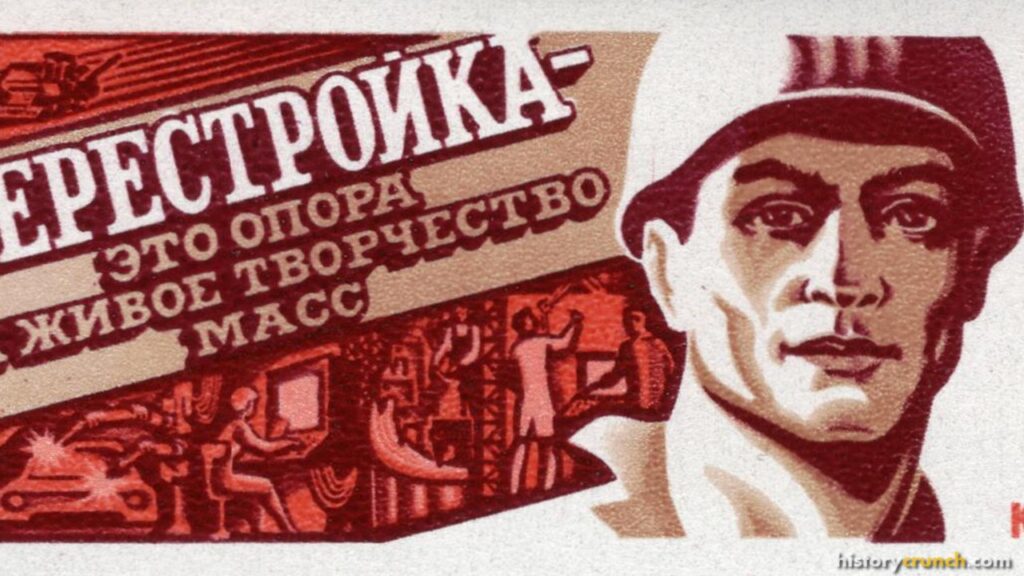
On March 11th, 1985, the day after Konstantin Chernenko died, the Politburo chose Mikhail Gorbachev, a 54-year-old lawyer and farm official from Stavropol, to lead the Soviet Union. He inherited an economy that had stopped growing, a war in Afghanistan, and a leadership that had buried three chiefs in three years. He answered with two words: glasnost, openness, and perestroika, rebuilding. Neither was meant to end communism.
LEARN MORESHOW LESSwhy it matters · key numbers · 2 key figuresPOLITICALGorbachev is the man without whom the Cold War does not end as it did. He let people speak, let the satellites go, and would not shoot, and each choice made the next one harder to avoid. Within six years the bloc, the Wall and the Soviet Union itself were gone. Reagan's Star Wars and Gorbachev's decency are the two explanations, and historians still weigh them.
On November 19th, 1985 Ronald Reagan and Mikhail Gorbachev met in Geneva, the first summit in six years, and talked alone by a fire for longer than planned. They agreed on nothing but to meet again. At Reykjavik in October 1986 they came within a sentence of agreeing to abolish all nuclear weapons within ten years, and broke on Star Wars. Reagan visited Moscow in 1988 and, asked about the evil empire, said that was another time.
LEARN MORESHOW LESSwhy it matters · key numbers · 2 key figuresPOLITICALThe summits turned the two men who had frightened each other into partners. Reagan found a Soviet leader he could trust; Gorbachev found that the West would deal. Reykjavik failed, but the INF Treaty a year later did what no treaty had done before.
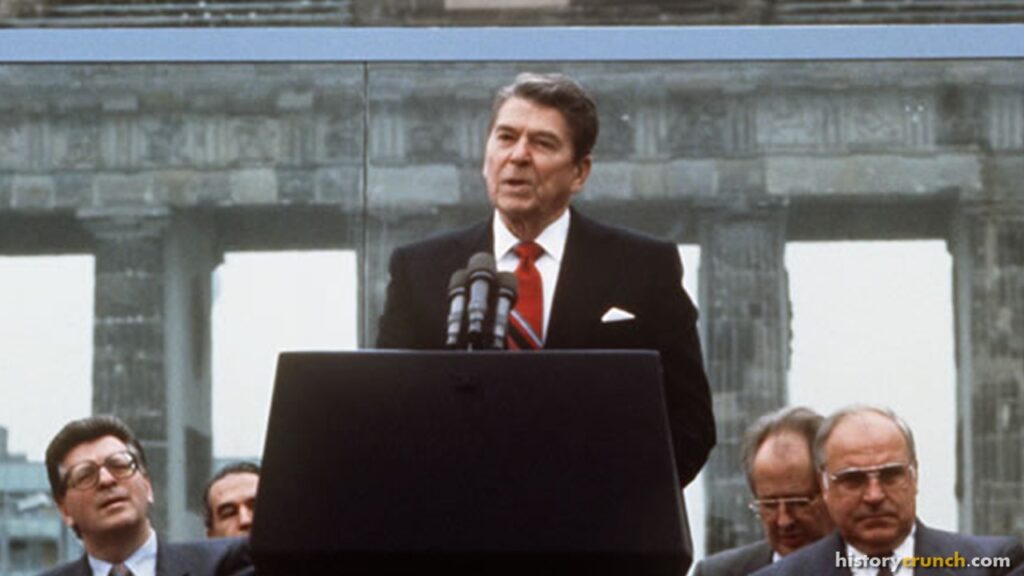
On June 12th, 1987 Ronald Reagan spoke in West Berlin with the Brandenburg Gate and the Wall behind him. His advisers had asked him three times to cut the line; he kept it. If Mikhail Gorbachev sought peace and prosperity, he said, he should come to the gate, open it, and tear down the wall. East German police kept crowds away from the speakers set up on their side.
LEARN MORESHOW LESSwhy it matters · key numbers · a sourceIDEASThe line was little noticed at the time and became famous only when the Wall came down twenty-nine months later. It is remembered because it named the test: a Soviet leader who said he wanted openness could be asked to prove it with the one structure that stood for the opposite.
IN THEIR OWN WORDS“Mr. Gorbachev, open this gate. Mr. Gorbachev, tear down this wall.”
Ronald Reagan, West Berlin, June 12th, 1987
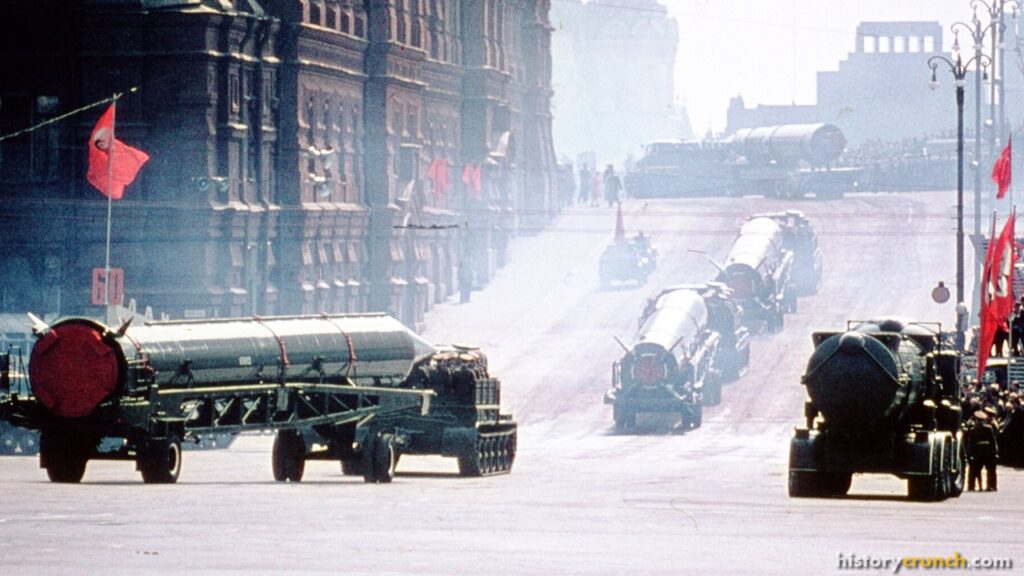
On December 8th, 1987, in the East Room of the White House, Ronald Reagan and Mikhail Gorbachev signed the Intermediate-Range Nuclear Forces Treaty. For the first time the two sides agreed not to limit a class of weapons but to destroy it: every ground-launched missile with a range between 300 and 3,400 miles, 2,692 of them, with inspectors from each side watching the other. Reagan quoted a Russian proverb, trust but verify; Gorbachev said he said it at every meeting.
LEARN MORESHOW LESSwhy it matters · key numbers · a sourcePOLITICALThe INF Treaty was the first real disarmament of the nuclear age and the proof that the two men's summits meant something. It removed the missiles that had put Europe on a hair trigger since 1979, and it set the pattern for the treaties that cut the big arsenals in the 1990s.
IN THEIR OWN WORDS“Trust, but verify.”
Ronald Reagan at the signing, December 8th, 1987
On February 15th, 1989 General Boris Gromov walked across the bridge over the Amu Darya into Soviet territory, the last of the army that had entered Afghanistan nine years before. Mikhail Gorbachev had decided in 1986 to get out and signed the agreement in Geneva in April 1988. The communist government he left in Kabul lasted three more years; the fighters the United States had armed went on to fight each other, and then the world.
LEARN MORESHOW LESSwhy it matters · key numbers · 1 key figureMILITARYThe withdrawal ended the war that had killed detente, and it was the first time the Soviet Union had given up a country it had taken. Its army came home to a country that was itself coming apart. Nine months later the Wall fell.
On May 2nd, 1989 Hungarian soldiers began taking down the electrified fence along the border with Austria, with television cameras invited to watch. Mikhail Gorbachev, asked whether he minded, did not. Through the summer tens of thousands of East Germans drove to Hungary on holiday and walked across into the West, and in September Hungary opened the border to them officially. The Wall in Berlin now had a hole 400 miles away.
LEARN MORESHOW LESSwhy it matters · key numbers · 1 key figurePOLITICALThe Iron Curtain came down where it had first been tested in 1956, and it came down because Moscow had said the Brezhnev Doctrine was over. Once one country's border was open, East Germany's people could leave, and the regime that had built the Wall to stop them had no answer.
After months of round-table talks, Poland's communist government agreed to elections in which Solidarity could contest all the seats in a new Senate and a third of the seats in the lower house. On June 4th, 1989 Solidarity won 99 of the 100 Senate seats and every seat it was allowed to contest. In August a Solidarity editor, Tadeusz Mazowiecki, became the first non-communist prime minister in the Soviet bloc since the 1940s. Mikhail Gorbachev told the Polish communists to accept it.
LEARN MORESHOW LESSwhy it matters · key numbers · 1 key figurePOLITICALPoland showed the rest of the bloc that a communist party could be voted out and that Moscow would not send tanks. The same day, on the other side of the world, China's army cleared Tiananmen Square with gunfire, and the two answers to 1989 have divided the world since.
On September 4th, 1989 a few hundred people walked out of the Monday evening prayers for peace at St. Nicholas Church in Leipzig and marched through the city calling for the right to leave. They came back the next Monday, and the next. On October 9th, with 70,000 in the streets and the army in the barracks, the East German leadership decided not to fire. A week later the party removed Erich Honecker, who had run the country for eighteen years.
LEARN MORESHOW LESSwhy it matters · key numbersSOCIALLeipzig was the East German revolution, and October 9th was the night it was won: the state that had built the Wall found it could not shoot its own people with the world watching and Moscow silent. A month later, the Wall opened.
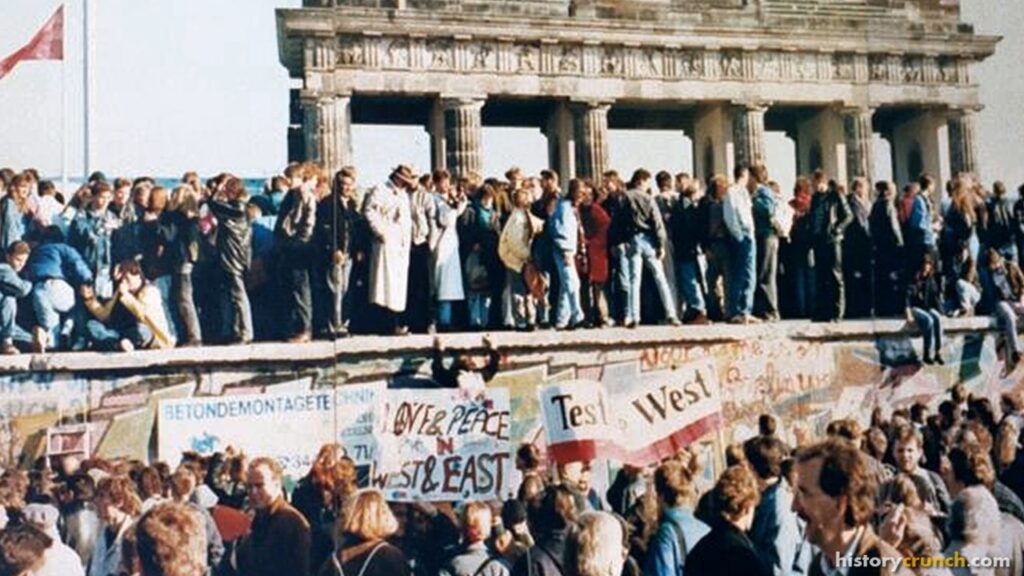
On the evening of November 9th, 1989 an East German spokesman, Gunter Schabowski, read out a new travel rule at a press conference and, asked when it took effect, said as far as he knew, immediately. He was wrong, but it was on television. Within hours tens of thousands of East Berliners were at the crossings, the guards, with no orders, opened the gates, and Berliners from both sides climbed onto the Wall at the Brandenburg Gate and began to break it with hammers.
LEARN MORESHOW LESSwhy it matters · key numbers · 2 key figuresPOLITICALThe Wall had stood for twenty-eight years as the Cold War's symbol, and its fall was the moment the world knew the war was over, whatever the treaties said. Mikhail Gorbachev, asleep in Moscow, was told in the morning and did nothing. Germany was one country again within eleven months.
On November 17th, 1989 riot police beat a student march in Prague, and within days half a million people filled Wenceslas Square, jangling their keys at the government. The playwright Vaclav Havel, jailed for years as a dissident, led the crowds; Alexander Dubcek, the leader of 1968, stood beside him on the balcony. The communist government resigned on December 10th, and on December 29th parliament chose Havel as president. Nobody was killed.
LEARN MORESHOW LESSwhy it matters · key numbersPOLITICALCzechoslovakia finished in six weeks what Prague had started in 1968, and it did so without a shot, which is why it was called velvet. Bulgaria's communists had given up on November 10th; only Romania, on Christmas Day, ended in blood.
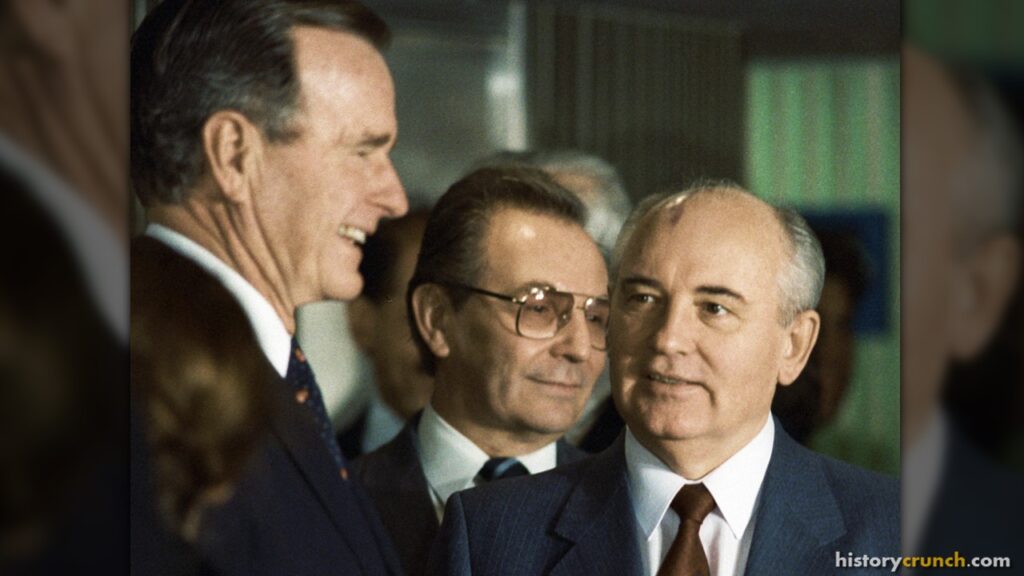
On December 2nd and 3rd, 1989, three weeks after the Wall opened, George H.W. Bush and Mikhail Gorbachev met on ships in a storm off Malta. Gorbachev said the Soviet Union would never start a hot war against the United States and that the two countries were no longer enemies; Bush promised not to dance on the Wall. Neither wanted to say the Cold War was over, and both, in their own words, did.
LEARN MORESHOW LESSwhy it matters · key numbers · 2 key figuresPOLITICALBush, a former CIA director and ambassador, ran the end of the Cold War as quietly as he could, so that a humiliated Soviet Union would not lash out. Malta was the summit that turned the two sides into partners in managing the collapse, and the Gulf War of 1991 was fought with Soviet consent.
Nicolae Ceausescu had ruled Romania since 1965 with a secret police, a personality cult and a starving people. When a crowd booed his speech in Bucharest on December 21st, 1989, live on television, his face showed he did not understand what was happening. The army joined the rising, he fled by helicopter, and on Christmas Day he and his wife Elena were tried in a barracks for two hours and shot. About 1,100 Romanians died in the week of fighting.
LEARN MORESHOW LESSwhy it matters · key numbersPOLITICALRomania was the one revolution of 1989 that ended in blood, and its dictator's trial and execution, shown on television, told every other ruler in the bloc how it could end. By New Year's Day 1990 every communist government in Eastern Europe had fallen or agreed to elections.
On March 11th, 1990 Lithuania's parliament voted to restore the independence the Soviet Union had taken in 1940, the first of the fifteen Soviet republics to leave. Mikhail Gorbachev answered with an oil blockade and, in January 1991, with paratroopers who killed fourteen people at the Vilnius television tower. Latvia and Estonia followed; by the end of 1990 every republic, including Russia under Boris Yeltsin, had declared some form of sovereignty.
LEARN MORESHOW LESSwhy it matters · key numbers · 1 key figurePOLITICALThe revolutions of 1989 had freed the satellites; now the Soviet Union itself began to come apart along the lines of its nations. Gorbachev had opened the argument about the past and could not close it, and the empire that Stalin had built on the Baltic states in 1940 was the first piece to go.
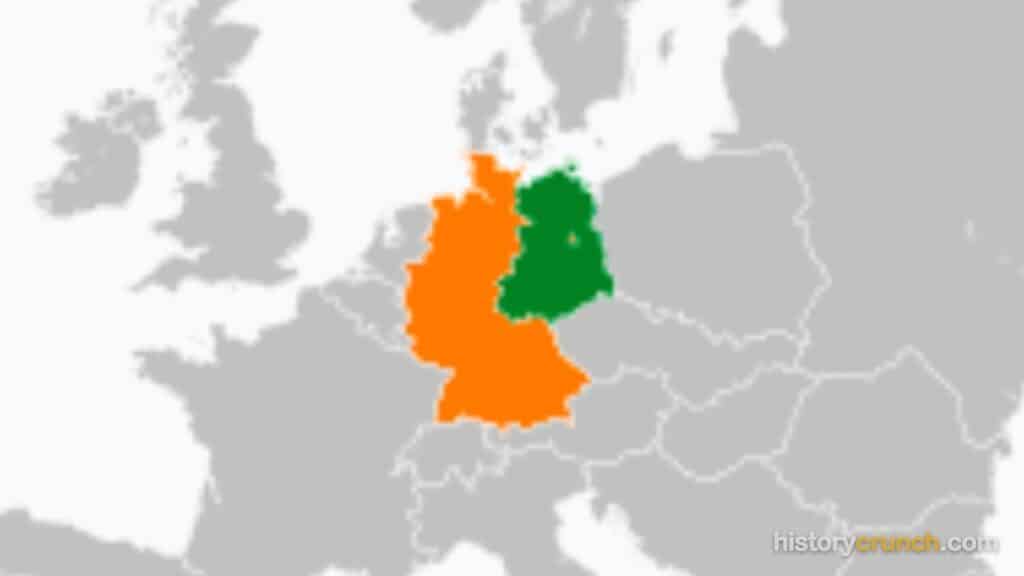
East Germany held its first free election in March 1990 and voted for parties that wanted to join the West as fast as possible. The two states merged their currencies in July, and on October 3rd, 1990 the German Democratic Republic ceased to exist and its five states joined the Federal Republic. Mikhail Gorbachev had agreed in return for German money and a promise that NATO troops would not be stationed in the former East. Chancellor Helmut Kohl was called the father of unity.
LEARN MORESHOW LESSwhy it matters · key numbers · 2 key figuresPOLITICALGermany's division had been the Cold War's cause and its front line, and its reunification in a single NATO country was the West's complete victory in Europe. Forty-five years after the Yalta Conference, the question the Big Three could not settle was settled by the Germans.
On February 25th, 1991 the foreign and defense ministers of the six remaining members met in Budapest and declared the Warsaw Pact's military structure dissolved; the treaty itself was ended in Prague on July 1st. East Germany had left in 1990 when it ceased to exist. NATO, which the pact had been founded to face, stayed, and most of the pact's former members joined it within fifteen years.
LEARN MORESHOW LESSwhy it matters · key numbersMILITARYThe alliance that had invaded two of its own members ended with a signature in one of them. The Soviet army began to leave Eastern Europe; the last troops left Germany in 1994. The Iron Curtain, as a line of armies, was gone.
On August 19th, 1991, the day before Mikhail Gorbachev was to sign a treaty giving the republics more power, eight hardline officials led by the KGB chief and the defense minister declared a state of emergency, put Gorbachev under house arrest at his holiday home in Crimea and sent tanks into Moscow. Boris Yeltsin, president of Russia by popular vote since June, climbed onto a tank outside the parliament and called the coup illegal. Crowds surrounded the building, the army would not fire, and the coup collapsed in three days.
LEARN MORESHOW LESSwhy it matters · key numbers · 1 key figurePOLITICALThe coup was meant to save the Soviet Union and destroyed it. Gorbachev came back to Moscow with no power; Yeltsin, who had faced the tanks, had all of it. Within a week the Communist Party was suspended, and within four months the republics had voted the union out of existence.
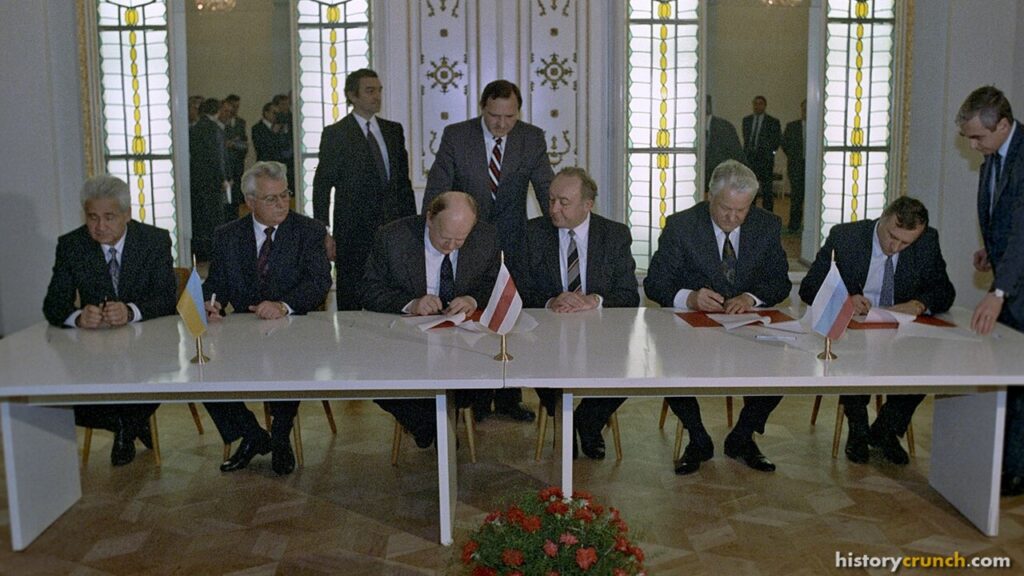
On December 8th, 1991 Boris Yeltsin of Russia, Leonid Kravchuk of Ukraine and Stanislav Shushkevich of Belarus met at a hunting lodge in the Belavezha forest and signed an agreement declaring that the Soviet Union, as a subject of international law and a geopolitical reality, had ceased to exist. In its place they founded a loose Commonwealth of Independent States. Ukraine had voted for independence a week earlier by 92 percent. Mikhail Gorbachev was not invited; Yeltsin telephoned George H.W. Bush before he telephoned him.
LEARN MORESHOW LESSwhy it matters · key numbers · 2 key figuresPOLITICALThe three founding republics of 1922 ended the union the way it had been made, by agreement among themselves, and there was nothing left for Gorbachev to lead. Eight more republics joined the Commonwealth on December 21st. The Soviet Union had seventeen days left.
On the evening of December 25th, 1991 Mikhail Gorbachev went on television to resign as president of a country that no longer existed, handed the codes for the nuclear weapons to Boris Yeltsin, and at 7:32 the red flag with the hammer and sickle was lowered from the Kremlin and the Russian tricolor raised. The next day the Supreme Soviet voted itself out of existence. Fifteen countries stood where one had been.
LEARN MORESHOW LESSwhy it matters · key numbers · a sourcePOLITICALThe Cold War ended without a war, without a treaty of surrender, and without the nuclear exchange that four generations had feared. The United States was the only superpower left. What the forty-six years had cost, from Korea to Afghanistan, and whether the peace that followed was as good as the one people had hoped for on the Wall in 1989, are the questions this timeline leaves for its readers.
IN THEIR OWN WORDS“We live in a new world. An end has been put to the Cold War, the arms race and the insane militarization of our country.”
Mikhail Gorbachev, resignation address, December 25th, 1991
Why did the Soviet Union collapse?
Because it lost the Cold War: an economy a third the size of America's could not match Reagan's build-up, feed its people and hold an empire, and Gorbachev's reforms were an admission of defeat.
Because Gorbachev chose not to hold it by force. The system was failing but had survived worse; what changed was a leader who let people speak, let the satellites go and would not shoot, and a union held by fear cannot survive the end of fear.

I'm the founder of History Crunch, which I first began in 2015 with a small team of like-minded professionals. I have an Education Degree with a focus in Social Studies education. I spent nearly 15 years teaching history, geography and economics in secondary classrooms to thousands of students. Now I use my time and passion researching, writing and thinking about history education for today's students and teachers.

I'm a passionate history and geography teacher with over 15 years of experience working with students in the middle and high school years. I have an Education Degree with a focus in World History. I have been writing articles for History Crunch since 2015 and love the challenge of creating historical content for young learners!

K.L. is a content writer for History Crunch. She is a fantastic history and geography teacher that has been helping students learn about the past in new and meaningful ways since the mid-2000s. Her primary interest is Ancient History, but she is also driven by other topics, such as economics and political systems.
To cite this timeline as a source, use one of the formats below.
MLA: Millar, B., et al. “Cold War Timeline.” HistoryCrunch, 11 September 2026, https://historycrunch.com/cold-war-timeline/.
APA: Millar, B., Beck, E., & Woida, K.L. (2026). Cold War Timeline. HistoryCrunch. https://historycrunch.com/cold-war-timeline/
Chicago: Millar, B., Elias Beck, and K.L Woida. “Cold War Timeline.” HistoryCrunch. September 11, 2026. https://historycrunch.com/cold-war-timeline/
© History Crunch
In 1945 the Allies had won the war together. Four years later Europe had two alliances, two Germanies and a wall of barbed wire between them. How?
Historians disagree about who started the Cold War. The traditional view blames Stalin, who broke his Yalta promises and imposed communist governments by force. Revisionists argue that the United States, with the bomb and the Marshall Plan, was trying to build a world in its own image and that Stalin was defending a buffer against a third invasion. Most now hold that both sides acted on fear, and that the division was the result rather than anyone's plan.
A city a hundred miles inside the Soviet zone produced a blockade, an airlift, an ultimatum, a wall and the most famous speeches of the Cold War. Why Berlin?
Was the Wall a defeat for the West? Kennedy privately thought a wall was better than a war, and West Berlin stayed free. Critics said the West had let the East imprison a nation and done nothing. The Wall's fall in 1989 settled the argument in one sense: the side that had to build it was the side that lost.
Hungary in 1956 and Czechoslovakia in 1968 were crushed by Soviet tanks. Poland in 1989 was not. What changed?
Historians argue about whether the risings were doomed. One view holds that nothing could succeed while Soviet tanks were the final answer, and that Hungary and Prague were brave and futile. Another holds that each rising weakened the system's claim to rule, that Solidarity's survival proved the tanks could not be used forever, and that the revolutions of 1989 were won in Budapest in 1956 and Prague in 1968 as much as in the year the Wall fell.
In 1945 one country had one bomb. How did the world get to 70,000 warheads, and how did it start to come back down?
Did the bomb keep the peace? Supporters of deterrence say the Cold War stayed cold because both sides knew what a war would cost, and that seventy years without a great-power war is the proof. Critics say the peace was luck, point to the near misses of 1962 and 1983, and argue that the arms race cost trillions to build weapons whose only use was not being used.
The Soviet Union won every first in space for four years. Why did the United States win the race?
Historians disagree about why the Soviet Union lost. One view is money: the American economy was three times the size and Apollo cost $25 billion. Another is organization: NASA was one program and the Soviet effort was several rival design bureaus. A third is that the Soviets never really raced for the Moon after Korolev died and let the Americans win a contest they had stopped entering.
If both sides could destroy the other, why did they keep building? And how did they start to stop?
Was MAD a strategy or an accident? Its defenders say it kept the peace between the great powers for forty years, longer than any arrangement before it. Its critics say a strategy that depends on both sides being rational every hour for forty years is not a strategy but a gamble, and that the near misses of 1962 and 1983 were the gamble almost failing.
In 1983 the two sides nearly went to war by mistake. Four years later they were destroying missiles together. What happened?
Historians divide over who ended the arms race. The Reagan view: the build-up and Star Wars forced Moscow to the table because it could not keep up. The Gorbachev view: a Soviet leader decided on his own that the race was ruining his country and offered the cuts; Reagan had the sense to take them. The evidence supports both, which is why the argument continues.
A line drawn across Korea in an evening in 1945 is still there. How did it become the Cold War's first war?
Was Korea a success? Containment's defenders say yes: the line held, South Korea became a democracy and one of the richest countries in Asia, and the Cold War stayed limited. Critics point to three million dead, a border that has not moved in seventy years, and the lesson that led to Vietnam, that American troops could hold any line anywhere.
The United States sent 700 advisers to Vietnam in 1960 and 536,000 soldiers by 1968. How did it happen, and how did it end?
Could Vietnam have been won? One school holds that political limits on the military, no invasion of the North, no bombing of Hanoi's ports until 1972, threw away a war that could have been won. Another holds that no amount of force could have made South Vietnam's government worth fighting for to its own people, and that the war was lost the day it was started. The Vietnam War timeline takes the argument further.
In 1949 China went communist and fought American troops a year later. In 1972 an American president was in Beijing. What changed?
Was the opening to China Nixon's masterstroke or Mao's? Nixon and Kissinger told it as their triangle: play Beijing against Moscow. Chinese sources suggest Mao, frightened of a Soviet attack after 1969, reached out first. Both needed the other, and the partnership outlasted the Cold War it was made for.
The Soviet Union sent an army into Afghanistan in 1979 expecting a short war. Why did it last nine years, and what did it cost?
Did Afghanistan bring down the Soviet Union? Some historians say the war exposed the army, drained the treasury and sent home a generation that had stopped believing. Others say the Soviet economy was failing anyway and the war was a symptom; Gorbachev's reforms, not the mujahideen, ended the system. Both agree the war was a disaster for everyone in it, above all the Afghans.
The Cold War is told as two superpowers. Most of the world's people lived in countries that belonged to neither. What did it look like from there?
Historians increasingly argue the Cold War should be told from the global south, where most of the casualties were. Traditional accounts focus on Washington and Moscow and treat other countries as theaters. The newer work argues local conflicts had their own causes and that superpower involvement changed their scale rather than starting them.
For thirteen days in October 1962 the world waited to see whether two men would start a nuclear war. How did it start, and how did it stop?
Was the crisis Kennedy's finest hour or a crisis he helped make? Admirers say his calm and his refusal of the air strike saved the world. Critics say the Bay of Pigs and the missiles in Turkey invited Khrushchev's gamble, that Kennedy risked war over missiles that did not change the balance, and that the secret deal shows the crisis was settled by a trade he could have offered on the first day.
Two men who met in Mexico in 1955 took an island in 1959 and tried to take a continent. What did they achieve?
Was Castro's Cuba a success? Its defenders point to literacy, health care and sixty years of defiance of the United States. Its critics point to one-party rule, prisons, an economy kept alive by Soviet subsidies and then by remittances, and the million Cubans who left. The Cold War lens, which both sides used, is not the only one.
The two sides nearly destroyed each other in October 1962. What did they do differently afterward?
Historians agree Cuba changed the Cold War and disagree about how much. Some see it as the turning point, the day both sides accepted that the contest must stay cold and began the long road to arms control. Others note that the arms race grew faster after 1962 than before, because the Soviet Union resolved never to be caught weak again, and that detente was a decade away.
Between 1947 and 1954 Americans hunted communists in Hollywood, the State Department and the Army. Why then, and why did it stop?
Historians disagree about the Red Scare's balance. One view, strengthened by the Venona decrypts released in 1995, is that Soviet spying was real and extensive and the fear had grounds. Another is that the spies were caught by the FBI, not by McCarthy or HUAC, whose hearings found almost none and destroyed thousands of innocent people. Most now hold both: real spies, and a witch hunt that did not catch them.
The Vietnam War was fought 8,000 miles away. How did it change the United States?
Did the protests end the war? One view holds that the antiwar movement forced Johnson out and Nixon to the table. Another holds that the movement made most Americans angrier at the protesters than at the war, and that Nixon left because the war was unwinnable and expensive, not because of Kent State. The polls of 1970 support the second; the calendar supports the first.
Radio, comic books, a kitchen in Moscow, a farewell speech and the Olympics: how did the Cold War reach ordinary Americans?
Historians disagree about how much the Cold War shaped American life. One view is that it built the suburbs, the interstates, the universities and the space program, and that the fear was the price of the prosperity. Another is that the fear was manufactured to keep the money flowing, which is close to what Eisenhower said on his way out.
Both sides ran enormous intelligence operations for forty years. Did any of it alter the outcome, or was it mostly two governments watching each other?
Historians argue about the value of espionage. Soviet archives showed atomic spying saved real time, perhaps a year or two. Beyond that, many argue the vast intelligence apparatus mostly produced information that confirmed what each side already believed, and that the U-2 over Cuba is the exception rather than the rule.
One diplomat's telegram became the policy that ran American foreign relations for forty years. How did an idea turn into alliances, money and armies?
Did containment work? Its defenders say yes: the Soviet system failed from within in 1991 exactly as Kennan predicted, and no Soviet tank ever crossed the line. Critics say containment became a global crusade that fought wars in Korea and Vietnam, backed dictators, and cost millions of lives that a more patient policy would have spared. Kennan himself was among the critics.
In the 1970s the two enemies signed treaties, traded, and met in each other's capitals. Why did it start, and why did it end?
Was detente a success? Its architects, Nixon and Kissinger, said it kept the peace and capped the arms race in a decade when America was weak. Its critics on the right said it let the Soviet Union build up and expand into Africa and Afghanistan while America slept; on the left, that it accepted Soviet rule over Eastern Europe. Helsinki's human rights clause, which nobody thought mattered, may have done more than the treaties.
Potsdam, Paris, Vienna, Geneva, Malta: what made a Cold War summit succeed or collapse?
Do summits matter? One view holds that leaders meeting in person changed the Cold War at its beginning and its end, and that the years without summits were the most dangerous. Another holds that summits only ratify what the balance of power has already decided, and that Geneva worked because the Soviet Union was already failing.
A president who called the Soviet Union an evil empire and the last Soviet leader ended the Cold War together. How?
Historians divide the credit. The Reagan school: the build-up forced Gorbachev to reform, and Reagan's willingness to deal let him. The Gorbachev school: the Soviet leader chose to end the contest for his own reasons, and any president would have accepted. A third view gives it to neither: the Soviet economy had failed, and both men were reading the same result.
Truman had been vice president for 82 days and had not been told about the bomb. How did he end up setting the Cold War's course?
Was Truman right to use the bomb, hold Berlin, fight Korea and fire MacArthur? Each is still argued. His defenders see a decisive man who set limits on both Stalin and his own generals. His critics see a president who militarized a rivalry that might have been managed, and who taught his successors that the Cold War could be fought anywhere without Congress.
Kennedy was president for a thousand days that held the Bay of Pigs, the Wall and the missile crisis. What did he learn, and what did he leave?
Kennedy's reputation is still argued. Admirers see the leader who faced down Khrushchev in October 1962 and turned toward peace in 1963. Critics see a president whose recklessness at the Bay of Pigs and toughness at Vienna helped bring on the crisis he is praised for solving, and who put 16,000 advisers into Vietnam.
Six men led the Soviet Union in the Cold War. How did the country go from Stalin's terror to Gorbachev's resignation?
Historians disagree about whether the Soviet Union could have been reformed. One view holds that the system Stalin built could only be run by terror or by inertia, and that Gorbachev's openness was bound to break it. Another holds that China reformed its economy without losing the party, and that Gorbachev's mistake was to open politics first.
Nixon built his career on the Hiss case and the Kitchen Debate, and then made peace with China and Moscow. Was he the same man?
Nixon divides historians more than any Cold War president. One view holds that his opening to China and SALT I were the most creative diplomacy of the contest and that Watergate should not erase them. Another holds that the same secrecy and contempt for rules that produced Watergate also produced the secret bombing of Cambodia and the coup in Chile, and that the man was of a piece.
In January 1989 every country in Eastern Europe was communist. By New Year's Day 1990 none was. How did it happen so fast?
Why was 1989 peaceful? One view credits Gorbachev, who refused to use the army that could have crushed every rising. Another credits the people, from Solidarity to Leipzig, who made the cost of shooting too high. A third credits the leaders of the satellite states, who had lost faith in their own system and let go. Romania shows what the alternative looked like.
For forty years people expected the Cold War to end in a war or never. It ended in six years without one. Why?
The argument about why the Cold War ended is the argument about who gets the credit. Reagan's admirers say he won it; Gorbachev's say he ended it; economic historians say the Soviet system lost it; and the people of Poland, Hungary, East Germany and Czechoslovakia have a claim of their own. Most historians now say all four, in an order that is still argued.
The bloc fell in 1989. The Soviet Union itself lasted two more years. How did the union of fifteen republics dissolve?
Was the Soviet collapse inevitable? Some historians say an empire of fifteen nations held together by force could not survive the end of force. Others say the union might have become a looser federation, which was what Gorbachev's treaty of August 1991 proposed, and that the coup, not the nations, destroyed it. The Russian government today calls the collapse a catastrophe; the Baltic states call it liberation.
No question matches that word.
Research question 1In 1945 the Allies had won the war together. Four years later Europe had two alliances, two Germanies and a wall of barbed wire between them. How?
Research question 2A city a hundred miles inside the Soviet zone produced a blockade, an airlift, an ultimatum, a wall and the most famous speeches of the Cold War. Why Berlin?
Research question 3Hungary in 1956 and Czechoslovakia in 1968 were crushed by Soviet tanks. Poland in 1989 was not. What changed?
Research question 4In 1945 one country had one bomb. How did the world get to 70,000 warheads, and how did it start to come back down?
Research question 5The Soviet Union won every first in space for four years. Why did the United States win the race?
Research question 6If both sides could destroy the other, why did they keep building? And how did they start to stop?
Research question 7In 1983 the two sides nearly went to war by mistake. Four years later they were destroying missiles together. What happened?
Research question 8A line drawn across Korea in an evening in 1945 is still there. How did it become the Cold War's first war?
Research question 9The United States sent 700 advisers to Vietnam in 1960 and 536,000 soldiers by 1968. How did it happen, and how did it end?
Research question 10In 1949 China went communist and fought American troops a year later. In 1972 an American president was in Beijing. What changed?
Research question 11The Soviet Union sent an army into Afghanistan in 1979 expecting a short war. Why did it last nine years, and what did it cost?
Research question 12The Cold War is told as two superpowers. Most of the world's people lived in countries that belonged to neither. What did it look like from there?
Research question 13For thirteen days in October 1962 the world waited to see whether two men would start a nuclear war. How did it start, and how did it stop?
Research question 14Two men who met in Mexico in 1955 took an island in 1959 and tried to take a continent. What did they achieve?
Research question 15The two sides nearly destroyed each other in October 1962. What did they do differently afterward?
Research question 16Between 1947 and 1954 Americans hunted communists in Hollywood, the State Department and the Army. Why then, and why did it stop?
Research question 17The Vietnam War was fought 8,000 miles away. How did it change the United States?
Research question 18Radio, comic books, a kitchen in Moscow, a farewell speech and the Olympics: how did the Cold War reach ordinary Americans?
Research question 19Both sides ran enormous intelligence operations for forty years. Did any of it alter the outcome, or was it mostly two governments watching each other?
Research question 20One diplomat's telegram became the policy that ran American foreign relations for forty years. How did an idea turn into alliances, money and armies?
Research question 21In the 1970s the two enemies signed treaties, traded, and met in each other's capitals. Why did it start, and why did it end?
Research question 22Potsdam, Paris, Vienna, Geneva, Malta: what made a Cold War summit succeed or collapse?
Research question 23A president who called the Soviet Union an evil empire and the last Soviet leader ended the Cold War together. How?
Research question 24Truman had been vice president for 82 days and had not been told about the bomb. How did he end up setting the Cold War's course?
Research question 25Kennedy was president for a thousand days that held the Bay of Pigs, the Wall and the missile crisis. What did he learn, and what did he leave?
Research question 26Six men led the Soviet Union in the Cold War. How did the country go from Stalin's terror to Gorbachev's resignation?
Research question 27Nixon built his career on the Hiss case and the Kitchen Debate, and then made peace with China and Moscow. Was he the same man?
Research question 28In January 1989 every country in Eastern Europe was communist. By New Year's Day 1990 none was. How did it happen so fast?
Research question 29For forty years people expected the Cold War to end in a war or never. It ended in six years without one. Why?
Research question 30The bloc fell in 1989. The Soviet Union itself lasted two more years. How did the union of fifteen republics dissolve?