Robert Oppenheimer was an American physicist who led the Los Alamos Laboratory during the Manhattan Project in World War II. He is remembered as a central figure in the creation of the atomic bomb and later as an important voice in debates over nuclear weapons and science.
 FactsthatCrunch
Oppenheimer led the Los Alamos Laboratory during the Manhattan Project, directing the team that designed the first atomic bombs used in World War II. His career later became a well-known example of Cold War political pressure on scientists, after a 1954 security hearing stripped him of his government clearance.
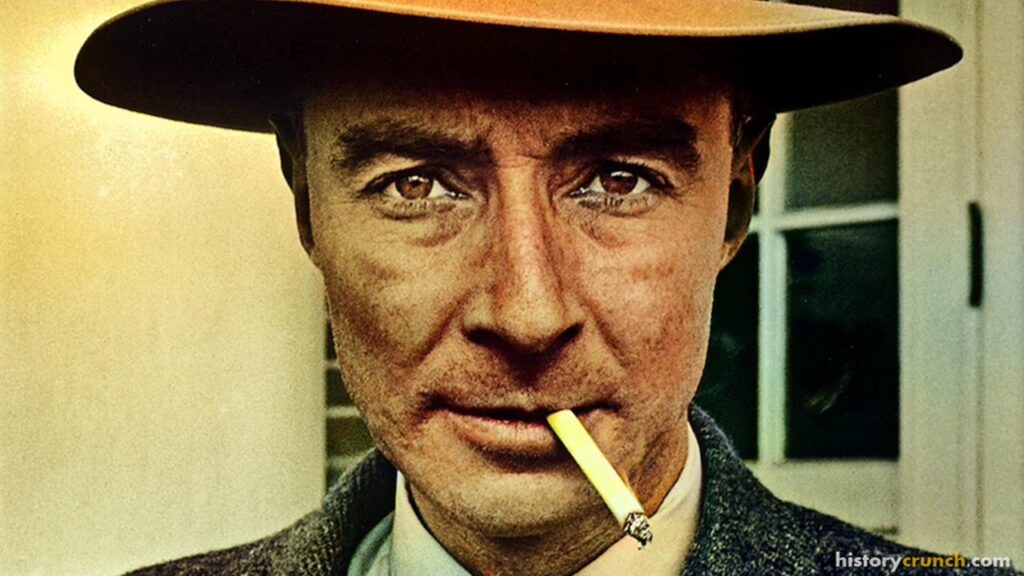
Robert Oppenheimer – Early Life
Julius Robert Oppenheimer was born on April 22nd, 1904, in New York City. He came from a wealthy family, as his father was a successful textile importer and his mother was a painter. Oppenheimer was a gifted student from an early age, attended the Ethical Culture School, and later developed a lasting connection to New Mexico after spending time there as a young man recovering from illness.
Oppenheimer continued his education at Harvard, where he graduated in 1925. After that, he studied at Cambridge and then at the University of Göttingen in Germany, where he completed his Ph.D. in 1927 under Max Born. These years were important because they placed him at the center of the fast-growing world of modern physics.
FactsthatCrunchCan you match each part of Robert Oppenheimer’s early life to the right detail?
Robert Oppenheimer – Rise in Science
After finishing his studies in Europe, Oppenheimer returned to the United States and built his career as a theoretical physicistA scientist who uses math and ideas, rather than experiments alone, to explain how the physical world works.. He taught at the University of California, Berkeley, and also worked with the California Institute of Technology. Over time, he became one of the leading American physicists of his generation, and Berkeley promoted him to full professor in 1936.
Oppenheimer’s scientific work was wide-ranging and important. He made contributions to quantum mechanicsA branch of physics that describes how extremely small particles like atoms and electrons behave., nuclear physics, and astrophysics, and later historians have also pointed to his work on neutron stars and gravitational collapseThe process by which a massive object caves inward under its own gravity, which can form a neutron star or black hole. as especially significant. Therefore, before he became famous for the atomic bomb, he had already earned major respect within the scientific world.
FactsthatCrunchOppenheimer's research on neutron stars and gravitational collapse gave science a framework for understanding how massive stars can cave inward under their own gravity and form extremely dense objects.
Before the Manhattan Project made him famous, Oppenheimer had already earned serious scientific respect for this work in astrophysics.
His 1939 papers, written with colleagues George Volkoff and Hartland Snyder, helped establish that a collapsing star could shrink to a point where not even light escapes, a concept that later physicists would connect directly to black holes.
This work was significant because it moved the idea of stellar collapse from speculation to a calculation grounded in Einstein's general theory of relativity.
Later historians of science have pointed to this research as one of Oppenheimer's most lasting contributions, independent of his wartime role.
Robert Oppenheimer – the Manhattan Project
Oppenheimer rose to even greater importance during World War II. In 1942, as the United States pushed forward with the secret effort to build an atomic bomb, General Leslie Groves selected him to help lead the project and then placed him in charge of the new Los Alamos Laboratory in New Mexico. Oppenheimer also helped choose the Los Alamos site, and the laboratory became the main center for designing the first atomic bombs.
This was a surprising choice in some ways because Oppenheimer had little experience managing a large organization. Even so, he proved highly effective at bringing together brilliant scientists, military officials, and engineers in a secret wartime environment. As such, his leadership mattered not only because of his scientific ability, but also because he helped turn a huge and difficult project into a functioning laboratory.
The most famous moment of Oppenheimer’s wartime career came on July 16th, 1945, with the Trinity test in New Mexico, which was the first detonationThe explosion of a bomb or nuclear device at a specific moment and place. of a nuclear device. Only weeks later, atomic bombs developed through the Manhattan Project were dropped on Hiroshima on August 6th, 1945, and Nagasaki on August 9th, 1945. This made Oppenheimer one of the most recognized scientific figures in the world, but it also tied his legacy to the destructive power of nuclear warfare.
FactsthatCrunch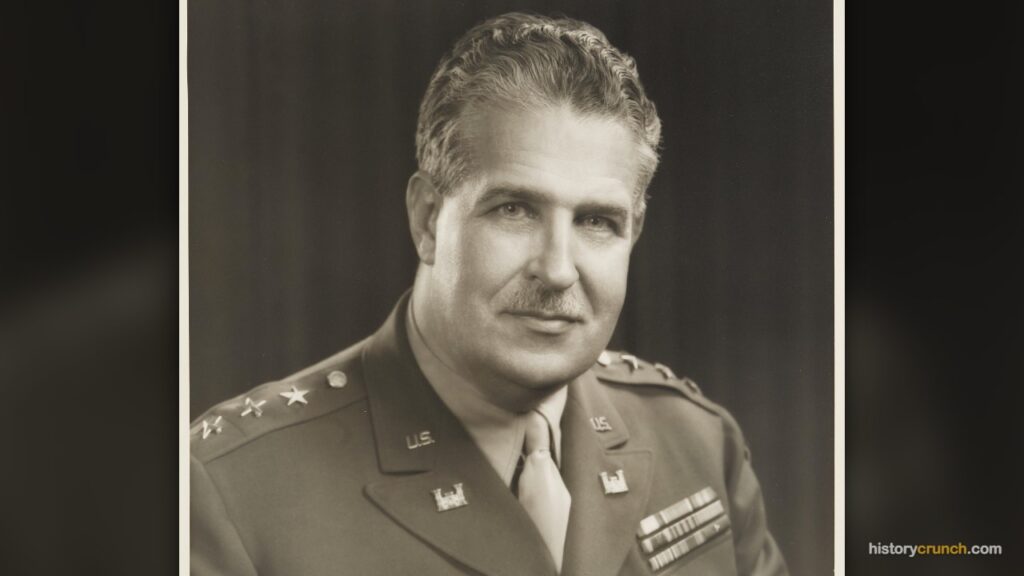
Robert Oppenheimer – Later Years and Death
After the war, Oppenheimer left Los Alamos and returned briefly to academic life. In 1947, he became director of the Institute for Advanced Study in Princeton, New Jersey, and he also served as chairman of the General Advisory Committee of the United States Atomic Energy Commission from 1947 to 1952. In those years, he argued for international control of atomic energy and warned about the dangers of a nuclear arms raceA competition between countries to build more or stronger weapons than their rivals..
However, Oppenheimer’s political influence was badly damaged in 1954. During the anti-communist atmosphere of the early Cold War, he faced a security hearing focused on his past left-wing associations and his views on nuclear weapons policy. The hearing ended with the revocationThe official cancellation or taking away of a right or permission that was previously granted. of his security clearanceOfficial government permission allowing a person to access secret or classified information., which pushed him out of formal government influence even though the board did not find him disloyal. This is important because the case became one of the best-known examples of Cold War suspicion and political pressure in the scientific world.
Even so, Oppenheimer remained respected by many scientists and public figures. In 1963, he received the Enrico Fermi Award, which was widely seen as a public sign that his reputation had at least partly recovered. By then, however, his health was failing. After years of heavy smoking, he developed throat cancer and died on February 18th, 1967, in Princeton, New Jersey, at the age of 62.
FactsthatCrunchAfter World War II, Oppenheimer argued strongly that atomic energy had to be placed under international control rather than left to individual nations competing against each other. In 1946, he played a central part in drafting the Acheson-Lilienthal Report, which proposed an international authority to oversee atomic materials and share peaceful uses of nuclear energy. He warned that a nuclear arms race between nations would make the world far more dangerous, and he believed that shared oversight was the only reliable path to security.
Robert Oppenheimer – Significance
Robert Oppenheimer was significant because he stood at the meeting point of science, war, and politics in the 20th century. He helped lead the project that produced the first atomic bombs, and this placed him at the center of one of the most important turning points in modern history. In fact, his role in the Manhattan Project helped change warfare, diplomacy, and international relations for the rest of the century.
At the same time, Oppenheimer remains a deeply debated historical figure. Some people remember him mainly as the scientific leader behind the atomic bomb, while others focus on his later warnings about nuclear danger and his treatment during the 1954 security hearing. Regardless, Robert Oppenheimer remains one of the most important scientists in modern history because his life reflected both the power of science and the moral problems that can come with it.
FactsthatCrunchAt 5:29 a.m. on July 16th, 1945, scientists and military officials at the Alamogordo Bombing Range in New Mexico watched as the first nuclear device ever detonated exploded with a blast far larger than most of the team had expected, proving that the Los Alamos design actually worked.
Nuclear weapons existed only in theory and laboratory work; no country had yet proven an atomic bomb could function in a real detonation.
The United States had a confirmed working weapon. Within weeks, atomic bombs were dropped on Hiroshima on August 6th, 1945, and Nagasaki on August 9th, 1945, changing warfare and international relations permanently.
Key Vocabulary
Theoretical physicist
Quantum mechanics
Gravitational collapse
Detonation
Security clearance
Revocation
Arms race
Frequently Asked Questions
Why is Robert Oppenheimer called the father of the atomic bomb?
Oppenheimer earned that nickname because he led the Los Alamos Laboratory, where the first atomic bombs were designed. General Leslie Groves chose him to run the lab in 1942 during the Manhattan Project. His leadership brought together scientists, engineers, and military officials in a secret wartime effort.
What was the Trinity test?
The Trinity test was the first detonation of a nuclear device, held in New Mexico on July 16th, 1945. It proved that the design built at Los Alamos actually worked. Only weeks later, atomic bombs were dropped on Hiroshima and Nagasaki in Japan.
Why did Oppenheimer lose his security clearance?
Oppenheimer lost his security clearance in 1954 after a government hearing during the early Cold War. Officials questioned his past left-wing ties and his views on nuclear weapons policy. The board did not find him disloyal, but it still revoked his clearance and ended his government influence.
What did Oppenheimer do before the Manhattan Project?
Before the war, Oppenheimer was already one of the leading American physicists of his generation. He taught at the University of California, Berkeley, which promoted him to full professor in 1936. He also made respected contributions to quantum mechanics, nuclear physics, and astrophysics.
How and when did Robert Oppenheimer die?
Oppenheimer died of throat cancer on February 18th, 1967, in Princeton, New Jersey, at age 62. Years of heavy smoking contributed to his illness. Before his death, he received the Enrico Fermi Award in 1963, a sign that his reputation had partly recovered.
Cite This Article
To cite this article as a source, use one of the formats below.
MLA: Millar, B. “Robert Oppenheimer: A Detailed Biography.” HistoryCrunch, 3 October 2026, https://historycrunch.com/robert-oppenheimer/.
APA: Millar, B. (2026). Robert Oppenheimer: A Detailed Biography. HistoryCrunch. https://historycrunch.com/robert-oppenheimer/
Chicago: Millar, B. “Robert Oppenheimer: A Detailed Biography.” HistoryCrunch. October 3, 2026. https://historycrunch.com/robert-oppenheimer/
Sources
- Max Hastings, Inferno / All Hell Let Loose.
- Antony Beevor, The Second World War.
- The National WWII Museum
- Gerhard L. Weinberg, A World at Arms.