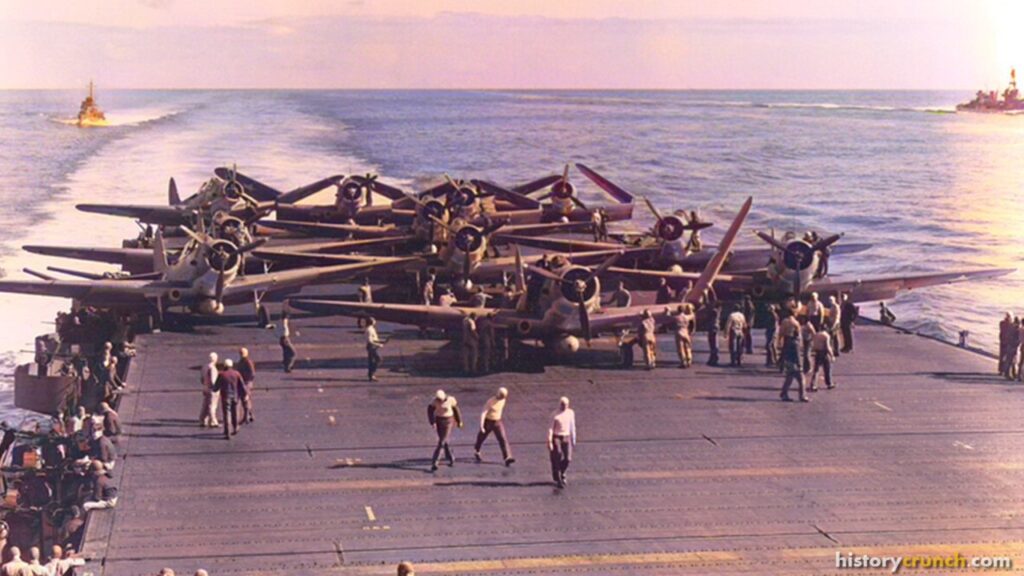
The Battle of Midway in World War II is considered by many historians to be one of the most important battles of the Pacific Theater of the war. The Battle of Midway occurred from June 3rd to the 7th in 1942 and was a major naval battle fought between Japan and the United States near the Midway AtollA ring-shaped coral island or chain of islands surrounding a lagoon in the ocean. in the Northern Pacific Ocean.
 FactsthatCrunch
Battle of Midway in World War II – Background
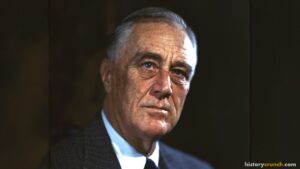
The Battle of Midway was a major event in World War II. The Second World War began on September 1st, 1939 when Nazi Germany invaded the country of Poland. In the years that followed, Europe underwent a series of significant battles, including: Battle of France, Battle of Britain and Operation Barbarossa. During this time, though, the United States remained out of the direct fighting in the war. Instead, the United States, under the leadership of President Franklin D. Roosevelt, practiced a policy of isolationismA foreign policy where a country stays out of other nations’ conflicts and limits its involvement in international affairs.. This saw the United States limit its involvement in international affairs. As such, when World War II began in Europe in 1939, the United States remained on the sidelines, except for its supply shipments under the Lend-Lease Act.
At the same time, the United States opposed Japan’s expansionismA nation’s policy of growing its territory or power by taking over new lands or regions., and viewed Japan as a legitimate threat in the Pacific Ocean. In response to this perceived threat, the United States imposed economic sanctionsPenalties one country places on another, such as cutting off trade or resources, to pressure it politically. against Japan and stopped all oil exports to Japan in 1941. This was devastating to the Japanese Empire, because Japan lacked the necessary oil reserves to continue its expansion in the Pacific. As such, Japan viewed these sanctions as a direct threat to its national survival and economic stability. This ultimately was one of several factors that pushed Japan to surprise attack the United States at Pearl Harbor in 1941.
The attack on Pearl Harbor on December 7th, 1941 was the event that ultimately brought the United States into the fighting of World War II. As well, it essentially launched the Pacific Theater of World War II. Furthermore, after the attack on Pearl Harbor, Japan rapidly expanded across the Pacific, capturing key territories including the Philippines, Malaya, Singapore, and parts of New Guinea. In fact, by mid-1942, Japanese forces threatened to isolate Australia and dominate the entire Pacific.
FactsthatCrunchAfter the attack on Pearl Harbor, Japanese forces seized territory across the Pacific at a rapid pace from late 1941 into mid-1942. This chart tracks the approximate number of days each major territorial capture came after the Pearl Harbor attack on December 7th, 1941.
Battle of Midway in World War II – Summary
With the success that Japan saw in its early battles of the Pacific theater, the Japanese military leadership sought to lure the Americans into a trap. In fact, Admiral Isoroku Yamamoto, commander of the Japanese Combined FleetThe main fighting force of the Japanese Imperial Navy during World War II., devised a plan to destroy the United States Pacific Fleet of aircraft carriers, which had escaped destruction during the earlier attack on Pearl Harbor. As well, Yamamoto wanted to capture Midway Atoll, which was a strategically important island about 1,300 miles northwest of Hawaii.
However, American codebreakersPeople who secretly decode enemy messages written in a secret language or cipher to reveal hidden plans., led by Commander Joseph Rochefort, famously broke the Japanese naval code. This was an important breakthrough, because it allowed the Americans the ability to decipher the Japanese battle plans before they could be hatched. As a result, the American leaders were able to devise their own surprise attack against Japan at Midway. As such, while the Japanese believed that they were going to carry out a surprise attack against the American Pacific Fleet, instead the United States decoded the Japanese plans and ordered their own surprise attack against the Japanese Imperial Navy. Pacific Fleet commander Admiral Chester W. Nimitz used the decoded Japanese plans to order the use of American aircraft carriers to counter the Japanese attack at Midway and unleash their own surprise attack on the Japanese fleet.
The effective American attack at Midway devastated the Japanese fleet in the Pacific. As such, the Battle of Midway was an important American victory in the Pacific Theater of World War II. In all, the naval battle saw significant losses for both sides. For instance, Japanese losses included: 4 aircraft carriers, nearly 250 aircraft, and over 3,000 soldiers. For their part, the Americans lost: 1 aircraft carrier (Yorktown) and 1 destroyer, approximately 150 aircraft and 300 soldiers.
FactsthatCrunchPut these events of the Battle of Midway in the order they happened.
Battle of Midway in World War II – Significance
Just as in its earlier attack on Pearl Harbor, Japan went into the Battle of Midway with the goal of destroying the United States’ Pacific Fleet and removing the United States as a threat in the war in the Pacific. The Japanese Navy hoped that it could draw the United States’ Pacific Fleet into a battle near Midway Atoll and surprise attack the American ships, thus delivering the final blow to the United States in the Pacific. Instead, the Battle of Midway was a decisive victory for the United States and dramatically changed the rest of the war in the Pacific. The victory at Midway was mostly caused by the United States’ ability to decode Japanese communications.
The strategic loss of four carriers and their experienced aircrews was a devastating blow to Japanese naval power during the rest of World War II. In fact, many historians now view the Battle of Midway as the turning pointA moment in a conflict when the balance of power shifts decisively in one side’s favor. of the war because the American victory was so decisive. Japan suffered huge losses and was ultimately unable to rebuild its fleet to counter the United States as they pushed their way towards the Japanese home islands. For instance, over 3,000 Japanese soldiers died in the battle while just over 300 American soldiers died. As well, Japan suffered the loss of almost 250 aircraft, while the United States lost approximately 150.
What did Japan lose at the Battle of Midway that it was never able to rebuild?
Explore World War II · 1939 – 1945
Keep exploring World War II with these History Crunch resources.
Key Vocabulary
Isolationism
Expansionism
Economic sanctions
Codebreakers
Combined Fleet
Atoll
Turning point
Frequently Asked Questions
When was the Battle of Midway?
The Battle of Midway took place from June 3rd to June 7th, 1942. It was fought near the Midway Atoll in the Northern Pacific Ocean. The battle came just six months after Japan’s attack on Pearl Harbor.
Who won the Battle of Midway?
The United States won the Battle of Midway in a decisive victory over Japan. The American attack destroyed much of the Japanese fleet in the Pacific. This win shifted the balance of naval power toward the United States.
Why was the Battle of Midway a turning point in World War II?
Many historians view Midway as the turning point of the Pacific war because the American victory was so complete. Japan lost four aircraft carriers and many skilled aircrews it could not easily replace. After the battle, Japan was unable to rebuild its fleet to match American strength.
How did codebreaking help the United States at Midway?
American codebreakers, led by Commander Joseph Rochefort, broke the Japanese naval code before the battle. This let American leaders read the Japanese battle plans ahead of time. Admiral Chester W. Nimitz used that knowledge to set a trap of his own.
What were the losses on each side at Midway?
Japan lost four aircraft carriers, nearly 250 aircraft, and over 3,000 men. The United States lost one aircraft carrier, the Yorktown, along with one destroyer. American losses also included about 150 aircraft and around 300 men.
What was Japan trying to achieve at Midway?
Japan wanted to destroy the United States Pacific Fleet of aircraft carriers that had escaped harm at Pearl Harbor. Admiral Isoroku Yamamoto also planned to capture Midway Atoll, about 1,300 miles (2,092 km) northwest of Hawaii. The goal was to remove the United States as a threat in the Pacific.
Cite This Article
To cite this article as a source, use one of the formats below.
MLA: Woida, K.L. “Battle of Midway in World War II: A Detailed Summary.” HistoryCrunch, 2 October 2026, https://historycrunch.com/battle-of-midway-in-world-war-ii/.
APA: Woida, K. L. (2026). Battle of Midway in World War II: A Detailed Summary. HistoryCrunch. https://historycrunch.com/battle-of-midway-in-world-war-ii/
Chicago: Woida, K.L. “Battle of Midway in World War II: A Detailed Summary.” HistoryCrunch. October 2, 2026. https://historycrunch.com/battle-of-midway-in-world-war-ii/
Sources
- Max Hastings, Inferno / All Hell Let Loose.
- Imperial War Museum
- The National WWII Museum
- Gerhard L. Weinberg, A World at Arms.