The Battle of Britain took place from July 10th to October 31st in 1940 and was one of the most significant battles of World War II. It was the first major military conflict in history fought entirely by air forces and saw the Royal Air Force (RAF) of Britain battle in the skies against the Luftwaffe, which was Nazi Germany’s air force. As such, it was an air-superiorityControl of the skies so the enemy cannot effectively use their own aircraft. battle that occurred following the defeat of France in the Battle of France. The Battle of Britain was particularly important in World War II, because Britain’s victory prevented the continued advancement of the Nazi German Army and was a significant turning point in World War II.
Battle of Britain in World War II – Background
As stated above, the Battle of Britain was an important conflict during the time of World War II. The Second World War began on September 1st, 1939 when Nazi Germany invaded the nation of Poland. Although, Britain and France declared war against Germany just a few days later, on September 3rd, no large-scale fighting occurred in Western Europe until Nazi Germany’s invasion of France during the Battle of France in May of 1940.
The Battle of France was an important campaign in the early phases of World War II. It took place from May 10th to June 25th, 1940, and resulted in a victory for Nazi Germany and the complete defeat of France. At the time, this was shocking because France was considered to be one of the world’s foremost military powers at the time. In fact, the speed and efficiency of the Nazi German invasion shocked the world and was a key moment in the early years of the war. In fact, Britain now stood alone in western Europe against Nazi Germany.
Initially, Germany planned to carry out an invasion of Britain with an amphibiousA military attack launched from the sea onto land. attack called Operation Sea LionNazi Germany’s plan to invade Britain by crossing the English Channel by sea.. However, the invasion required control of the skies over the English Channel first. As such, the Nazis first tried to defeat the Royal Air Force and wear Britain down through a naval blockadeUsing warships to stop supplies and goods from reaching an enemy country by sea. and a strategic bombing campaign. Nazi forces began the battle in 1940 with the hopes of forcing Britain to agree to peace terms. Germany’s goal was to remove any threat of an Allied counter-attack on the western half of Europe and believed it could achieve this with the defeat of Britain.
It’s also important to note that Britain underwent some significant political changes before the start of the Battle of Britain. In fact, Winston Churchill replaced Neville Chamberlain as the Prime Minister of the United Kingdom on May 10th, 1940. Chamberlain’s resignation followed criticism of his handling of the early stages of World War II, particularly the Norwegian Campaign. As well, Chamberlain has been widely criticized for his policy of appeasement in the years before the outbreak of World War II. Winston Churchill would go on to lead Britain throughout the rest of World War II, including the Battle of Britain.
Battle of Britain in World War II – Summary
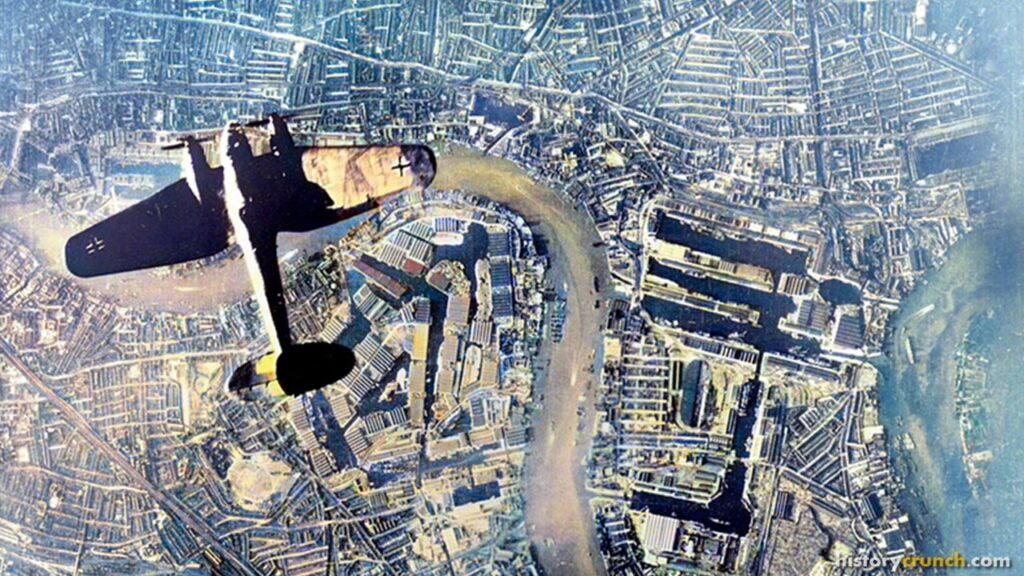
The Battle of Britain in World War II unfolded as a series of major events. First, Nazi German air forces (Luftwaffe) focused on Allied shipping convoys in the English Channel. They attempted to prevent supplies from reaching Britain while also luring British RAF fighters into battle as a means of wearing down British military capabilities. Next, Nazi Germany launched massive assaults on British RAF airfields, radar stations, and aircraft factories. The RAF suffered heavy losses, but Britain as a whole was still able to withstand the assault. This was followed by the ‘BlitzThe Nazi German bombing campaign targeting British cities and defenses from September 1940 to May 1941.’, which was a Nazi German bombing campaign that lasted from September of 1940 to May of 1941.
During the Blitz, the German Luftwaffe carried out bombing runs against British anti-air defenses, RAF airstrips and, most devastatingly, major British cities. For instance, the city of London was bombed by the Nazis for 57 consecutive nights starting on September 7th, 1940. Other British cities that were targeted, included: Birmingham, Liverpool, Manchester, Coventry, Sheffield, and others.
The Nazi German goal was to destroy the British morale of both the military and the citizens and force the British government to give in and agree to terms of surrender. At this point in World War II, the Prime Minister of Britain was Winston Churchill who is remembered today as steadfastly refusing to give up during the German attack. This determination shown by Churchill is a defining feature of his time as Britain’s Prime Minister and is the reason many regard him as one of the best war-time leaders of the 20th century. In fact, he remarked that based on the actions of British pilots in the Battle of Britain “never was so much owed by so many to so few”.
In the end, the German Luftwaffe was no match for the British air-defense systems and the superiority of the British RAF pilots. The Germans suffered heavy losses in their bombing runs and Adolf Hitler was eventually forced to give up on his hopes of a British invasion.
 FactsthatCrunch
 Black & whiteColour
Battle of Britain in World War II – Significance
The Battle of Britain is remembered as one of the most important battles of World War II in Europe for several reasons. First, the Battle of Britain occurred shortly after the Battle of France, which saw France defeated by the German forces. Since the Soviet Union had signed a nonaggression pact with Germany in 1939 and the United States was yet to join the war effort, this meant that Britain was the last major Allied Power left to stand against the impressive Nazi forces. Had Britain fallen, Germany would have gained complete control of western Europe. In fact, the Battle of Britain was the first real setback for Nazi Germany, and the British victory ultimately convinced Adolf Hitler, the Nazi German leader, to abandon Operation Sea Lion.
Britain remaining in the war effort of World War II was vitally important. For instance, Britain’s survival ensured it could continue to serve as a base for Allied operations throughout the remainder of World War II. This proved to be important in the later years of the war, especially in relation to the events of the Normandy Invasion and the eventual liberation of Europe from Nazi control.
Second, the Battle of Britain unfolded as a major air-superiority campaign between the British Royal Air Force (RAF) and the German Air Force (Luftwaffe). Since Britain was an island-nation, Germany was unable to use its blitzkriegA fast, overwhelming military attack combining air power and ground forces, used successfully against Poland and France. tactics that had proved so successful against both Poland and France, and instead had to attempt to knock Britain out of the war by use of its air force. In fact, the Battle of Britain was the first battle in history that occurred entirely as an air-based battle.
FactsthatCrunchWinston Churchill's government refused to negotiate peace with Germany in May 1940, keeping Britain in the war after France fell.
If Churchill had agreed to terms with Germany in May 1940, Britain would likely have been removed from the war entirely. Without Britain as a base, the Western Allied strategy of attacking Germany from the west would have had no foothold in Europe.
Explore World War II · 1939 – 1945
Keep exploring World War II with these History Crunch resources.
Key Vocabulary
Air-superiority
Amphibious
Operation Sea Lion
Naval blockade
Blitz
Appeasement
Blitzkrieg
Frequently Asked Questions
When was the Battle of Britain fought?
The Battle of Britain lasted from July 10th to October 31st in 1940. It began soon after the fall of France and became one of the key battles of World War II. The fighting took place almost entirely in the skies over Britain and the English Channel.
Who fought in the Battle of Britain?
The Battle of Britain was fought between Britain’s Royal Air Force (RAF) and Nazi Germany’s air force, the Luftwaffe. It was the first major battle in history fought entirely by air forces. The RAF defended Britain while the Luftwaffe tried to win control of the skies.
What was Operation Sea Lion?
Operation Sea Lion was Nazi Germany’s plan to invade Britain by sea. The plan required control of the skies over the English Channel first. When the Luftwaffe failed to defeat the RAF, Adolf Hitler gave up on the invasion.
What was the Blitz?
The Blitz was a German bombing campaign against British cities that lasted from September of 1940 to May of 1941. London was bombed for 57 nights in a row starting on September 7th, 1940. Other targeted cities included Birmingham, Liverpool, Manchester, Coventry, and Sheffield.
Why was the Battle of Britain so important?
The Battle of Britain was the first real setback for Nazi Germany in World War II. Britain’s victory kept it in the war as the last major Allied power standing in western Europe. This allowed Britain to serve as a base for later Allied operations, including the Normandy Invasion.
Who led Britain during the Battle of Britain?
Winston Churchill led Britain as Prime Minister during the Battle of Britain. He replaced Neville Chamberlain on May 10th, 1940, after criticism of Chamberlain’s handling of the war. Churchill refused to surrender and praised the RAF pilots with the famous words, “never was so much owed by so many to so few.”
Cite This Article
To cite this article as a source, use one of the formats below.
MLA: Beck, Elias. “Battle of Britain in World War II: A Detailed Summary.” HistoryCrunch, 4 October 2026, https://historycrunch.com/battle-of-britain-in-world-war-ii/.
APA: Beck, E. (2026). Battle of Britain in World War II: A Detailed Summary. HistoryCrunch. https://historycrunch.com/battle-of-britain-in-world-war-ii/
Chicago: Beck, Elias. “Battle of Britain in World War II: A Detailed Summary.” HistoryCrunch. October 4, 2026. https://historycrunch.com/battle-of-britain-in-world-war-ii/
Sources
- Gerhard L. Weinberg, A World at Arms.
- Antony Beevor, The Second World War.