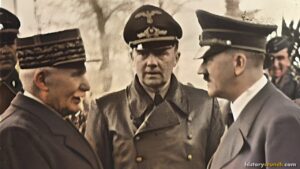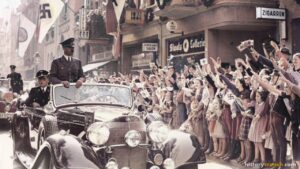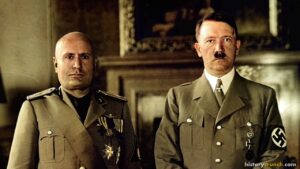
The Nazi Germany invasion of Poland began on September 1st, 1939 and is considered to be the beginning of World War II. In fact, the invasion of Poland was the result of Adolf Hitler’s expansionist policies, driven by his desire for lebensraumA German word meaning ‘living space,’ used by Hitler to justify taking land from other countries for Germany. (living space) and the reunification of ethnic Germans. It was a continuation of his earlier territorial gains, including Austria in 1938 and Czechoslovakia in 1939. Furthermore, the Nazi Germany invasion of Poland is considered to be an example of ‘blitzkrieg‘, which means ‘lightning war’.
 FactsthatCrunch
What Was World War II?
Just two decades after the end of the First World War, the world again plunged into war in September of 1939 when Nazi Germany invaded the sovereign nation of Poland. World War II lasted until 1945 and included major battles in Europe, Africa and the Pacific. As well, World War II involved some of the most dramatic events in human history, including: some of the largest battles in human history, the Holocaust and the first use of atomic weaponry. Including civilian deaths and other related tragedies, it is believed that as many as 80 million people died as a result of the events of World War II.
Nazi Germany Invasion of Poland – Background
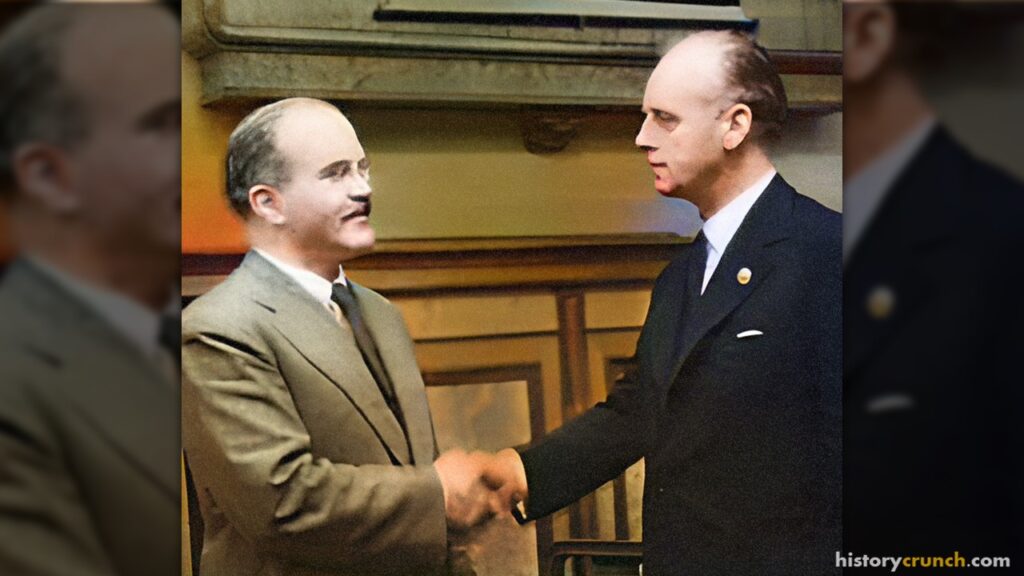
As stated above, the Nazi Germany invasion of Poland began on September 1st, 1939 and is one of the most important events of the early years of World War II. Germany, under the leadership of Adolf Hitler, had just recently signed a nonaggression pact with the Soviet Union (also known as the Molotov–Ribbentrop Pact) and used the opportunity to invade Poland. In fact, the invasion would see Poland become split in two with one half under the control of Nazi Germany and the other under the control of the Soviet Union. Poland was created at the end of World War I out of territory that had traditionally been part of Germany, the Austro-Hungarian Empire and the Russian Empire. Hitler sought to reclaim this territory for Germany and to unite all German-speaking people.
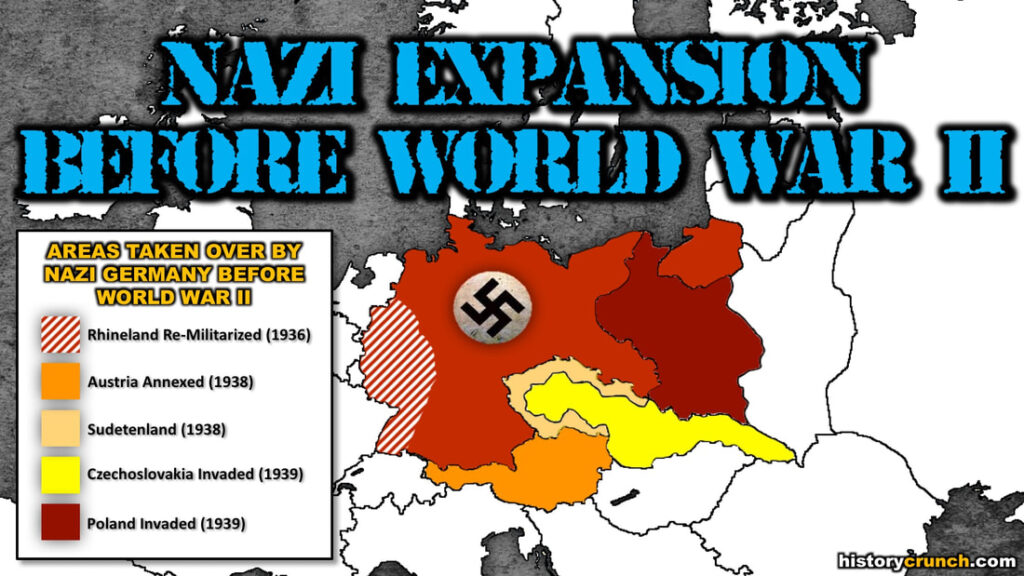
Germany had already annexed Austria in 1938 and taken Czechoslovakia in 1939. At the time, Britain and France were practicing a strategy referred to as ‘appeasement‘, which saw the British and French essentially give in to Hitler’s demands. The hope was that if given what he wanted, then Hitler would stop his aggressive expansionist actions. However, this strategy proved to be a failure, as it allowed Nazi Germany to rebuild its territory and military capabilities throughout the 1930s. With that said, Britain and France had guaranteed Polish independence. However, in August of 1939, when Nazi Germany signed the Molotov-Ribbentrop PactA 1939 nonaggression agreement between Nazi Germany and the Soviet Union that secretly planned to divide Poland between them. with the Soviet Union, it secretly included a protocol to divide Poland between them. As such, the stage was set for the Nazi Germany invasion of Poland.
 FactsthatCrunch
Before the invasion, Britain and France had promised to defend Polish independence.
Nazi Germany Invasion of Poland – Summary
Germany began its invasion on the morning of September 1st, 1939, following the ‘Gleiwitz IncidentA staged attack on August 31, 1939 where SS soldiers disguised as Polish troops attacked a German radio station to justify invading Poland.‘. This incident saw SS men pose as Polish troops and attack a German radio station on August 31st. Naturally, the radio station reported that Germany was under attack and German citizens became fearful of a Polish attack against Germany. In reality, the Nazis had staged the incident to create a propaganda campaign that would favor a German attack against Poland. Hitler believed this gave him the opportunity to invade Poland, as a means of capturing more territory in Europe.
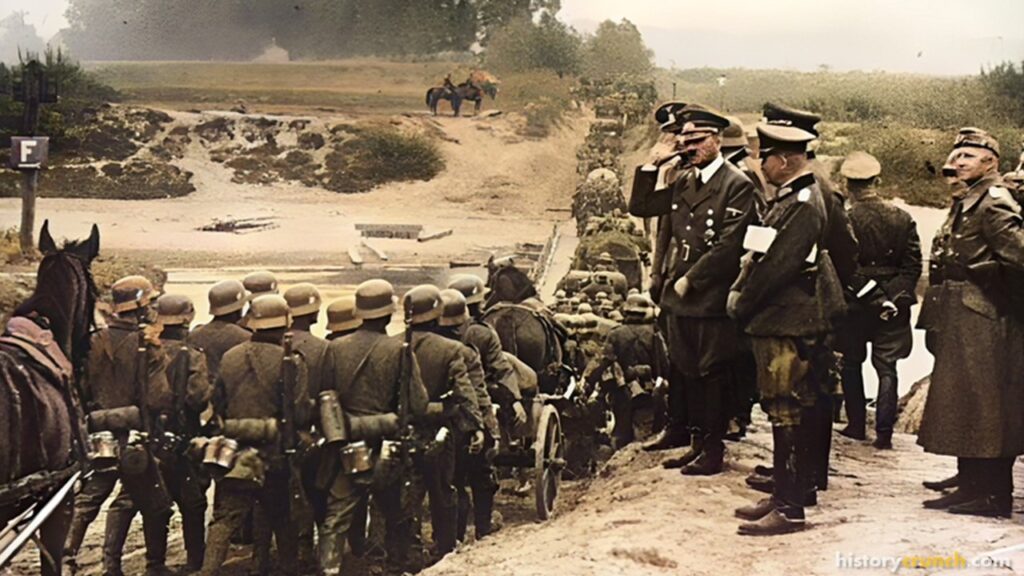
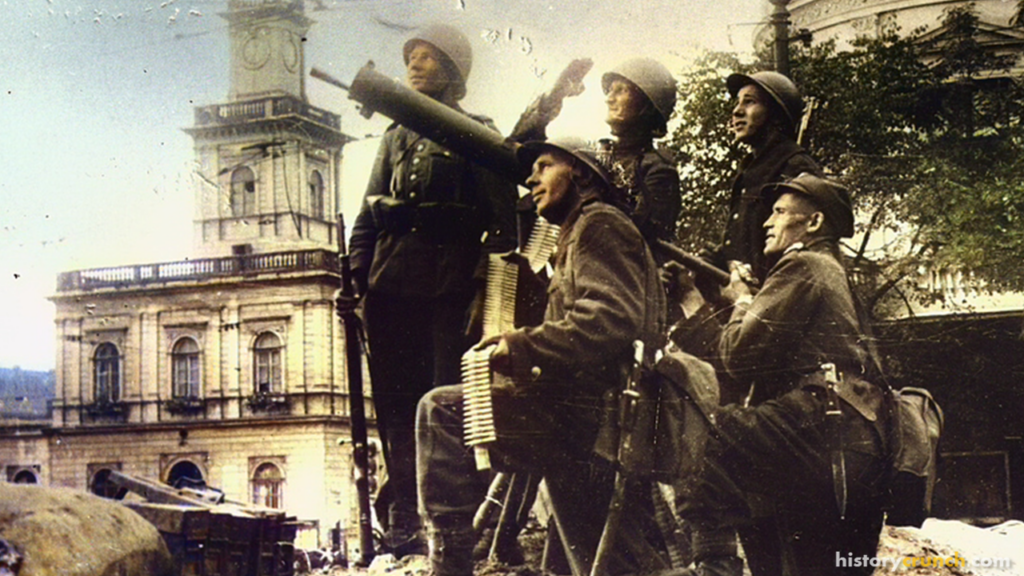
As such, on September 1st, 1939, Nazi Germany invaded Poland from the west. In the assault, Germany mobilized over 1.5 million troops, supported by bombing runs by the German Air Force (Luftwaffe), tanks, and motorized divisions. For its part, the Polish Army was ultimately ill-equipped for the onslaught. For instance, historians have noted how the Polish forces were badly outnumbered in tanks and aircraft, which made them vulnerable to Germany’s modern tactics.
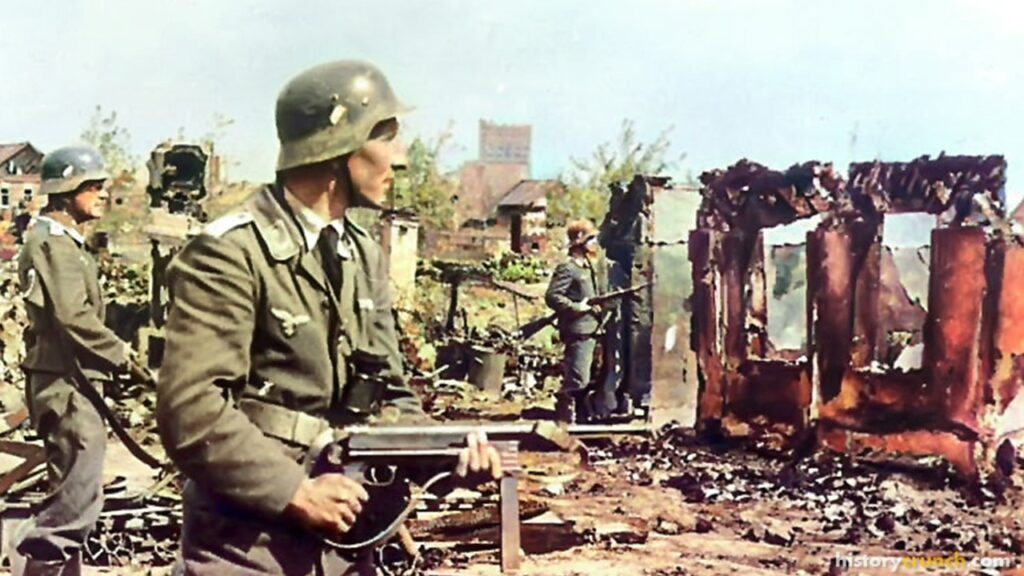
German forces quickly overwhelmed the Polish defenses, bombed cities, and targeted key infrastructure and railways to disrupt any Polish resistance. Furthermore, Germany unleashed its blitzkrieg tactics during the invasion of Poland, which proved to be successful in much of the fighting of World War II. BlitzkriegA German military tactic meaning ‘lightning war,’ using fast-moving tanks and air strikes to overwhelm enemies before they can react. involved German tank divisions and air support overwhelming the Polish forces as they encircled and cut off the Polish troops. The point was to avoid the trench warfare stalemate of World War I. Instead, the Nazis planned to move their forces into enemy territory as quickly as possible and use the speed of attack as a strategy to overwhelm and confuse the enemy troops. This Nazi blitzkrieg strategy was devastatingly effective, causing confusion and a quick Polish retreat.
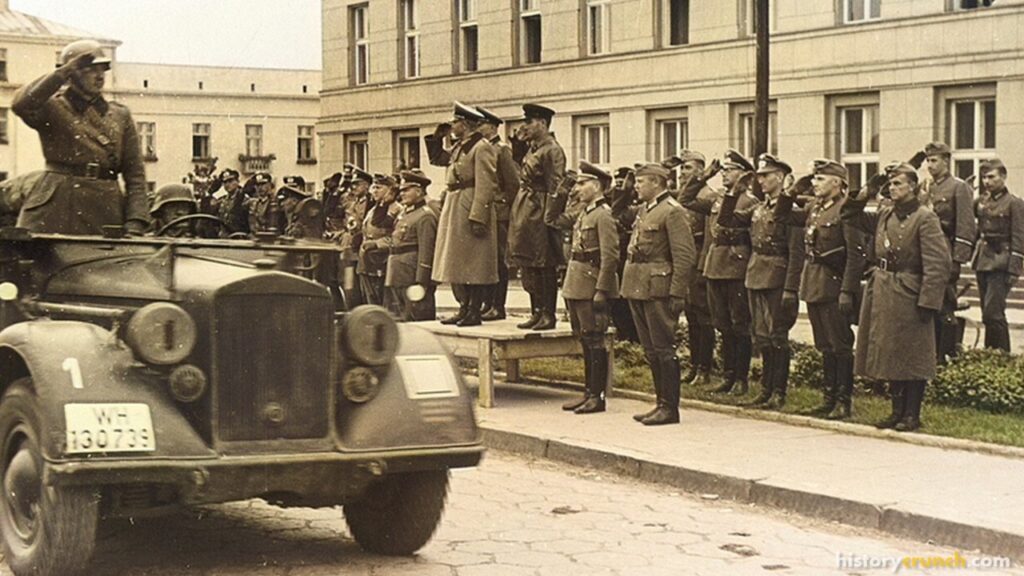
What made the situation even more difficult for Poland was the Soviet invasion of their country just two weeks later. For instance, on September 17th, 1939, the Soviet Union invaded eastern Poland under the terms of the Molotov-Ribbentrop Pact. This essentially trapped the Polish army between two fronts: Nazi Germany on one side and the Soviet Union on the other. The Soviets, under the leadership of Joseph Stalin, claimed they were protecting ethnic Ukrainians and Belarusians in Poland but were, in fact, carrying out the division of Poland with Nazi Germany.
German forces invaded from the north, south and west and quickly forced the Polish into a retreat. A series of battles followed in which Polish forces continued to struggle against the superior German assault until finally on October 6th, 1939, Germany and the Soviet Union took full control over Poland. The first major conflict of World War II was over and the world was once again plunged into a world war.
The country was divided, with the western half controlled by Nazi Germany and the eastern half taken by the Soviet Union. Central Poland turned into the ‘General GovernmentA Nazi-controlled zone created from central Poland after the 1939 invasion, described in the article as a zone of terror and oppression.‘, a Nazi-controlled zone of terror and oppression. Poland’s government fled to London, and ultimately formed a ‘government-in-exileA country’s official government that continues to operate from a foreign nation after its homeland has been occupied by an enemy.‘. Although Britain and France declared war on Germany on September 3rd, they provided no direct military support to Poland during the invasion.
Why were blitzkrieg tactics so effective against Poland in September 1939?
Nazi Germany Invasion of Poland – Significance
The Nazi Germany invasion of Poland in September of 1939 was one of the most significant events of World War II. For instance, it was the event that directly led to the outbreak of World War II. Nazi Germany invaded Poland on September 1st, 1939, and just two days later, on September 3rd, 1939, Britain and France declared war on Nazi Germany. As such, historians identify September 1st, 1939 as the start of World War II, since it caused the other major European powers to enter the conflict and led to the events of World War II.
It was also one of several events in which Nazi Germany was attempting to regain land lost after World War I as part of the Treaty of Versailles. For example, in the years before 1939, Germany had annexed Austria and taken control of Czechoslovakia. Hitler, believing that the Allied leaders would continue with their policy of appeasementA foreign policy where Britain and France gave in to Hitler’s demands, hoping to prevent another major war., continued his aggressive action in Europe and invaded Poland. Finally, realizing their policy of appeasement had failed, Britain and France declared war on Germany for invading Poland and World War II had begun.
The occupation of Poland by Nazi Germany also led to the events of the Holocaust. For instance, Nazi Germany, under the control of the Nazi Party, established the first ghettos and concentration camps, which set the stage for the Holocaust. Furthermore, all of the major death camps of the Holocaust were located in Poland, including: Auschwitz-Birkenau, Treblinka, Belzec, Sobibor, Chelmno and Majdanek. These camps were specifically designed for mass killing, primarily using gas chambers, and were responsible for the deaths of millions of people.
In all, the Nazi Germany invasion of Poland was a significant turning point in world history and displayed the failure of appeasement as a foreign policy.
 FactsthatCrunch
Why is the invasion of Poland seen as the start of World War II?
Germany invaded Poland on September 1st, 1939, and Britain and France declared war on Germany two days later. Their entry turned a German attack on one country into a war between the major powers of Europe. The invasion also showed that appeasement had failed, since giving in to Hitler over Austria and Czechoslovakia had not stopped his expansion.
Explore World War II · 1939 – 1945
Keep exploring World War II with these History Crunch resources.
Key Vocabulary
Lebensraum
Blitzkrieg
Molotov-Ribbentrop Pact
Appeasement
Gleiwitz Incident
General Government
Government-in-exile
Frequently Asked Questions
When did Germany invade Poland?
Germany invaded Poland on September 1st, 1939, which is seen as the start of World War II. Hitler wanted more land and hoped to unite German-speaking people. Two days later, on September 3rd, 1939, Britain and France declared war on Germany.
What was blitzkrieg?
Blitzkrieg means “lightning war” and was the fast attack style Germany used in Poland. Tank divisions and air support moved quickly to surround and cut off enemy troops. The goal was to avoid the slow trench warfare that marked World War I.
What was the Molotov-Ribbentrop Pact?
The Molotov-Ribbentrop Pact was a nonaggression deal signed by Germany and the Soviet Union in August of 1939. It included a secret plan to split Poland between the two powers. This agreement cleared the way for the invasion to begin.
Why did the Soviet Union also invade Poland?
The Soviet Union invaded eastern Poland on September 17th, 1939, under the secret terms of the pact with Germany. This trapped the Polish army between two enemy fronts. Stalin claimed he was protecting ethnic groups, but the real goal was dividing the country.
Why did Britain and France fail to stop Hitler before the invasion?
Britain and France had used a policy called appeasement, which gave in to many of Hitler’s demands. They hoped this would satisfy him and prevent another war. Instead, it let Germany grow stronger and take Austria and Czechoslovakia before invading Poland.
How did the invasion connect to the Holocaust?
The occupation of Poland led directly to the events of the Holocaust. Nazi Germany set up the first ghettos and concentration camps in the conquered land. All of the major death camps, including Auschwitz-Birkenau and Treblinka, were later built in Poland.
Cite This Article
To cite this article as a source, use one of the formats below.
MLA: Beck, Elias. “Nazi Germany Invasion of Poland: A Detailed Summary.” HistoryCrunch, 2 October 2026, https://historycrunch.com/nazi-germany-invasion-of-poland/.
APA: Beck, E. (2026). Nazi Germany Invasion of Poland: A Detailed Summary. HistoryCrunch. https://historycrunch.com/nazi-germany-invasion-of-poland/
Chicago: Beck, Elias. “Nazi Germany Invasion of Poland: A Detailed Summary.” HistoryCrunch. October 2, 2026. https://historycrunch.com/nazi-germany-invasion-of-poland/
Sources
- The National WWII Museum
- Antony Beevor, The Second World War.
- Max Hastings, Inferno / All Hell Let Loose.
- Gerhard L. Weinberg, A World at Arms.