The annexationWhen one country takes over and absorbs another country, making it part of its own territory. of Austria by Nazi Germany, known also as the ‘Anschluss’, occurred in March of 1938 and marked a significant step in Adolf Hitler’s expansionist aggression in the years before World War II. The event was an example of the failure of appeasement, which was the foreign policy strategy that was practiced by the Western democracies, such as Britain and France. As such, historians view the Nazi Germany annexation of Austria as a major step towards World War II, which broke out in September of 1939.

Annexation of Austria by Nazi Germany – Background
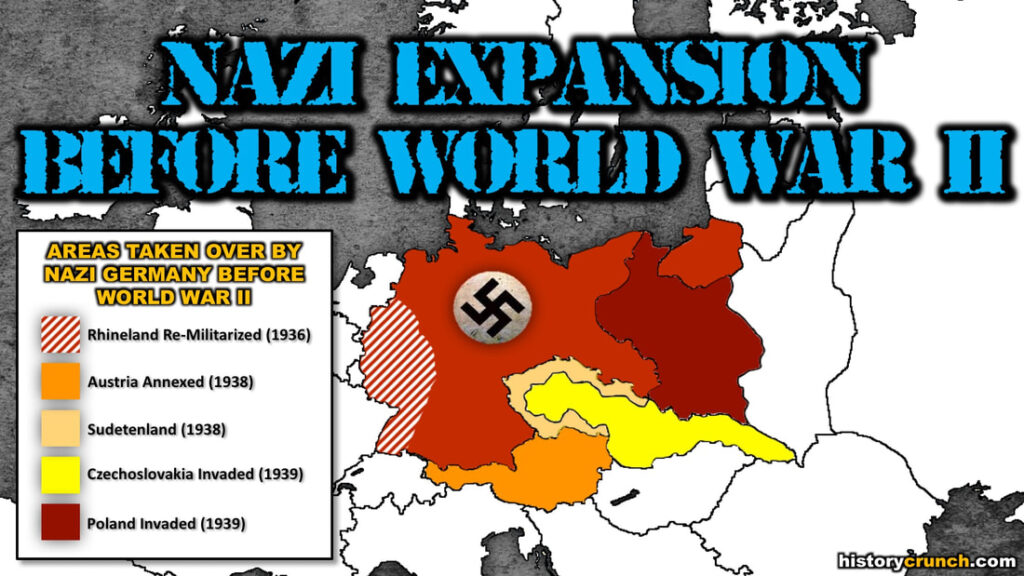
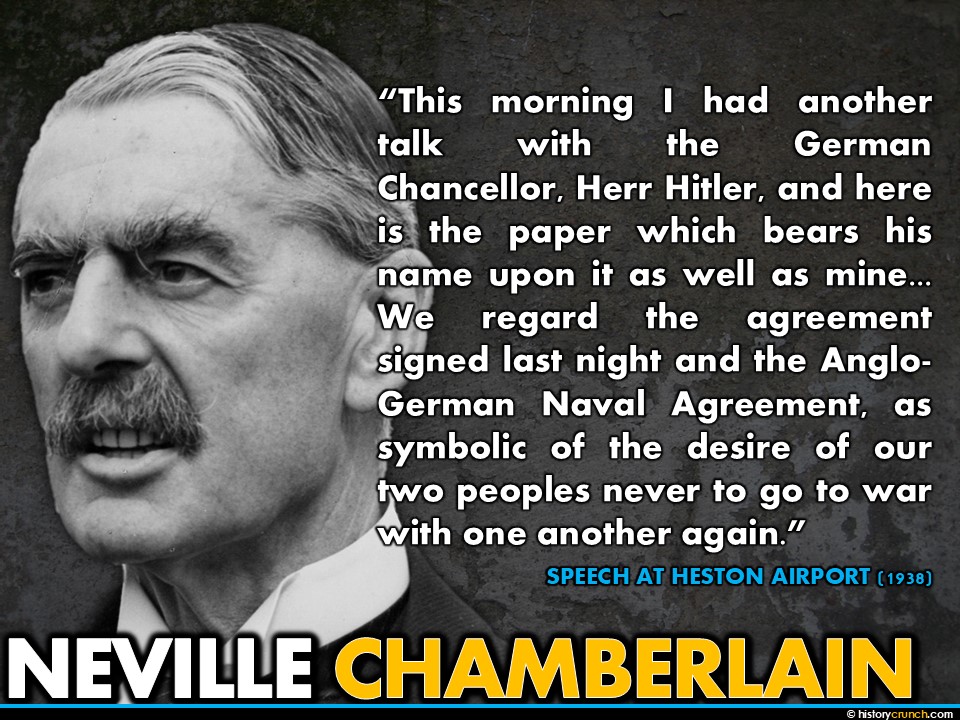
Historians consider the Nazi Germany annexation of Austria to be one of the most significant events in the years before the start of World War II. More specifically, this was the time frame when the foreign policy of appeasement was being practiced by the Western democracies, such as Britain and France. The policy essentially worked by conceding to some of Adolf Hitler’s, the Nazi leader, demands. It was driven by the desire to maintain peace in Europe, especially in relation to the death and destruction caused by the events of World War I. AppeasementA foreign policy of giving in to some of an aggressive leader’s demands in order to avoid war. reached its peak under British Prime Minister Neville Chamberlain, who believed that giving into some of Hitler’s territorial demands would prevent another large-scale war. All of this eventually culminated in the Nazi Germany invasion of Poland in September of 1939, and the outbreak of World War II. As such, historians consider the failure of appeasement as a significant cause of World War II, and the annexation of Austria was one of several examples of the failure of appeasement, alongside: the remilitarization of the Rhineland, the events of the Munich Conference and the occupation of Czechoslovakia.
Another note of importance was the role that culture played in the Nazi Germany annexation of Austria. For instance, Austria and Germany shared a deep cultural, linguistic, and historical connection. After World War I, there was widespread agreement in both countries that the two should be unified. However, the Treaty of Versailles and the Treaty of Saint-Germain both denied the unification of Germany and Austria, as a means to maintain peace in Europe. Furthermore, Adolf Hitler, the fascist dictator of Nazi Germany, was born in Austria in 1889. As such, he personally shared a deep connection with Austria. Finally, during the 1930s, Austrian Nazis, inspired by Hitler’s rise in Germany, actively sought to bring Austria under the control of the Nazi Party.
 FactsthatCrunch
What did Austria and Germany share before 1938, and what kept them separate?
Annexation of Austria by Nazi Germany – Summary
As stated previously, Nazi Germany carried out the annexation of Austria in 1938. More specifically, Hitler officially proclaimed the annexation of Austria on March 13th, 1938. The Treaty of Versailles forbade Germany from uniting with Austria but Hitler, who was born in Austria, wanted to unite all German speaking people under his control. The German annexation of Austria was known as the ‘Anschluss’ which was the Nazi German term for ‘union’ or ‘connection’ in the region.
In order to conquer Austria, Hitler threatened invasion of the Austrian nation-state. For instance, on March 11th, 1938, Hitler issued an ultimatumA final demand where one side warns another that refusal will lead to serious consequences. and demanded the resignation of Austria’s ChancellorThe head of government in Austria or Germany, similar to a prime minister., Kurt von Schuschnigg. Schuschnigg was actively trying to preserve Austrian independence and frustrated Hitler’s attempts to control the region. That same day, Schuschnigg resigned after realizing that the western democracies of Britain and France were not going to intervene and stop the Anschluss. Arthur Seyss-Inquart, a Nazi sympathizer, was hand-picked by Hitler to become the next Austrian Chancellor.
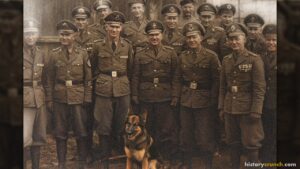
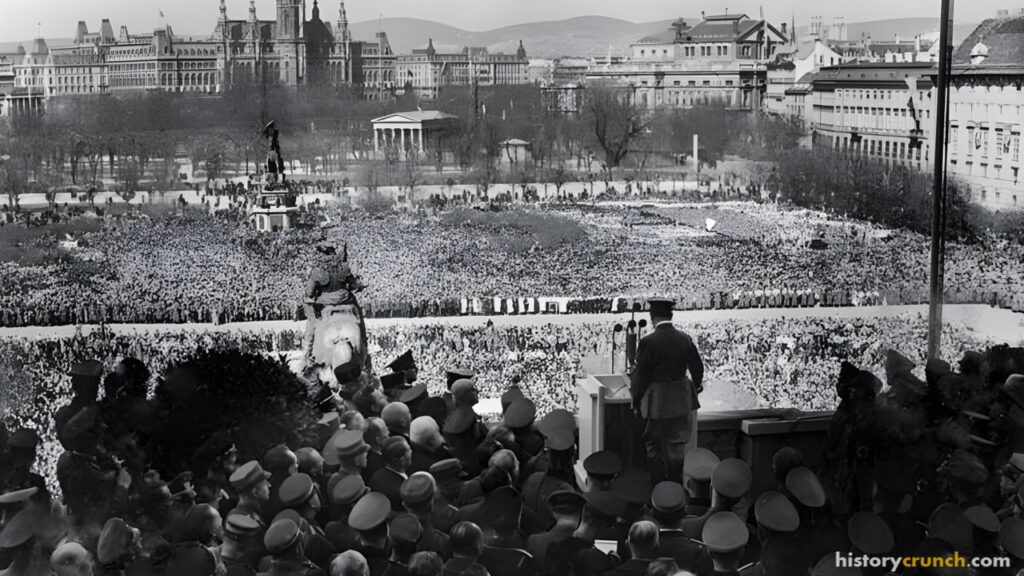
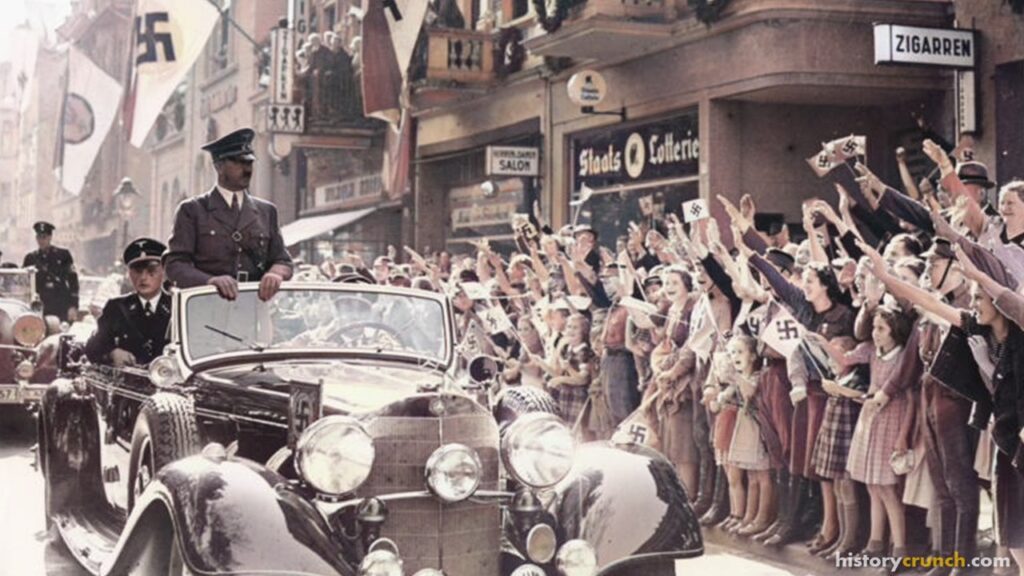
The next day, on March 12th, 1938, Nazi Germany troops crossed the border into Austria under orders from Hitler. They were greeted enthusiastically by many Austrians. In fact, the Nazi regime used the opportunity to photograph the cheering Austrian crowds, as a means of propagandaInformation, images, or media used by a government to shape public opinion in its favor..
After obtaining power the Austrian Nazis ‘invited’ the German forces into the country and the annexation of Austria was complete. Britain and France protested the move by Germany but did not respond in any meaningful way, which furthered Hitler’s belief that the Allied nations would not stop his aggression. In all, the entire annexation of Austria by Nazi Germany, was carried out without a single bullet fired by either side. Hitler had essentially conquered Austria without any bloodshed. Rather, he used fear, repression and propaganda.
FactsthatCrunch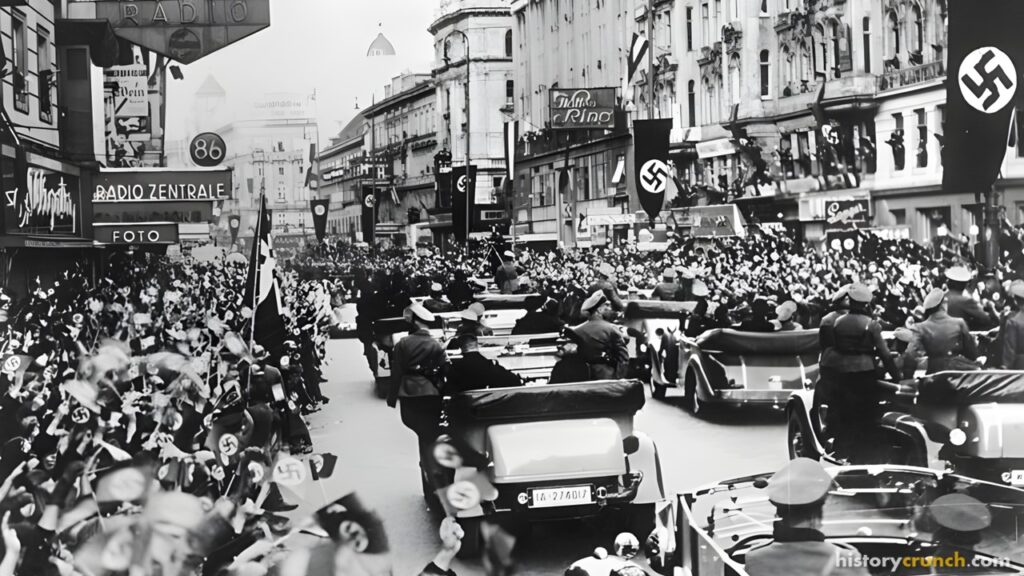
Annexation of Austria by Nazi Germany – Significance
The Nazi Germany annexation of Austria was an incredibly significant event, especially in terms of the outbreak of World War II. For instance, the annexation of Austria was one of several examples of the failure of appeasement, alongside: the remilitarization of the Rhineland, the events of the Munich Conference and the occupation of Czechoslovakia. Furthermore, the unification of Germany and Austria violated the terms of the Treaty of Versailles, but Britain and France took no action to stop Hitler’s aggression. This ultimately reinforced Hitler’s belief that Western democracies would not confront him. As such, the success of the Austrian annexation convinced Hitler he could continue his aggression and led directly to his next moves against Czechoslovakia and the Sudetenland.
Militarily, the annexation proved to be significant for the strength of Nazi Germany in the buildup to World War II. In fact, the annexation gave Nazi Germany control over Austria’s resources, military assets, and strategic geographic position in Europe. Ultimately, this strengthened Hitler’s position in Central Europe and drastically altered the balance of power in Europe.
Another important factor was the impact of the Anschluss on Austria’s Jewish population, which totaled approximately 200,000 people. For instance, Austrian Jews immediately faced persecutionOngoing cruel or unfair treatment of a group of people because of who they are., including forced labor, public humiliation and later deportation to concentration camps as part of the events of the Holocaust.
FactsthatCrunch
Explore World War II · 1939 – 1945
Keep exploring World War II with these History Crunch resources.
Key Vocabulary
Annexation
Appeasement
Ultimatum
Chancellor
Propaganda
Persecution
Remilitarization
Frequently Asked Questions
What was the Anschluss?
The Anschluss was the annexation of Austria by Nazi Germany in March of 1938. The word was the Nazi German term for “union” or “connection.” Hitler used it to describe joining Austria with Germany under his control.
When did Nazi Germany annex Austria?
Hitler officially proclaimed the annexation of Austria on March 13th, 1938. German troops had crossed the border the day before, on March 12th. The pressure began on March 11th, when Hitler demanded that Austria’s chancellor resign.
Why did Hitler want to annex Austria?
Hitler wanted to unite all German speaking people under his control, and Austria shared a deep cultural and linguistic link with Germany. He was also born in Austria in 1889, so he felt a personal connection to it. Gaining Austria added resources and a strong strategic position in Central Europe.
How did the Anschluss relate to appeasement?
The annexation was a clear example of the failure of appeasement by Britain and France. Both nations protested but took no real action to stop Hitler. Their inaction convinced him that the Western democracies would not confront his aggression.
What happened to Austria’s Jewish population after the Anschluss?
Austria’s roughly 200,000 Jews immediately faced persecution after the annexation. This included forced labor, public humiliation, and later deportation to concentration camps. These events became part of the Holocaust.
Was the annexation of Austria violent?
The entire annexation was carried out without a single bullet fired by either side. Hitler used fear, repression, and propaganda instead of force. Many Austrians greeted German troops with cheers, which the Nazis photographed for propaganda.
Cite This Article
To cite this article as a source, use one of the formats below.
MLA: Woida, K.L. “Annexation of Austria by Nazi Germany: A Detailed Summary.” HistoryCrunch, 4 October 2026, https://historycrunch.com/annexation-of-austria-by-nazi-germany/.
APA: Woida, K. L. (2026). Annexation of Austria by Nazi Germany: A Detailed Summary. HistoryCrunch. https://historycrunch.com/annexation-of-austria-by-nazi-germany/
Chicago: Woida, K.L. “Annexation of Austria by Nazi Germany: A Detailed Summary.” HistoryCrunch. October 4, 2026. https://historycrunch.com/annexation-of-austria-by-nazi-germany/
Sources
- Imperial War Museum
- The National WWII Museum
- Gerhard L. Weinberg, A World at Arms.
- Antony Beevor, The Second World War.