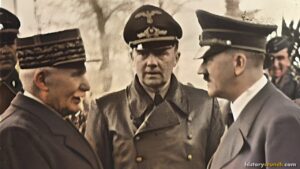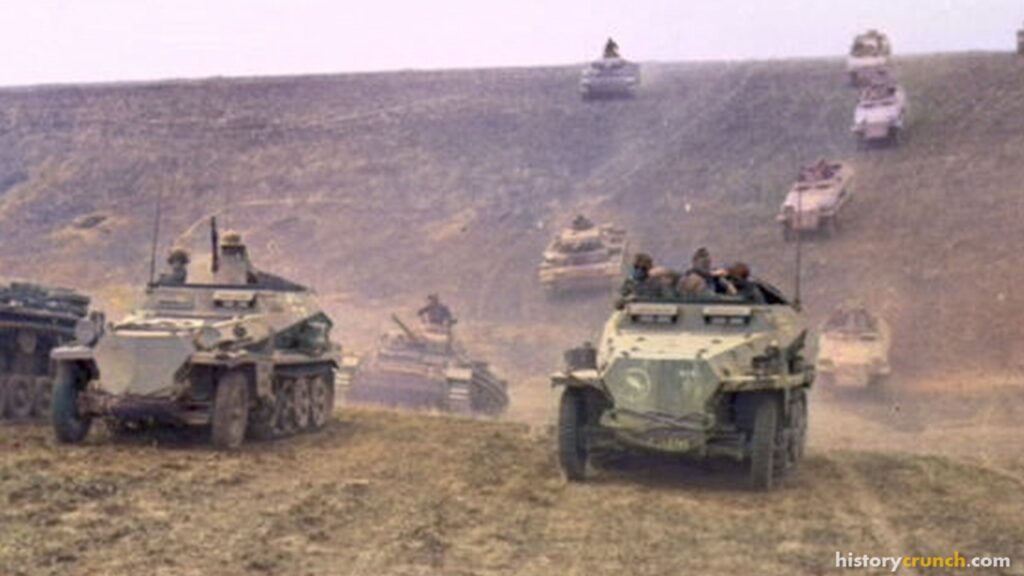
BlitzkriegA German military tactic combining tanks, aircraft, and infantry in rapid, coordinated attacks designed to overwhelm enemies before they could defend. in World War II refers to the speed and efficiency with which the Nazi German forces carried out their attacks. In short, blitzkrieg is a term for ‘lightning war’ which was a German war tactic during World War II that proved effective for the German advances in the early years of the war. It was characterized by rapid, highly mobile attacks that combined air power, infantry, and armored units. Blitzkrieg aimed to surprise and overwhelm the enemy before they could effectively mobilize a defense. Nazi Germany used blitzkrieg tactics with a great deal of success in battles such as the Nazi German invasion of Poland and the Battle of France.
 FactsthatCrunch
Blitzkrieg, meaning 'lightning war,' was the German tactic that combined tanks, aircraft, and infantry into one fast-moving attack to break through enemy lines before defenders could react.
Blitzkrieg in World War II – Background
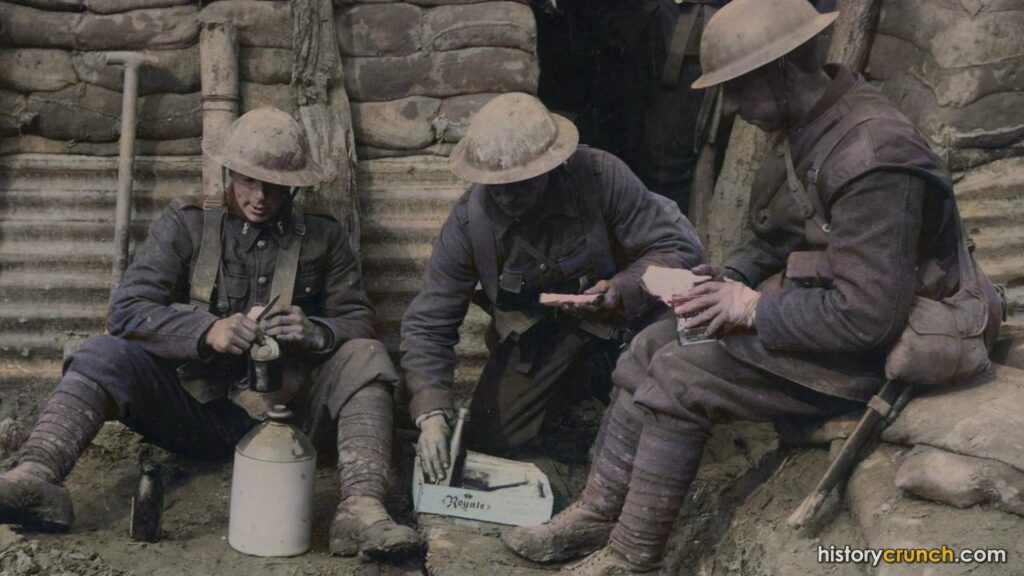
In order to understand the strategy of blitzkrieg, it’s first important to discuss the reasons for its development. World War I occurred from 1914 to 1918 and was a devastating conflict for the people of Europe. For instance, World War I is often characterized by the trench warfare that occurred along the Western Front. In general, trench warfareA style of fighting where opposing armies dig long ditches facing each other, leading to a deadlock neither side can break. involved two opposing armies digging trenches in the Earth that faced each other. The armies of World War I did this in order to avoid gunfire from the enemy forces and to await their own orders to attack ‘over the top’ of the trench. This ultimately led to a stalemateA situation in a conflict where neither side can defeat the other and the fighting stops making progress. between the opposing armies. As such, during the course of World War I, the two opposing sides were unable to push through and defeat the other. This led to the development of new strategies, since most military leaders sought to avoid the stalemate like conditions that existed in the First World War.
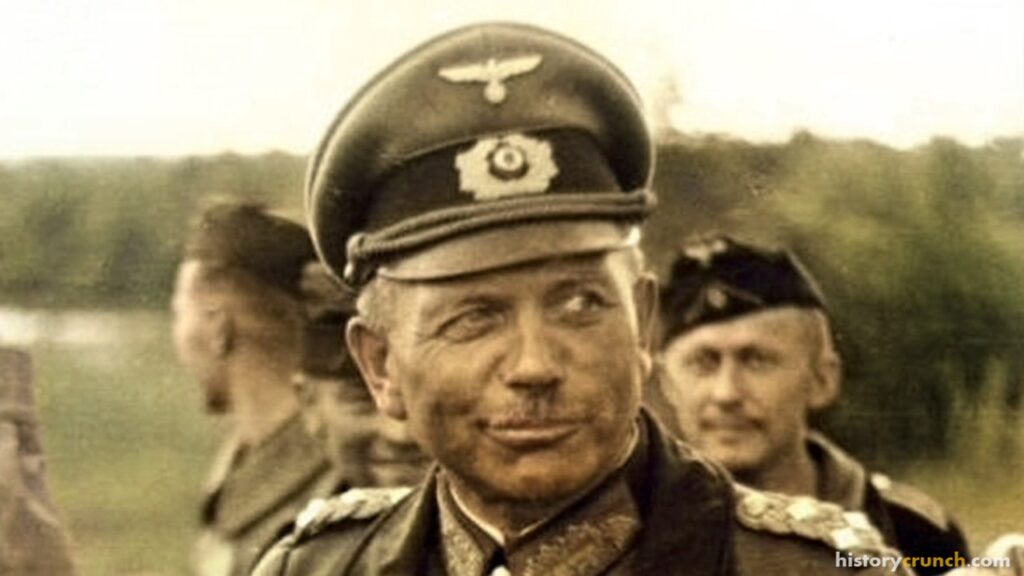
In particular, Nazi German military thinkers recognized the need for faster, more decisive forms of combat. For instance, military theorists such as Heinz Guderian emphasized mechanizationThe use of machines, especially tanks and motorized vehicles, to replace foot soldiers and horses in combat movement., mobility, and combined armsA military approach that uses tanks, aircraft, and infantry together at the same time to attack an enemy. tactics. The concept relied on three main factors. First, tanks were used for fast, armored breakthroughs. Second, motorized infantrySoldiers transported by vehicles so they can move quickly and hold ground taken by advancing tanks. were then used to hold territorial gains. Finally, air support was used to disrupt enemy defenses and communications. When all three were combined, it created a mass of armed units that moved with incredible speed and efficiency. This was the basis for Nazi German blitzkrieg tactics during World War II.
Blitzkrieg in World War II – Summary
Blitzkrieg in World War II was characterized by a few factors. First, were the elements of speed and surprise, which were used to quickly overwhelm the enemy forces. As such, Nazi Germany tried to carry out attacks that were launched quickly and often without warning.
Second, was the combination of forces used to advance and break through the enemy frontlines. For instance, blitzkrieg involved advancing armies using fast moving armor divisions supported by aircraft bombing runs. The advancing tanks and planes would overwhelm the enemy by moving at an incredible pace and encircling enemy troops, while equally quick bombing runs would suppress and pummel the enemy soldiers. The enemy forces would become confused and overrun as tanks broke through the front lines and circled back on them. Next, the advancing forces would support the tanks and aircraft by having soldiers move in and capture the territory from the now destroyed or retreating enemy.
During World War II, blitzkrieg tactics were used effectively during several significant military campaigns. For instance, the Nazi German invasion of Poland in 1939 is considered to be the first use of blitzkrieg. Nazi German forces crushed Polish defenses within just five weeks through the use of coordinated air and ground attacks. Another example was the events of the Battle of France. Nazi German forces bypassed the Maginot Line by moving through Belgium and the Ardennes Forest, which led to the Fall of France in just six weeks.
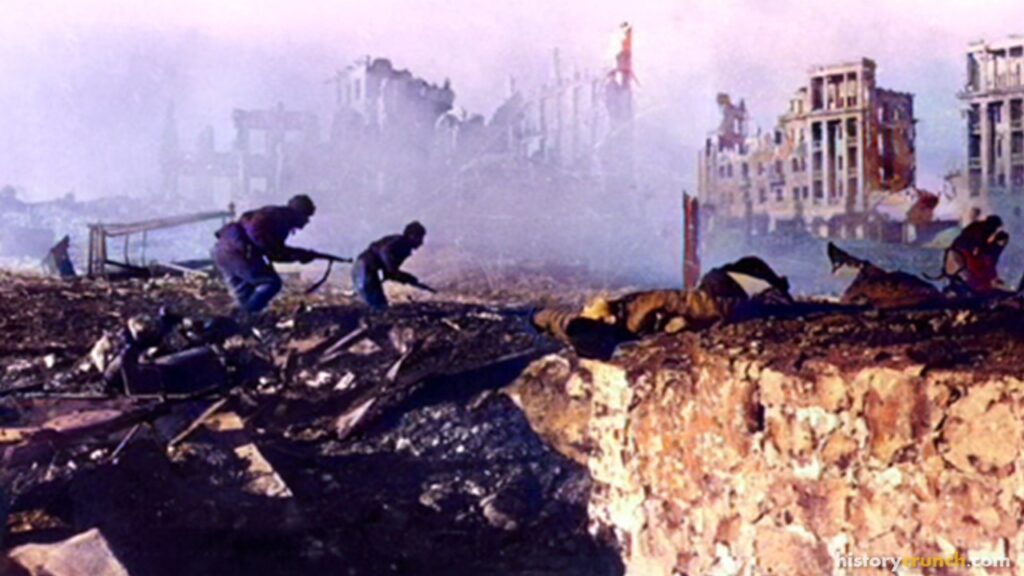
In both cases, German forces were able to advance so quickly that Polish and French forces were surprised and overwhelmed. Blitzkrieg was so effective that Germany quickly defeated both the countries in a matter of weeks. In general, blitzkrieg tactics would be responsible for much of the early advances throughout the European Theater that Nazi Germany made in the early years of World War II. In fact, blitzkrieg tactics were mostly successful until the later stages of the Nazi German invasion of the Soviet Union, which was codenamed ‘Operation Barbarossa‘. While blitzkrieg tactics worked in the early stages of the Nazi invasion of the Soviet Union, it ultimately failed during the Battle of Stalingrad. In fact, the intense street fighting that occurred in Stalingrad from 1942 until 1943 slowed the pace of warfare. This caused the Nazi blitzkrieg tactics to falter, as the strategy worked best in large open spaces and not in close quarters. Historians consider the failure of the Nazis in the Battle of Stalingrad to be a major turning point of World War II.
 FactsthatCrunch
Trench warfare locked World War I into a nearly static stalemate where territory was measured in yards. Blitzkrieg was developed partly in response to that experience, using speed and coordination to prevent a static front from forming at all.
Blitzkrieg in World War II – Significance
Blitzkrieg was a significant aspect of World War II and an important military strategy of Nazi Germany. As stated previously, it fundamentally changed the way wars were fought. For instance, World War I saw the establishment of trench warfare which led to stalemate conditions. Where, blitzkrieg in World War II was mechanized, fast-paced and based on a combined effort of units. Ultimately, blitzkrieg proved so successful that it allowed Nazi Germany to conquer much of Europe within the first two years of World War II.
Why did blitzkrieg tactics fail at the Battle of Stalingrad after working so well across Western Europe?
Key Vocabulary
Blitzkrieg
Trench warfare
Stalemate
Mechanization
Combined arms
Motorized infantry
Operation Barbarossa
Frequently Asked Questions
What does blitzkrieg mean?
Blitzkrieg is a German word that means “lightning war.” It described the speed and power of Nazi German attacks in the early years of World War II. The goal was to strike fast and overwhelm the enemy before they could set up a strong defense.
How did blitzkrieg tactics work?
Blitzkrieg combined three forces that worked together at high speed. Tanks broke through enemy lines, aircraft bombed defenses and communications, and infantry moved in to hold the captured land. This mix of air power, armor, and foot soldiers confused and surrounded enemy troops.
Why was blitzkrieg developed after World War I?
Blitzkrieg was developed to avoid the stalemate of trench warfare seen in World War I. During that war, armies dug trenches and could not push through each other for years. German military thinkers like Heinz Guderian wanted faster, more mobile combat that used machines to break the deadlock.
Where was blitzkrieg used successfully?
Blitzkrieg was first used in the Nazi German invasion of Poland in 1939, which fell in about five weeks. It worked again during the Battle of France, where German forces moved through Belgium and the Ardennes Forest. France fell in just six weeks, which showed how fast the tactic could be.
Why did blitzkrieg fail at Stalingrad?
Blitzkrieg failed at Stalingrad because the tactic needed large open spaces to work well. The intense street fighting from 1942 to 1943 slowed the German advance to a crawl. Many historians view the German defeat at Stalingrad as a major turning point of World War II.
Cite This Article
To cite this article as a source, use one of the formats below.
MLA: Beck, Elias. “Blitzkrieg in World War II: A Detailed Summary.” HistoryCrunch, 1 October 2026, https://historycrunch.com/blitzkrieg-in-world-war-ii/.
APA: Beck, E. (2026). Blitzkrieg in World War II: A Detailed Summary. HistoryCrunch. https://historycrunch.com/blitzkrieg-in-world-war-ii/
Chicago: Beck, Elias. “Blitzkrieg in World War II: A Detailed Summary.” HistoryCrunch. October 1, 2026. https://historycrunch.com/blitzkrieg-in-world-war-ii/
Sources
- Antony Beevor, The Second World War.
- Gerhard L. Weinberg, A World at Arms.
- Max Hastings, Inferno / All Hell Let Loose.
- The National WWII Museum