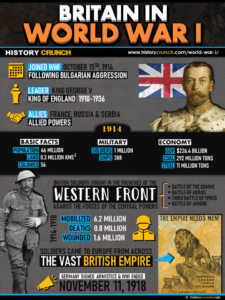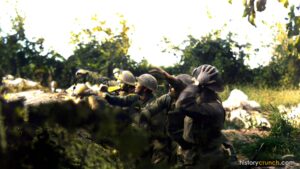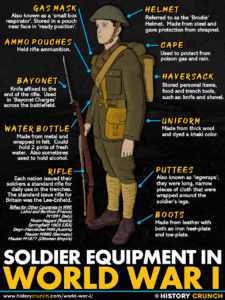
The Western Front of World War I was the line of fighting that occurred in the trenches that stretched through parts of Belgium and northern France. World War I was a global conflict that was fought on several fronts, including the Western Front, Eastern Front and Italian (Alpine) Front. The Western Front developed following the failure of the German plan of attack (Schlieffen Plan) at the beginning of World War I, which forced Germany to fight a two-front warFighting enemies on opposite sides at the same time, forcing a country to split its military forces. against the Allied Powers. The Western Front was the major scene of fighting between Germany and the Allied Powers of France and Britain. Other Allied forces that participated on the Western Front included Australia, Belgium, Canada, United States, and New Zealand.
 FactsthatCrunch
On Christmas 1914, soldiers along parts of the Western Front stopped fighting, climbed out of their trenches, and met in No Man’s Land.
British and German soldiers sang carols, swapped small gifts such as food and tobacco, and buried their dead. Commanders on both sides disapproved, and the truce was never repeated on the same scale in later years of the war.
Formation of the Western Front of World War I
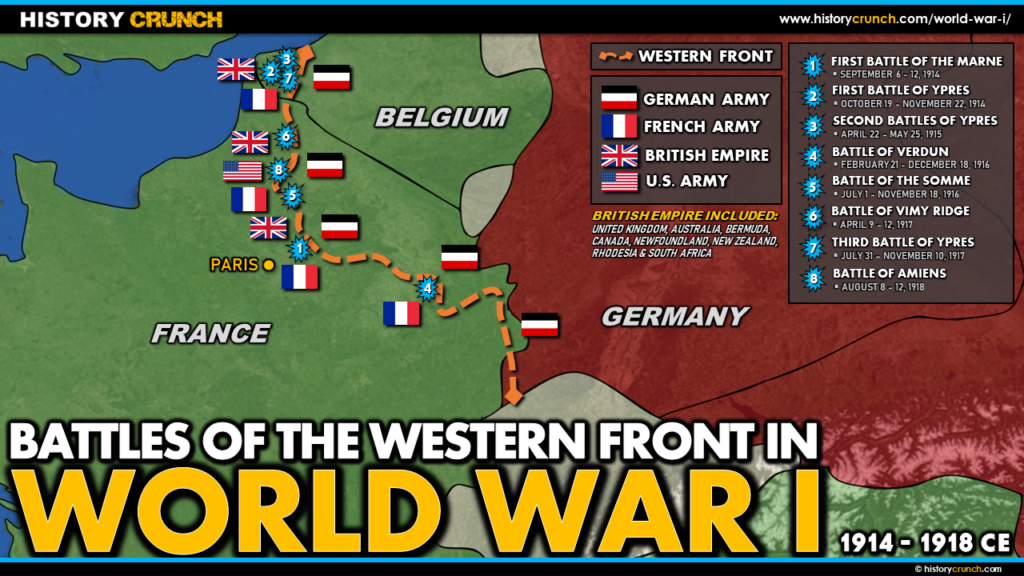
The line of trenches that became the Western Front stretched from the English Channel in the north to the Swiss border in the south. In total, the trenches were about 475 miles long (764 km) and ran through much of Belgium and northeastern France. With that said, the line of trenches was broken up in parts and not a continuous line. Regardless, the trenches of the Western Front were created following the failure of the Schlieffen PlanGermany’s strategy at the start of World War I to defeat France quickly before turning to fight Russia in the east..
The Schlieffen Plan was the German plan of attack at the beginning of World War I in 1914. Since Germany was facing both France and Russia in World War I, Germany had to deal with a two-front war and the possibility of its total armed forces being split to fight on both its western and eastern borders. The Schlieffen Plan was Germany’s response to this problem. In fact, the basis of the Schlieffen Plan was that Germany was going to attack France first, and then turn its attention to Russia next.
In reality, the Schlieffen Plan failed to deliver the result that the Germans hoped for. The overall plan failed for several different reasons. First, Germany did not plan on the British forces (British Expeditionary Force) arriving in time to help the Belgian forces defend against the German offensive. This slowed the German push towards France and allowed France to prepare for war in the north. When the Germans finally did push into France they failed to capture Paris and were stopped at the First Battle of the Marne. At the same time, Russia was able to mobilize its war effort in the east in less than two weeks, and forced Germany to begin to fight a two-front war.
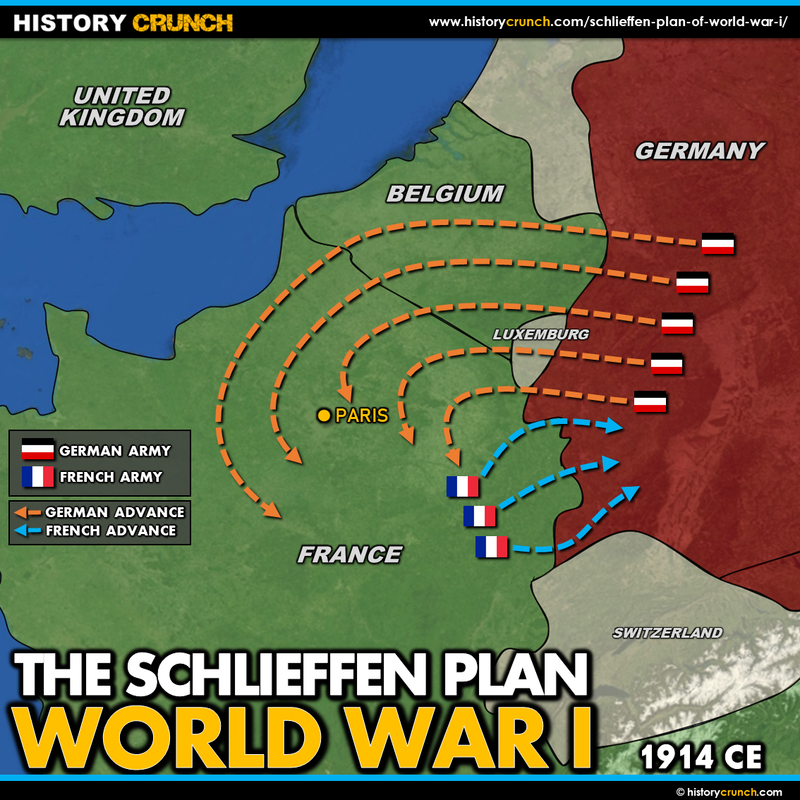
In the end, the Schlieffen Plan failed to bring a quick end to World War I and instead led to trench warfare in northern France. For instance, following the First Battle of the Marne in 1914, the Allies raced against Germany to ‘outflankTo go around the side of an enemy’s position to attack from an unexpected angle.’ the other in an event known as the ‘Race to the SeaThe September–October 1914 competition where German and Allied forces each rushed north trying to get around the other’s side until they hit the North Sea.’.
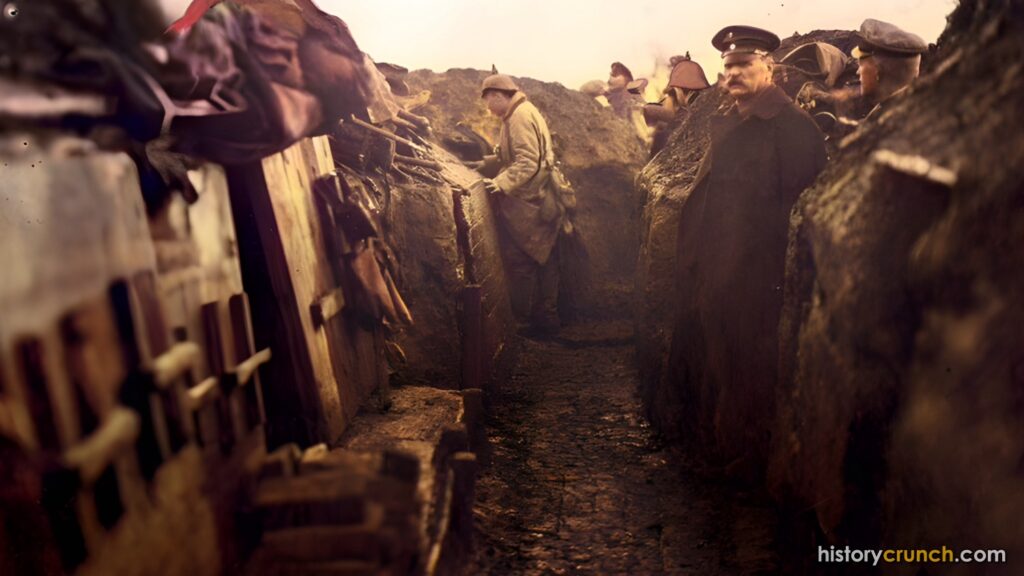
The ‘Race to the Sea’ occurred throughout September and October of 1914. The German Army was successfully stopped at the First Battle of the Marne in early September and each side raced north in an attempt to flank the other. British and French forces countered the German push north throughout September and October until the two sides reached the North Sea in Belgium on October 19th. What resulted was a line of trenches that extended throughout much of northern Belgium and France. It was along this line of trenches that some of the most significant battles of World War I took place. The Western Front was established and remained a relative stalemateA situation in which neither side can gain an advantage or make progress against the other. for the rest of the war.
Battles of the Western Front of World War I
The Western Front was the site of some of the most significant battles of World War I. In fact, the Western Front was the most famous line of fighting in the war, and saw fighting from 1914 until 1918. For example, the most significant battles of the Western Front are included in the list below. In these battles, the Allied Powers (Britain, France, United States, Canada, Australia, New Zealand, Belgium, etc.) faced off against the German Army. Click on the links below to learn more information about each battle.
- Battle of the Frontiers
- First Battle of the Marne
- First Battle of Ypres
- Second Battle of Ypres
- Battle of the Somme
- Battle of Verdun
- Battle of Vimy Ridge
- Battle of Passchendaele
- Battle of Château-Thierry
- Battle of Belleau Wood
- Battle of Saint-Mihiel
- Meuse–Argonne Offensive
- Hundred Days Offensive
 FactsthatCrunch
In September 1914, French and British troops counterattacked along the Marne River, east of Paris, and forced the German armies to retreat to the Aisne River, where both sides began to dig trenches.
German armies sweeping toward Paris
Trench stalemate across the Western Front
Trenches of the Western Front of World War I
As stated above, one of the key features of the Western Front was the line of trenches that stretched across Belgium and northeastern France. The image of these trenches, and the experience for the soldiers in them, has become characteristic of both World War I and the Western Front. As such, the life for soldiers in the trenches of the Western Front is an important topic.
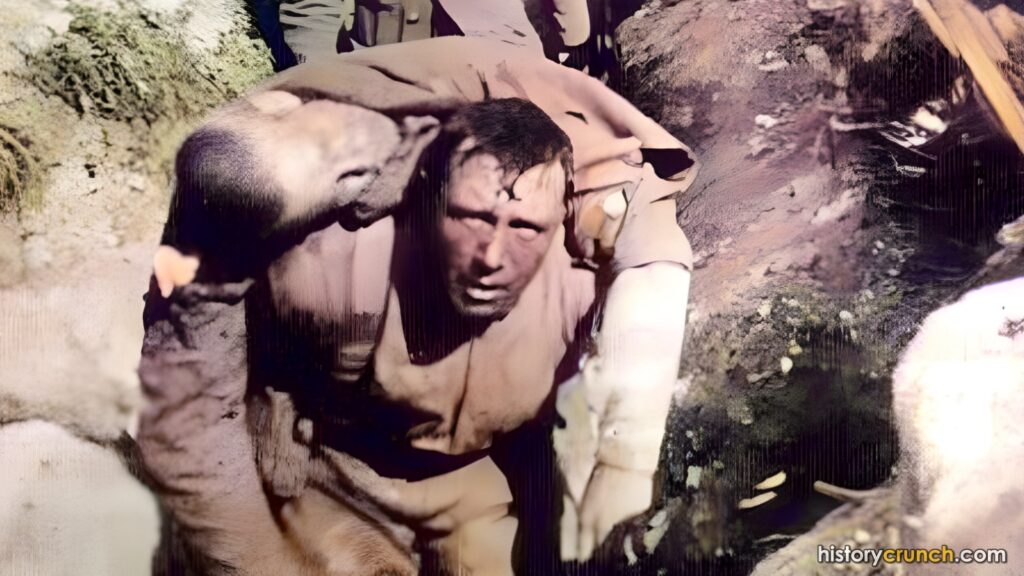
In all, the trenches of the Western Front were terrible for the soldiers due to the harsh conditions present. For instance, there were several main aspects of the trenches that made life for the soldiers so difficult. Trench warfare was a strategy that heavily favored the defenders and helped lead to the massive death tolls caused during World War I. In fact, the land between the frontline trenches was known as ‘No Man’s Land‘ symbolizing the likelihood of advancing soldiers dying in this region. Soldiers attempting to cross ‘No Man’s Land’ were met with barbed wire, mines, artillery fire, enemy machine gun fire and the mud of northern France.
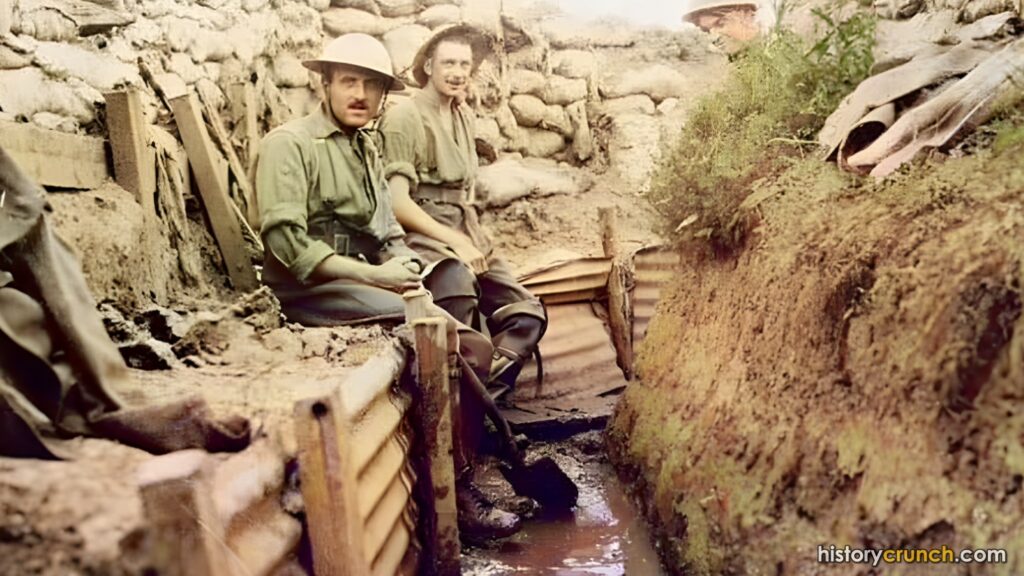
The mud of ‘No Man’s Land’ made crossing the stretch of land almost impossible at times. Artillery bombardments had torn up the land and destroyed all trees, grass and vegetation. Rain turned the dead landscape into a thick layer of mud that was sometimes up to the knees of the soldiers and sometimes deep enough that soldiers could become stuck and drown.
Life in the trenches of the Western Front was dangerous for many reasons. The more obvious dangers included enemy fire, poisonous gas attacks and artillery shelling. While the trenches offered general protection from enemy fire and artillery shelling, they could also be extremely dangerous places. For example, the trenches offered no protection from artillery shelling when the shell made a direct impact. As well, some soldiers were known to be buried alive when an artillery shell exploded beside them and covered them in large amounts of mud and dirt that the explosion lifted into the air. The trenches also proved to be deadly when the soldiers experienced a poisonous gas attack.
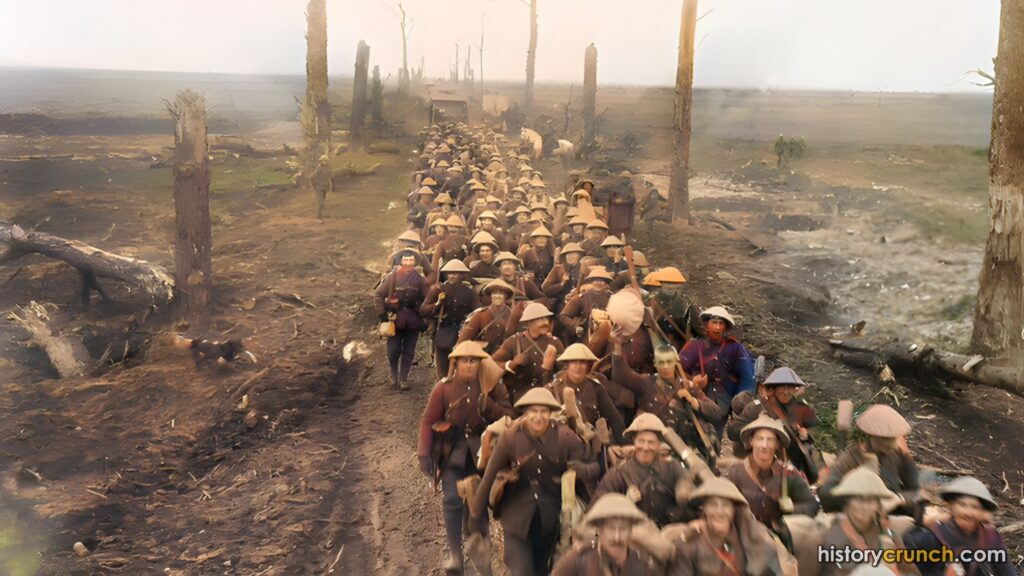 FactsthatCrunch
When Allied commanders ordered infantry to advance across No Man's Land, soldiers were exposed to overlapping fields of machine gun fire, barbed wire, mines, and deep mud with almost no cover.
Significance of the Western Front of World War I
The Western Front was incredibly significant in the overall events of World War I. For instance, the Western Front was the most active front of World War I and involved the most famous battles of the war. The fighting along the Western Front occurred from August 4th, 1914 until November 11th, 1918. During this time, millions of soldiers participated for both the Allied Powers and the Central Powers in the battles, which led to many casualtiesSoldiers lost to a military force through death, wounds, capture, or other causes during fighting. of the war. For example, historians estimate that approximately 15.9 million Allied soldiers participated in the fighting of the Western Front, while the Central Powers had nearly 13.3 million.
The brutality of the fighting on the Western Front led to the Allied Powers suffering 7.5 million casualties and the Central Powers suffering 5.5 million casualties. There were also numerous civilian losses on both sides due to the realities of war. France suffered the most losses for the Allies, while Germany suffered the most losses for the Central Powers.
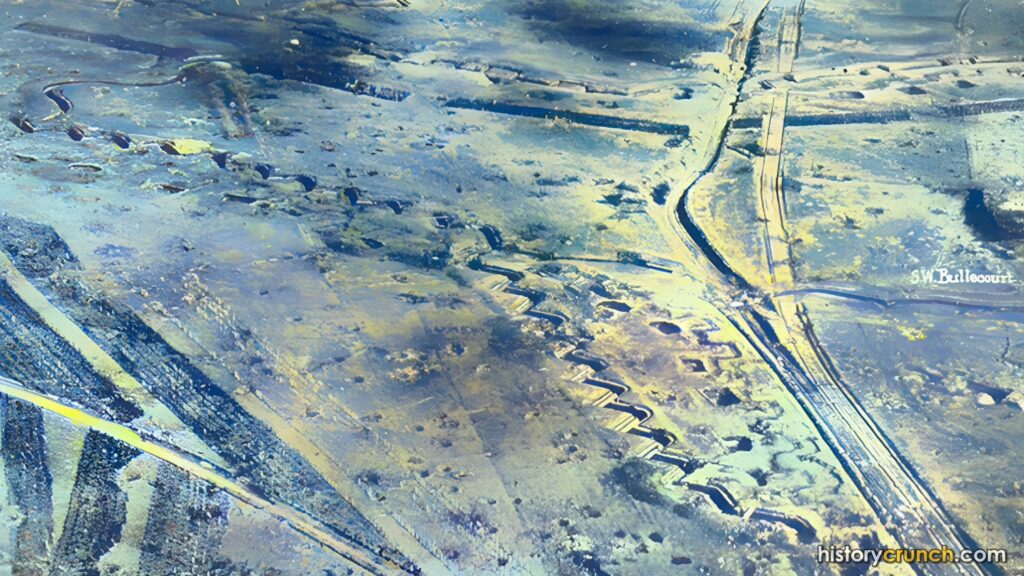
The Western Front was also significant due to the damage it caused both physically and economically. For instance, the trenches of the Western Front stretched through fields, towns and businesses in Belgium, northeastern France, and parts of Germany. The nature of trench warfare meant that much of the surrounding area was destroyed and left farms, rail networks and roads destroyed. As such, the war on the Western Front had a devastating impact on the lives of people living in the region. Not only did this impact the towns and people in the area, but it negatively impacted the economic development. For instance, farms and businesses were limited in their ability to produce goods and transport them to market.
As such, when the war was over, the countries of the region had much redevelopment to carry out. This was expensive and cost the nations massively. In all, the fighting of the Western Front in World War I was important and had a profound impact on the lives of people during and after the war.
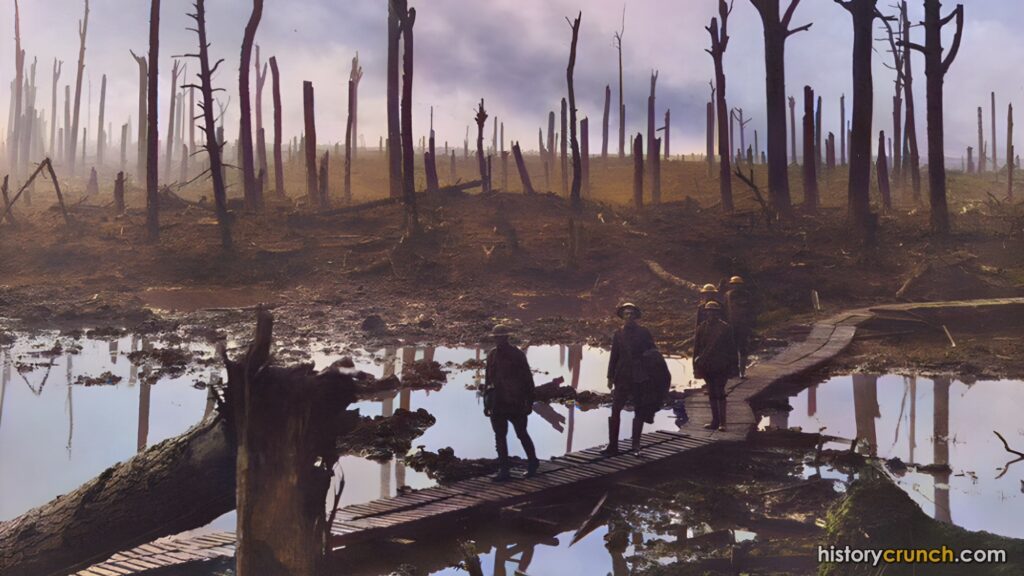 FactsthatCrunch
During the war, the Western Front turned the towns, farms and forests of Belgium and northeastern France into a wasteland of trenches, barbed wire and shell craters. Whole villages were destroyed and never rebuilt.
Today the old front line is dotted with war cemeteries and memorials. At the Menin Gate in Ypres, Belgium, buglers have sounded the Last Post every evening since 1928, except during the German occupation in World War II.
The land where the Western Front ran is still a place where people come to remember those who died there.
World War I timeline · 1914 – 1918
Key Vocabulary
Schlieffen Plan
Two-front war
Outflank
Race to the Sea
No Man’s Land
Stalemate
Casualties
Frequently Asked Questions
Where was the Western Front located?
The Western Front ran through Belgium and northeastern France during World War I. Its line of trenches stretched from the English Channel in the north to the Swiss border in the south. In total, the trenches ran about 475 miles (764 km), though they were broken up in some places.
Why did the Western Front turn into trench warfare?
Trench warfare began after the German Schlieffen Plan failed in 1914. Germany hoped to beat France quickly, but the attack stalled at the First Battle of the Marne. Both sides then raced north to outflank each other, which created a long line of trenches instead of a fast victory.
What was ‘No Man’s Land’?
No Man’s Land was the open ground between the enemy trenches. Soldiers who tried to cross it faced barbed wire, mines, artillery fire, and machine gun fire. Artillery had torn up the land, and rain turned it into thick mud where soldiers could get stuck or even drown.
What were the major battles of the Western Front?
Some of the most famous battles of World War I took place on the Western Front. These include the First Battle of the Marne, the Battle of the Somme, the Battle of Verdun, and the Battle of Passchendaele. Later battles such as the Meuse-Argonne Offensive and the Hundred Days Offensive helped end the war.
How many casualties happened on the Western Front?
The fighting caused millions of casualties on both sides. Historians estimate the Allied Powers suffered about 7.5 million casualties, while the Central Powers suffered about 5.5 million. France lost the most among the Allies, and Germany lost the most among the Central Powers.
When did the fighting on the Western Front take place?
The fighting on the Western Front lasted from August 4th, 1914 until November 11th, 1918. It began soon after the war started and ended with the armistice that stopped the fighting. For most of that time, the front stayed a relative stalemate with little land changing hands.
Cite This Article
To cite this article as a source, use one of the formats below.
MLA: Beck, Elias. “Western Front of World War I: A Detailed Summary.” HistoryCrunch, 29 September 2026, https://historycrunch.com/western-front-of-world-war-i/.
APA: Beck, E. (2026). Western Front of World War I: A Detailed Summary. HistoryCrunch. https://historycrunch.com/western-front-of-world-war-i/
Chicago: Beck, Elias. “Western Front of World War I: A Detailed Summary.” HistoryCrunch. September 29, 2026. https://historycrunch.com/western-front-of-world-war-i/
Sources
- John Keegan, The First World War.
- Fordham Modern History Sourcebook
- Hew Strachan, The First World War.