The Cuban Revolution was an armed uprising led by Fidel Castro that overthrew the military dictatorship of Fulgencio Batista on January 1st, 1959. It brought a communist government to power in Cuba, just 90 miles from the coast of the United States. The revolution had its roots in years of political corruption, poverty, and resentment of American influence in Cuba. It began with a failed military attack in 1953 and ended six years later with Batista’s government collapsing almost overnight. After taking power, Castro aligned Cuba with the Soviet Union, turning it into one of the most important flashpoints of the Cold War and triggering a decades-long conflict with the United States that included an economic embargoAn official ban on trade with a country, used as an economic and political punishment., a failed invasion, and the Cuban Missile Crisis of 1962.
 FactsthatCrunch
How did the Cuban Revolution unfold from the first attack in 1953 to the fall of Batista?
What Was the Cold War?
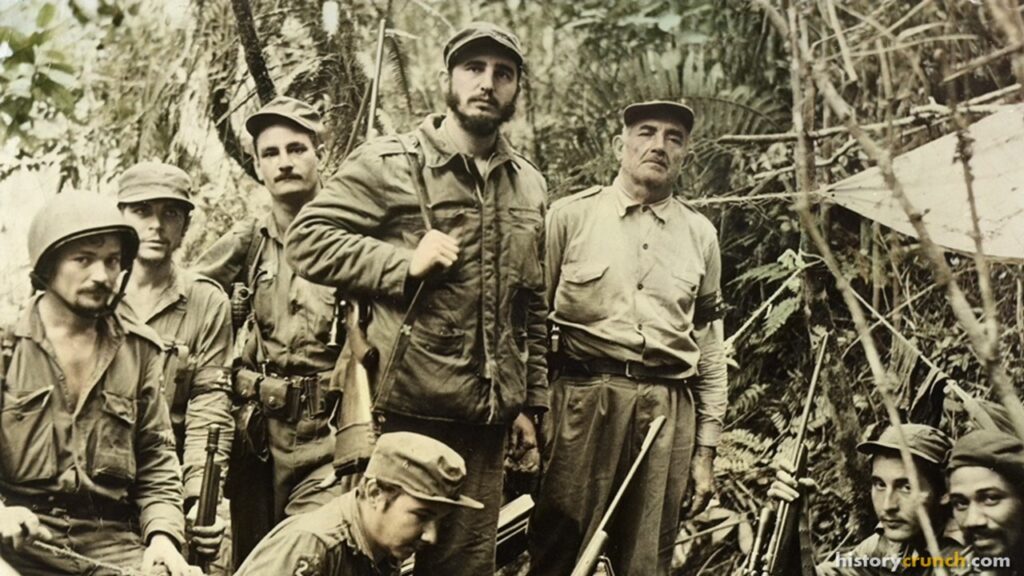
The Cold War was a period of political tension and rivalry between the United States and the Soviet Union that lasted from approximately 1947 to 1991. The two superpowers competed for global influence without fighting each other directly, instead supporting opposing sides in conflicts around the world. Cuba became one of the most important Cold War battlegrounds when Fidel Castro’s revolutionary government aligned with the Soviet Union in the early 1960s, placing a communist state within striking distance of the American mainland.
Cuban Revolution – Background and Causes
Cuba had a long history of political instability and foreign influence before the revolution. After winning independence from Spain following the Spanish-American War of 1898, Cuba became a republic in 1902. However, the United States maintained significant influence over Cuban affairs and had the right to intervene militarily under a provision known as the Platt Amendment. American businesses owned large portions of Cuba’s sugar plantations, utilities, and industries. This heavy American presence was deeply resented by many Cubans who felt that their country was not truly independent.
Cuba’s political history was also marked by corruption and instability. Several governments came and went in the decades following independence, and the country experienced repeated periods of economic difficulty. Fulgencio Batista was a former army sergeant who first came to power in 1933 and served as president from 1940 to 1944. After his chosen candidate lost the 1944 election, he left Cuba. He returned in March of 1952 and seized power in a military coupA sudden, illegal seizure of a government by the military, cutting off normal political processes., canceling planned elections and establishing a military dictatorship. Batista closed Congress and concentrated power in his own hands, governing through a combination of corruption, violence, and the suppression of political opposition.
Batista’s government was deeply corrupt and relied heavily on the support of the United States and wealthy Cuban landowners and businessmen. His secret police used torture and terror to suppress opposition. Unemployment was a serious problem, particularly among young people, and the gap between the wealthy and the poor was enormous. In the countryside, peasants worked on large sugar plantations owned by foreign companies under harsh conditions. By the mid-1950s, opposition to Batista had spread across Cuban society, from students and intellectuals to workers and rural peasants.
FactsthatCrunchCuban Revolution – Fidel Castro and the 26th of July Movement
The most important leader of the revolution was Fidel Castro, a young Cuban lawyer who had been planning to run for Congress when Batista’s coup canceled the elections. Castro decided that legal means were not sufficient to challenge Batista and turned to armed resistance. On July 26th, 1953, he led an armed assault on the Moncada Barracks, a major Cuban military installation in the city of Santiago de Cuba, with a group of around 160 men. The attack was a disaster. Government forces were better prepared than Castro had expected. Most of his men were killed or captured, and Castro himself was arrested and imprisoned.
At his trial, Castro gave a two-hour speech defending his actions that won him national fame. He ended the speech with the famous words that history will absolve me. He was sentenced to 15 years in prison but was released in May of 1955 after Batista, under international pressure, granted a general political amnestyAn official pardon given by a government, releasing prisoners without punishment.. Castro left Cuba for Mexico, where he organized a new revolutionary movement that he named the 26th of July Movement, after the date of the failed Moncada attack.
In Mexico, Castro was joined by his brother Raul Castro and by an Argentine revolutionary doctor named Ernesto Che Guevara. Guevara would become one of the most important military commanders of the revolution and one of the most iconic figures of 20th-century revolutionary politics. In November of 1956, Castro and approximately 82 men sailed from Mexico to Cuba aboard a small yacht called the Granma. Government forces were waiting for them. The landing force was ambushed and most of the men were killed. Only around 20 survivors, including Castro, Raul, and Guevara, escaped into the Sierra Maestra mountains in eastern Cuba.
FactsthatCrunchCondemn me. It does not matter. History will absolve me.
Fidel Castro · Courtroom, Santiago de Cuba · October 16th, 1953
Fidel Castro spoke these closing words at his own trial after leading the failed armed attack on the Moncada Barracks in Santiago de Cuba on July 26th, 1953. Acting as his own defense attorney, he turned his two-hour speech into an attack on the Batista dictatorship, and the court sentenced him to 15 years in prison. The speech won him national fame and later became the manifesto of his 26th of July Movement.
Cuban Revolution – The Guerrilla Campaign
From their base in the Sierra Maestra mountains, the survivors of the Granma landing rebuilt the 26th of July Movement into an effective guerrillaA fighter who uses hit-and-run raids, ambushes, and sabotage rather than open battlefield warfare. force. Castro proved a skilled guerrilla commander. He attracted new recruits from the local peasant population, who were sympathetic to the revolution and provided food, shelter, and intelligence. The guerrillas launched raids on government military posts, ambushed patrols, and gradually expanded their control over the remote mountain regions of eastern Cuba.
The guerrilla campaign was accompanied by a broader political strategy. Castro gave interviews to foreign journalists, most notably a famous interview with the American reporter Herbert Matthews of the New York Times in February of 1957, which was published widely and introduced the revolutionary leader to international audiences. The interview helped build Castro’s image as a romantic and idealistic rebel fighting against a corrupt dictatorship, generating sympathy in the United States and elsewhere.
As the guerrilla campaign continued, Batista’s government became increasingly discredited. Corruption was rampant. His forces responded to the insurgencyAn armed rebellion by a group fighting against an established government using irregular tactics. with mass arrests, torture, and executions that alienated the population further. In fact, the brutality of Batista’s methods drove more Cubans to support Castro rather than fewer. Urban opposition groups connected to the 26th of July Movement carried out sabotage and assassinations in Havana and other cities. By 1958, opposition to Batista had spread so widely that even the United States, which had previously supported him, began withdrawing its backing.
FactsthatCrunchThe Granma landed 82 fighters on Cuba's coast in November 1956, but only around 20 survived the ambush waiting for them, meaning the entire Cuban Revolution was rebuilt from fewer people than fill a typical classroom.
Government forces were ready and waiting when the Granma reached Cuba. The landing force was ambushed almost immediately, and most fighters were killed or captured within days. The roughly 20 survivors, including Fidel Castro, Raul Castro, and Ernesto Che Guevara, fled into the Sierra Maestra mountains and used that tiny group as the foundation of a guerrilla army that toppled a government three years later.
Cuban Revolution – The Final Offensive
By late 1958, the revolution was entering its final phase. Castro launched a major offensive from the Sierra Maestra, sending columns of guerrilla fighters westward across the island toward Havana. Che Guevara commanded one of the most important of these columns. In December of 1958, Guevara’s forces captured the city of Santa Clara in central Cuba after a dramatic battle in which they derailed and captured an armored train carrying government troops and weapons. The fall of Santa Clara was a decisive blow to Batista’s government.
Batista, seeing that his position was hopeless, fled Cuba in the early hours of January 1st, 1959, boarding a plane with family members and close supporters and leaving for the Dominican Republic. He lived in exile in Portugal and later Spain, where he died in 1973. When news of his departure spread, Cubans took to the streets in celebration. Castro proclaimed the victory of the revolution from the balcony of the Santiago de Cuba city hall and then made a triumphant journey westward across the island to Havana, arriving on January 8th, 1959, to enormous crowds.
FactsthatCrunchIt is the early hours of January 1st, 1959, and you are Fulgencio Batista, the military dictator of Cuba. Your regime is collapsing. Che Guevara's rebel forces have just taken the city of Santa Clara, cutting the island in two, and your army commanders are no longer reliable. If you stay, you may be captured or killed. If you run, you abandon everything you built.
Cuban Revolution – Castro Takes Power
Following the revolution’s success, Castro moved quickly to consolidate control. A provisional government was established with Manuel Urrutia Lledo as president, but real power rested with Castro, who became Prime Minister in February of 1959. He had promised free elections during the revolutionary struggle but postponed them indefinitely once in power, arguing that elections would simply restore the corrupt political system that had existed under Batista.
The new government introduced sweeping changes to Cuban society. The Agrarian Reform Law of May 1959 broke up large landholdings, including those owned by American companies, and distributed land to peasants. Around 200,000 peasant families received land titles under this law. The government also nationalizedTaken over and placed under government ownership, removing it from private or foreign control. American-owned businesses, utilities, and industries. These measures deeply alarmed the United States, which had major economic interests in Cuba.
As Castro moved closer to the Soviet Union and declared Cuba a socialist state, the United States grew increasingly hostile. In 1961, the United States broke off diplomatic relations with Cuba and organized the Bay of Pigs invasion, in which a force of around 1,400 Cuban exiles trained and equipped by the CIA attempted to overthrow Castro. The invasion was a complete failure. Castro’s forces defeated the invaders within three days, and the episode was a major embarrassment for the United States and a significant political victory for Castro. The failed invasion pushed Cuba even closer to the Soviet Union.
FactsthatCrunchWhat pushed Cuba into alliance with the Soviet Union after Castro took power?
Cuban Revolution – The Cuban Missile Crisis
The most dangerous consequence of the Cuban Revolution in the context of the Cold War was the Cuban Missile Crisis of 1962. Following the Bay of Pigs invasion, Castro allowed the Soviet Union to place nuclear missiles on Cuban soil as a deterrent against any future American attack. When American reconnaissance aircraft discovered the missile installations in October of 1962, the United States demanded their removal. For 13 days, the two superpowers stood on the brink of nuclear war. As such, historians consider the Cuban Missile Crisis to be an example of brinkmanship. The crisis was eventually resolved when the Soviet Union agreed to remove the missiles in exchange for an American promise not to invade Cuba and a secret agreement to remove American missiles from Turkey. The Cuban Missile Crisis was the closest the Cold War ever came to becoming a direct military confrontation between the United States and the Soviet Union.
FactsthatCrunchCuban Revolution – Significance
The significance of the Cuban Revolution in the history of the Cold War and of Latin America is considerable. It demonstrated that a small guerrilla force could overthrow a government backed by the United States, inspiring revolutionary movements across Latin America and the wider developing world. In fact, Che Guevara spent the years after the revolution attempting to export the Cuban model of guerrilla revolution to other countries in Latin America and Africa, though these efforts were ultimately unsuccessful.
The revolution also transformed Cuba itself in fundamental ways. The communist government that Castro established brought significant improvements in education and healthcare to the island, dramatically reducing illiteracy and expanding access to medical care. At the same time, it established a one-party authoritarian state that suppressed political opposition, restricted freedom of speech and movement, and drove hundreds of thousands of Cubans into exile, particularly from the middle and upper classes who lost their property and businesses to nationalization.
The Cuban Revolution also demonstrated the limits of American power in its own backyard and was one of the most significant setbacks in American Cold War policy. The United States imposed an economic embargo on Cuba that remained in place for decades. Castro himself remained in power until 2008, making him one of the longest-serving heads of government in the world. As such, the Cuban Revolution stands as one of the most consequential events in the history of the Cold War, with consequences that shaped the politics of Cuba and the Americas for generations.
FactsthatCrunch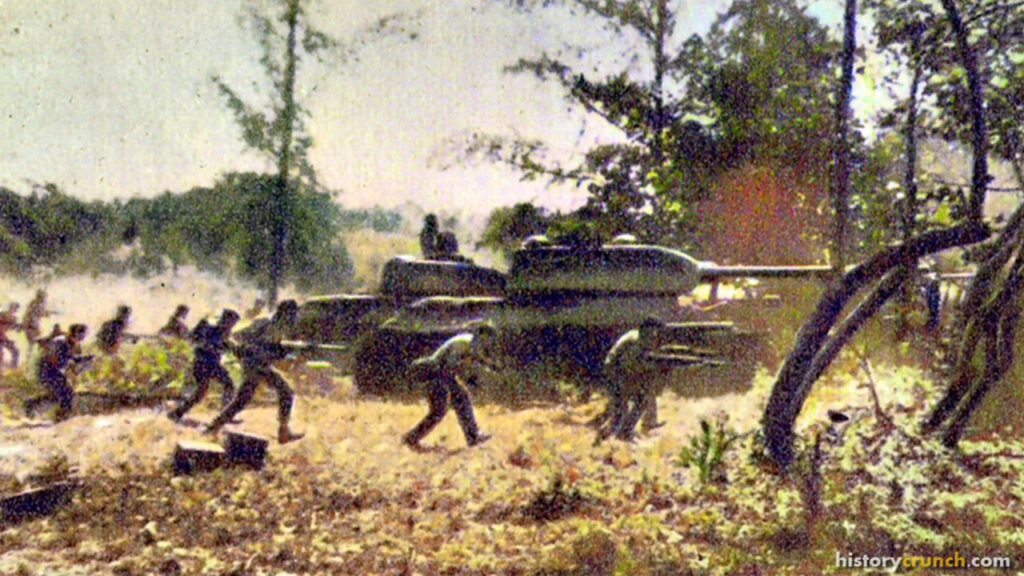 Black & whiteColor
Explore Cold War · 1947 – 1991
Keep exploring Cold War with these History Crunch resources.
Key Vocabulary
Military coup
Amnesty
Guerrilla
Insurgency
Nationalized
Brinkmanship
Embargo
Frequently Asked Questions
When did the Cuban Revolution happen?
The Cuban Revolution ended on January 1st, 1959, when Fulgencio Batista fled the country. The armed struggle began with a failed attack on the Moncada Barracks on July 26th, 1953. The main guerrilla war lasted from late 1956 until Batista’s government collapsed.
Who led the Cuban Revolution?
Fidel Castro led the Cuban Revolution through his 26th of July Movement. He was joined by his brother Raul Castro and the Argentine revolutionary Che Guevara. Guevara became a key military commander and later a famous symbol of revolutionary politics.
What caused the Cuban Revolution?
The revolution grew out of years of corruption, poverty, and anger over American control of Cuba. Batista seized power in a 1952 military coup and ruled as a harsh dictator. His secret police used torture and terror, which pushed many Cubans to support Castro.
How did the Cuban Revolution affect the United States?
The revolution created a communist state just 90 miles (145 km) from the American coast. The United States broke off relations and backed the failed Bay of Pigs invasion in 1961. It later imposed an economic embargo on Cuba that lasted for decades.
Why is the Cuban Revolution important to the Cold War?
The revolution turned Cuba into one of the most important Cold War flashpoints. Castro aligned with the Soviet Union and allowed Soviet nuclear missiles on the island. This led to the Cuban Missile Crisis of 1962, the closest the Cold War came to nuclear war.
What changes did Castro make after taking power?
Castro broke up large estates and gave land to about 200,000 peasant families through the Agrarian Reform Law of 1959. He also nationalized American-owned businesses and industries. His government improved education and healthcare but built a one-party state that crushed opposition.
Cite This Article
To cite this article as a source, use one of the formats below.
MLA: Millar, B. “Cuban Revolution: A Detailed Summary.” HistoryCrunch, 9 October 2026, https://historycrunch.com/cuban-revolution/.
APA: Millar, B. (2026). Cuban Revolution: A Detailed Summary. HistoryCrunch. https://historycrunch.com/cuban-revolution/
Chicago: Millar, B. “Cuban Revolution: A Detailed Summary.” HistoryCrunch. October 9, 2026. https://historycrunch.com/cuban-revolution/
Sources
- Odd Arne Westad, The Global Cold War.
- State Department — Office of the Historian