Fidel Castro was the revolutionary leader who took power in Cuba in 1959 and remained one of the most important figures in the overall Cold War. He is remembered for the Cuban Revolution, his communist rule in Cuba, and his role in events such as the Bay of Pigs invasion and the Cuban Missile Crisis.
 FactsthatCrunch
Fidel Castro led the Cuban Revolution that overthrew dictator Fulgencio Batista in 1959 and then ruled Cuba as a communist state for nearly half a century. He played a direct role in major Cold War events, including the Bay of Pigs invasion and the Cuban Missile Crisis, and remains a deeply debated political leader of the 20th century.
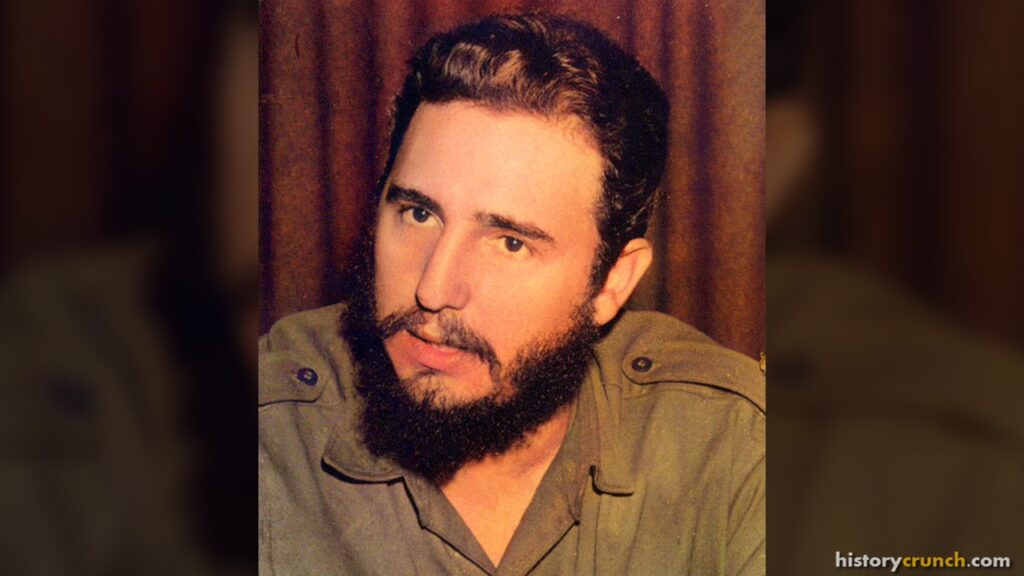
Fidel Castro – Early Life
Fidel Alejandro Castro Ruz was born on August 13th, 1926, in Birán, Oriente, Cuba. He came from a relatively wealthy farming family and received a strong education before studying law at the University of Havana. While at university, Castro became involved in politics and developed a strong anti-imperialistOpposing the practice of powerful countries controlling or dominating weaker ones. outlook, which helped shape his later revolutionary ideas.
As a young lawyer, Castro first tried to oppose Cuba’s political problems through legal and political action. However, after Fulgencio Batista seized power in the coupA sudden, often violent takeover of a government by a small group, outside of normal elections. of 1952, Castro became convinced that the Batista government could not be removed through normal constitutional means. Therefore, he moved toward armed rebellion.
FactsthatCrunchFidel Castro – The Cuban Revolution
A major turning point came on July 26th, 1953, when Castro and his followers attacked the Moncada Barracks in Santiago de Cuba. The attack failed, and Castro was arrested and sentenced to prison. Even so, the event became extremely important because it helped make him nationally known and later gave its name to the 26th of July Movement, which became the main revolutionary group fighting Batista.
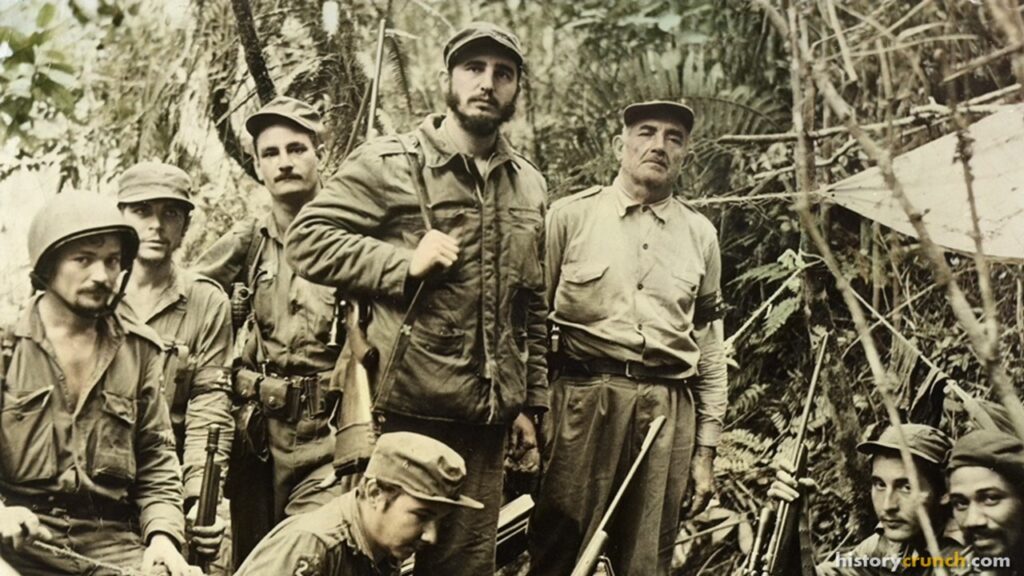
After receiving amnestyAn official pardon that frees a person or group from punishment for past offenses. in 1955, Castro went to Mexico. There, he rebuilt his movement with Raúl Castro and Ernesto “Che” Guevara. In 1956, the group returned to Cuba aboard the Granma and began a guerrilla warA type of fighting where small groups use surprise attacks and hit-and-run tactics against a larger enemy force. from the Sierra Maestra mountains. Over time, Castro’s forces gained support and weakened Batista’s regime. Batista fled Cuba at the beginning of 1959, and Castro soon emerged as the dominant revolutionary leader.
FactsthatCrunchCondemn me. It does not matter. History will absolve me.
Fidel Castro · Courtroom, Santiago de Cuba · October 16th, 1953
Fidel Castro spoke these closing words at his own trial after leading the failed armed attack on the Moncada Barracks in Santiago de Cuba on July 26th, 1953. Acting as his own defense attorney, he turned his two-hour speech into an attack on the Batista dictatorship, and the court sentenced him to 15 years in prison. The speech won him national fame and later became the manifesto of his 26th of July Movement.
Fidel Castro – Leadership of Cuba
After the revolution, Castro took control of Cuba and helped establish it as the first communist state in the Western Hemisphere. He served as prime minister from February 16th, 1959, to December 2nd, 1976, and then as president from December 2nd, 1976, to February 24th, 2008. During his rule, the Cuban government reduced illiteracy and expanded health care, but it was also heavily criticized for limiting political freedom and repressingUsing force or authority to crush opposition and prevent people from speaking or acting freely. opponents.
Castro’s rule quickly brought Cuba into conflict with the United States. He nationalizedWhen a government takes private or foreign-owned businesses and puts them under state control. many United States-owned businesses, and the United States responded with a trade embargoAn official ban that stops or severely limits trade and business between two countries. in 1960. Tensions then grew even worse with the Bay of Pigs invasion in April of 1961, which was a failed attempt by Cuban exiles backed by the United States to overthrow Castro. This was important because the failed invasion strengthened Castro’s power inside Cuba and pushed him closer to the Soviet Union.
That closer Soviet relationship helped lead to the Cuban Missile Crisis in October of 1962. Castro allowed the Soviet Union to place nuclear missiles in Cuba, and the crisis became the closest the Cold War came to full-scale nuclear war. As such, Fidel Castro became one of the central figures in Cold War history, even though the main negotiations were carried out by Nikita Khrushchev and John F. Kennedy.
FactsthatCrunchCastro's rule brought real improvements to some areas of Cuban life, but it also came with serious losses of freedom and opportunity.
Fidel Castro – Later Years and Death
Castro remained the dominant figure in Cuba for decades, although his direct role in government became smaller in his later years. In 2006, after surgery for intestinal bleeding, he transferred his duties to Raúl Castro. Raúl officially became president in 2008, which marked the end of Fidel Castro’s long formal leadership of Cuba.
Fidel Castro died on November 25th, 2016, at the age of 90. His death received worldwide attention because he had been one of the most recognizable and controversial political leaders of the 20th century. For many people, Castro symbolized resistance to United States influence. For others, he symbolized dictatorship and political repression.
FactsthatCrunchMany supporters around the world saw Castro's death as the end of a life devoted to standing up against United States influence in Latin America. They pointed to real gains under his government, including sharp reductions in illiteracy and expanded access to health care across Cuba. For them, he represented a small nation refusing to be controlled by a more powerful neighbor.
Critics, including many Cuban exiles living in Miami and elsewhere, viewed his death as the end of a long dictatorship built on one-party rule and political repression. They focused on the imprisonment of opponents, the severe limits on personal freedoms, and the human rights abuses carried out by his government over nearly five decades. For them, Castro was a symbol of authoritarian control, not liberation.
Fidel Castro – Significance
Fidel Castro was significant because he changed Cuba through revolution and then kept power for nearly half a century. He helped turn Cuba into a communist state, challenged the influence of the United States in Latin America, and played a direct role in major Cold War events such as the Bay of Pigs invasion and the Cuban Missile Crisis.
At the same time, Castro remains a deeply debated historical figure. Some people remember him for improvements in literacy, health care, and Cuban independence from outside control. Others focus on one-party rule, limited freedoms, and human rights abuses under his government. Regardless, Fidel Castro was one of the most important leaders in modern Latin American history.
FactsthatCrunchFidel Castro held formal power in Cuba for close to fifty years, serving first as prime minister and then as president from 1959 to 2008.
Key Vocabulary
Anti-imperialist
Coup
Guerrilla war
Amnesty
Nationalized
Trade embargo
Repressing
Frequently Asked Questions
How did Fidel Castro come to power in Cuba?
Fidel Castro came to power in 1959 after leading a guerrilla war that forced dictator Fulgencio Batista to flee. His 26th of July Movement fought from the Sierra Maestra mountains and slowly weakened Batista’s government. Once Batista left at the start of 1959, Castro emerged as the main revolutionary leader.
What was the attack on the Moncada Barracks?
The Moncada Barracks attack was a failed assault led by Castro on July 26th, 1953, in Santiago de Cuba. Castro was arrested and sent to prison, but the event made him known across the country. It later gave its name to his 26th of July Movement, the main group fighting Batista.
Why did Fidel Castro clash with the United States?
Castro clashed with the United States after he seized many United States-owned businesses in Cuba. The United States replied with a trade embargo in 1960, which cut off much trade between the two nations. Tensions grew further with the Bay of Pigs invasion in 1961, a failed effort to remove him from power.
What was Fidel Castro’s role in the Cuban Missile Crisis?
Castro allowed the Soviet Union to place nuclear missiles in Cuba, which triggered the Cuban Missile Crisis in October of 1962. This standoff became the closest the Cold War came to full nuclear war. The main talks, though, were handled by Soviet leader Nikita Khrushchev and United States President John F. Kennedy.
When did Fidel Castro die, and who replaced him?
Fidel Castro died on November 25th, 2016, at the age of 90. He had already handed his duties to his brother Raúl Castro in 2006 after surgery for intestinal bleeding. Raúl officially became president in 2008, ending Fidel’s long formal leadership of Cuba.
Why is Fidel Castro such a debated figure?
Castro is debated because people judge his nearly fifty years of rule in very different ways. Supporters point to gains in literacy, health care, and Cuban independence from outside control. Critics focus on one-party rule, limited freedoms, and human rights abuses under his government.
Cite This Article
To cite this article as a source, use one of the formats below.
MLA: Millar, B. “Fidel Castro: A Detailed Biography.” HistoryCrunch, 12 October 2026, https://historycrunch.com/fidel-castro/.
APA: Millar, B. (2026). Fidel Castro: A Detailed Biography. HistoryCrunch. https://historycrunch.com/fidel-castro/
Chicago: Millar, B. “Fidel Castro: A Detailed Biography.” HistoryCrunch. October 12, 2026. https://historycrunch.com/fidel-castro/
Sources
- Vladislav Zubok, A Failed Empire.
- John Lewis Gaddis, The Cold War: A New History.