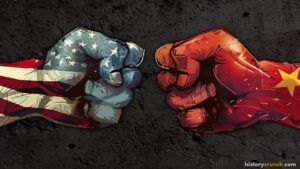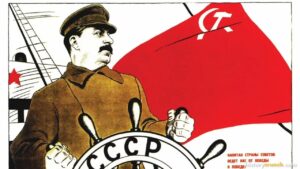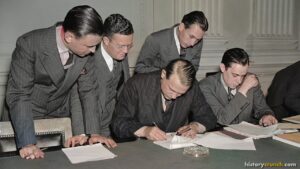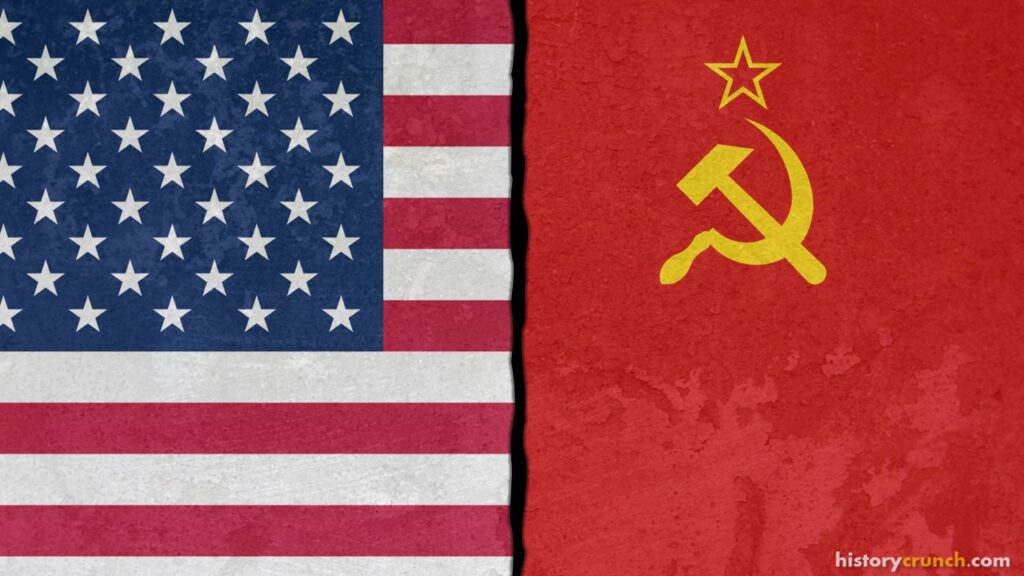
The Cold War was not a conventional war fought with armies on a battlefield. Rather, it was a prolonged state of political hostility, ideological conflict, military rivalry, and mutual suspicion between two of the world’s most powerful nations. On one side was the United States, which represented a democratic and capitalist system of government and economics. On the other side was the Soviet Union, which represented a communist and authoritarian system. The two nations competed for global influence across every continent and came close to direct military conflict on several occasions. The Cold War is generally considered to have lasted from approximately the mid-1940s until the collapse of the Soviet Union in 1991. The main events of the Cold War include: the Berlin Blockade, the Korean War, the Cuban Missile Crisis, the Vietnam War, the Space Race, the nuclear arms race, and the eventual collapse of the Soviet Union.
 FactsthatCrunch
How did the United States and Soviet Union view free markets versus state control during the Cold War?
Causes of the Cold War
The Cold War developed out of the conditions that existed at the end of World War II in 1945. During the war, the United States and the Soviet Union had been allied against Nazi Germany, but deep tensions existed between the two nations even during that alliance. The United States was a capitalist democracy that valued individual freedoms, free elections, and free markets. The Soviet Union was a communist state in which the government controlled the economy and political life, and individual freedoms were severely restricted. These differences in ideology made genuine trust between the two nations very difficult.
The Yalta Conference of February 1945 and the Potsdam Conference of July 1945, held near the end of and just after World War II, revealed the growing tensions between the Allied leaders. At these meetings, American Presidents Franklin D. Roosevelt (at Yalta) and Harry Truman (at Potsdam) disagreed with Soviet leader Joseph Stalin over the future of Europe, particularly over the fate of the countries of Eastern Europe that had been liberated from German occupation by the Soviet Army. The Soviet Union sought to establish friendly, communist-controlled governments in these countries as a buffer zone against future threats from the west. The United States and Britain viewed this as Soviet expansionism and a threat to democracy. These disagreements laid the groundwork for the Cold War.
The ideological conflict between the two sides was at the heart of the Cold War. The United States feared the spread of communism, which it viewed as a threat to individual freedom and democratic government. The Soviet Union feared American capitalism and Western influence, viewing them as tools of exploitation and imperialism. Each side believed its own system of government and economics was superior and sought to spread its influence around the world. Historians refer to this as the ideological conflictA clash between two opposing sets of beliefs about how government and society should be organized. of the Cold War, and it drove nearly every aspect of the competition between the two superpowers.
Another key cause of the Cold War was the development of nuclear weapons. The United States had developed the first atomic bomb through the Manhattan Project and used it against Japan in August of 1945. The Soviet Union developed its own atomic bomb in 1949, and the two nations entered into a nuclear arms race that lasted for decades. Each side built thousands of nuclear weapons in an effort to maintain military superiority over the other. The nuclear arms race created a doctrine known as Mutual Assured Destruction, which held that any nuclear attack by one side would result in a devastating nuclear response from the other, making nuclear war essentially unwinnable for either side.
FactsthatCrunchEarly Cold War (1947-1953)
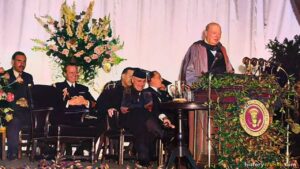
The early Cold War was characterized by the rapid division of Europe into two competing blocs and by a series of crises that brought the superpowers into direct confrontation. In 1946, Winston Churchill delivered a famous speech in which he declared that an ‘Iron Curtain‘ had descended across Europe, dividing the democratic west from the communist east. The Iron Curtain became one of the defining symbols of the Cold War.
In 1947, President Truman announced the Truman Doctrine, which pledged American economic and military assistance to countries threatened by communist takeover. This was closely connected to the broader American foreign policy of containment, which sought to prevent the further spread of communism beyond the countries where it already existed. The Marshall Plan, announced in 1947, provided large amounts of American economic aid to help rebuild the war-damaged economies of Western Europe, in part to reduce the appeal of communism in those countries.
The Berlin Blockade of 1948 was one of the first major crises of the Cold War. The Soviet Union blockaded all road, rail, and canal routes into West Berlin in an attempt to force the Western powers out of the city. The United States and Britain responded by organizing the Berlin Airlift, a massive operation that supplied West Berlin entirely by air for nearly a year. The blockade was lifted in May of 1949 without achieving its objectives, and the successful airlift was seen as a significant Western victory.
In 1949, the United States and its Western allies formed the North Atlantic Treaty Organization (NATO), a collective defense alliance in which an attack on any member would be considered an attack on all. The Soviet Union responded by forming the Warsaw Pact in 1955, a similar alliance among the communist nations of Eastern Europe. The formation of these two military alliances formalized the division of Europe into two armed camps.
The Korean War, which lasted from 1950 to 1953, was the first major military conflict of the Cold War. When communist North Korea invaded South Korea in June of 1950, the United States led a United Nations military force to defend the south, while China eventually entered the war on the side of North Korea. The war ended in a stalemate along approximately the same boundary line that had existed before the war began, but it demonstrated that the Cold War could erupt into real military conflict.
FactsthatCrunchThe Berlin Airlift was a massive operation in which the United States and Britain supplied the entire civilian population of West Berlin by air after the Soviet Union cut off all ground routes into the city in 1948.
The Cold War and Anti-Communism in America
Within the United States, fear of communist influence produced a period of intense anti-communist activity in the late 1940s and early 1950s. The House Un-American Activities Committee (HUAC) conducted hearings to investigate alleged communist influence in American society, including in the film industry and government. The execution of Julius and Ethel Rosenberg in 1953 for passing nuclear secrets to the Soviet Union reflected the depth of American fears about espionage. Espionage was a major feature of the Cold War, with both sides operating extensive networks of spies to gather intelligence on each other.
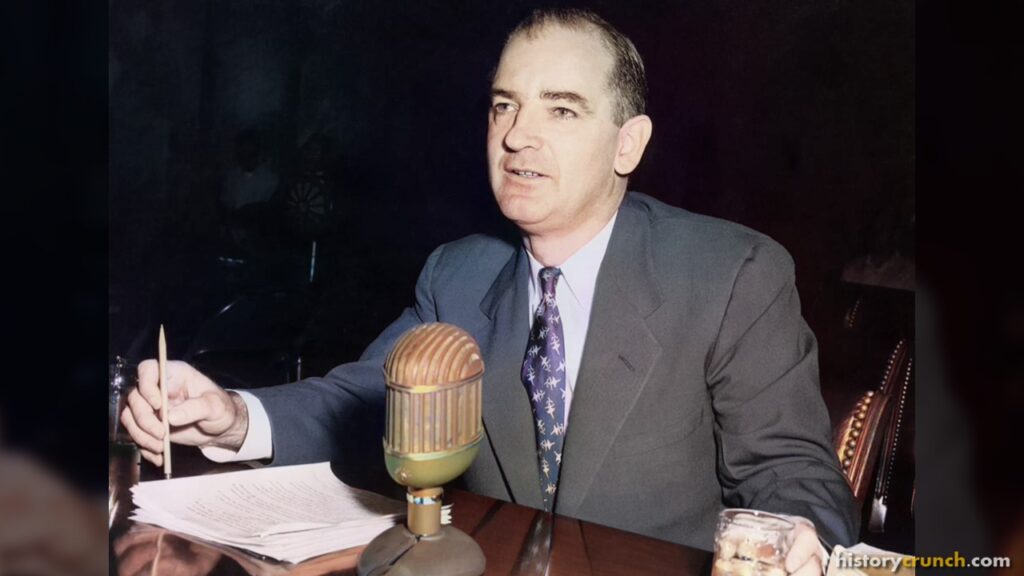
The most prominent figure of American anti-communism during this period was Senator Joseph McCarthy, who launched a wide-ranging campaign of accusations against alleged communists in the government, military, and other institutions. McCarthyism, as this period became known, resulted in the careers of many Americans being destroyed on the basis of unsubstantiated accusations. McCarthy’s influence eventually collapsed after televised hearings in 1954 exposed his methods to the American public, but the fear of communism that drove his rise remained a powerful force in American politics throughout the Cold War.
FactsthatCrunchCan you name this mystery person before the photo develops? Click through the hints and lock in your guess.
Cold War Crises (1956-1968)
The middle years of the Cold War were marked by a series of crises that brought the world to the edge of nuclear conflict. The Hungarian Revolution of 1956 saw the people of Hungary rise up against Soviet-backed communist rule, only to be crushed by a Soviet military invasion. The Prague Spring of 1968 saw a similar uprising in Czechoslovakia, which was also suppressed by Soviet forces. Both events demonstrated the Soviet Union’s willingness to use military force to maintain control over its Eastern European satellite statesCountries in Eastern Europe that were controlled and dominated by the Soviet Union during the Cold War..
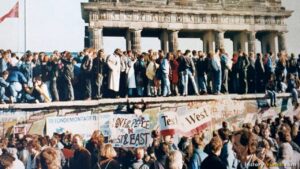
The Berlin Crisis of 1961 produced one of the most visible symbols of the Cold War. East Germany, with Soviet backing, constructed the Berlin Wall in August of 1961 to prevent its citizens from fleeing to West Berlin. The Berlin Wall divided the city for nearly three decades and became the most powerful physical symbol of the Iron Curtain and the division between communism and democracy.
The Cuban Missile Crisis of October 1962 was the most dangerous moment of the entire Cold War. The Soviet Union, under leader Nikita Khrushchev, placed nuclear missiles in Cuba, just 90 miles (145 kilometers) from the coast of Florida. American President John F. Kennedy demanded their removal and ordered a naval blockade of Cuba. For thirteen days the world stood on the edge of nuclear war before the Soviet Union agreed to remove the missiles in exchange for American pledges not to invade Cuba and to remove American missiles from Turkey. The Cuban Missile Crisis is widely regarded as the closest the Cold War came to becoming a nuclear war.
The Cold War in Asia
The Cold War was not confined to Europe. It played out across Asia, Africa, Latin America, and the Middle East as both superpowers competed for influence in the developing world. The most significant Cold War conflict outside Europe was the Vietnam War, which lasted from 1955 to 1975. The United States became deeply involved in Vietnam in an effort to prevent the communist North Vietnamese government from taking control of South Vietnam. American involvement grew steadily through the late 1950s and 1960s, with large numbers of American troops deployed from 1965 onward. The Vietnam War was enormously costly in lives and resources, deeply unpopular at home, and ultimately ended with the communist North Vietnam reunifying the country under its control in 1975.
The concept of the Domino Theory drove much of American policy in Asia during the Cold War. This was the belief that if one country in a region fell to communism, its neighbors would likely follow, like a row of falling dominoes. While the theory was disputed, it shaped American decisions to intervene in Korea, Vietnam, and other parts of the world during the Cold War.
The Domino Theory was a disputed belief, not an accepted fact, yet it still drove major American military decisions during the Cold War.
Détente (1969-1979)
The late 1960s and 1970s saw a gradual reduction in Cold War tensions in a period known as détente. Both sides recognized the dangers of continued escalation and sought to manage their rivalry through negotiation and diplomacy. President Richard Nixon played a central role in this process, opening diplomatic relations with communist China in 1972 and signing the Strategic Arms Limitation Talks agreement, known as SALT I, with the Soviet Union in the same year. Nixon’s visit to China was one of the most significant diplomatic events of the Cold War and helped shift the balance of power by bringing China into a more cooperative relationship with the United States.
The Helsinki Accords of 1975, signed by both the United States and the Soviet Union, recognized the existing borders of Europe and included commitments to respect human rights, though the Soviet Union largely ignored the human rights provisions. The SALT II agreement of 1979 placed further limits on nuclear weapons, though it was never ratified by the United States Senate following the Soviet invasion of Afghanistan later that year.
FactsthatCrunchWhich definition fits each détente agreement?
The Space Race
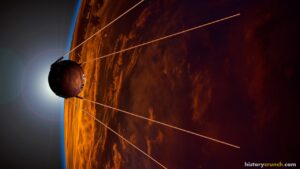
One of the most visible areas of Cold War competition was the Space Race, in which the United States and the Soviet Union competed to achieve milestones in space exploration. The Soviet Union launched Sputnik, the first artificial satellite, in October of 1957, which shocked the American public and raised fears that the Soviets were gaining a technological advantage. The Soviets also sent the first human into space, cosmonaut Yuri Gagarin, in April of 1961. In response, President Kennedy committed the United States to landing a man on the moon before the end of the 1960s. On July 20th, 1969, American astronauts Neil Armstrong and Buzz Aldrin became the first humans to walk on the surface of the Moon during the Apollo 11 mission. The first moon landing was a major symbolic victory for the United States in the Cold War competition.
Can you put these Space Race milestones in the correct order?
The Final Stages and End of the Cold War (1979-1991)
The period of détenteA period of reduced tension and increased diplomacy between the United States and Soviet Union in the late 1960s and 1970s. came to an abrupt end in 1979 when the Soviet Union invaded Afghanistan in an attempt to prop up its communist government there. The Soviet invasion of Afghanistan drew the United States into a lengthy indirect conflict, as the American government provided weapons and financial support to Afghan resistance fighters known as the mujahideen. The Soviet military became bogged down in a costly and unwinnable war that lasted nearly a decade and drained Soviet resources and morale.
The election of Ronald Reagan as American president in 1980 brought a sharp increase in Cold War tensions. Reagan dramatically increased American military spending and took an aggressive rhetorical stance against the Soviet Union, describing it as an ‘evil empire’. In 1987, Reagan delivered his famous ‘Tear Down This Wall‘ speech at the Berlin Wall, calling on Soviet leader Mikhail Gorbachev to open up Eastern Europe. Reagan’s military buildup put enormous pressure on the already strained Soviet economy, which struggled to keep pace.
The most important factor in ending the Cold War was the internal reform program launched by Soviet leader Mikhail Gorbachev, who came to power in 1985. Gorbachev introduced two major reform policies known as ‘perestroika‘, meaning restructuring of the economy, and ‘glasnost‘, meaning greater openness in political and social life. These reforms were intended to revitalize the Soviet system but instead unleashed forces that the Soviet government could not control. Political freedoms in the Soviet Union and Eastern Europe expanded rapidly, and communist governments across Eastern Europe began to fall in 1989. The Berlin Wall fell on November 9th, 1989, in one of the most dramatic moments of the Cold War. By the end of 1991, the Soviet Union itself had dissolved into fifteen independent nations, bringing the Cold War to a definitive end.
FactsthatCrunch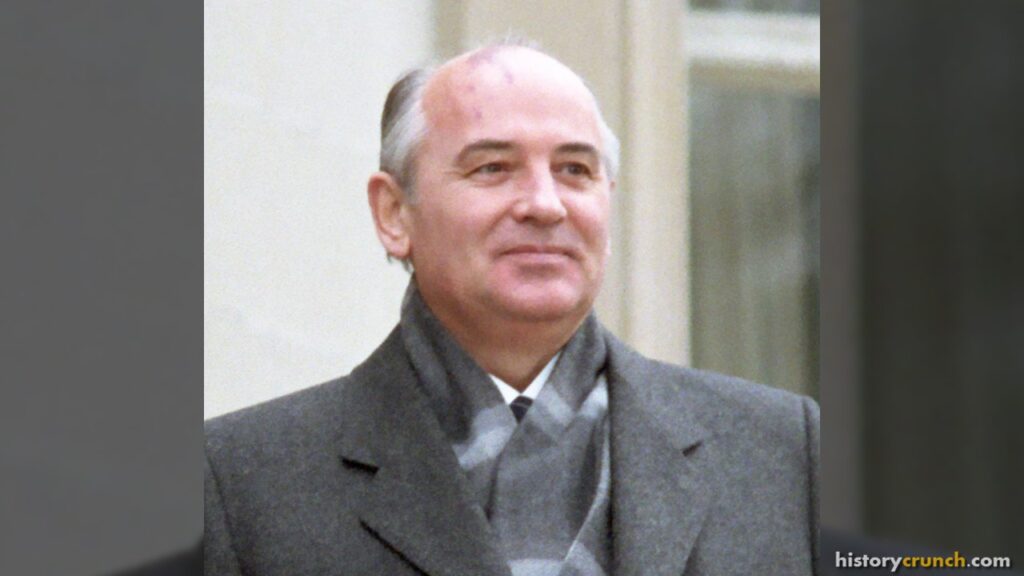
Significance of the Cold War
The Cold War was one of the most significant events of the twentieth century and had profound consequences for the entire world. It shaped the foreign policies of dozens of nations, produced the threat of nuclear annihilation, drove technological advances including the Space Race, and determined the political fate of hundreds of millions of people across Europe, Asia, Africa, and Latin America.
The end of the Cold War left the United States as the world’s dominant superpower and spread democratic and capitalist systems of government across much of the former communist world. At the same time, the collapse of the Soviet Union created instability across a large part of the world and left unresolved conflicts that continued to shape global events in the decades that followed. In all, the Cold War left a lasting impact on the history of the modern world that continues to be studied and debated by historians today.
FactsthatCrunchThe end of the Cold War reshaped the entire world order, leaving behind a United States that stood as the sole superpower and a global landscape permanently altered by decades of ideological competition.
NATO, formed in 1949 as a defense alliance against Soviet power, did not dissolve when the Cold War ended and remained the central military alliance of the Western world well into the 21st century.
The nuclear weapons built up during the arms race did not disappear. Thousands of warheads remained in existence after 1991, making arms control a continuing challenge for governments around the world.
Eastern European countries that had been Soviet satellite states gained independence after the Soviet Union collapsed in 1991, and many moved to join NATO and the European Union in the years that followed.
The doctrine of Mutual Assured Destruction, developed during the Cold War arms race, continued to shape how nuclear-armed nations thought about military conflict and deterrence long after the rivalry between the two superpowers ended.
Explore Cold War · 1947 – 1991
Keep exploring Cold War with these History Crunch resources.
Key Vocabulary
Ideological conflict
Containment
Mutual Assured Destruction
Satellite states
Détente
Perestroika
Glasnost
Domino Theory
Frequently Asked Questions
When did the Cold War start and end?
The Cold War lasted from about the mid-1940s until 1991, when the Soviet Union collapsed. It grew out of the tensions that remained after World War II ended in 1945. The rivalry stretched across more than four decades and touched nearly every part of the world.
Why was it called a “cold” war?
It was called cold because the United States and the Soviet Union never fought each other directly in open battle. Instead, they competed through politics, spying, propaganda, and an arms race. The two sides also backed opposite sides in smaller wars, such as Korea and Vietnam.
What was the Cuban Missile Crisis?
The Cuban Missile Crisis of October 1962 was the closest the Cold War came to nuclear war. The Soviet Union placed nuclear missiles in Cuba, just 90 miles (145 km) from Florida. For thirteen days the world waited before the Soviets agreed to remove them in exchange for American pledges.
What was the policy of containment?
Containment was the American policy of stopping communism from spreading beyond the countries where it already existed. It shaped the Truman Doctrine of 1947, which offered aid to nations threatened by communist takeover. This idea guided American choices to get involved in Korea, Vietnam, and other regions.
How did the Cold War end?
The Cold War ended when the Soviet Union dissolved into fifteen independent nations by the close of 1991. Soviet leader Mikhail Gorbachev launched reforms called perestroika and glasnost that he could not fully control. Communist governments in Eastern Europe fell in 1989, and the Berlin Wall came down that November.
Cite This Article
To cite this article as a source, use one of the formats below.
MLA: Millar, B. “Cold War: A Detailed Overview.” HistoryCrunch, 8 October 2026, https://historycrunch.com/cold-war-overview/.
APA: Millar, B. (2026). Cold War: A Detailed Overview. HistoryCrunch. https://historycrunch.com/cold-war-overview/
Chicago: Millar, B. “Cold War: A Detailed Overview.” HistoryCrunch. October 8, 2026. https://historycrunch.com/cold-war-overview/
Sources
- State Department — Office of the Historian
- Odd Arne Westad, The Global Cold War.
- John Lewis Gaddis, The Cold War: A New History.