The Warsaw Pact was the military allianceA formal agreement between countries to support each other with armed forces against common enemies. of the Soviet Union that united most of communist Eastern Europe during the events of the Cold War. It was created on May 14th, 1955, and it became the main military counterweightA force or power that balances or offsets another opposing force. to the North Atlantic Treaty Organization (NATO) in Europe until it was dissolved in 1991. As such, historians consider the Warsaw Pact to be one of the most significant elements of understanding the tensions and conflict of the Cold War.
 FactsthatCrunch
The Soviet Union and seven communist states signed the Treaty of Friendship, Cooperation, and Mutual Assistance, creating the Warsaw Pact.
Warsaw Pact – Background
The Warsaw Pact grew out of the tense early years of the Cold War after World War II. By the late 1940s and early 1950s, Europe had become divided between a western bloc backed by the United States and an eastern bloc dominated by the Soviet Union. Further to this, in 1949, the western democratic powers created NATO to act as a military alliance to contain Soviet expansionismThe Soviet Union’s drive to spread its political control into neighboring or foreign territories. in Europe. Then, in 1955, West Germany entered NATO as a member nation. Soviet leaders saw this as a serious threat, especially because Germany had been the main invader of the Soviet Union during World War II. As well, at the time, Germany was divided along ideological lines. For instance, West Germany was supported by American, French and British interests, while East Germany was controlled by the Soviet Union.
In response, the Soviet Union and its eastern European allies signed the Treaty of Friendship, Cooperation and Mutual Assistance in Warsaw, Poland. This agreement created what later became known as the Warsaw Pact. The founding members were the Soviet Union, Albania, Bulgaria, Czechoslovakia, East Germany, Hungary, Poland and Romania. On paper, the alliance was presented as a defensive agreement in which members would help one another if attacked. In reality, the Soviet Union held the dominant position from the beginning.
FactsthatCrunchWhat were the real Soviet goals behind the Warsaw Pact that went beyond its public image as a defensive alliance?
Warsaw Pact – Creation
As stated above, the Warsaw Pact was created when the Soviet Union and seven communist states in Eastern Europe signed the Treaty of Friendship, Cooperation, and Mutual Assistance. More specifically, the treaty was signed on May 14th, 1955, in Warsaw, Poland.
The Warsaw Pact was not just a military agreement. It was also a political tool that helped the Soviet Union leadership tighten control over the Eastern Europe nations under its sphere of influenceA region where one powerful country controls or strongly shapes the politics of weaker surrounding nations.. Soviet leaders wanted a formal alliance that would link the armies of the eastern bloc more closely to Soviet command. This was important because the Cold War had become more militarized and both sides had constructed large alliances, large armies and nuclear strategies in Europe.
Regardless, the Warsaw Pact created a combined military command and a political structure for consultation among member states. However, the alliance did not operate like a partnership of equals. Historians agree that the Soviet Union controlled most major decisions and used the alliance to reinforce its control over the eastern bloc of Europe’s nations. In that sense, the Warsaw Pact was both an international alliance and a system for holding Soviet satellite statesCountries that are officially independent but are actually controlled by a more powerful neighboring nation. within the Soviet Union’s sphere of influence.
Warsaw Pact – Cold War
For most of the Cold War, the Warsaw Pact stood opposite NATO in a tense military standoff across Europe. The two alliances never fought each other directly in Europe, but they shaped the larger balance of power. Both sides built up military forces, planned for large-scale war, and prepared for the possibility of nuclear conflict. The division of Europe into two armed camps became one of the clearest features of the Cold War and highlighted the ideological conflict of the period.
The Warsaw Pact also became important because it revealed how Soviet power worked inside Eastern Europe. Although the treaty spoke of mutual defense and respect for sovereigntyA country’s full right to govern itself without outside interference., the Soviet Union used the alliance to keep member states loyal. For example, in 1956, Soviet power was used to crush the Hungarian Revolution. Then, in August of 1968, Warsaw Pact forces invaded Czechoslovakia during the Prague Spring. This was the alliance’s most famous direct military action and it showed that the Warsaw Pact could be used against one of its own members if that country seemed to be breaking away from Soviet control.
The events in Czechoslovakia were especially important because they showed that the Warsaw Pact was not only about defense against NATO. It was also about internal discipline inside the communist bloc of nations. The invasion helped support what later became known as the ‘Brezhnev DoctrineThe Soviet claim that it had the right to intervene militarily if socialism in any Eastern European country was threatened.‘, which was the idea that the Soviet Union had the right to intervene if socialism in Eastern Europe was threatened. This gave the alliance a double role: it was aimed outward against the west and inward against unrest inside the eastern bloc. The Brezhnev Doctrine was named after Soviet leader Leonid Brezhnev.
Not every member accepted Soviet control in the same way. For instance, Albania broke with the Soviet Union in the early 1960s and formally withdrew from the Warsaw Pact in 1968. As well, Romania remained a member but often acted more independently than other eastern bloc states. Regardless, the alliance continued to function as a Soviet-led military system through the 1970s and 1980s.
FactsthatCrunchIt is August 1968, and you are the leader of a Warsaw Pact member country that has been quietly introducing political reforms, loosening press controls, and allowing citizens more freedoms, much as Czechoslovakia did during the Prague Spring. Soviet leader Leonid Brezhnev has sent you a direct warning: pull back the reforms or face consequences. The Cold War standoff between the Soviet-led eastern bloc and NATO is at its most rigid, and the Soviet Union has just shown, by sending Warsaw Pact forces into Czechoslovakia, that it is willing to use military power against its own members. If you do not act now, Soviet tanks could cross your border, your reforms could be crushed by force, and your people could pay the price.
Warsaw Pact – Decline and End
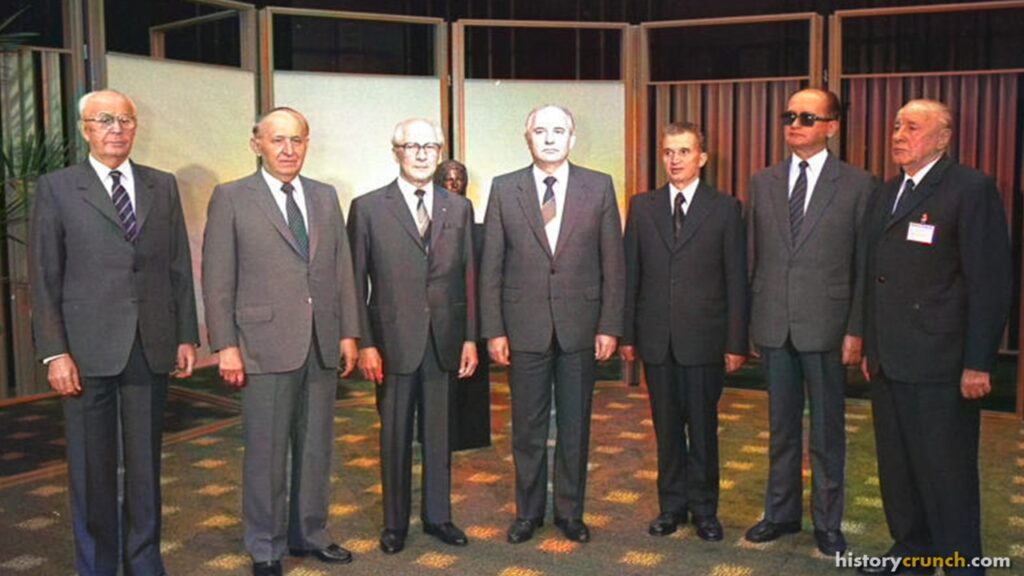
The Warsaw Pact began to weaken in the late 1980s as communist governments across Eastern Europe came under growing economic and political pressure. Economically, problems were worsening and Soviet power was no longer as strong as it had once been. As well, political reform movements spread throughout the eastern bloc of nations. For instance, in Poland, the Solidarity Movement challenged communist rule. As well, in 1989, communist governments began falling across Eastern Europe, and the Soviet Union did not use force to save them. This marked a major change from the earlier years of the Warsaw Pact.
As those governments collapsed, the alliance itself began to unravel. More specifically, East Germany withdrew in 1990 as German reunification approached. By early 1991, the Warsaw Pact had effectively ceased to function as a real military alliance. On February 25th, 1991, the pact was declared disbanded at a meeting in Hungary. Then, on July 1st, 1991, the treaty itself was formally ended in Prague, Czechoslovakia. The Soviet Union dissolved later that same year.
The end of the Warsaw Pact was one of the clearest signs that the Cold War in Europe was ending. In fact, in the decades that followed, many former Warsaw Pact countries joined NATO. This was a dramatic reversal because countries that had once been part of the Soviet military bloc later entered the western alliance that the Warsaw Pact had originally been created to oppose.
FactsthatCrunchHow did the Warsaw Pact come to an end between 1989 and 1991?
Warsaw Pact – Significance
The Warsaw Pact was important because it defined the military shape and strategies of the eastern bloc during the Cold War. It formalized the division of Europe into two rival armed camps and helped turn the Cold War into a long period of military tension and ideological conflict. The alliance also showed how the Soviet Union organized and controlled its sphere of influence in Eastern Europe.
The Warsaw Pact is also important because it reveals the limits of communist unity in Eastern Europe. Although the alliance claimed to be based on cooperation, it was dominated by centralized Soviet power. Its history shows that the eastern bloc was held together not only by shared ideology but also by pressure, fear and the threat of military force. For that reason, the Warsaw Pact remains one of the clearest symbols of the Cold War world in Europe.
FactsthatCrunchThe Warsaw Pact is best understood not as a genuine military alliance but as a tool of Soviet control over Eastern Europe.
Explore Cold War · 1947 – 1991
Keep exploring Cold War with these History Crunch resources.
Key Vocabulary
Military alliance
Counterweight
Soviet expansionism
Sphere of influence
Satellite states
Brezhnev Doctrine
Sovereignty
Frequently Asked Questions
When was the Warsaw Pact created and why?
The Warsaw Pact was created on May 14th, 1955, in Warsaw, Poland. The Soviet Union formed it after West Germany joined NATO, which Soviet leaders saw as a threat. It gave the eastern bloc a formal military alliance to match NATO in Europe.
Which countries were members of the Warsaw Pact?
The founding members were the Soviet Union, Albania, Bulgaria, Czechoslovakia, East Germany, Hungary, Poland, and Romania. These were communist states in Eastern Europe within the Soviet sphere of influence. Albania later broke away and formally withdrew in 1968.
What was the difference between the Warsaw Pact and NATO?
The Warsaw Pact was the Soviet-led alliance, while NATO was the western alliance backed by the United States. NATO was created in 1949 to contain Soviet expansion, and the Warsaw Pact formed six years later in response. The two sides stood opposite each other for most of the Cold War but never fought directly in Europe.
Did the Warsaw Pact ever use military force?
Yes, the Warsaw Pact’s most famous action was the invasion of Czechoslovakia in August of 1968 during the Prague Spring. This showed the alliance could be used against its own members who tried to break from Soviet control. It supported the Brezhnev Doctrine, the idea that the Soviet Union could intervene to protect socialism.
When and how did the Warsaw Pact end?
The Warsaw Pact was declared disbanded on February 25th, 1991, at a meeting in Hungary. The treaty was then formally ended on July 1st, 1991, in Prague, Czechoslovakia. The alliance fell apart as communist governments across Eastern Europe collapsed in 1989 and 1990.
Did former Warsaw Pact countries join NATO?
Yes, many former Warsaw Pact countries joined NATO in the decades after the Cold War ended. This was a dramatic reversal, since these nations had once been part of the Soviet military bloc. They entered the very western alliance the Warsaw Pact was built to oppose.
Cite This Article
To cite this article as a source, use one of the formats below.
MLA: Millar, B. “Warsaw Pact: A Detailed Summary.” HistoryCrunch, 9 October 2026, https://historycrunch.com/warsaw-pact/.
APA: Millar, B. (2026). Warsaw Pact: A Detailed Summary. HistoryCrunch. https://historycrunch.com/warsaw-pact/
Chicago: Millar, B. “Warsaw Pact: A Detailed Summary.” HistoryCrunch. October 9, 2026. https://historycrunch.com/warsaw-pact/
Sources
- John Lewis Gaddis, The Cold War: A New History.
- Odd Arne Westad, The Global Cold War.
- Wilson Center Digital Archive
- Vladislav Zubok, A Failed Empire.