The Hungarian Revolution of 1956 was one of the most significant challenges to Soviet control in Eastern Europe during the Cold War. Beginning on October 23rd, 1956, Hungarian citizens rose up against the communist government that had ruled the country under Soviet influence since the end of World War II. The revolution was initially successful in forcing major political changes, but was crushed by a large-scale Soviet military intervention in November of 1956. In general, historians consider the Hungarian Revolution to have been important for several reasons, including: what it revealed about the limits of Soviet tolerance for reform in Eastern Europe, its impact on the international reputation of the Soviet Union, and its consequences for the overall course of the Cold War.
 FactsthatCrunch
Many people believe that Western nations, especially the United States, sent military forces or weapons to help the Hungarian revolutionaries fight the Soviet army in 1956.
No Western nation sent soldiers or weapons to Hungary. The United States and its allies condemned the Soviet intervention publicly but took no military action to aid the revolutionaries. Western governments feared that intervening would risk a direct armed conflict with the Soviet Union and possibly trigger a wider war.
What Was the Cold War?
The Cold War was a period of intense political, ideological, and military tension between the United States and the Soviet Union that lasted from the end of World War II in 1945 until the early 1990s. At its heart, the Cold War was a ‘face off’ or competition between the two superpowers, rooted in a fundamental ideological conflict between the capitalism and democracy of the United States and the communism and dictatorship of the Soviet Union. Throughout the Cold War, the Soviet Union practiced a policy of expansionism, seeking to maintain and extend its sphere of influence across Eastern Europe and other regions of the world. The Hungarian Revolution was a direct challenge to this Soviet control over Eastern Europe and became one of the most important events of the early Cold War era.
Hungarian Revolution – Background
To fully understand the Hungarian Revolution, it is first important to understand the conditions that led to it. Following the end of World War II in 1945, Hungary fell within the Soviet sphere of influence as Soviet forces had occupied the country during the final stages of the war. A communist government was gradually established in Hungary under Soviet direction, and by 1949 Hungary had become a fully communist one-party state under the control of the Hungarian Working People’s Party. The communist government introduced a Soviet-style command economyAn economic system where the government controls all production and business decisions instead of private individuals., suppressed political opposition, and relied heavily on the secret police, known as the AVHHungary’s feared secret police force, used to control the population through surveillance, arrests, and intimidation., to maintain control over the population through surveillance, arrests, and intimidation.
Life under communist rule in Hungary was characterized by political repression, economic hardship, and a general lack of the individual rights and freedoms that the pre-war generation had known. For instance, the communist government nationalized private businesses, collectivized agriculture, and imposed strict controls over the press and public life. As such, by the mid-1950s, significant discontent had built up within Hungarian society, particularly among students, intellectuals, and workers.
A major change in the political climate came in 1953 following the death of Soviet leader Joseph Stalin on March 5th, 1953. Stalin’s successor, Nikita Khrushchev, began a process known as de-Stalinization, which involved publicly criticizing some of Stalin’s abuses and allowing a degree of political relaxation across the Soviet bloc. For instance, Khrushchev’s famous ‘secret speech’ delivered on February 25th, 1956, in which he condemned Stalin’s cult of personality and political repression, sent shockwaves through the communist governments of Eastern Europe and emboldened those who hoped for reform. As such, the political climate of 1956 was one in which many people in Eastern Europe believed that change might now be possible.
FactsthatCrunchWhat built up discontent in Hungary under communist rule by the mid-1950s?
Hungarian Revolution – The Uprising
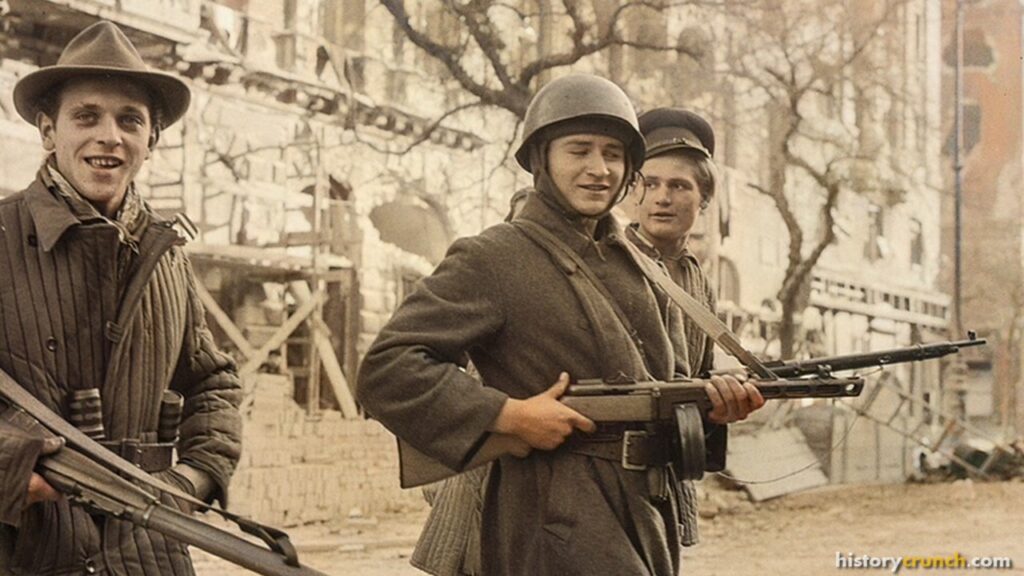
The Hungarian Revolution began on October 23rd, 1956, when a large student demonstration took place in Budapest, Hungary. The students gathered to express support for reform movements occurring in neighboring Poland and to demand their own political changes, including: the withdrawal of Soviet troops from Hungary, the introduction of free elections, freedom of the press, and the release of political prisoners. The demonstration quickly grew in size and was joined by workers and other citizens. For instance, protesters gathered around a large statue of Joseph Stalin in central Budapest and pulled it down, which became one of the most powerful symbols of the uprising.
The Hungarian secret police responded to the protests by opening fire on the crowd, which caused the demonstrations to turn into a full-scale armed uprising. Hungarian soldiers and police officers began defectingSwitching loyalty from one side to the other, as when Hungarian soldiers joined the revolutionaries instead of fighting them. to the side of the revolutionaries rather than suppressing them, and weapons were distributed among the civilian population. Within days, the revolutionary forces had taken control of much of Budapest and fighting had spread to other parts of the country. The scale and speed of the uprising shocked both the Hungarian communist government and the Soviet leadership.
In response to the crisis, the Hungarian communist leadership appointed Imre Nagy as the new Prime Minister of Hungary on October 24th, 1956. Nagy was a reformist communist who was genuinely popular among the Hungarian public. He immediately announced a series of major concessions, including: the dissolution of the AVH secret police, the formation of a new coalition government that included non-communist parties, and negotiations with the Soviet Union for the withdrawal of Soviet troops from Hungarian territory. For a brief period it appeared that the revolution had succeeded in forcing meaningful political change.
FactsthatCrunchOn November 1st, 1956, Hungarian Prime Minister Imre Nagy announced that Hungary was withdrawing from the Warsaw Pact and declaring the country neutral, a step that directly challenged Soviet control over Eastern Europe during the Cold War. Soviet leader Nikita Khrushchev faced a choice about how to respond to a move that threatened to unravel the entire Soviet alliance system in the region. The world waited to see whether Moscow would accept Hungary's break or act.
Hungarian Revolution – Soviet Intervention
The period of apparent Soviet willingness to accept Hungarian reforms was short-lived. On November 1st, 1956, Prime Minister Imre Nagy made the dramatic announcement that Hungary was withdrawing from the Warsaw Pact, the Soviet-led military alliance of Eastern European communist states, and declaring Hungarian neutrality. This announcement crossed a line that Soviet leader Nikita Khrushchev was unwilling to accept, as the withdrawal of Hungary from the Warsaw PactA Soviet-led military alliance of Eastern European communist states that Hungary announced it was leaving in 1956. would have represented a fundamental challenge to Soviet control over Eastern Europe.
On November 4th, 1956, the Soviet Union launched a massive military intervention to crush the Hungarian Revolution. The Soviet intervention involved approximately 17 divisions, over 1,000 tanks, and tens of thousands of soldiers entering Hungary to suppress the uprising by force. For instance, Soviet armored columns moved into Budapest and other major Hungarian cities, engaging in street fighting with Hungarian revolutionary forces. The fighting was intense but brief, as the lightly armed Hungarian revolutionaries were no match for the overwhelming force of the Soviet military. By November 10th, 1956, organized resistance had been crushed and the revolution was over.
Imre Nagy took refuge in the Yugoslav embassy in Budapest following the Soviet intervention, but was later lured out under promises of safe conduct. He was arrested by Soviet authorities, taken to Romania, and subsequently tried and executed on June 16th, 1958. A new pro-Soviet government was installed in Hungary under the leadership of János Kádár, who had broken with the revolution and sided with the Soviet Union. As a result, Hungary remained firmly within the Soviet sphere of influence and the communist government was restored to full control.
Hungarian Revolution – Casualties and Aftermath
The Hungarian Revolution and its suppression resulted in significant casualties on both sides. Historians estimate that approximately 2,500 Hungarian civilians and fighters were killed during the uprising and the subsequent Soviet intervention, with a further 20,000 wounded. Soviet forces suffered an estimated 700 killed and approximately 1,500 wounded. Furthermore, in the weeks and months that followed the suppression of the revolution, the restored communist government carried out widespread arrests and reprisalsPunishments carried out against people in revenge for their actions, such as arrests after the revolution was crushed. against those who had participated in or supported the uprising. Some historians estimate that approximately 200,000 Hungarians fled the country as refugees in the aftermath of the revolution, seeking safety in Austria and other Western nations.
FactsthatCrunchThe Hungarian Revolution of 1956 left a heavy human cost on both sides and forced a mass flight of people from the country.
Hungarian Revolution – Significance
The Hungarian Revolution of 1956 was significant for several important reasons. First, it demonstrated clearly that the Soviet Union was not willing to tolerate genuine political independence in Eastern Europe, regardless of the degree of reform rhetoric that Khrushchev had introduced with de-Stalinization. The swift and violent suppression of the Hungarian Revolution sent a clear message to other Eastern European nations that Soviet military force would be used to maintain communist control whenever it was seriously threatened. This principle of using military force to preserve Soviet control in Eastern Europe became known in later years as the ‘Brezhnev DoctrineThe principle that Soviet military force would be used to maintain communist control in Eastern Europe whenever seriously threatened.‘, following similar Soviet interventions in Czechoslovakia in 1968.
Second, the Hungarian Revolution had an important impact on the international reputation of the Soviet Union. The decision to crush a popular uprising by force was widely condemned in the Western world and undermined Soviet claims to be a force for peace and the rights of working people. For instance, the events in Hungary caused many Western communists and socialist intellectuals to distance themselves from the Soviet Union in the years that followed. As such, the Hungarian Revolution contributed to a weakening of communist political movements in Western Europe and other parts of the world.
Third, the Hungarian Revolution demonstrated the deep desire for freedom and self-determination that existed within Soviet-controlled Eastern Europe. The willingness of Hungarian citizens to take up arms against an entrenched communist government and a Soviet military presence showed that Soviet control over Eastern Europe rested ultimately on force rather than genuine popular support. In this sense, the Hungarian Revolution of 1956 can be seen as an early indication of the tensions that would eventually contribute to the collapse of communist governments across Eastern Europe in 1989.
FactsthatCrunchHow did the Soviet Union's violent suppression of the Hungarian Revolution affect its international reputation?
Explore Cold War · 1947 – 1991
Keep exploring Cold War with these History Crunch resources.
Key Vocabulary
De-Stalinization
AVH
Command economy
Warsaw Pact
Defecting
Reprisals
Brezhnev Doctrine
Frequently Asked Questions
When did the Hungarian Revolution happen?
The Hungarian Revolution began on October 23rd, 1956, with a student demonstration in Budapest. The uprising spread quickly across the country and forced major political changes. It was crushed by a Soviet military intervention that ended organized resistance by November 10th, 1956.
What caused the Hungarian Revolution?
Years of harsh communist rule under Soviet direction built up deep anger in Hungary. The government crushed political opposition, ran a command economy, and used the AVH secret police to control people. Hopes for reform grew after Khrushchev’s “secret speech” in 1956 criticized Stalin’s abuses.
Why did the Soviet Union invade Hungary?
The Soviet Union invaded after Prime Minister Imre Nagy announced on November 1st, 1956, that Hungary would leave the Warsaw Pact. Leaving the Soviet-led alliance was a line Khrushchev would not accept. On November 4th, about 17 divisions and over 1,000 tanks entered Hungary to crush the uprising.
What happened to Imre Nagy?
Imre Nagy took refuge in the Yugoslav embassy in Budapest after the Soviet intervention. He was later lured out under promises of safe conduct and arrested by Soviet authorities. He was taken to Romania and then tried and executed on June 16th, 1958.
How many people died in the Hungarian Revolution?
About 2,500 Hungarian civilians and fighters were killed, and around 20,000 more were wounded. Soviet forces lost an estimated 700 killed and about 1,500 wounded. After the revolution, roughly 200,000 Hungarians fled the country as refugees to Austria and other Western nations.
Why was the Hungarian Revolution important?
The revolution showed that the Soviet Union would use force to keep control over Eastern Europe. The violent crackdown also hurt the Soviet reputation and pushed many Western communists to break away. It revealed a deep desire for freedom that would help bring down communist rule in 1989.
Cite This Article
To cite this article as a source, use one of the formats below.
MLA: Millar, B. “Hungarian Revolution: A Detailed Summary.” HistoryCrunch, 9 October 2026, https://historycrunch.com/hungarian-revolution/.
APA: Millar, B. (2026). Hungarian Revolution: A Detailed Summary. HistoryCrunch. https://historycrunch.com/hungarian-revolution/
Chicago: Millar, B. “Hungarian Revolution: A Detailed Summary.” HistoryCrunch. October 9, 2026. https://historycrunch.com/hungarian-revolution/
Sources
- State Department — Office of the Historian
- Odd Arne Westad, The Global Cold War.
- Vladislav Zubok, A Failed Empire.
- Wilson Center Digital Archive