The disarmamentThe process of reducing or limiting a country’s weapons, especially nuclear weapons. agreements in the Cold War refer to the main efforts by the United States and the Soviet Union to reduce the risk of nuclear warfare. In particular, historians argue that the main disarmament agreements in the Cold War were SALT I, SALT II, the Anti-Ballistic Missile Treaty and the Helsinki Accords. In general, these treaties and agreements aimed to limit the number, types, and use of nuclear weapons between the United States and the Soviet Union.
 FactsthatCrunch
Both treaties were signed in Moscow on May 26th, 1972, as part of the same summit between President Richard Nixon and Soviet General Secretary Leonid Brezhnev. Together they showed that limiting nuclear weapons was a core working method of detente, not a side issue, because the superpowers agreed both to cap offensive missiles and to restrict defensive systems at the same meeting.
The Anti-Ballistic Missile Treaty limited each country to two missile defense sites, preventing either side from building a shield that might tempt it to strike first. SALT I capped the number of offensive ballistic missiles each side could deploy. Together the two treaties showed that limiting nuclear weapons was a core working method of detente, not a side issue, because the superpowers agreed both to cap offensive missiles and to restrict defensive systems at the same summit.
What Was the Cold War?
The Cold War was a major world event that took place from approximately 1945 until 1991. In general, the Cold War was a period of increased tensions and hostility between the superpowers of the United States and the Soviet Union (USSR). It was characterized by a global struggle between capitalism and communism, with both sides competing for influence around the world. Although it never escalated into direct war between the superpowers, it involved proxy wars, nuclear arms races, and ideological confrontations. Many of the major events of the Cold War increased the tensions between the two nations, including: Cuban Missile Crisis, Vietnam War, Korean War and the nuclear arms race. However, some of these events or periods of time also helped to decrease tensions between the two. This period of reduced tensions is often referred to as ‘detente‘.
Disarmament Agreements in the Cold War – Detente
The main events that historians focus on when discussing detente during the Cold War are the series of agreements and treaties that the two superpowers agreed to throughout the 1960s and 1970s. The most significant of these treaties are collectively known as the disarmament agreements. The disarmament agreements were treaties in which the two superpowers agreed to limit or reduce the creation of new warheads and weapons of mass destruction. This is considered to be an example of detente because it involved the two countries discussing and working together to meet a common goal. Whereas, in the past, the two had generally been very competitive and combative towards one another, which increased tensions. The best examples of detente during the Cold War are SALT I, SALT II, the Anti-Ballistic Missile Treaty and the Helsinki Accords. These were the main disarmament agreements in the Cold War.
FactsthatCrunchWhat made the Cold War disarmament agreements an example of detente rather than earlier Cold War behavior?
Disarmament Agreements in the Cold War – SALT I
The first Strategic Arms Limitation Talks Agreement (SALT I) was signed on May 26th, 1972 after considerable discussions between the United States and the Soviet Union beginning in November of 1969. In general, SALT I saw the superpowers freeze the number of strategic ballistic missile launchersLong-range rocket systems designed to carry nuclear warheads over great distances. at their current levels. While there were allowances for each country to increase some missile production, it placed caps and saw each nation also commit to dismantling older style weapons with the production of newer ones. For example, SALT I concluded with the signing of the Anti-Ballistic Missile Treaty (ABM Treaty) between the United States and Soviet Union on May 26th, 1972. The ABM Treaty limited each nation in terms of the number of anti-ballistic missile systemsDefense weapons built to intercept and destroy incoming enemy missiles before they hit their target. and missiles. The treaty was signed during the 1972 Moscow Summit by American President Richard Nixon and the leader of the Soviet Union Leonid Brezhnev.
FactsthatCrunchAn anti-ballistic missile system is a defense network designed to detect, track, and destroy incoming ballistic missiles before they reach their targets. Ballistic missiles travel in a high arcing path and can carry nuclear warheads across thousands of miles. An ABM system uses radar stations and interceptor missiles to knock out the incoming weapon while it is still in flight.
The United States and the Soviet Union both invested heavily in anti-ballistic missile systems during the Cold War, each side hoping to protect its cities from a nuclear strike.
Disarmament Agreements in the Cold War – SALT II
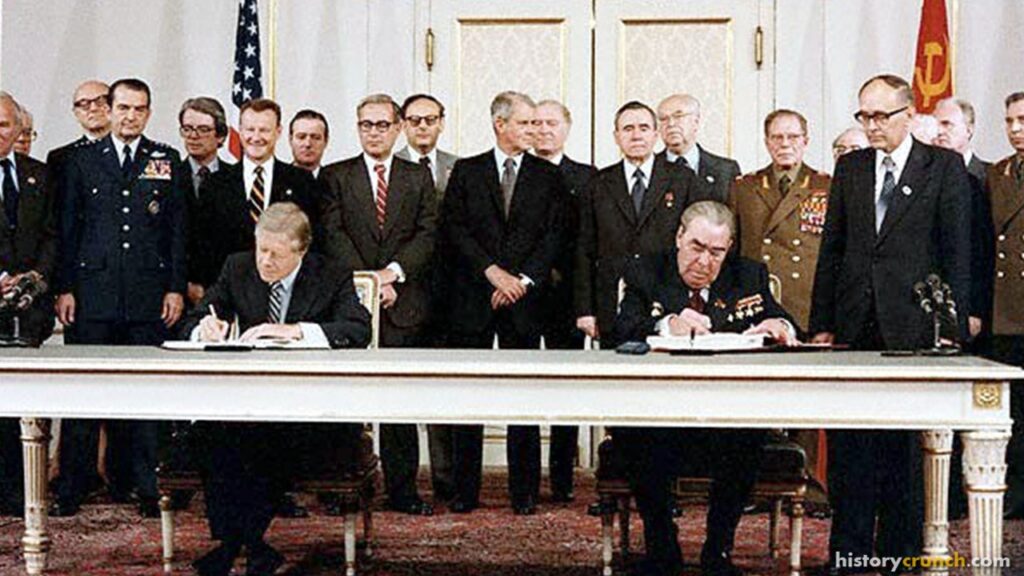
Following the conclusion of SALT I, the two superpowers shifted and began a new series of talks that historians refer to as the second round of the Strategic Arms Limitation Talks (SALT II). SALT II focused on limiting the creation of strategic nuclear weapons and the talks began in 1972 and continued until 1979. While the overall hope of SALT II was to limit the production of nuclear missiles it ultimately failed due to the Soviet invasion of Afghanistan in 1979. American President Jimmy Carter actually signed an agreement in relation to SALT II on June 18th, 1979 with Soviet leader Leonid Brezhnev, but the terms of the agreement were never ratifiedFormally approved by a government body, making a signed agreement officially binding and in effect. by the United States Senate. Before the United States Senate could review and ultimately approve the agreement, Soviet forces invaded the nation of Afghanistan. Historians consider this event to be the end of the détenteA period when tensions between the United States and Soviet Union decreased through cooperation and agreements. period of the Cold War since the conflict renewed tensions between the two superpowers. Throughout the 1980s, tensions increased until finally the Cold War ended in the late 1980s and early 1990s with the fall of the Berlin Wall and the reforms of ‘perestroika’ and ‘glasnost’ in the Soviet Union.
FactsthatCrunchOn December 27th, 1979, Soviet forces invaded Afghanistan and removed its leader from power. President Jimmy Carter responded by asking the U.S. Senate to shelve the SALT II treaty, which he had signed with Soviet leader Leonid Brezhnev just six months earlier.
U.S. and Soviet leaders had signed SALT II in Vienna, limiting nuclear weapons on both sides, and Senate debate on ratification was underway
Senate ratification stalled permanently, U.S. arms talks with the Soviet Union collapsed, and the two superpowers entered a sharp new period of Cold War tension
Disarmament Agreements in the Cold War – Helsinki Accords
During the period of SALT II, another major event related to detente occurred called the Helsinki Accords. Also called the Helsinki Final Act, the agreement was signed by 35 member nations including the United States, Canada, Soviet Union and most of Europe. The act dealt with a range of significant global issues and, therefore, was important in the overall Cold War. The discussions for the Helsinki Final Act began in 1972 and continued with the formation of the Conference on Security and Cooperation in Europe (CSCE) in July of 1973. The act dealt with a variety of issues important at the time, including: political and military issues, economic issues, human rights and future negotiations between the member countries. Similar to SALT I and SALT II, the Helsinki Final Act was an important part of detente because it involved the United States and the Soviet Union working together, which resulted in a decrease of tensions at the time.
How many nations signed the Helsinki Final Act in 1975?
Key Vocabulary
Disarmament
Détente
Strategic ballistic missile launchers
Anti-ballistic missile systems
Ratified
Proxy wars
Perestroika
Frequently Asked Questions
What were the main disarmament agreements of the Cold War?
The main disarmament agreements were SALT I, SALT II, the Anti-Ballistic Missile Treaty, and the Helsinki Accords. These treaties aimed to limit the number, types, and use of nuclear weapons. They were signed by the United States and the Soviet Union during the 1960s and 1970s.
What was SALT I and when was it signed?
SALT I was the first Strategic Arms Limitation Talks agreement, signed on May 26th, 1972. It froze the number of strategic ballistic missile launchers at their current levels. Talks had begun back in November of 1969 after long discussions between the two superpowers.
Why did SALT II fail?
SALT II failed because the Soviet Union invaded Afghanistan in 1979. President Jimmy Carter signed an agreement on June 18th, 1979, but the United States Senate never ratified it. The invasion renewed tensions and is seen as the end of the détente period.
What was détente in the Cold War?
Détente was a period of reduced tensions between the United States and the Soviet Union. It was marked by the two sides talking and working together toward common goals. The disarmament agreements are the clearest examples of détente during the Cold War.
What did the Helsinki Accords cover?
The Helsinki Accords, also called the Helsinki Final Act, were signed by 35 nations including the United States and the Soviet Union. The act dealt with political, military, economic, and human rights issues. Talks began in 1972 and led to the Conference on Security and Cooperation in Europe in July of 1973.
Cite This Article
To cite this article as a source, use one of the formats below.
MLA: Beck, Elias. “Disarmament Agreements in the Cold War: A Detailed Summary.” HistoryCrunch, 9 October 2026, https://historycrunch.com/disarmament-agreements-in-the-cold-war/.
APA: Beck, E. (2026). Disarmament Agreements in the Cold War: A Detailed Summary. HistoryCrunch. https://historycrunch.com/disarmament-agreements-in-the-cold-war/
Chicago: Beck, Elias. “Disarmament Agreements in the Cold War: A Detailed Summary.” HistoryCrunch. October 9, 2026. https://historycrunch.com/disarmament-agreements-in-the-cold-war/
Sources
- State Department — Office of the Historian
- Vladislav Zubok, A Failed Empire.