Richard Nixon was one of the most important and controversialCausing strong disagreement or opposing opinions among many people. American political leaders of the 20th century because his presidency reshaped Cold War diplomacy while ending in the Watergate scandal. He was an American politician who served as the 37th president of the United States from January 20th, 1969 to August 9th, 1974, after earlier serving as vice president under Dwight D. Eisenhower. Due to the timeframe of his presidency, he is most closely associated with the Vietnam War and Cold War.
 FactsthatCrunch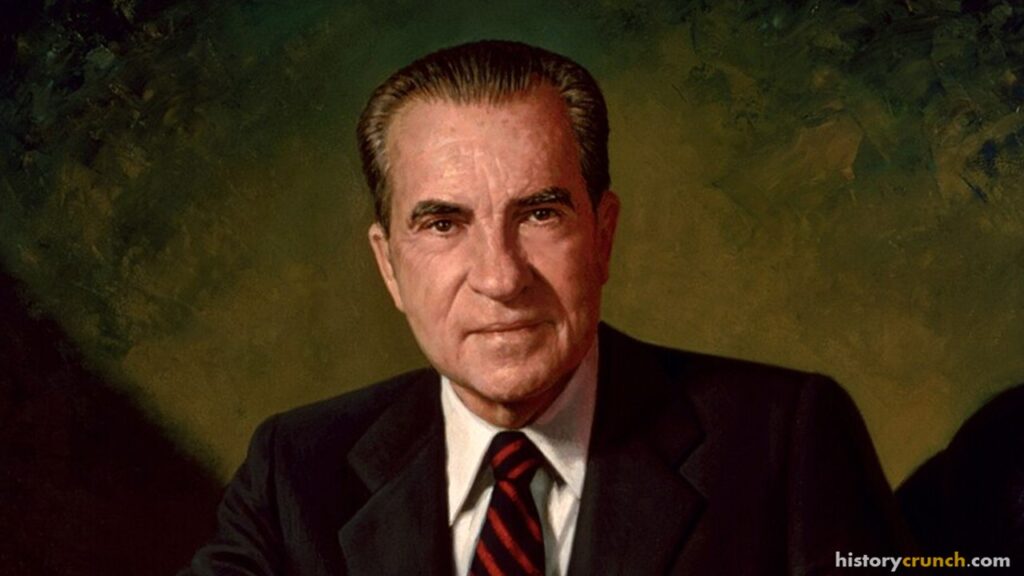
Richard Nixon – Early Life
Richard Milhous Nixon was born on January 9th, 1913, in Yorba Linda, California. He grew up in a modest Quaker family, and his early life included both financial struggle and strong expectations around discipline and hard work. These early experiences helped shape his personality and political outlook, especially his focus on perseverance and competition.
Nixon attended Whittier College and later studied law at Duke University, graduating in 1937. He then practiced law before serving in the United States Navy during World War II. His military service did not place him in major combat, but it contributed to his public image as part of the wartime generation.
FactsthatCrunchNixon served in the United States Navy during World War II
Richard Nixon – Rise in Politics
Richard Nixon entered national politics in 1946 when he was elected to the U.S. House of Representatives. During this period, he became widely associated with anti-communismStrong opposition to the political system where the government controls all property and production., especially through his role in investigating Alger Hiss, a government official accused of spying for the Soviet Union. This helped Nixon gain national attention and establish himself as a determined political figure.
He was elected to the U.S. Senate in 1950, and by 1952 he was chosen as the Republican vice-presidential candidate alongside Dwight D. Eisenhower. Nixon served as vice president from January 20th, 1953 to January 20th, 1961. During these years, he gained significant experience in foreign policy and international travel, which later shaped his approach as president. More specifically, he famously participated in the ‘Kitchen Debate‘, which was a 1959 exchange between Richard Nixon and Soviet leader Nikita Khrushchev at an American exhibition in Moscow. During the argument, Nixon defended American capitalism and consumer living standards, which made the event an important Cold War moment because it showed how the United States and Soviet Union competed through ideas as well as military power.
After losing the presidential election of 1960 to John F. Kennedy and a later race for governor of California in 1962, Nixon temporarily stepped away from politics. However, he returned in 1968 and won the presidency, presenting himself as a leader who could restore order during a time of social unrest and war. In fact, this was the height of the Vietnam War during the overall events of the Cold War.
FactsthatCrunchThis exhibit was not designed to astound but to interest. Diversity, the right to choose, the fact that we have 1,000 builders building 1,000 different houses is the most important thing. We don't have one decision made at the top by one government official. This is the difference.
Nixon spoke these words to Soviet leader Nikita Khrushchev on July 24th, 1959, as the two men debated American and Soviet living standards in the model kitchen at the American National Exhibition in Moscow. Khrushchev had been arguing that Soviet communism would surpass American capitalism, and Nixon responded by pointing to the variety of consumer goods and housing choices available to ordinary Americans as evidence that a free-market system served its citizens better than a centrally planned one.
Richard Nixon – President of the United States
Richard Nixon became the President of the United States on January 20th, 1969. His presidency took place during a difficult period marked by the Vietnam War, Cold War tensions, and domestic division. One of his main goals was to reduce American involvement in Vietnam. For instance, his policy of ‘VietnamizationNixon’s plan to hand over fighting responsibility to South Vietnamese troops while pulling U.S. soldiers out gradually.‘ aimed to transfer responsibility for the war to South Vietnamese forces while gradually withdrawing American troops.
At the same time, Nixon made major changes in foreign policy. For instance, historians refer to this period as ‘Ping-Pong DiplomacyThe 1971 friendly table tennis exchanges between the U.S. and China that helped open diplomatic relations between the two countries.‘, which was the name given to the friendly table tennis exchanges between the United States and China in 1971. It was important because it helped ease tensions between the two countries and opened the way for Nixon’s historic visit to China in February of 1972. For example, in 1972, he visited the People’s Republic of China, which had been largely isolated from the United States since 1949. This visit opened diplomatic relations between the two countries and shifted the balance of the Cold War. As well, Nixon worked toward détente, which refers to a relaxation of tensions, with the Soviet Union. This included the signing of the first Strategic Arms Limitation Talks agreement (SALT I) in May of 1972.
Nixon’s presidency also saw important domestic developments. His administration created the Environmental Protection Agency in December of 1970 and supported environmental legislation such as the Clean Air Act. These actions showed that his presidency was not only focused on foreign policy but also on major issues within the United States.
However, Nixon’s time in office became increasingly overshadowed by the Watergate Scandal. In June of 1972, individuals connected to Nixon’s campaign were caught breaking into the Democratic National Committee headquarters at the Watergate complex. Investigations later revealed attempts by members of the administration to cover up the incident. As the scandal expanded, it raised serious questions about abuse of presidential power and the limits of executive authority.
FactsthatCrunchIn February 1972, President Nixon traveled to the People's Republic of China, making the first visit by a sitting U.S. president to the country since the communist government took power in 1949.
Richard Nixon – Resignation and Death
As evidence continued to build during 1973 and 1974, Nixon faced growing political pressure. The release of tape recordings from the White House revealed his involvement in efforts to block the investigation. This led to the beginning of impeachmentThe formal process by which Congress charges a sitting president with serious wrongdoing while still in office. proceedings in the House of Representatives.
On August 8th, 1974, Nixon announced that he would resign, and he officially left office on August 9th, 1974. He became the first president in United States history to resign from office. This outcome marked a dramatic end to his political career and had a lasting impact on public trust in government.
After his resignation, Nixon lived in private life but remained involved in writing and foreign policy discussions. He died on April 22nd, 1994, in New York City.
Richard Nixon – Significance
Richard Nixon was significant because his presidency combined major achievements in foreign policy with one of the most serious political scandals in American history. His opening of relations with China and efforts at détenteA deliberate easing or relaxation of tense relations between countries, especially rival superpowers. with the Soviet Union helped reshape Cold War diplomacy and changed how the United States interacted with other global powers.
At the same time, the Watergate scandal demonstrated the importance of limits on presidential power and the role of institutions such as Congress and the courts in holding leaders accountable. As a result, Nixon’s legacy continues to be discussed as a combination of diplomatic success and political failure, which makes him one of the most complex figures in modern American history.
FactsthatCrunchNixon's February 1972 visit to the People's Republic of China broke more than two decades of limited contact between Washington and Beijing, forcing both the Soviet Union and America's allies to rethink the balance of Cold War power.
China had been largely cut off from the United States since 1949, so the visit signaled that the two governments could work together despite deep ideological differences.
By building ties with China, the United States gained leverage over the Soviet Union, because Moscow now had to worry about a closer American relationship with its rival neighbor.
The groundwork was laid by the Ping-Pong Diplomacy exchanges of 1971, showing that small, low-stakes contacts could open the door to major shifts in international relations.
The China opening helped establish an overall strategy of detente, which Nixon also applied to the Soviet Union through the signing of the Strategic Arms Limitation Talks agreement (SALT I) in May of 1972, reducing the risk of nuclear conflict.
Explore Cold War · 1947 – 1991
Keep exploring Cold War with these History Crunch resources.
Key Vocabulary
Controversial
Anti-communism
Vietnamization
Détente
Strategic Arms Limitation Talks agreement
Impeachment
Ping-Pong Diplomacy
Frequently Asked Questions
Why did Richard Nixon resign as president?
Richard Nixon resigned because of the Watergate scandal, which exposed his role in covering up a break-in. White House tape recordings revealed that he tried to block the investigation. Facing near-certain impeachment, he announced his resignation on August 8th, 1974, and left office the next day. He became the first president in United States history to resign.
What was the Watergate scandal?
The Watergate scandal began in June of 1972 when people connected to Nixon’s campaign broke into the Democratic National Committee headquarters. Later investigations showed that members of his administration tried to cover up the crime. The scandal raised serious questions about abuse of presidential power. It damaged public trust in government and ended Nixon’s political career.
What did Nixon do about the Vietnam War?
Nixon tried to reduce American involvement in the Vietnam War through a policy called Vietnamization. This plan shifted responsibility for the fighting to South Vietnamese forces. At the same time, it allowed American troops to withdraw gradually. The goal was to lower United States losses while still supporting South Vietnam.
Why was Nixon’s 1972 visit to China important?
Nixon’s visit to the People’s Republic of China in February of 1972 opened diplomatic relations between the two countries. China had been largely cut off from the United States since 1949. The friendly table tennis exchanges of 1971, known as Ping-Pong Diplomacy, helped set the stage. The visit shifted the balance of the Cold War.
What was the Kitchen Debate?
The Kitchen Debate was a 1959 exchange between Nixon and Soviet leader Nikita Khrushchev at an American exhibition in Moscow. Nixon defended American capitalism and the high living standards of United States consumers. The moment showed that the superpowers competed through ideas, not just weapons. It happened while Nixon served as vice president under Dwight D. Eisenhower.
What positions did Nixon hold before becoming president?
Before his presidency, Nixon served in the House of Representatives, the Senate, and as vice president. He was first elected to the House in 1946 and gained fame for his strong anti-communism. He won a Senate seat in 1950 and became vice president in 1953 under Eisenhower. He held that role until 1961.
Cite This Article
To cite this article as a source, use one of the formats below.
MLA: Millar, B. “Richard Nixon: A Detailed Biography.” HistoryCrunch, 10 October 2026, https://historycrunch.com/richard-nixon/.
APA: Millar, B. (2026). Richard Nixon: A Detailed Biography. HistoryCrunch. https://historycrunch.com/richard-nixon/
Chicago: Millar, B. “Richard Nixon: A Detailed Biography.” HistoryCrunch. October 10, 2026. https://historycrunch.com/richard-nixon/
Sources
- Vladislav Zubok, A Failed Empire.
- Odd Arne Westad, The Global Cold War.
- Wilson Center Digital Archive
- John Lewis Gaddis, The Cold War: A New History.