The Kitchen Debate occurred on July 24th, 1959, when Vice President Richard Nixon and Soviet Premier Nikita Khrushchev engaged in a series of unscriptedNot planned or rehearsed in advance; happening spontaneously. exchanges about the differences of capitalism and communism while touring the American National Exhibition in Moscow, the capital of the Soviet Union. The debate took place in front of journalists, photographers, and television cameras, and was broadcast to audiences in both the United States and the Soviet Union. In general, historians consider the Kitchen Debate to have been significant for several reasons, including: the way it brought the ideological conflict of the Cold War into a highly public and unusual setting, its role as a piece of American propaganda demonstrating the consumer benefits of capitalism, and its impact on the political careers of both men involved.
 FactsthatCrunch
What Was the Cold War?
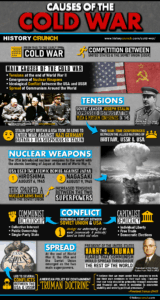
The Cold War was a period of intense political, ideologicalRelated to a set of political or economic beliefs that guide a society or government., and military tension between the United States and the Soviet Union that lasted from the end of World War II in 1945 until the early 1990s. At its heart, the Cold War was a ‘face off’ or competition between the two superpowers, rooted in a fundamental ideological conflict between the capitalism and democracy of the United States and the communism and dictatorship of the Soviet Union. Although the Cold War never escalated into direct military conflict between the two nations, it involved proxy wars, nuclear arms races, and a series of dangerous confrontations and crises. The Kitchen Debate was a product of this rivalry, representing an attempt by both nations to demonstrate the superiority of their respective systems through a cultural exchange rather than military confrontation.
Kitchen Debate – Background
To fully understand the Kitchen Debate, it is first important to understand the events that led to it. In 1958, the United States and the Soviet Union signed a cultural agreement committing both nations to hold national exhibitions in each other’s country as a way of promoting mutual understanding and reducing Cold War tensions. As part of the agreement, a Soviet exhibition opened in New York City in June of 1959, and an American exhibition was scheduled to open in Moscow the following month.
The American National Exhibition opened in Moscow on July 24th, 1959. The exhibition was designed to showcase American life, technology and consumer culture to the Soviet public and included displays provided by more than 450 American companies. It should also be noted that the exhibition was as much a piece of deliberate propagandaInformation spread by a government to promote its own system and make its rival look inferior. as it was a cultural event. For instance, the centerpiece of the American exhibition was a model suburban home, cut in half for easy public viewing, which was filled with modern consumer appliances including a dishwasher, a washing machine, and a range of other household products. The home was intended to demonstrate the high standard of living available to ordinary American families under capitalism. The model home could be purchased for approximately $14,000, and Nixon used this fact to argue that such a home was well within the means of the average American worker.
Vice President Richard Nixon traveled to Moscow to formally open the American exhibition, and Soviet Premier Nikita Khrushchev accompanied him on a tour. Both men were accompanied by a large group of journalists, photographers, and television cameras, which meant that their exchanges were captured and broadcast to a wide audience.
FactsthatCrunch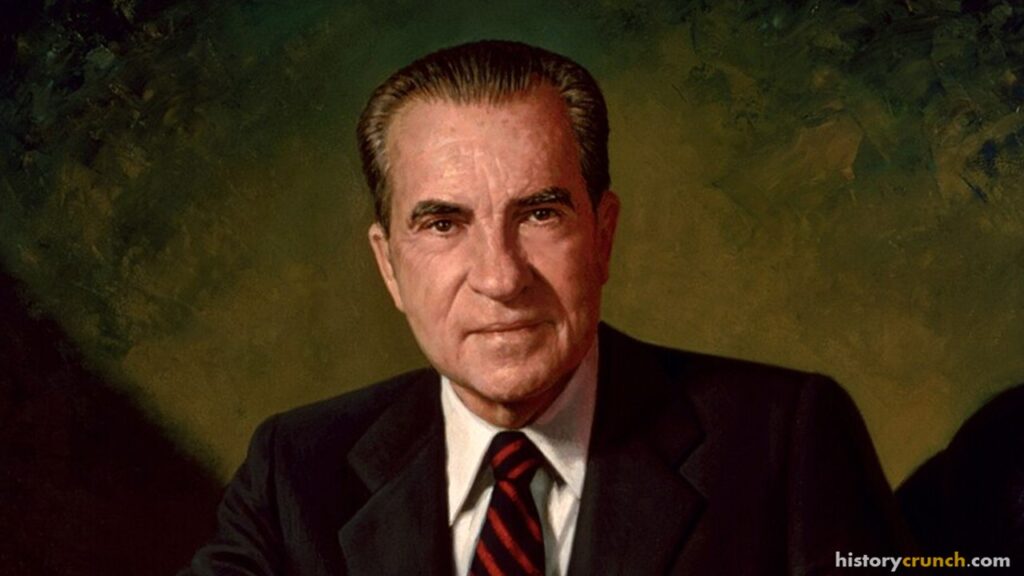
Kitchen Debate – What Happened?
The exchanges between Nixon and Khrushchev that became known as the Kitchen Debate were unscripted and took place at several locations throughout the exhibition, though they are most closely associated with the model kitchen of the display home. The two men debated through interpreters, and the conversations were recorded using the then new technology of color videotape.
As mentioned above, Nixon used the kitchen and its appliances to argue that American capitalism provided ordinary working families with a high standard of living and genuine consumer choice. He pointed to the dishwasher and other appliances as examples of how American technology and the free market worked to make life easier for ordinary people. Khrushchev was dismissive of many of the devices on display, questioning whether some of them were necessary at all and arguing that the Soviet Union would soon match and surpassTo go beyond or do better than something else. American consumer technology. He also pushed back on Nixon’s framing by arguing that Soviet citizens were entitled to housing simply by virtue of being born in the Soviet Union, whereas in America, he suggested, those without money had the right to sleep on the street.
The exchanges became heated at several points, with both men raising their voices and pointing fingers at each other. Further to this idea, Nixon challenged Khrushchev on the subject of nuclear threats, suggesting that constant Soviet threats to use nuclear missiles could lead to war. Khrushchev warned of serious consequences before pulling back and stating that he wanted peace with all nations, especially America. Regardless, it should be noted that both men also expressed a degree of mutual respect and agreed at several points that competition between their two systems should be technological and economic rather than military. In fact, before parting, the two men agreed that their conversation would be broadcast on television in both countries.
FactsthatCrunchKitchen Debate – Broadcast and Reaction
The Kitchen Debate was broadcast on the three major American television networks on July 25th, 1959, reaching a very large American audience. The Soviet Union subsequently broadcast the debate on Moscow television two days later, though Nixon’s remarks were only partially translated. As such, the two nations’ publics experienced somewhat different versions of the exchange.
In the United States, the reaction was largely positive toward Nixon. The image of the American Vice President standing up to Khrushchev and defending capitalism in a direct and confident manner played well with the American public. For instance, the famous photograph, which showed Nixon jabbing his finger at Khrushchev’s chest in a confrontational gesture, became one of the most recognized images of the Cold War era and reinforced the impression of Nixon as a strong and assertiveConfident and direct in putting forward one’s position or opinions. defender of American values. As a result, the Kitchen Debate is generally considered to have boosted Nixon’s political stature in the United States.
FactsthatCrunch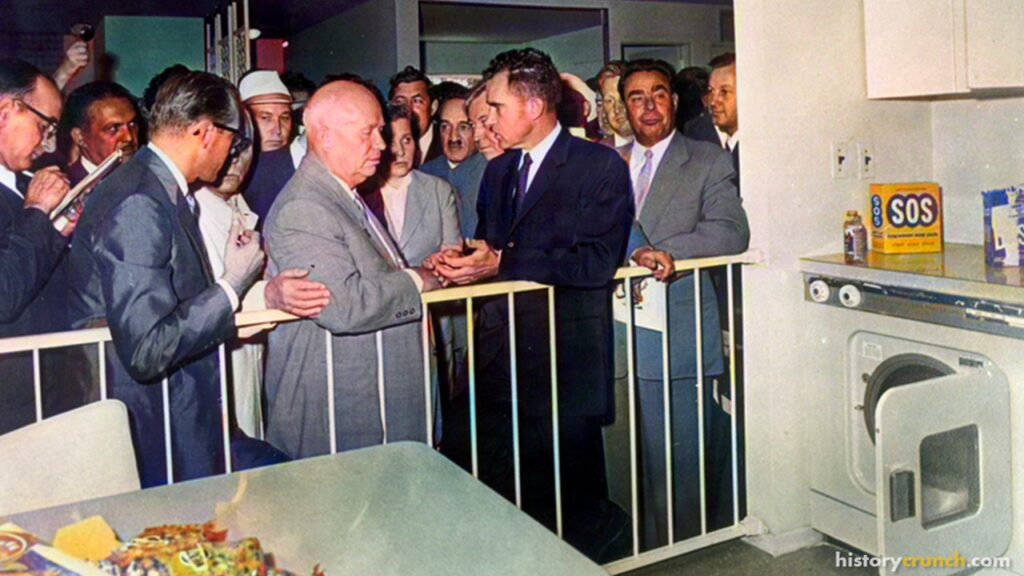 Black & whiteColor
Kitchen Debate – Significance
The Kitchen Debate was significant for several reasons. First, it was one of the most direct and public confrontations of the Cold War’s ideological conflict, bringing the arguments between capitalism and communism out of diplomaticRelated to formal relations and negotiations between governments of different countries. meetings and into an exhibition hall in front of cameras and reporters. As such, it gave ordinary people in both the United States and the Soviet Union a rare opportunity to see the leaders of the two superpowers argue their positions directly.
Second, the Kitchen Debate was an important example of how the Cold War was fought through culture and propaganda as much as through military confrontation. The American National Exhibition itself was a carefully designed piece of propaganda intended to impress Soviet citizens with the consumer benefits of capitalism. Nixon’s use of the model kitchen and its appliances to make his arguments about the superiority of the American economic system was a deliberate and effective communication strategy that reached millions of viewers on both sides.
Third, the Kitchen Debate reflected a brief but important moment in the Cold War when both the United States and the Soviet Union were exploring cultural exchange and cautious diplomatic engagement as alternatives to direct confrontation. The agreement that led to the exhibitions, and the fact that both men agreed to have their debate broadcast in each other’s countries, showed that even during a period of intense rivalry, the two superpowers were capable of engaging with each other in ways that did not involve the threat of military force. As such, the Kitchen Debate stands as one of the most unusual and significant episodes of the early Cold War era.
FactsthatCrunchThe Kitchen Debate between Nixon and Khrushchev was shown on television in both the United States and the Soviet Union.
Explore Cold War · 1947 – 1991
Keep exploring Cold War with these History Crunch resources.
Key Vocabulary
Unscripted
Ideological
Proxy wars
Propaganda
Surpass
Assertive
Diplomatic
Frequently Asked Questions
When and where did the Kitchen Debate take place?
The Kitchen Debate took place on July 24th, 1959, in Moscow, the capital of the Soviet Union. It happened at the American National Exhibition, a display of American life and technology. The most famous exchanges occurred in the kitchen of a model suburban home.
Who took part in the Kitchen Debate?
The Kitchen Debate was between American Vice President Richard Nixon and Soviet Premier Nikita Khrushchev. Nixon traveled to Moscow to open the American exhibition, and Khrushchev joined him on a tour. The two men argued through interpreters as cameras and reporters watched.
Why was it called the Kitchen Debate?
It was called the Kitchen Debate because its best known exchanges happened in the kitchen of a model American home. The home was cut in half for easy viewing and filled with appliances like a dishwasher and washing machine. Nixon used these items to argue that capitalism gave ordinary families a high standard of living.
What did Nixon and Khrushchev argue about?
They argued about whether capitalism or communism gave people a better life. Nixon pointed to modern appliances as proof of American consumer choice and comfort. Khrushchev dismissed many of the devices and claimed the Soviet Union would soon catch up. The two also touched on nuclear threats before agreeing that competition should stay economic.
Why was the Kitchen Debate important?
The Kitchen Debate was important because it brought the Cold War’s clash of ideas into a public setting in front of cameras. It showed how the Cold War was fought through culture and propaganda, not just weapons. The event also boosted Nixon’s political standing after a famous photo showed him confronting Khrushchev.
Cite This Article
To cite this article as a source, use one of the formats below.
MLA: Millar, B. “Kitchen Debate in the Cold War: A Detailed Summary.” HistoryCrunch, 13 October 2026, https://historycrunch.com/kitchen-debate-in-the-cold-war/.
APA: Millar, B. (2026). Kitchen Debate in the Cold War: A Detailed Summary. HistoryCrunch. https://historycrunch.com/kitchen-debate-in-the-cold-war/
Chicago: Millar, B. “Kitchen Debate in the Cold War: A Detailed Summary.” HistoryCrunch. October 13, 2026. https://historycrunch.com/kitchen-debate-in-the-cold-war/
Sources
- Odd Arne Westad, The Global Cold War.
- Wilson Center Digital Archive
- State Department — Office of the Historian
- John Lewis Gaddis, The Cold War: A New History.