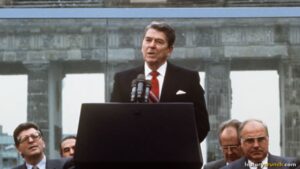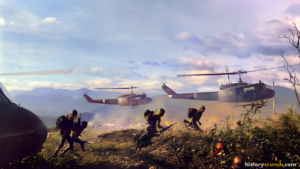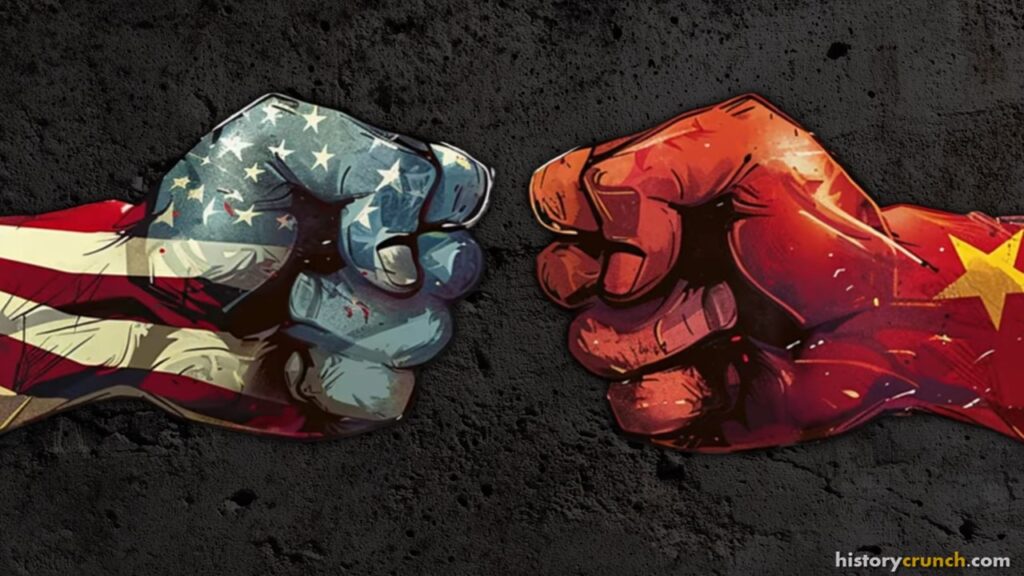
Ideological conflict in the Cold War played a considerable role in the tensions and conflicts from the time period. Lasting from the end of World War II in 1945 until the early 1990s, the Cold War was one of the most significant events of the 20th century. While the Cold War is remembered for many of the important events that occurred during its time frame, including the major wars in both Vietnam and Korea, the Cuban Missile Crisis and the buildup and fall of the Berlin Wall, it is also remembered for the ideological conflict that occurred during the time.
 FactsthatCrunch
How does a dictatorship differ from a democracy in government, power, and accountability?
What Was the Cold War?
The Cold War was essentially a ‘face off’ or competition between the United States and the Soviet Union after World War II. At the time, the Soviet Union was a communist nation that was based on the principles of collectivism, while the United States was a democratic liberal nation based primarily on the principles of individualism. This means that the Soviet Union was positioned on the far-left side of the economic spectrum, while the United States was positioned on the right side. This difference in ideology was a major source of the conflict between the two nations because throughout the Cold War, the Soviet Union sought to expand communism to other regions and the United States sought to stop it with its policy of containmentThe U.S. policy of preventing communism from spreading to additional countries or regions.. As such, many people now view the Cold War as a conflict of the left and right sides of the spectrum, among other things.
Ideological Conflict in the Cold War – Summary
This conflict was famously characterized by former British Prime Minister Winston Churchill as an ‘iron curtain’. Less than a year after the end of World War II, Churchill delivered a speech that introduced the Cold War era term ‘iron curtainChurchill’s term for the dividing line separating self-governing Western Europe from Soviet-controlled Eastern Europe.’. His March 5th, 1946 speech at Fulton, Missouri, United States was titled the “Sinews of Peace”. It was a significant step in the early stages of the Cold War. He used the term ‘iron curtain’ to describe the line in Europe that divided Western Europe from Eastern Europe. The Western European nations were self-governing and based on the western principles of capitalism and democracy, while the Eastern European nations were under Soviet communist control. Throughout the rest of the Cold War, many of the most significant events can be best understood by viewing them as part of this ideological conflict.
For example, in both the Korean War and Vietnam War, the Soviet Union was seeking to expand communism into the countries while the United States was fighting to stop the spread of communism and instead support the values of capitalism and democracy. This can also be seen in the events of the Berlin Blockade. Essentially, the Soviet Union, under the leadership of Joseph Stalin, attempted to blockade West Berlin which was in Soviet-controlled East Germany. By carrying out the blockade, Stalin had hoped to end the Allies’ (Britain, France and the United States) control of West Berlin and therefore spread communism and limit capitalism. In response, the United States carried out a massive air campaign called the Berlin Airlift. United States President Harry S. Truman refused to give in to the Soviets and fought to keep control over West Berlin. As such, it can now be viewed as an ideological conflict wherein each side was trying to promote their own ideology while trying to limit the other.
To better understand the ideological conflict of the Cold War it is first important to understand the main principles of capitalism, communism, democracy and dictatorship. During the Cold War, the United States was based upon capitalism and democracy while the Soviet Union was based upon communism and dictatorship.
FactsthatCrunchFrom Stettin in the Baltic to Trieste in the Adriatic, an iron curtain has descended across the Continent. Behind that line lie all the capitals of the ancient states of Central and Eastern Europe.
What does Churchill's use of specific city names at opposite ends of Europe in the passage suggest about the nature of Europe's division?
Ideological Conflict in the Cold War – United States
At its heart, capitalism is an economic system based upon the values of individualism and promotes individual liberty over government regulation and control. For example, laissez-faire capitalism is a form of the ideology that translates to “leave us alone” meaning that the government should remain out of the economy and instead allow individuals to freely carry out their own economic affairs. The development of capitalism as an economic system sought to reject the idea of government control of the economy and instead put the focus on individuals. On the economic spectrum, capitalism is a right-wing ideology that is fundamentally based on: private ownership, competition, free trade, self-reliance, self-interest, and the principles of supply and demand. Capitalist societies are often based on free-market economies. This system differs from communism wherein the government usually controls the means of productionThe resources, factories, and tools used to create goods in an economy. and makes all important economic decisions.
Democracy is a political system that is associated with the idea that power or authority in a society rests with the people. In general, the people exercise their authority through elections in which they choose others to represent their interests in a formal legislative structure. This system differs from dictatorships wherein many of the decisions are made by the government which is often a single person and single political party.
FactsthatCrunchLaissez-faire capitalism, the economic system the United States championed during the Cold War, has clear strengths and real drawbacks.
Ideological Conflict in the Cold War – Soviet Union
Communism is an economic system that is based on the principles of socialism, especially the earlier development of Marxism and the ideas of Karl Marx as expressed in the Communist Manifesto. Similar to MarxismThe ideas of Karl Marx calling for a classless society built on public ownership of the economy., communism is centered on the idea of establishing a society based upon public ownership of the means of production and the removal of any form of social classes. For example, communism generally focuses on the conditions of the working-class, and the wide income gap that existed in laissez-faireA form of capitalism where the government stays out of the economy and lets individuals manage their own affairs. capitalist societies. Communist countries such as the Soviet Union are also often dictatorships. Communism differs from capitalism because it focuses on the government having much more control over the economy, and is often referred to as a command economy.
A dictatorship is a form of government in which most or all authority of the country is in the hands of a single individual; the leader. While the term has been used several times throughout history, most common usage of the term is in relation to different types of dictatorships that existed in the 20th and 21st centuries. For example, famous dictators include: Adolf Hitler in Nazi Germany, Joseph Stalin in the Soviet Union, Benito Mussolini in Italy, Kim Il-Sung in North Korea and Fidel Castro in Cuba. In general, a dictatorship is the opposite of democracy, which is a system of government in which the people hold the power and the ability to choose who represents their government. Essentially, in a democracy the people have the power over the major aspects of government and have the responsibility to elect their leaders. In contrast, a dictatorship is ruled by a single person who generally acts to protect his own position and power over the welfare of the citizens.
FactsthatCrunchKey Vocabulary
Collectivism
Containment
Iron curtain
Laissez-faire
Command economy
Means of production
Marxism
Frequently Asked Questions
What was the main ideological conflict in the Cold War?
The main conflict was between the capitalist, democratic United States and the communist, dictatorial Soviet Union. The United States valued individualism and free markets, while the Soviet Union valued collectivism and government control of the economy. These opposite beliefs placed the two nations on opposite sides of the political spectrum. The clash of ideas fueled tensions for nearly 50 years.
How long did the Cold War last?
The Cold War lasted from the end of World War II in 1945 until the early 1990s. It stretched across most of the second half of the 20th century. During this time the two superpowers never fought each other directly in open war. Instead, they competed through smaller conflicts, an arms race, and the spread of their ideologies.
What did Winston Churchill mean by the “iron curtain”?
The “iron curtain” described the dividing line that split Western Europe from Eastern Europe. Churchill used the phrase in his “Sinews of Peace” speech on March 5th, 1946, in Fulton, Missouri. Western Europe stayed self-governing with capitalism and democracy. Eastern Europe fell under Soviet communist control.
How did the Berlin Blockade show the ideological conflict?
The Berlin Blockade showed each side trying to spread its own system while blocking the other. Joseph Stalin blockaded West Berlin to push out the Allies and expand communism. President Harry S. Truman answered with the Berlin Airlift, flying in supplies to keep the city free. The United States refused to give up control, defending capitalism and democracy.
What is the difference between capitalism and communism?
Capitalism is based on private ownership and competition, while communism is based on public ownership and government control. In capitalism, individuals run their own economic affairs with little government interference. In communism, the government controls the means of production and makes the major economic choices. This is why communism is often called a command economy.
How is democracy different from dictatorship?
In a democracy the people hold the power and elect leaders to represent them. In a dictatorship, most or all authority rests with a single leader. The United States followed democracy during the Cold War, while the Soviet Union was a dictatorship under Joseph Stalin. Famous dictators of the era include Adolf Hitler, Benito Mussolini, and Fidel Castro.
Cite This Article
To cite this article as a source, use one of the formats below.
MLA: Beck, Elias. “Ideological Conflict in the Cold War: A Detailed Summary.” HistoryCrunch, 8 October 2026, https://historycrunch.com/ideological-conflict-in-the-cold-war/.
APA: Beck, E. (2026). Ideological Conflict in the Cold War: A Detailed Summary. HistoryCrunch. https://historycrunch.com/ideological-conflict-in-the-cold-war/
Chicago: Beck, Elias. “Ideological Conflict in the Cold War: A Detailed Summary.” HistoryCrunch. October 8, 2026. https://historycrunch.com/ideological-conflict-in-the-cold-war/
Sources
- State Department — Office of the Historian
- Odd Arne Westad, The Global Cold War.