The Berlin Wall was one of the most significant aspects of the Cold War. It was a concrete barrier built by the East German government in 1961. They constructed it to prevent the flow of people fleeing from communist East Berlin to democratic West Berlin. The Berlin Wall became one of the most powerful symbols of the Cold War and demonstrated the division between the two main superpowersThe two most powerful nations in the world during the Cold War, the United States and the Soviet Union. (United States and Soviet Union) and their ideological differences (democracy and capitalism versus communism).
What Was the Cold War?
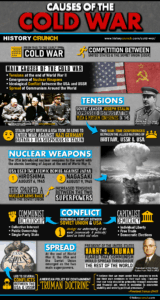
The Cold War was a major world event that took place from approximately 1945 until 1991. In general, the Cold War was a period of increased tensions and hostility between the superpowers of the United States and the Soviet Union (USSR). It was characterized by a global struggle between capitalism and communism, with both sides competing for influence around the world. Although it never escalated into direct war between the superpowers, it involved proxy wars, nuclear arms races, and ideological confrontations. The Berlin Wall was constructed during the Cold War, and became a symbol of the ideological differences between the United States and the Soviet Union. In fact, the fall of the Berlin Wall in 1989 was a symbolic end of the heightened tensions of the Cold War and displayed the growing issues with the Soviet Union.
Berlin Wall – Background
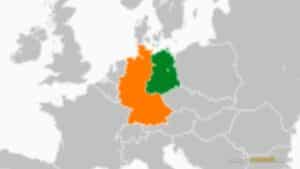
When World War II came to an end in 1945, the Allied powers (USA, Britain and the Soviet Union) held conferences to discuss how Germany should be divided up upon its defeat. The first conference was held at Yalta in February of 1945 and the second was held at Potsdam in July of the same year. The agreements ultimately led to the splitting of the defeated Germany into four Allied occupation zonesSections of defeated Germany divided among the Allied powers to each control after World War II. with portions controlled by the Soviet Union, United States, Britain and France.
After the division of the country, Berlin (the capital of Germany) was located entirely in the Soviet Union controlled portion of the country. Due to the agreements at the Yalta and Potsdam Conferences, Berlin was also split into four portions between the same four Allied Powers. As such, West Berlin was controlled by the three capitalist and democratic nations (France, Britain and the United States), while East Berlin was controlled by the communist Soviet Union.
This is significant, because it made Berlin a central focus point of the entire Cold War. For instance, the Berlin Blockade and the Berlin Airlift were important events in the early years of the Cold War and showcased the clash between the United States and its allies against the Soviet Union. Tensions in the city first erupted in 1948 when the Soviet Union tried to blockade the city and prevent the western half of Berlin from receiving supplies. The United States and its allies withstood the blockade by carrying out an unprecedented airlift of supplies to the western half of the city. The Soviets were eventually forced to end the blockade of Berlin in 1949. Regardless, the conflict highlighted the symbolic importance of Berlin to the Cold War.
 FactsthatCrunch
The United States and its allies began airlifting supplies into West Berlin to counter the Soviet blockade.
Berlin Wall – When and Why Was It Created?
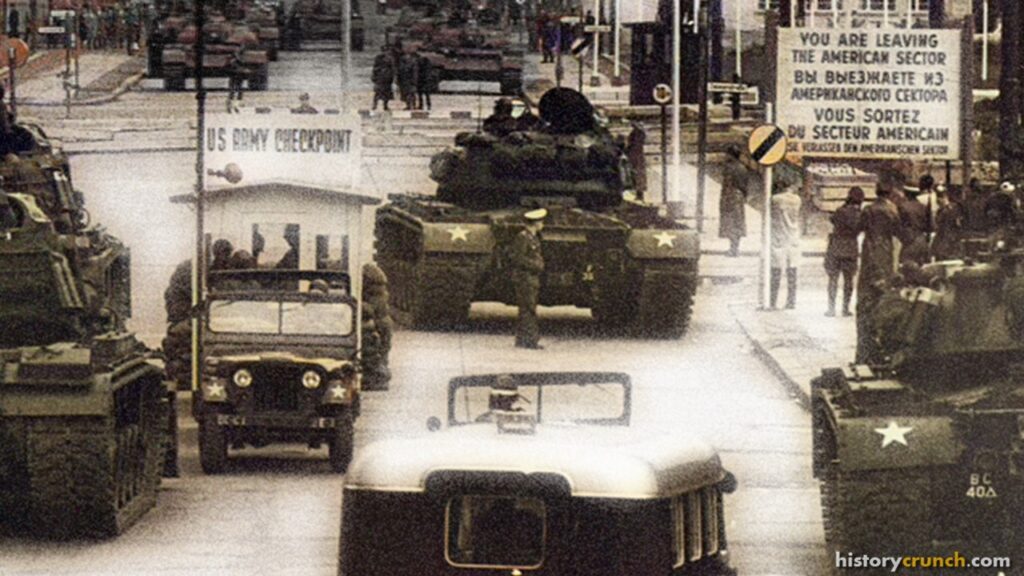
On August 13th, 1961, Berlin again became a central focus point for Cold War tensions when East German troops locked down the border between East Germany and West Berlin. West Berlin was effectively surrounded and turned into an isolated island of capitalism and democracy in the communism of East Germany. In fact, the East German troops laid barbed wire and makeshiftHastily put together from whatever materials are available, not built to last. fences across the border, establishing an early version of the Berlin Wall.
Before the creation of the wall, Berliners on both sides were able to move freely throughout the city. People were able to cross the border in order to work, shop or visit with friends and family. The creation of the Berlin Wall effectively ended this, and forced Berliners to cross at Soviet checkpoints. This had devastating impacts for Berlin families because now some family members were separated and unable to see each other.
The East German government claimed that the Berlin Wall was built to protect East Germany from western aggression. However, many westerners viewed the creation of the wall as an attempt by the Soviets to stop East Germans from fleeing East Germany into West Berlin. In the years leading up to the creation of the Berlin Wall nearly 3 million East Germans fled to West Berlin in search of economic and political freedoms not available in the Soviet-controlled territory of East Germany. This was an embarrassment to the Soviet Union and they sought to stop the flow of people to West Berlin. As such, the East German government constructed the Berlin Wall as a means of preventing people from fleeing to West Berlin.
FactsthatCrunchHow did each side explain the purpose of the Berlin Wall?
Berlin Wall – Death Strip
As stated above, the early version of the Berlin Wall was made of relatively makeshift fences, barbed wire and guard towers. However, as time passed, the East German government eventually replaced it with a concrete wall complete with watchtowers, bunkers and trenches. The concrete wall was 12 feet high and was nearly impossible to climb over. A second fence was later built that ran parallel to the original creating a space in between that became known as the ‘Death StripThe open, heavily guarded space between two parallel sections of the Berlin Wall where guards shot escapees.‘. East German troops patrolled the wall and were ordered to shoot any would-be escapees on sight. In addition to the physical barriers, the wall was equipped with alarm systems, dogs, and barbed wire, making it one of the most fortified borders in the world. The Berlin Wall eventually stretched over 155 kilometers (about 96 miles) around West Berlin.
FactsthatCrunchWhat really pushed East Germany to seal its border with West Berlin in 1961?
Berlin Wall – Reagan’s ‘Tear Down This Wall’
In June of 1987, United States President Ronald Reagan visited West Berlin and delivered a speech to West Berliners at the Brandenburg Gate. The Brandenburg Gate is a historic monument in Berlin and was originally built in the late 18th century. Over time, it became a powerful symbol of German history, especially during the Cold War, when it stood just behind the Berlin Wall and represented the division between East and West Berlin.
As part of his speech, Reagan famously challenged the Soviet leader, Mikhail Gorbachev, to open the Brandenburg Gate and to ‘tear down’ the Berlin Wall. Reagan’s speech was unexpected and his challenge to Gorbachev to ‘tear down this wall’ became one of the most famous phrases from the entire Cold War. His stance against communism and support for freedom was popular with many in both East and West Germany. In fact, Reagan’s words symbolized growing Western pressure and hope for the reunification of Germany as the Cold War neared its end. Just two years later, the Berlin Wall fell, marking a key moment in the collapse of Soviet influence in Eastern Europe. While Reagan’s speech was not directly responsible for the fall of the Berlin Wall, it highlighted the changing views that were occurring in the Soviet Union.
Berlin Wall – Fall of the Berlin Wall
The Berlin Wall stood for nearly 30 years. In that time it was a daily reminder to Berliners and the world of the divide that existed between the major superpowers of the world. However, in 1989, the Berlin Wall fell as a result of a changed attitude in the Soviet Union and citizen uprising. For instance, growing public pressure, public protests, economic struggles in East Germany intensified the call for change. The East German government, facing internal unrest and international pressure, announced new travel policies allowing citizens to cross the border freely. In fact, on November 9th, 1989, an East German spokesman announced a change in policy related to the Berlin Wall. He effectively announced a change in travel policy and that Berliners were now free to cross the border. That night, both East and West Berliners gathered at the wall and celebrated an end to the wall that had divided their city. They used hammers, bulldozers and cranes to dismantle and demolish the wall.
The fall of the Berlin Wall was significant for a number of reasons. First, it paved the way for German reunification, which was officially completed just a year later on October 3rd, 1990. It also signaled the decline of communist regimes across Eastern Europe. At the time, the Soviet Union was experiencing major economic issues of its own and was undergoing a period of change and reform. This is best evidenced by Soviet leader Mikhail Gorbachev’s policies of glasnost (openness) and perestroika (restructuring), which were economic and political reforms that fundamentally altered life for many in the Soviet Union. As such, historians view the fall of the Berlin Wall as the symbolic end of the Cold War. Today, the Berlin Wall serves as a reminder of the ideological conflict that separated people globally for nearly 45 years.
FactsthatCrunchOn November 9th, 1989, East German spokesman Guenter Schabowski read aloud a new travel policy at a live press conference and, when asked when it would take effect, replied that it was effective immediately. He had not been briefed on the details. Within hours, crowds gathered at crossing points across Berlin and guards, overwhelmed and receiving no orders to stop them, opened the gates.
The Berlin Wall had divided East and West Berlin for 28 years, and crossing required permission from the East German government.
Berliners from both sides tore down the wall that same night, setting Germany on a path to official reunification on October 3rd, 1990
Explore Cold War · 1947 – 1991
Keep exploring Cold War with these History Crunch resources.
Key Vocabulary
Superpowers
Proxy wars
Occupation zones
Makeshift
Death Strip
Glasnost
Perestroika
Frequently Asked Questions
When was the Berlin Wall built?
The Berlin Wall was first built on August 13th, 1961, when East German troops locked down the border. The earliest version was made of barbed wire and makeshift fences. Over time the East German government replaced it with a tall concrete wall and guard towers.
Why was the Berlin Wall built?
The Berlin Wall was built to stop East Germans from fleeing to West Berlin. In the years before 1961, nearly 3 million people had crossed over in search of economic and political freedom. The East German government claimed the wall protected the country from western aggression, but its real purpose was to trap its own people.
What was the Death Strip?
The Death Strip was the open space between two parallel sections of the Berlin Wall. The concrete wall stood 12 feet (3.7 m) high, and a second fence ran alongside it. Guards patrolled the gap with dogs and alarms and were ordered to shoot anyone trying to escape.
What did Reagan mean by “Tear down this wall”?
In June of 1987, President Ronald Reagan challenged Soviet leader Mikhail Gorbachev to “tear down” the Berlin Wall. He gave the speech at the Brandenburg Gate in West Berlin, a monument that stood just behind the wall. The phrase became one of the most famous moments of the Cold War and showed growing Western hope for reunification.
When did the Berlin Wall fall?
The Berlin Wall fell on November 9th, 1989, after an East German spokesman announced that citizens could cross the border freely. Crowds from both sides gathered and began tearing it down with hammers, bulldozers, and cranes. German reunification was officially completed about a year later, on October 3rd, 1990.
How long was the Berlin Wall?
The Berlin Wall stretched about 96 miles (155 km) around West Berlin. It turned the western half of the city into an isolated island of democracy inside communist East Germany. The wall stood for nearly 30 years before it came down.
Cite This Article
To cite this article as a source, use one of the formats below.
MLA: Beck, Elias. “Berlin Wall: A Detailed Summary.” HistoryCrunch, 9 October 2026, https://historycrunch.com/berlin-wall/.
APA: Beck, E. (2026). Berlin Wall: A Detailed Summary. HistoryCrunch. https://historycrunch.com/berlin-wall/
Chicago: Beck, Elias. “Berlin Wall: A Detailed Summary.” HistoryCrunch. October 9, 2026. https://historycrunch.com/berlin-wall/
Sources
- Vladislav Zubok, A Failed Empire.
- Odd Arne Westad, The Global Cold War.
- John Lewis Gaddis, The Cold War: A New History.
- State Department — Office of the Historian