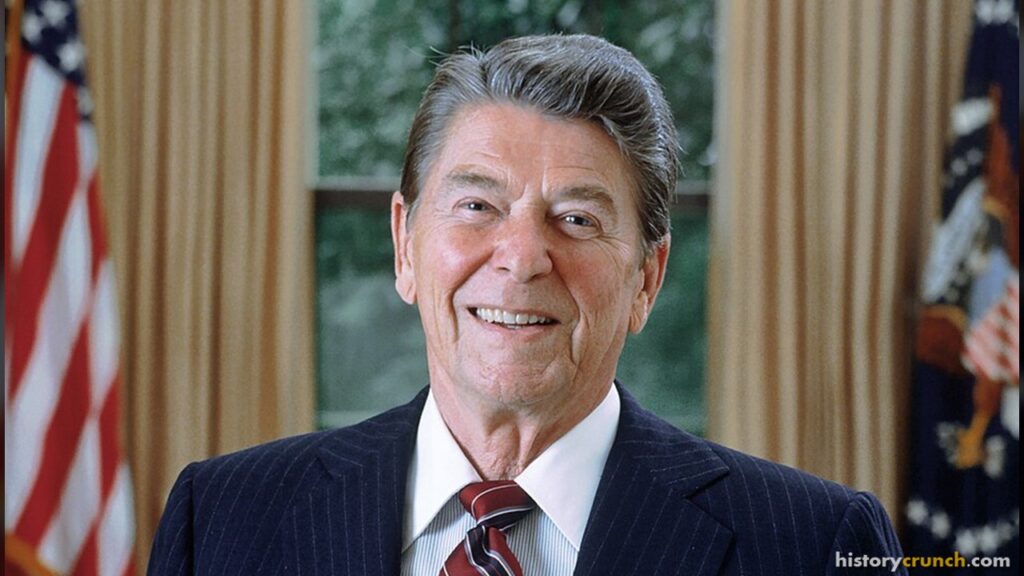
Ronald Reagan was the 40th president of the United States, serving from January 20th, 1981, to January 20th, 1989, after earlier careers in broadcastingWorking in radio or television to communicate information or entertainment to a large audience., acting, and state politics. He played an important role in American history in the 20th century, as his presidency was connected with major events such as: the Cold War, major economic changes and an assassination attempt.
 FactsthatCrunch
Reagan built his public voice first through radio sports announcing, then through Hollywood films, and later as a television host, developing a communication style that shaped how he led and persuaded as a political figure. His 1987 challenge to Soviet leader Mikhail Gorbachev in West Berlin and his 1994 open letter announcing his Alzheimer's diagnosis are two of the most remembered public moments of his career outside the White House.
Ronald Reagan – Early Life
Ronald Wilson Reagan was born on February 6th, 1911, in Tampico, Illinois. His parents were John Reagan and Nelle Reagan, and he spent much of his childhood in Illinois as his family moved between towns before settling in Dixon. Reagan later attended Eureka College, where he developed interests in sports, public speaking, and student activities. These experiences helped shape the communication style that later made him one of the most recognizable political figures in the United States.
After college, Reagan worked as a radio sports announcer. He later moved into film and became a Hollywood actor, appearing in several movies before also becoming a television host. During World War II, he served in the U.S. Army, although his service was mainly in training and film-related assignments rather than overseas combat. Therefore, before entering politics, Reagan had already built a public image as a confident speaker and media personality.
Before he became a Hollywood actor, Ronald Reagan worked as a radio sports announcer.
Ronald Reagan – Rise in Politics
Reagan’s path into politics was unusual. Unlike many presidents, he did not begin as a lawyer or longtime elected official. Instead, he first became widely known as an actor and public spokesman. Before entering politics, Ronald Reagan served as president of the Screen Actors GuildThe Hollywood union that represented film actors and gave Reagan early leadership experience., which was the union for film actors in Hollywood. This was important because it gave Reagan leadership experience and helped raise his profile long before he became governor of California and later president.
Over time, his political views moved in a more conservative direction, and he became an important voice for the Republican Party. In 1966, he won election as governor of California and began serving in 1967. He held that office for two terms, which gave him major experience in state government and made him a national political figure.
Reagan sought the Republican nomination for the presidency in 1968 and again in 1976, but he did not win. Even so, those campaigns helped him build support among conservatives. By 1980, the United States was dealing with high inflation, economic uncertainty, and foreign policy problems. Reagan appealed to many voters by promising stronger leadership, lower taxes, reduced government spending in some areas, and a tougher stance against the Soviet Union. He ultimately defeated President Jimmy Carter in the election of November 1980.
FactsthatCrunchIt is the fall of 1980, and you are Jimmy Carter, president of the United States during the Cold War era. Inflation is high, the economy is struggling, and American hostages are still held in Iran with no clear end in sight. Voters are losing confidence, and Republican challenger Ronald Reagan is telling the country it needs stronger leadership, lower taxes, and a tougher stance against the Soviet Union. If you cannot convince Americans that staying your course is the right choice, you will lose the presidency in November.
Ronald Reagan – President of the United States
Reagan became president on January 20th, 1981. On that same day, the American hostages who had been held in Iran were released, which added to the dramatic beginning of his presidency. Soon after taking office, Reagan proposed higher defense spending, lower taxes, and cuts to many domestic programs. This approach became strongly associated with what historians and economists later called ‘ReaganomicsReagan’s economic policy of cutting taxes, reducing regulation, and trimming domestic programs to spur growth.‘, which focused on tax reduction, deregulationRemoving or reducing government rules that control how businesses operate., and the belief that economic growth would expand if businesses and individuals kept more of their money.
His presidency faced an early shock on March 30th, 1981, when he was shot and seriously wounded in an assassination attempt outside a Washington hotel. Reagan survived after emergency surgery, and his recovery increased the public image of him as calm and resilient. Regardless, the event also reminded Americans of how suddenly a presidency could be thrown into crisis.
Domestically, Reagan’s years in office were marked by both recovery and controversy. The United States experienced a serious recession early in his presidency, but by 1983 the economy was growing again. Reagan also signed major legislation connected to taxes and Social Security reform. At the same time, critics argued that his policies increased inequality and federal deficits. As such, Reagan’s domestic record remains debated: supporters point to economic growth and renewed confidence, while critics focus on social cuts and rising debt.
Foreign policy was one of the most important parts of Reagan’s presidency. He took a hard line against the Soviet Union and greatly increased military spending. In March of 1983, he announced the Strategic Defense InitiativeA proposed missile defense system Reagan announced in 1983 to protect against nuclear attack., which aimed to create a missile defense system. He also took strong anti-communist positions in several parts of the world. For instance, the United States invaded Grenada on October 25th, 1983, and Reagan’s administration remained heavily involved in Cold War struggles in places such as Central America and the Middle East.
However, Reagan’s foreign policy also included setbacks. In October of 1983, 241 United States servicemen were killed in the bombing of the Marine barracks in Beirut, Lebanon. Later, his administration became involved in the Iran-Contra scandalA secret scheme involving arms sales to Iran and funneling that money to Nicaraguan rebel fighters., which centered on secret arms sales to Iran and the diversion of money to the Contra rebels in Nicaragua. This badly damaged the administration’s reputation because it suggested that officials had acted against stated U.S. policy and legal restrictions. Therefore, Reagan’s presidency included both major Cold War successes and serious controversy.
Even so, Reagan is especially remembered for his role in the later Cold War. In June of 1987, he spoke in West Berlin and famously challenged Soviet leader Mikhail Gorbachev to tear down the wall dividing Berlin. His words became one of the best-known moments of the Cold War. While Reagan did not end the Cold War by himself, he was an important part of the wider pressure, diplomacy, and military competition that shaped the final years of Soviet power.
Reagan won reelection in 1984 by a large margin, defeating Walter Mondale. He left office on January 20th, 1989, after serving two full terms. His vice president, George H.W. Bush, then won the presidency, which showed that Reagan had helped strengthen the Republican Party at the national level.
Mr. Gorbachev, tear down this wall!
Ronald Reagan – Later Years and Death
After leaving the White House, Reagan retired to California. He spent much of his time working on his memoirs and helping oversee the creation of his presidential library in Simi Valley. For several years, he remained a respected public figure, although he appeared less often in public life as he got older.
On November 5th, 1994, Reagan publicly announced that he had been diagnosed with Alzheimer’s disease. By sharing the news openly, he and his family helped bring greater public attention to the illness. In the years that followed, he mostly disappeared from public life as his condition worsened. Reagan died on June 5th, 2004, at the age of 93. He received a state funeral, and he was buried at the Ronald Reagan Presidential Library in California.
Ronald Reagan – Significance
Ronald Reagan was significant because he transformed conservative politics in the United States and became one of the defining leaders of the late Cold War. His presidency helped push the Republican Party in a more clearly conservative direction on taxes, defense, and the role of government. As well, his strong anti-Soviet stance, public confidence, and communication skills made him one of the most influential presidents of the modern era.
At the same time, Reagan remains a debated historical figure. Some people see him as the leader who restored American confidence, encouraged economic growth, and helped the United States win the Cold War. Others argue that his policies increased deficits, widened social inequality, and overlooked major problems at home and abroad. This is important because Reagan’s legacy still shapes political debates in the United States today.
FactsthatCrunchSupporters argue that Reagan's tax cuts and deregulation helped pull the United States out of a serious recession. By 1983 the economy was growing again, and many Americans felt renewed confidence in the country's direction. They credit his policies with creating conditions for sustained economic growth through the mid to late 1980s.
Critics argue that Reagan's cuts to domestic programs reduced support for lower-income Americans and widened inequality. They also point out that his policies drove up federal budget deficits significantly over his two terms. In their view, the economic growth of the 1980s came at a cost that fell hardest on vulnerable communities.
Explore Cold War · 1947 – 1991
Keep exploring Cold War with these History Crunch resources.
Key Vocabulary
Broadcasting
Screen Actors Guild
Reaganomics
Deregulation
Strategic Defense Initiative
Iran-Contra scandal
Alzheimer’s disease
Frequently Asked Questions
What was Ronald Reagan known for before becoming president?
Reagan was known as a Hollywood actor and radio sports announcer before he entered politics. He also led the Screen Actors Guild, the union for film actors, which gave him early leadership experience. Later he served two terms as governor of California, starting in 1967. These jobs helped him become a national political figure.
What was Reaganomics?
Reaganomics was the name given to Reagan’s economic plan of lower taxes, less regulation, and cuts to many domestic programs. The idea was that growth would increase if people and businesses kept more of their money. Supporters point to the economic recovery that began by 1983. Critics argue it raised federal deficits and widened inequality.
What happened in the 1981 assassination attempt on Reagan?
On March 30th, 1981, Reagan was shot and seriously wounded outside a Washington hotel. He survived after emergency surgery, just months into his first term. His calm recovery strengthened his public image as resilient. The event also showed how quickly a presidency could face a crisis.
What was the Iran-Contra scandal?
The Iran-Contra scandal involved secret arms sales to Iran and sending the money to the Contra rebels in Nicaragua. It badly damaged the administration’s reputation during Reagan’s second term. The actions appeared to go against stated U.S. policy and legal limits. The scandal remains one of the most debated parts of his presidency.
Did Ronald Reagan end the Cold War?
Reagan did not end the Cold War by himself, but he played an important role in its final years. He increased military spending and took a hard line against the Soviet Union. In June of 1987, he urged Soviet leader Mikhail Gorbachev to tear down the Berlin Wall. His pressure and diplomacy helped shape the end of Soviet power.
When did Ronald Reagan die?
Reagan died on June 5th, 2004, at the age of 93. He had announced in 1994 that he was diagnosed with Alzheimer’s disease, then mostly left public life. He received a state funeral and was buried at his presidential library in Simi Valley, California. Sharing his diagnosis helped raise public awareness of the illness.
Cite This Article
To cite this article as a source, use one of the formats below.
MLA: Millar, B. “Ronald Reagan: A Detailed Biography.” HistoryCrunch, 10 October 2026, https://historycrunch.com/ronald-reagan/.
APA: Millar, B. (2026). Ronald Reagan: A Detailed Biography. HistoryCrunch. https://historycrunch.com/ronald-reagan/
Chicago: Millar, B. “Ronald Reagan: A Detailed Biography.” HistoryCrunch. October 10, 2026. https://historycrunch.com/ronald-reagan/
Sources
- Odd Arne Westad, The Global Cold War.
- Vladislav Zubok, A Failed Empire.
- John Lewis Gaddis, The Cold War: A New History.