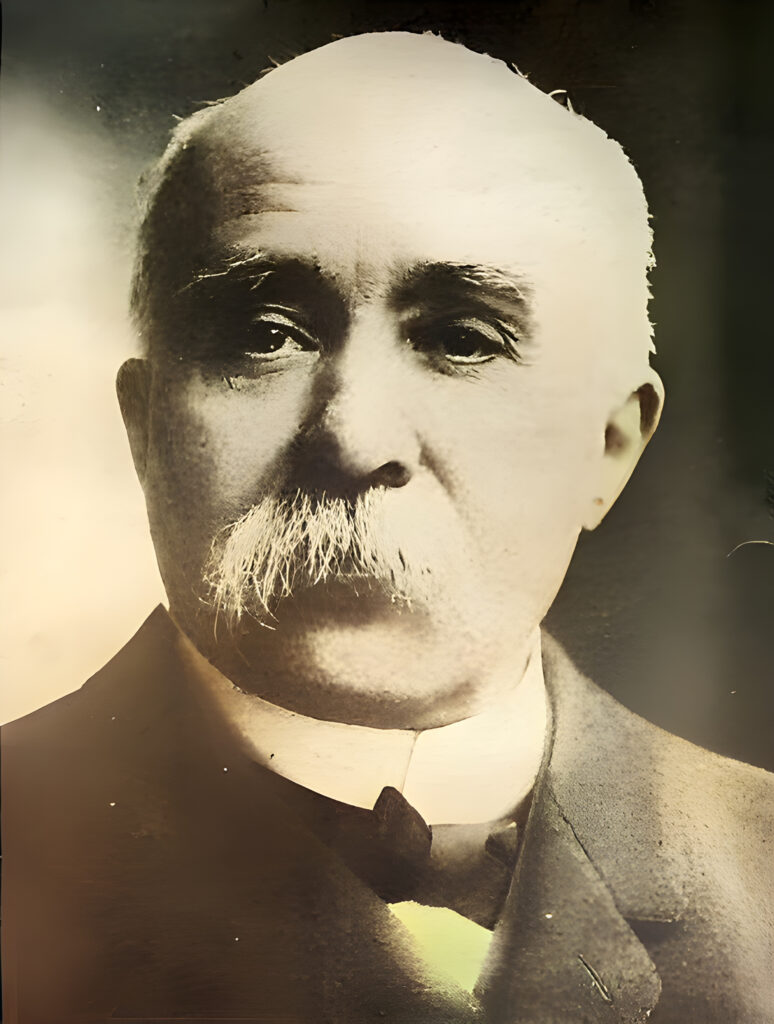
Georges Clemenceau was one of the most important political figures in French history and the man most responsible for leading France to victory in World War I. He served as Prime Minister of France from 1917 to 1920 and played a central role in negotiating the Treaty of Versailles, the peace agreement that formally ended the war. Known throughout his life for his fierce and combative personality, he earned the nickname the Tiger, and later the title Father of Victory.
 FactsthatCrunch
Clemenceau led France as Prime Minister during the final, critical years of World War I, pushing for a unified Allied command under General Ferdinand Foch and refusing any negotiated peace with Germany. At the Paris Peace Conference he chaired the talks that produced the Treaty of Versailles, insisting on the return of Alsace and Lorraine and a fifteen-year Allied occupation of the Rhineland to protect France from future German aggression.
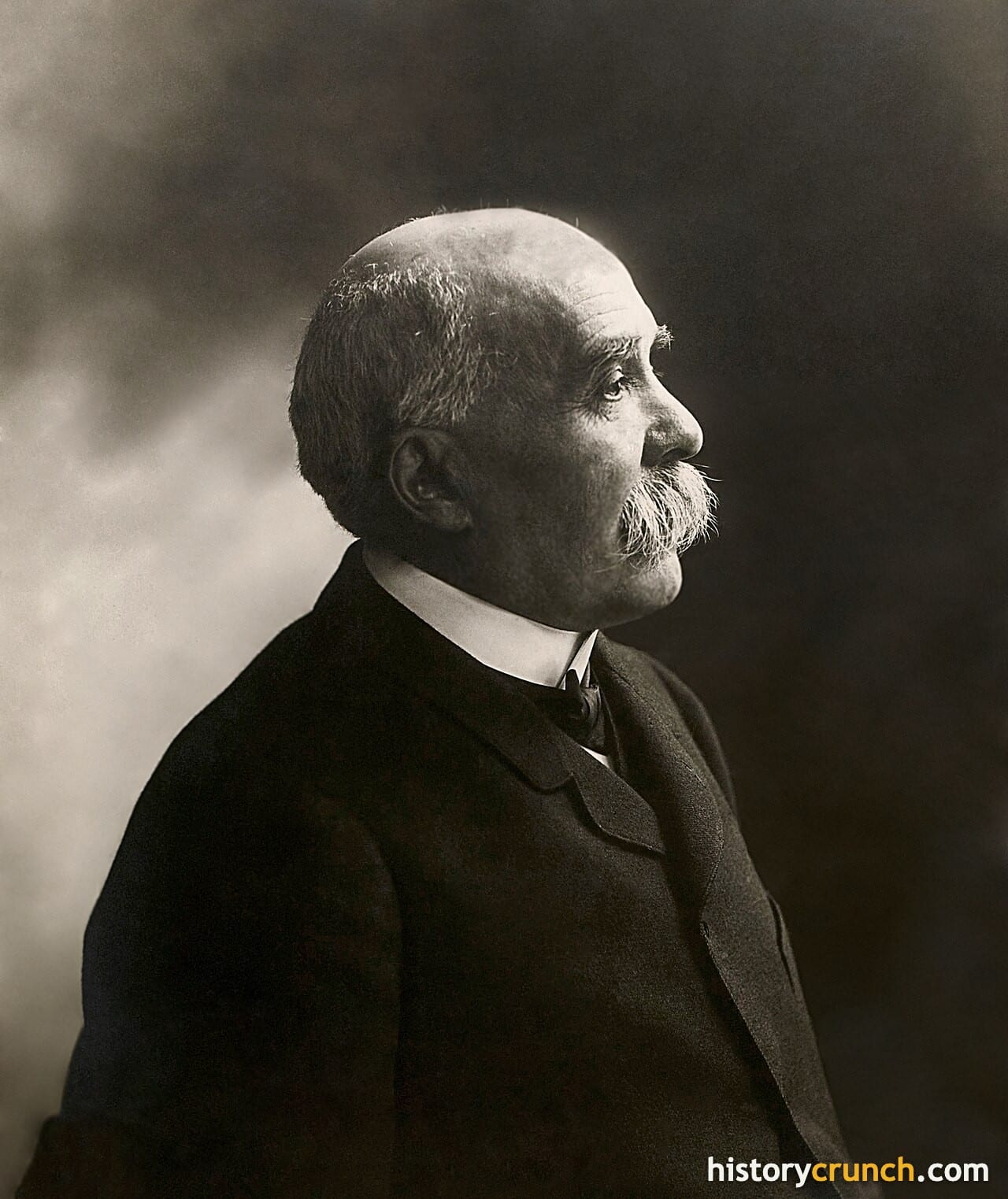
Georges Clemenceau’s Early Life
Georges Clemenceau was born on September 28th, 1841 CE in the town of Mouilleron-en-Pareds in the Vendée region of western France. His father, Benjamin Clemenceau, was a passionate republicanSomeone who believes in a government where citizens elect their leaders, without a king or emperor in power. who opposed the rule of Napoleon III and instilled in his son a deep commitment to the ideals of the French Revolution, including liberty, equality and the separation of church and state. Benjamin was briefly arrested for his political views in 1858 CE, and the experience made a lasting impression on young Georges, who grew up believing that the defense of republican principles was one of the most important duties a French citizen could fulfill.
Clemenceau studied medicine and qualified as a doctor. He spent several years in the United States in the 1860s, where he taught at a girls’ school in Connecticut and married his American wife, Mary Plummer. He returned to France in 1869 CE, just in time to witness the outbreak of the Franco-Prussian War of 1870 to 1871, in which France was decisively defeated by Prussia and forced to hand over the territories of Alsace and Lorraine to the newly unified German Empire. The humiliation of that defeat and the harsh peace terms imposed on France shaped Clemenceau’s political outlook for the rest of his life. Like Raymond Poincaré, he spent his career haunted by the memory of France’s defeat and determined that Germany must never be allowed to threaten France again.
FactsthatCrunchBefore he led France, Georges Clemenceau lived in the United States in the 1860s, taught at a girls' school in Connecticut and married an American, Mary Plummer.
He had trained as a doctor in France. He returned home in 1869, just before the Franco-Prussian War, and France's defeat and loss of Alsace and Lorraine in that war shaped his politics for the rest of his life.
Georges Clemenceau’s Political Career
Clemenceau entered politics in the years following the Franco-Prussian War, winning election to the French National Assembly in 1871 CE as a Radical RepublicanA member of a French political group that strongly supported democratic rights, secularism, and opposition to monarchy.. He quickly established himself as one of the most formidable debaters and political fighters of his generation. He was also a highly talented journalist and founded several newspapers over the course of his career, using them to voice his strongly held opinions on politics, government and the state of France. For instance, in 1913 CE he founded a daily newspaper called L’Homme Libre, meaning The Free Man, which he used to criticize what he saw as France’s inadequate military preparations in the face of the German threat.
Clemenceau served his first term as Prime Minister of France from 1906 to 1909 CE. During this period he passed significant labor reforms and governed with his characteristic energy and determination. However, he also faced criticism for his sometimes heavy-handed approach to industrial strikes, which alienated some of his former supporters on the political left. After leaving office he returned to journalism and the Senate, where he became increasingly vocal about the need for France to prepare for what he believed was an inevitable war with Germany.
FactsthatCrunchWhat did Clemenceau use L'Homme Libre to attack before World War I?
Georges Clemenceau and World War I
When World War I broke out in August of 1914 CE, Clemenceau was seventy-two years old and out of government. He threw himself into supporting the war effort from his seat in the Senate, using his newspapers and his platform in parliament to push relentlessly for a stronger, more determined war effort. He was sharply critical of what he saw as weak or ineffective leadership and demanded more resources for the front, better treatment of wounded soldiers and greater accountability from the military commanders. His criticisms made him popular with ordinary soldiers and with many in the French public, even as they made him enemies in the government.
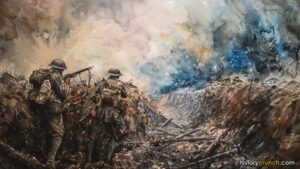
By November of 1917 CE, France was in crisis. Three years of devastating trench warfare had killed hundreds of thousands of French soldiers, morale among the troops was collapsing and there were growing voices calling for a negotiated peace with Germany. President Raymond Poincaré, despite his deep personal dislike of Clemenceau, concluded that the Tiger was the only man tough enough to pull France through. On November 16th, 1917 CE, Clemenceau was appointed Prime Minister for the second time at the age of seventy-six. His message to the French parliament was simple and uncompromising. He declared that his entire domestic and foreign policy could be summarized in one phrase: wage war. He immediately had several prominent pacifistA person who opposes war and believes conflicts should be solved without violence or fighting. politicians arrested for seeking a negotiated peace, telling the chamber of deputies that France’s only duty was to stand with its soldiers and fight until victory was achieved.
Clemenceau’s leadership transformed the French war effort. He visited the front lines regularly, boosting the morale of exhausted soldiers with his presence and his fierce determination. He worked to unify the Allied command structure, supporting the appointment of the French general Ferdinand Foch as Supreme Allied Commander in 1918 CE so that British, French and American forces could be coordinated more effectively. When the armisticeA formal agreement between enemies to stop fighting, ending combat without yet settling a final peace treaty. was finally signed on November 11th, 1918 CE, ending the fighting, Clemenceau reportedly broke down in tears of relief. He was celebrated across France as the Father of Victory, the man whose iron will had carried the country through its darkest hour.
Georges Clemenceau and the Treaty of Versailles
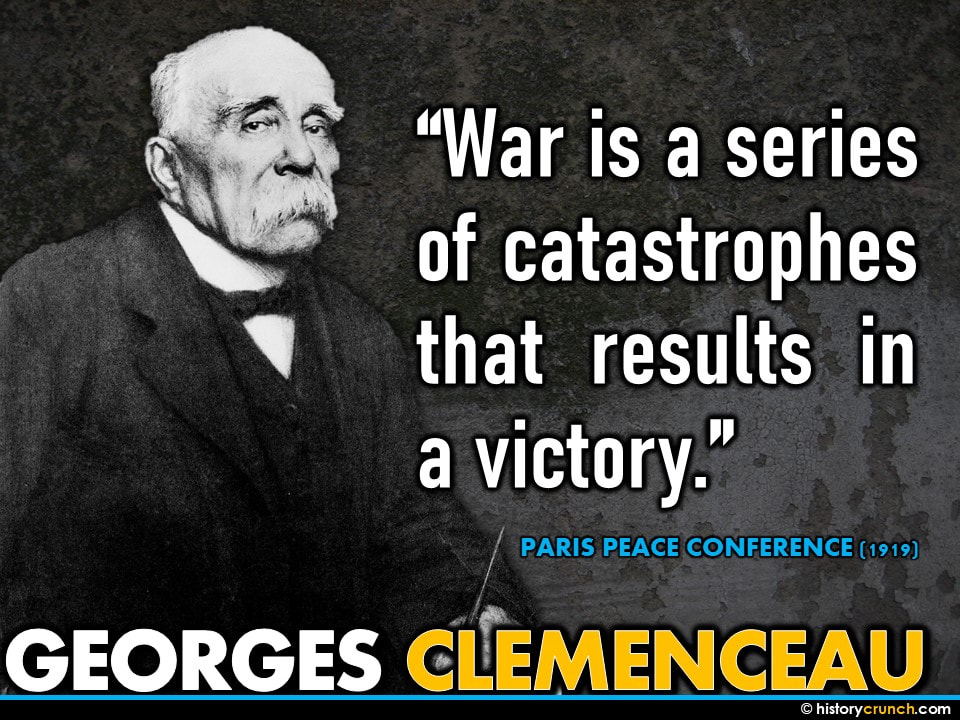
Following the armistice, the Allied leaders gathered in Paris to negotiate the terms of a formal peace settlement with Germany. The resulting Treaty of Versailles was signed on June 28th, 1919 CE. The Treaty of Versailles was the main peace agreement that formally ended World War I. It imposed a series of conditions on Germany, including the requirement to accept responsibility for starting the war, to pay large sums of money known as reparationsLarge sums of money a defeated country is forced to pay to the winning nations as punishment for war damages. to the Allied nations and to give up significant territories and military capabilities. Clemenceau chaired the Paris Peace Conference and was one of the three dominant figures in the negotiations, alongside British Prime Minister David Lloyd George and American President Woodrow Wilson.
Clemenceau pushed hard for the harshest possible treatment of Germany. He wanted Germany permanently weakened so that it could never again threaten France. For instance, he insisted on the occupation of the RhinelandThe German region bordering France that Clemenceau demanded be occupied by Allied forces for fifteen years after World War I., the German region bordering France, for fifteen years, and on strict limits on the size of the German army. He also insisted that Germany return the territories of Alsace and Lorraine to France, reversing the outcome of the Franco-Prussian War of 1871 CE. With a sense of deliberate historical symbolism, Clemenceau arranged for the treaty to be signed in the Hall of Mirrors at the Palace of Versailles, the very room where the German Empire had been proclaimed in 1871 after France’s defeat.
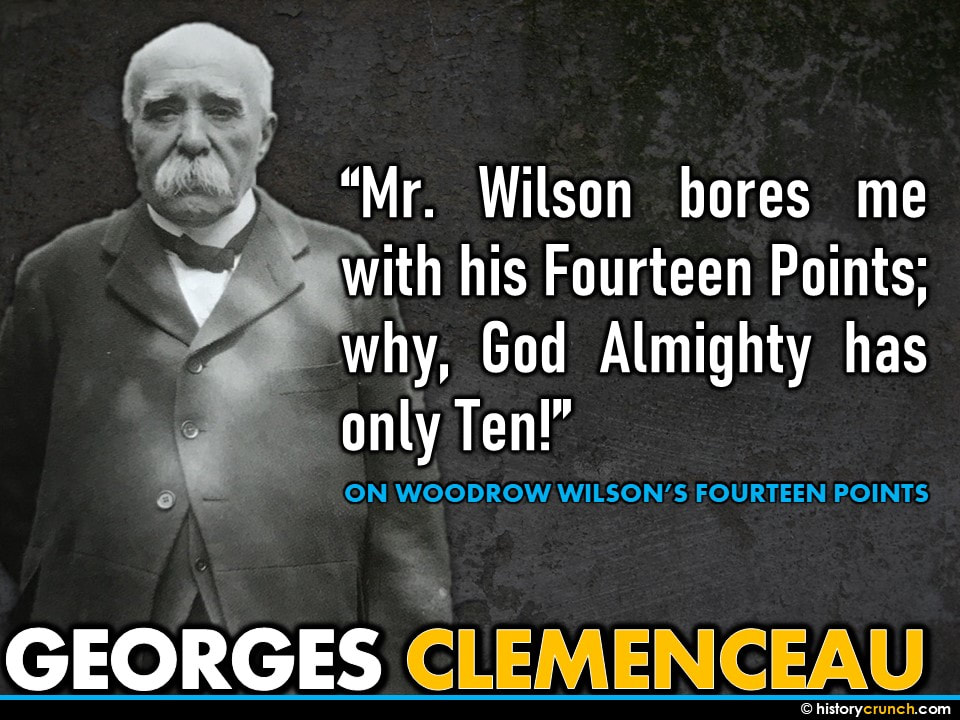
With that said, Clemenceau was forced to accept compromises he was unhappy with. Both Lloyd George and Wilson resisted what they felt were excessively punitiveIntended to severely punish rather than simply to correct or compensate. demands, and Clemenceau had to moderate some of his positions in order to reach an agreement. As a result, he left Paris believing that France had not been given the security guarantees it needed and that Germany had been treated too leniently. Ironically, many in France felt exactly the opposite and blamed him for not being hard enough on Germany. He lost the election for the French presidency in January of 1920 CE and resigned as Prime Minister, bringing his active political career to an end.
Where did Clemenceau arrange for the Treaty of Versailles to be signed?
Georges Clemenceau’s Death and Legacy
After leaving office Clemenceau spent his final years writing, travelling and reflecting on the war and its aftermath. He wrote his memoirs, titled The Grandeur and Misery of Victory and published in 1930 shortly after his death, in which he warned that the failure to adequately restrain Germany meant that another war would likely break out within a generation. He died on November 24th, 1929 CE in Paris at the age of eighty-eight.
Georges Clemenceau is remembered as one of the most significant leaders of the First World War and one of the greatest figures in the history of France. His fierce determination and refusal to consider defeat helped hold France together during the darkest years of the war, and his leadership in the final year of the conflict played a direct role in the Allied victory. For instance, his famous phrase summarizing his war policy was quoted across France and beyond as a symbol of unyielding resolve. With that said, his role in shaping the Treaty of Versailles remains controversial. Some historians argue that the harsh terms he pushed for planted the seeds of resentment in Germany that would eventually contribute to the rise of Adolf Hitler and the outbreak of World War II. Regardless, Georges Clemenceau left a legacy as one of the most powerful and influential political figures of the early twentieth century.
 FactsthatCrunch
In his final years Clemenceau wrote his memoirs, The Grandeur and Misery of Victory, published in 1930 just after his death, in which he warned that the failure to adequately restrain Germany meant that another war would likely break out within a generation.
Clemenceau believed the Treaty of Versailles had been too lenient on Germany and had not given France the security guarantees it needed
His warning proved accurate. World War II began roughly twenty years after the Treaty of Versailles was signed in 1919.
Explore World War I
Keep exploring World War I with these History Crunch resources.
Key Vocabulary
Republican
Radical Republican
Reparations
Pacifist
Armistice
Punitive
Rhineland
Frequently Asked Questions
Why was Georges Clemenceau called the Tiger?
Clemenceau earned the nickname the Tiger because of his fierce and combative personality. He was known as one of the toughest debaters and political fighters of his generation. He attacked opponents without mercy and never backed down from a fight. Later he gained a second title, the Father of Victory, for leading France through World War I.
When was Georges Clemenceau Prime Minister of France?
Clemenceau served as Prime Minister of France twice, from 1906 to 1909 and again from 1917 to 1920. During his first term he passed major labor reforms but faced criticism for his harsh handling of strikes. His second term came during World War I, when he was appointed on November 16th, 1917, at the age of seventy-six.
What did Clemenceau want from the Treaty of Versailles?
Clemenceau wanted Germany permanently weakened so it could never threaten France again. He pushed for occupation of the Rhineland for fifteen years and strict limits on the German army. He also insisted that Germany return Alsace and Lorraine, reversing France’s loss in the Franco-Prussian War. He felt the final treaty was still too lenient on Germany.
How did Clemenceau help France win World War I?
Clemenceau transformed the French war effort with his message to simply wage war. He visited the front lines often to lift the morale of tired soldiers. He also backed the appointment of General Ferdinand Foch as Supreme Allied Commander in 1918, which united the Allied forces. His iron will helped carry France to the armistice on November 11th, 1918.
Why is Clemenceau’s role in the Treaty of Versailles controversial?
Clemenceau’s role is debated because some historians say the harsh terms caused lasting resentment in Germany. That anger may have helped Adolf Hitler rise to power and contributed to World War II. In his own memoirs, Clemenceau warned that failing to restrain Germany would likely bring another war within a generation. Many in France, however, blamed him for being too soft.
Cite This Article
To cite this article as a source, use one of the formats below.
MLA: Millar, B. “Georges Clemenceau: A Detailed Biography.” HistoryCrunch, 30 September 2026, https://historycrunch.com/georges-clemenceau/.
APA: Millar, B. (2026). Georges Clemenceau: A Detailed Biography. HistoryCrunch. https://historycrunch.com/georges-clemenceau/
Chicago: Millar, B. “Georges Clemenceau: A Detailed Biography.” HistoryCrunch. September 30, 2026. https://historycrunch.com/georges-clemenceau/
Sources
- Fordham Modern History Sourcebook
- Hew Strachan, The First World War.