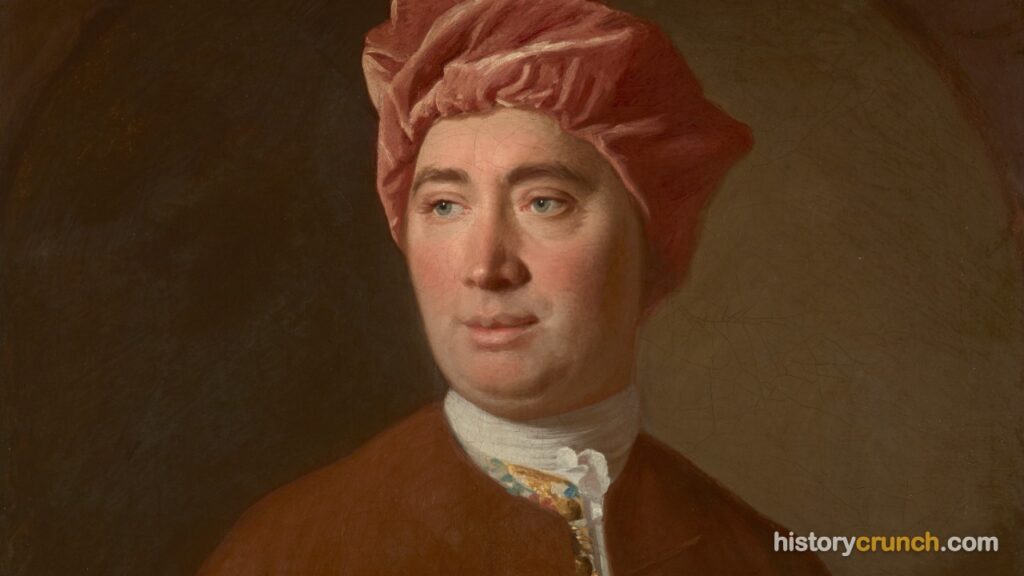
David Hume was one of the most important thinkers of the Enlightenment, the great movement of the 1700s in which writers across Europe used reason and observation to question old beliefs about religion, government, and human nature. A Scottish philosopher, historian, and essayist, Hume pushed the ideas of the Enlightenment to their limits by asking how much people can truly know about the world around them. His work on knowledge, cause and effect, and morality shaped philosophy for centuries, while his popular history books made him famous during his own lifetime.
In simple terms, Hume was an empiricist, which means he believed that all human knowledge comes from experience gathered through the senses rather than from ideas the mind is born with. He was also a skeptic, meaning he doubted claims that could not be tested by observation. These two ideas guided everything he wrote, from his studies of the human mind to his questions about religion.
Early Life and Background
David Hume was born on May 7th, 1711, in Edinburgh, the capital of Scotland. His family belonged to the landed gentry, which was a class of landowners just below the nobility. His father practiced law in Edinburgh and also owned a country estate called Ninewells near the border with England.
Hume’s father died when David was a young boy, which left the family with limited money. As a second son, Hume could not expect to inherit the estate, so he would need to find a profession of his own. His mother took charge of raising and educating the children in the years that followed.
Hume was a gifted student, and he entered the University of Edinburgh at the unusually early age of about eleven or twelve. As stated above, he was expected to become a lawyer, and his family pointed him toward the study of law. In reality, Hume had little interest in legal work and spent his time reading the great writers of ancient Greece and Rome instead.
By his late teens Hume had decided that philosophy and literature, not law, would be his life’s work. Around 1729 he suffered a period of poor health and low spirits, sometimes described as a kind of nervous breakdown, brought on by intense study. He recovered and continued his reading, determined to build a career as a writer and thinker.
Rise as a Philosopher
In his early twenties Hume traveled to France, where living was cheaper and where he could write in peace. There he worked on his first and most ambitious book, which he called A Treatise of Human Nature. His goal was bold. He wanted to study human beings using the same careful, experimental method that Isaac Newton had used to study the physical world.
The Treatise appeared in 1739 and 1740, but it sold poorly and attracted little attention at first. Hume later joked that the book had fallen flat, and he was deeply disappointed. Even so, the ideas inside it would become some of the most discussed in the history of philosophy.
Hume next tried a different approach. In 1741 and 1742 he published Essays, Moral and Political, a collection of short pieces written in a clear and lively style on politics, trade, and manners. These essays proved far more popular than the Treatise, and they helped establish Hume’s reputation as a graceful and readable writer.
Hume hoped to become a professor, but his questioning views on religion made that impossible. He was twice turned down for university teaching posts, at Edinburgh and later at Glasgow, because many people considered his ideas dangerous to Christian belief. To support himself, he worked at different times as a tutor, a secretary, and later as a librarian.
Major Achievements and Ideas
Hume’s central idea was that all knowledge begins with experience. He divided the contents of the mind into what he called impressions and ideas. Impressions are the vivid feelings and sensations people receive directly through their senses, while ideas are the fainter copies of those impressions that the mind remembers and thinks about later.
From this starting point, Hume examined the everyday belief in cause and effect, and his conclusion surprised many readers. He argued that people never actually observe one event causing another. For instance, when one billiard ball strikes another and the second ball moves, all that is really seen is one event followed by another. The hidden “power” that supposedly links them is never directly experienced.
According to Hume, the belief that causes must produce their usual effects comes from habit and custom rather than from reason. After seeing two events joined together many times, the mind simply grows used to expecting one to follow the other. This challenge became known as the problem of induction, which asks why anyone should assume the future will resemble the past.
Hume applied the same doubting method to the human self. When he looked inward for a fixed, unchanging “self,” he found only a bundle of changing perceptions, thoughts, and feelings, and never a single thing he could point to as the soul or mind. He also argued that reason alone cannot tell people how to act. In his famous phrase, reason is and ought to be the slave of the passions, meaning that emotions and desires, not cold logic, are what drive human choices and moral judgments.
Hume rewrote his difficult early work into two shorter and clearer books, An Enquiry Concerning Human Understanding in 1748 and An Enquiry Concerning the Principles of Morals in 1751. In the first of these he included a well-known argument against believing in miracles, claiming that the evidence for the laws of nature is always stronger than the testimony of a witness who reports a miracle. Views like this made Hume both admired and feared as a critic of organized religion.
Hume also wrote about economics. In a set of essays known as the Political Discourses, published in 1752, he argued in favor of free trade and challenged the popular idea that a nation grows rich mainly by piling up gold. His economic writing influenced his close friend Adam Smith, another leading figure of the Scottish Enlightenment.
In his own lifetime, Hume was most famous not as a philosopher but as a historian. Between 1754 and 1762 he published his six-volume History of England, which traced the story of the country from the ancient Britons up to the Glorious Revolution of 1688. The work became a bestseller, went through many editions, and made Hume both wealthy and widely known across Europe.
Later Life
In the 1760s Hume served as a secretary at the British embassy in Paris, where he was warmly welcomed by French writers and thinkers. He became a celebrated guest in the fashionable gatherings, called salons, where the leading minds of the day discussed new ideas. There he met important figures of the French Enlightenment, including the philosopher Jean-Jacques Rousseau.
Hume tried to help Rousseau by arranging a safe place for him to live in England after Rousseau was forced to leave the continent. The friendship, however, ended badly. Rousseau came to believe that Hume was plotting against him, and their public quarrel became a scandal talked about across Europe.
Hume eventually returned to Edinburgh, where he settled into a comfortable life surrounded by friends. He was known for his calm, cheerful, and good-natured personality, which stood in contrast to the shocking reputation of his ideas. His many admirers gave him the affectionate nickname “le bon David,” meaning “the good David.”
In his final years Hume suffered from a serious illness, most likely a cancer of the abdomen. He faced his approaching death with striking calm, refusing to change his views about religion even as the end drew near. David Hume died on August 25th, 1776, in Edinburgh. Before his death he had completed his boldest religious work, the Dialogues Concerning Natural Religion, which his friends published in 1779, three years after he was gone.
Significance of David Hume
David Hume is remembered as one of the most influential philosophers who ever lived, and his questions still shape the way people think about knowledge today. By showing that cause and effect cannot be proven by reason alone, he forced later thinkers to look more carefully at the foundations of science and everyday belief. His ideas pushed the empiricism of earlier thinkers such as John Locke and George Berkeley to a striking conclusion, arguing that human beings can never truly know anything beyond their own experience.
Hume’s influence reached far beyond Scotland. The German philosopher Immanuel Kant said that reading Hume woke him from his “dogmatic slumber” and inspired much of his own famous work. In this way, Hume helped set the direction for modern philosophy, and his questions about the mind still connect to fields such as psychology and cognitive science.
As a leading member of the Scottish Enlightenment, Hume also stood alongside figures like Adam Smith who helped make eighteenth-century Edinburgh one of the great centers of learning in the world. More specifically, his writing on trade and money shaped the beginnings of modern economics, while his History of England influenced how the English-speaking world understood its own past for generations. Today a statue of Hume stands on the Royal Mile in Edinburgh, a lasting reminder of a thinker whose bold questions continue to challenge readers.
Frequently Asked Questions
What is David Hume best known for?
David Hume is best known for his empiricism and his skepticism, especially his argument that cause and effect cannot be proven by reason. He is also famous for his lively essays and for his six-volume History of England, which made him rich and well known during his own lifetime. Modern readers usually study him as a philosopher, but people in the 1700s thought of him first as a historian.
When and where did David Hume live?
David Hume lived from 1711 to 1776 and spent most of his life in Edinburgh, Scotland. He also lived for stretches in France, where he wrote his first major book and later served at the British embassy. Scotland during his lifetime was going through the Scottish Enlightenment, a burst of learning that produced many important scientists, writers, and thinkers.
What is the problem of induction?
The problem of induction is Hume’s argument that people cannot logically prove the future will behave like the past. For example, the sun has risen every morning throughout history, but Hume pointed out there is no contradiction in imagining it failing to rise tomorrow. He concluded that belief in nature’s steady patterns rests on habit and expectation rather than on strict logical proof.
Why did David Hume never become a university professor?
Hume was twice rejected for university teaching posts because many people considered his views on religion to be dangerous or even atheistic. His doubts about miracles and his questioning of religious arguments alarmed church leaders of the day. Unable to teach, he earned his living through writing and through jobs such as tutoring, secretarial work, and running a library.
How did David Hume influence other thinkers?
Hume influenced later thinkers by inspiring the German philosopher Immanuel Kant, who said Hume had awakened him from his “dogmatic slumber.” His economic ideas about free trade shaped the work of his friend Adam Smith, often called the father of modern economics. His careful study of the mind also helped lay early groundwork for the modern fields of psychology and cognitive science.
Cite This Article
To cite this article as a source, use one of the formats below.
MLA: Millar, B. “David Hume: A Detailed Biography.” HistoryCrunch, 9 August 2026, https://historycrunch.com/david-hume/.
APA: Millar, B. (2026). David Hume: A Detailed Biography. HistoryCrunch. https://historycrunch.com/david-hume/
Chicago: Millar, B. “David Hume: A Detailed Biography.” HistoryCrunch. August 9, 2026. https://historycrunch.com/david-hume/
Sources
- Jerry Bentley & Herbert Ziegler, Traditions & Encounters: A Global Perspective on the Past.
- J.M. Roberts & Odd Arne Westad, The Penguin History of the World.