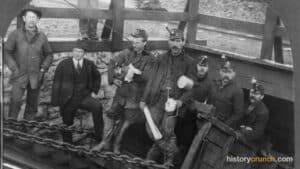
Richard Arkwright was a significant figure in the timeframe of the Industrial Revolution and is remembered today as a noted inventor and entrepreneurA person who starts and runs businesses, often taking financial risks to make a profit.. For example, he invented the water frame, which had a profound impact on production in England and around the world during the time of the Industrial Revolution. For example, Richard Arkwright’s water frameA spinning machine powered by moving water that produced strong cotton yarn with little human labor. transformed the textile industry by speeding up production.
 FactsthatCrunch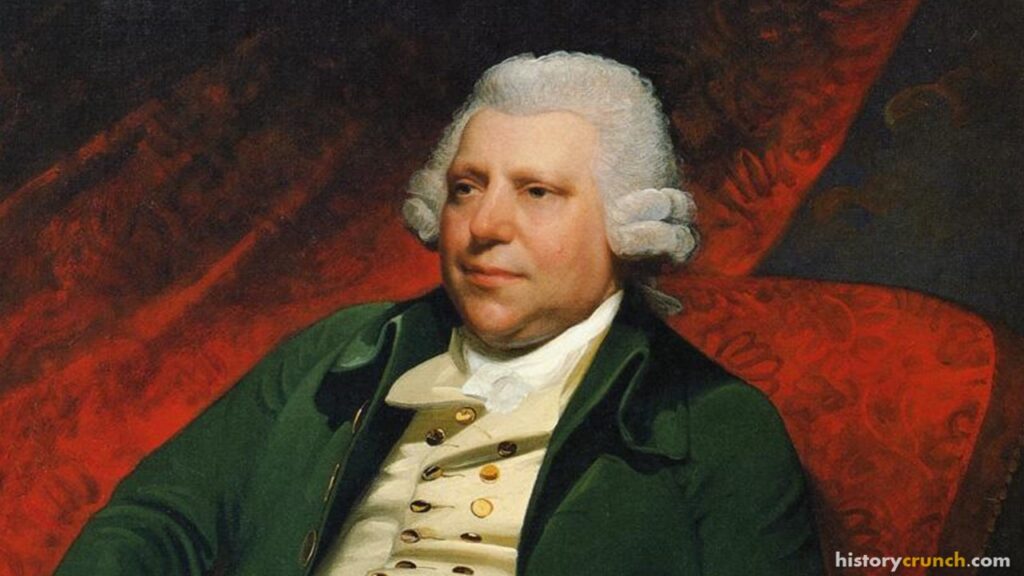
Richard Arkwright – Early Life
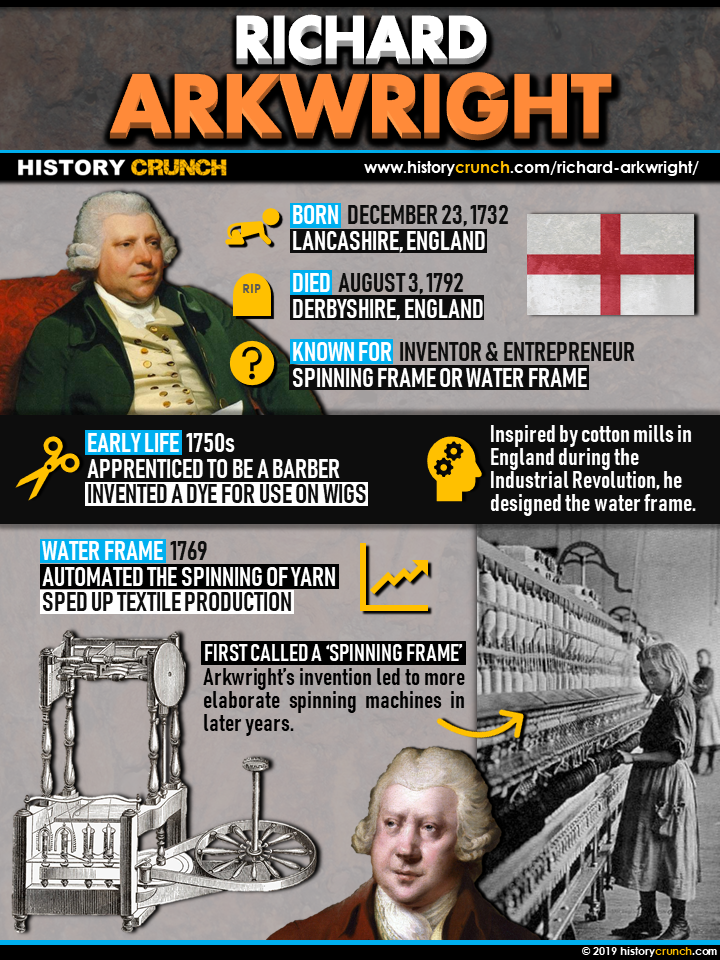
Richard Arkwright was born on December 23rd, 1732 in Lancashire, England. He was the youngest child of Sarah and Thomas, who were poor, manual-labor workers. Arkwright did not go to school because his parents could not afford the expense, but he was taught to read and write by his cousin. As a young man, Arkwright apprenticedWorked under a skilled tradesperson to learn a craft or trade. as a barber, and set up his own shop in the 1750s. While working at his shop he invented a dye that could be used on the periwigsFashionable hairpieces worn by people during the 1700s., which were the famous hair pieces that were fashionably worn at the time. He made a sizeable profit from his dye, and he used that money to develop other inventions. In fact, he would go on to be one of the most significant inventors of the Industrial Revolution and had a profound impact on textile manufacturing.
FactsthatCrunchRichard Arkwright – Invention of the Water Frame
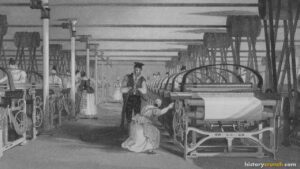
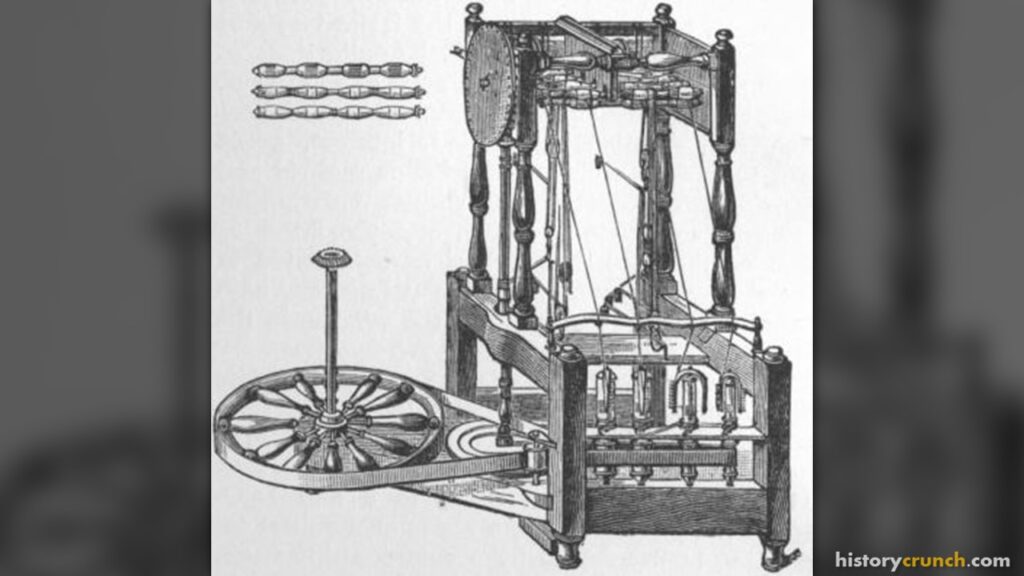
In 1755, Arkwright married his first wife, Patience Holt. They had a child together, but soon after the birth, Patience died. Arkwright remarried Margaret Biggins in 1761. It was during his second marriage that Arkwright realized his passion for inventing and entrepreneurship. He soon developed a spinning machine, called a water frame, that was capable of producing strong yarn. The machine replaced the need for manual labor and enabled the production of inexpensive spun cotton by using the moving force of a creek or river that spun a shaft. The machine was important at the time because cotton was used for clothing and other everyday items. At first, the machine was referred to as a ‘spinning frame’ but in later years, it was known as a water-frame. In fact, the water frame was a major advancement over previous types of machinery including James Hargreaves’ spinning jenny. This was because the water frame essentially mechanizedReplaced human hand-work with a machine that does the same task automatically. all of the process of spinning the yarn and required very little human labor.
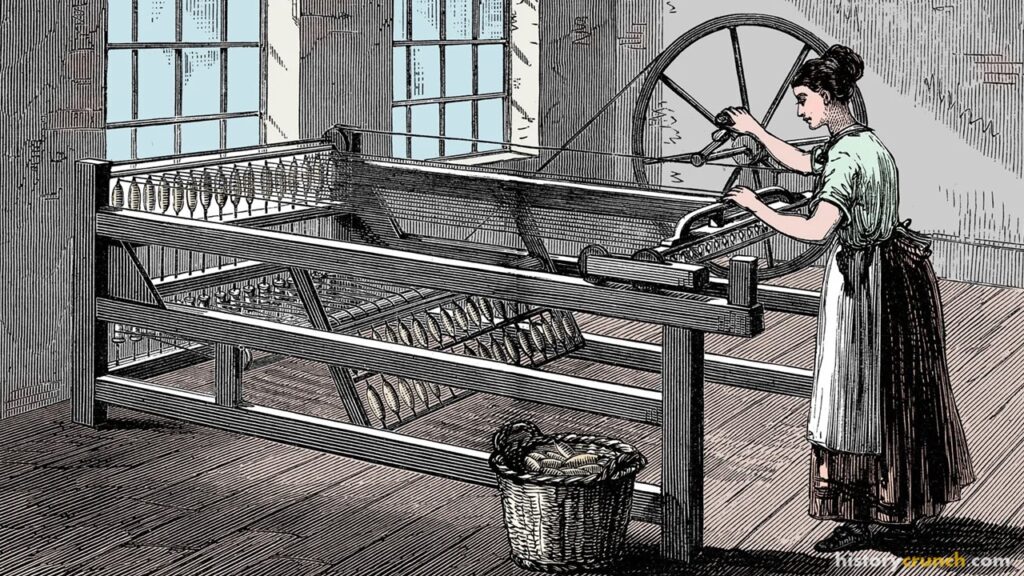
Arkwright moved to Nottingham where he formed a partnership with two local businesses. With the men, he built mills to process cotton and other products. The mills required a lot of workers, which the town could not provide. In order to ensure that the mills had enough employees, Arkwright built pubs to attract people, and imported workers from outside the area. Arkwright managed other mills, most notably the Birkacre Mill at Chorley. This mill was important to the growth of the town, which later played an important part in the Industrial Revolution. Arkwright developed a disciplined factory system at his mills, especially at Cromford in Derbyshire, and it was replicated in other factories across England. In fact, Arkwright struggled to maintain the patent on his invention, as other people across England copied it and used it in their own factories.
Richard Arkwright – Death and Legacy
Despite this, Richard Arkwright was famous and wealthy in his own life for his inventions and businesses. For instance, he was formally knightedGiven an honorary title by the British monarch in recognition of service or achievement. in 1786 for his accomplishments. This means that he was given a title by the British monarch for his service to his country. His innovations had fundamentally altered England in the time of the Industrial Revolution and made him a rich man. For instance, when he died on August 3rd, 1792, his estate was worth more than £500,000. Today he is celebrated as one of the most significant figures of the entire Industrial Revolution.
Richard Arkwright – Infographic
Key Vocabulary
Entrepreneur
Apprenticed
Periwigs
Water frame
Spinning jenny
Mechanized
Knighted
Frequently Asked Questions
What did Richard Arkwright invent?
Richard Arkwright invented the water frame, a spinning machine that produced strong cotton yarn. It used the moving force of a creek or river to power its parts. The machine replaced much of the manual labor needed to spin cotton by hand.
How did the water frame work?
The water frame used flowing water to spin a shaft that powered the machine. This moving force turned the parts that twisted cotton fibers into strong yarn. Because it ran on water power, it needed very little human labor to operate.
How was the water frame different from the spinning jenny?
The water frame was a major step forward from James Hargreaves’ spinning jenny. It mechanized nearly the whole spinning process and needed far less human effort. The yarn it made was also stronger than yarn made on earlier machines.
Why is Richard Arkwright important to the Industrial Revolution?
Arkwright helped change the textile industry by speeding up cotton production. He built mills and created a disciplined factory system that other factories across England copied. His methods became a model for how factories were run during the Industrial Revolution.
When was Richard Arkwright born and when did he die?
Richard Arkwright was born on December 23rd, 1732 in Lancashire, England, and died on August 3rd, 1792. He was knighted in 1786 for his accomplishments. When he died, his estate was worth more than £500,000, which showed how wealthy his inventions had made him.
Cite This Article
To cite this article as a source, use one of the formats below.
MLA: Beck, Elias. “Richard Arkwright: A Detailed Biography.” HistoryCrunch, 25 September 2026, https://historycrunch.com/richard-arkwright/.
APA: Beck, E. (2026). Richard Arkwright: A Detailed Biography. HistoryCrunch. https://historycrunch.com/richard-arkwright/
Chicago: Beck, Elias. “Richard Arkwright: A Detailed Biography.” HistoryCrunch. September 25, 2026. https://historycrunch.com/richard-arkwright/
Sources
- The Science Museum Group
- Emma Griffin, A Short History of the British Industrial Revolution.
- Joel Mokyr, The Enlightened Economy.
- Fordham Modern History Sourcebook