Kim Il-Sung was the founder of North Korea and ruled the country for decades during the Cold War. He led the Democratic People’s Republic of Korea, which is the official name of North Korea, from 1948 until his death in 1994, and he played a central role in the Korean War, the growth of the North Korean dictatorship, and the creation of the Kim family political system.
 FactsthatCrunch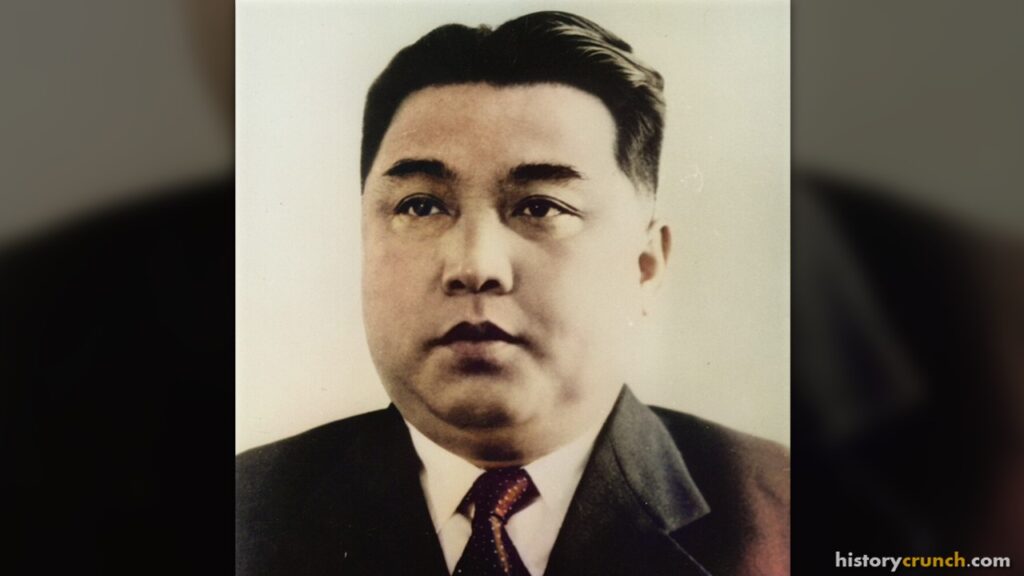
Early Life
Kim Il-Sung was born Kim Song-ju on April 15th, 1912, in Man’gyŏndae, near Pyongyang, Korea, now in North Korea. During his childhood, Korea was under Japanese rule, and his family later moved to Manchuria, in northeastern China. This was important because many Koreans fled there during the period of Japanese occupation, and it was in that setting that Kim first became involved in communist politics and anti-Japanese activism.
As a young man, Kim attended school in Manchuria and joined a communist youth organization while still a student. He was arrested and jailed in 1929 and 1930 for political activity. Therefore, before he became a national leader, Kim had already entered the world of underground revolutionary politics, which shaped the rest of his career.
FactsthatCrunchWhat were the key roles Manchuria played as a base for Korean anti-Japanese communists?
Rise to Power
During the 1930s, Kim joined the guerrillaA type of fighter who uses small-scale, irregular tactics like raids rather than fighting in a traditional army. resistance against Japanese rule in Korea and Manchuria. In 1937, he led a raid on Poch’onbo, Korea, now in North Korea, which later became one of the most celebrated events in North Korean propagandaInformation spread by a government to promote its own image and shape what people believe.. This mattered because it helped build his image as an anti-Japanese fighter, even though his wartime reputation was expanded even more by the North Korean state after he came to power.
As Japanese pressure on guerrilla fighters increased, Kim crossed into the Soviet Union in 1940. He later served in the Soviet Red Army during World War II and was part of the 88th Separate Rifle Brigade. These years were important because they connected him closely to the Soviet Union, which later helped place him in power in northern Korea after Japan’s defeat.
When World War II ended in 1945, Korea was no longer under Japanese control, but it was divided between Soviet occupation in the north and American occupation in the south. Kim returned to Korea in September of 1945 with Soviet support and quickly rose inside the new communist system in the north. By 1948, two separate Korean states had been created along the 38th parallelThe line of latitude that divided Korea into a Soviet-controlled north and an American-controlled south after 1945.: North Korea under Kim Il-Sung and South Korea under Syngman Rhee.
FactsthatCrunchNorth Korea
Kim became the first premier of North Korea in 1948 and the dominant leader of the Korean Workers’ Party soon after. At this point, the division of Korea had become one of the first major flashpoints of the Cold War. Both northern and southern leaders wanted to reunify the peninsula, but they wanted to do so under completely different political systems. As such, tension between the two sides kept increasing.
On June 25th, 1950, North Korea invaded South Korea, beginning the Korean War. The war quickly became much larger than a civil conflict inside Korea. The United States and other countries fighting under the United Nations supported South Korea, while North Korea received help from the Soviet Union and later major military support from China. This is significant because the Korean War turned Korea into one of the most dangerous battlegrounds of the Cold War.
The war caused enormous destruction and loss of life. At first, North Korean forces advanced deep into the south, but then United Nations forces pushed north and captured Pyongyang, North Korea, in October of 1950. China then entered the war, which prevented the destruction of Kim’s regime. Fighting continued until the armisticeAn agreement between warring sides to stop fighting, without formally ending the war with a peace treaty. of July 27th, 1953, which ended the war without permanently reuniting Korea. Therefore, Kim failed to conquer the south, but he survived the war and remained in power.
After the war, Kim used the state to remove rivals and build a highly centralized dictatorshipA government in which one leader holds total power and citizens have little or no political freedom.. He promoted the JucheThe official North Korean philosophy meaning ‘self-reliance,’ used to justify the country’s closed and centralized political system. idea, which means “self-reliance,” as the guiding philosophy of North Korea. In practice, this meant that North Korea presented itself as independent and strong, while also building a tightly controlled political system centered on Kim himself. During the 1950s and 1960s, the economy grew, but it later slowed badly and shortages became more serious by the early 1990s.
Kim’s rule also became more personal over time. In 1972, a new constitution made him president of North Korea, and in 1980 he raised his son Kim Jong Il to high party and military positions, making clear that power would likely stay inside the family. This was important because it helped create the dynasticRelating to a system where political power passes down within the same family across generations. system that still shapes North Korean politics today.
FactsthatCrunchWhat did Kim Il-Sung fail to achieve by the end of the Korean War in 1953?
Later Years and Death
In his later years, Kim remained the dominant figure in North Korea even as the wider communist world began to change. He proposed different plans for Korean reunification, including the Koryŏ Confederation in 1980, but Korea remained divided. At the same time, North Korea’s political system remained rigid, and relations with South Korea and the United States continued to move between tension and limited diplomacy.
Kim Il-Sung died on July 8th, 1994, in Pyongyang, North Korea. After his death, Kim Jong Il took over as the country’s main ruler, and later constitutional changes described Kim Il-Sung as the “Eternal President” of the republic. This is significant because even after his death, the North Korean state continued to place him at the symbolic center of the country.
FactsthatCrunchSignificance
Kim Il-Sung was significant because he founded North Korea, led it through the Korean War, and created one of the most tightly controlled dictatorships of the modern era. He helped turn the division of Korea into a long-term Cold War conflict, and his leadership shaped North Korean politics, society, and ideology for decades.
At the same time, Kim remains a deeply controversial historical figure. Some North Korean accounts portray him as a national liberator and heroic revolutionary leader. Outside North Korea, he is more often remembered as the founder of an authoritarian state built on repression, propaganda, and a powerful cultHere, an organized system of extreme devotion and glorification built around a single political leader. around his family. Regardless, Kim Il-Sung is essential to understanding both the history of Korea after World War II and the larger history of the Cold War in Asia.
Kim Il-Sung's anti-Japanese guerrilla record was entirely invented by North Korean propaganda after he came to power.
Korean War timeline · 1950 – 1953
Key Vocabulary
Guerrilla
Propaganda
38th parallel
Juche
Armistice
Dynastic
Authoritarian
Frequently Asked Questions
Who was Kim Il-Sung?
Kim Il-Sung was the founder and first leader of North Korea, ruling from 1948 until 1994. He was born Kim Song-ju in 1912, near Pyongyang, when Korea was under Japanese rule. He led the country through the Korean War and built one of the most tightly controlled dictatorships in the modern world.
What role did Kim Il-Sung play in the Korean War?
Kim Il-Sung ordered the invasion of South Korea on June 25th, 1950, which started the Korean War. His forces first advanced deep into the south, but United Nations troops pushed back and captured Pyongyang. China then entered the war and saved his regime, and the fighting ended with an armistice on July 27th, 1953.
What is the Juche idea?
Juche was the guiding philosophy Kim Il-Sung promoted, and the word means “self-reliance.” In theory it meant North Korea would stay independent and strong without depending on other countries. In practice it supported a tightly controlled political system built around Kim himself.
How did power stay in the Kim family?
Kim Il-Sung built a dynastic system by preparing his son to take over after him. In 1980 he raised Kim Jong Il to high party and military positions, signaling that power would stay in the family. When Kim Il-Sung died in 1994, Kim Jong Il became the country’s main ruler.
When did Kim Il-Sung die?
Kim Il-Sung died on July 8th, 1994, in Pyongyang, North Korea. After his death, the state honored him with the title “Eternal President” of the republic. This kept him at the symbolic center of the country even after he was gone.
Why is Kim Il-Sung important in Cold War history?
Kim Il-Sung matters because he founded North Korea and helped turn the division of Korea into a lasting Cold War conflict. His invasion of the south drew in the United States, the Soviet Union, and China. His leadership shaped North Korean politics, society, and ideology for decades.
Cite This Article
To cite this article as a source, use one of the formats below.
MLA: Millar, B. “Kim Il-Sung: A Detailed Biography.” HistoryCrunch, 18 September 2026, https://historycrunch.com/kim-il-sung/.
APA: Millar, B. (2026). Kim Il-Sung: A Detailed Biography. HistoryCrunch. https://historycrunch.com/kim-il-sung/
Chicago: Millar, B. “Kim Il-Sung: A Detailed Biography.” HistoryCrunch. September 18, 2026. https://historycrunch.com/kim-il-sung/
Sources
- Jerry Bentley & Herbert Ziegler, Traditions & Encounters: A Global Perspective on the Past.
- J.M. Roberts & Odd Arne Westad, The Penguin History of the World.