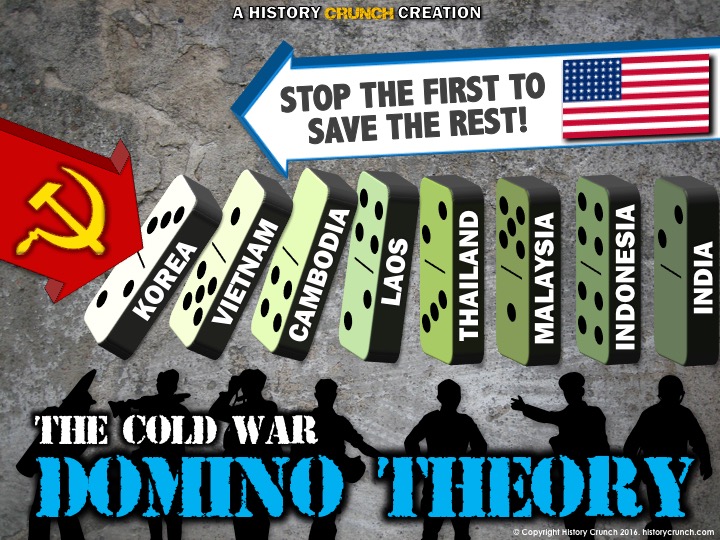
The domino theoryThe Cold War belief that if one country fell to communism, neighboring countries would follow like falling dominoes. was a Cold War era belief popular within the United States from the 1950s until the end of the Cold War. It was premised on the concept of containment, which was a popular view of American foreign policy at the time. Essentially, it promoted the idea that the spread of communism should be stopped at all costs. For instance, the domino theory was the idea that the first domino should be prevented from tumbling in order to save the others.
 FactsthatCrunch
What was the containment policy that the domino theory was based on?
Containment was the American foreign policy goal of stopping communism from spreading to new countries. The domino theory grew directly out of this policy, arguing that if one country fell to communism, neighboring countries would follow. Together, containment and the domino theory shaped major U.S. decisions, including involvement in the Korean War and the Vietnam War.
Summary.
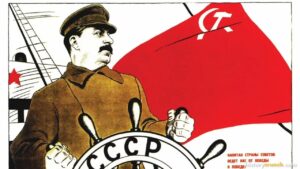
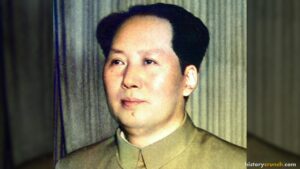
The Cold War was a major world event that took place from approximately 1945 until 1991. In general, the Cold War was a period of increased tensions and hostility between the superpowersNations with massive military and political power capable of influencing the entire world. of the United States and the Soviet Union (USSR). Based on the Truman Doctrine and American containment, the theory held the idea that if Soviet communism was able to spread into a single country, then it had the potential to spread to all of the other surrounding countries. The basic idea was that the Americans needed to prevent the first domino from falling (country turning to communism) in order to prevent the spread of communism. American containmentThe American foreign policy goal of stopping communism from spreading to new countries. was based on stopping communism any place it spread to, and as such, the domino theory helped explain the perceived need for the United States’ involvement in international issues.
For example, the domino theory was used to justify American involvement in both the Korean War and Vietnam War from the 1950s to the 1970s. Both countries are in Asia and both saw Soviet-style communismA government and economic system modeled on the USSR, where the state controls property and politics. spread into their political systems. The Korean War first occurred in the 1950s and saw the country divide between a communist north and democratic south. The United States eventually became involved in the conflict, supporting South Korea on the basis of the domino theory, fearing that Korean communism would spread throughout the rest of East and Southeast Asia.
American involvement in Vietnam in the 1960s and 1970s was very similar to the earlier Korean War, as the country divided between a communist north and democratic south. Again, the United States became involved fearing that a communist Vietnam would help spread communism throughout the rest of Southeast Asia.
In the end, the domino theory was important because it explained American foreign policy at the time and saw the United States become involved in two major wars. As well, both wars saw the United States struggle and cost the lives of thousands of American soldiers. As such, historians have called into question the validityWhether something is sound, logical, or actually works in practice. of the domino theory in the Cold War, in terms of its effectiveness as a foreign policy.
Why did the United States enter both the Korean War and the Vietnam War under the domino theory?
Explore Cold War · 1947 – 1991
Keep exploring Cold War with these History Crunch resources.
Key Vocabulary
Containment
Domino theory
Superpowers
Soviet-style communism
Validity
Frequently Asked Questions
What was the domino theory?
The domino theory was a Cold War belief that communism would spread from one country to its neighbors. It compared nations to a row of dominoes, where the fall of one would knock over the rest. American leaders used it to argue that communism had to be stopped in every place it appeared.
How is the domino theory connected to containment?
The domino theory grew directly out of the American policy of containment. Containment aimed to stop the spread of communism wherever it appeared in the world. The domino theory gave a simple picture for why that policy seemed necessary to many Americans.
How was the domino theory used to justify the Vietnam War?
Leaders argued that a communist Vietnam would cause communism to spread across the rest of Southeast Asia. Vietnam had divided into a communist north and a democratic south, much like Korea before it. The United States joined the conflict to stop that first domino from falling.
Which wars were shaped by the domino theory?
The Korean War and the Vietnam War were both shaped by the domino theory. Each war involved a country split between a communist north and a democratic south. The United States supported the southern side in both cases to block the spread of communism in Asia.
Was the domino theory accurate?
Historians have questioned whether the domino theory was a sound guide for foreign policy. Both wars it justified cost the lives of thousands of American soldiers and proved very difficult to win. These outcomes led many to doubt that communism spread in the simple chain the theory predicted.
Cite This Article
To cite this article as a source, use one of the formats below.
MLA: Beck, Elias. “Domino Theory in the Cold War: A Detailed Summary.” HistoryCrunch, 18 September 2026, https://historycrunch.com/domino-theory-in-the-cold-war/.
APA: Beck, E. (2026). Domino Theory in the Cold War: A Detailed Summary. HistoryCrunch. https://historycrunch.com/domino-theory-in-the-cold-war/
Chicago: Beck, Elias. “Domino Theory in the Cold War: A Detailed Summary.” HistoryCrunch. September 18, 2026. https://historycrunch.com/domino-theory-in-the-cold-war/
Sources
- Odd Arne Westad, The Global Cold War.
- State Department — Office of the Historian