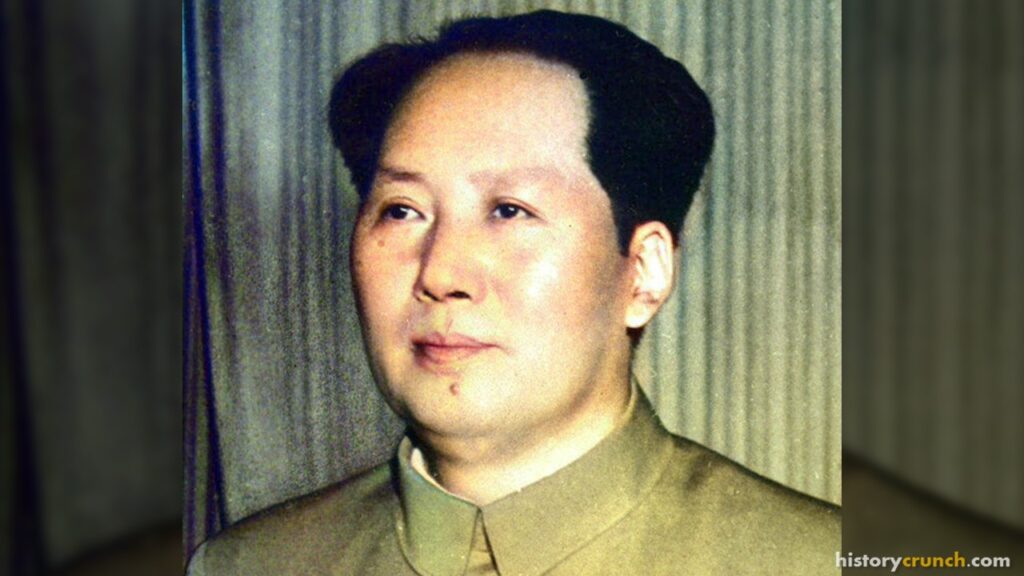
Mao Zedong was a Chinese revolutionary and the founder of the People’s Republic of China. He was born on December 26th, 1893, and died on September 9th, 1976. He led the Chinese Communist Party from 1935 until his death and governed China from the establishment of the People’s Republic in 1949. His rule transformed China in profound ways. He brought an end to a century of civil conflict and foreign domination and established China as a major world power. At the same time, his policies caused some of the greatest disasters in the history of the modern world, including a famine that killed tens of millions of people. He remains one of the most debated and complex political figures of the 20th century.
 FactsthatCrunch
Mao Zedong unified China under central authority after decades of civil war and foreign domination, founding a communist state that became a major world power. His rule also produced catastrophic human suffering, including the Great Leap Forward famine, which killed between 15 million and 55 million people, and the Cultural Revolution, which killed between 500,000 and 2 million more.
Early Life of Mao Zedong
Mao was born on December 26th, 1893, in the small village of Shaoshan in Hunan Province, China. He came from a peasant family, though his father had become relatively prosperous through farming and small-scale trade. Mao was a voraciousHaving an extremely strong and eager appetite for something, like reading. reader from childhood and was deeply interested in Chinese history and the novels of rebellion and adventure that were popular at the time. He left home at the age of 16 to pursue further education in the provincial capital of Changsha, against his father’s wishes.
In Changsha, Mao was exposed to the powerful political and intellectual currents sweeping China in the early 20th century. The Qing Dynasty, which had ruled China for centuries, was in rapid decline, undermined by foreign powers, internal rebellion, and military weakness. In 1911, a revolution overthrew the Qing Dynasty and established a republic, though China quickly fell into political chaos and was divided among competing warlords. These events shaped Mao’s political thinking and drove him toward radicalism. He studied at a teachers college in Changsha, graduating in 1918, and then traveled to Beijing, where he worked as a library assistant at Peking University. It was here that he was introduced to Marxism and became convinced that class struggle and revolution were the keys to transforming China.
FactsthatCrunchBefore leading a revolution that reshaped China, Mao Zedong worked as a low-level library assistant at Peking University, filing books and managing reading room attendance.
Mao arrived in Beijing after graduating from a teachers college in Changsha in 1918. His library job put him in the same halls as leading Chinese intellectuals and Marxist thinkers, and that exposure convinced him that class struggle and revolution were the path forward for China. Within three years of shelving books, he was a founding member of the Chinese Communist Party.
Mao Zedong – Rise in Politics
In 1921, Mao became one of the founding members of the Chinese Communist Party, attending its first congress in Shanghai as a delegate from Hunan. In the following years, he worked as a party organizer in Hunan and became increasingly convinced that the Chinese revolution would have to be built on the peasantryThe large class of poor farming people who work the land, especially in rural areas. rather than the urban working class, a significant departure from the standard Marxist-Leninist approach.
The Chinese Communist Party initially cooperated with the Nationalist Party, known as the Kuomintang or KMT, led by Chiang Kai-shek, in an effort to unite China and end warlord rule. However, in 1927 Chiang Kai-shek turned violently against the Communists, massacring party members in Shanghai and other cities and forcing the survivors to flee to the countryside. Mao retreated with a small group of followers to the Jinggang Mountains in Jiangxi Province, where he began building a rural guerrillaA style of fighting where small, unofficial groups use surprise attacks rather than open battle. army. It was in this period that he developed the military and political strategies that would eventually lead his party to victory.
In October of 1934, the Communist forces, surrounded and threatened by Nationalist armies, broke out and began the Long March, an extraordinary military retreat of approximately 6,000 miles across some of the most difficult terrain in China. Only a fraction of the original force survived to reach the northern province of Shaanxi. The Long March became a foundational legend of the Communist movement, and during it Mao consolidated his leadership of the party. By 1935 he was the dominant figure in the Chinese Communist Party, a position he would hold for the rest of his life.
FactsthatCrunchIn 1927, Nationalist leader Chiang Kai-shek turned violently against the Communist Party, massacring members in Shanghai and other cities and forcing survivors to flee. Mao retreated with a small group of followers to the Jinggang Mountains in Jiangxi Province, where he began building a rural guerrilla army.
Communists and Nationalists cooperating to unite China
Mao developing independent peasant-based guerrilla strategy in the countryside
Mao Zedong – The Civil War and the Founding of the People’s Republic
When Japan invaded China in 1937, the Communists and the Nationalists temporarily set aside their conflict to resist the common enemy. The Communist forces used the war years to expand their base of support among the peasantry by implementing land reforms and offering effective guerrilla resistance to the Japanese. When Japan surrendered in 1945 and World War II ended, the Chinese Civil War resumed immediately. The Communists, with their strong peasant base and effective military leadership, gradually gained the upper hand over the Nationalists, who were weakened by corruption, economic mismanagement, and loss of popular support.
By 1949 the Communist victory was complete. The Nationalist government of Chiang Kai-shek fled to the island of Taiwan. On October 1st, 1949, Mao stood in Tiananmen Square in Beijing and proclaimed the founding of the People’s Republic of China. It was one of the most significant political events of the 20th century, bringing the world’s most populous country under communist rule.
Mao Zedong – Leader of the People’s Republic
As the leader of the new People’s Republic, Mao immediately set about transforming Chinese society. Land was redistributed from landlords to peasants. Private businesses were nationalized. The Communist Party established control over all aspects of political, economic, and cultural life. Campaigns were launched to eliminate what the party called counter-revolutionaries, resulting in the execution of hundreds of thousands of people.
In 1950, Mao sent Chinese forces into the Korean War to support North Korea against the United States-led United Nations force. The intervention prevented the collapse of North Korea but cost China enormous casualties and deepened its conflict with the United States. China was isolated diplomatically from much of the Western world throughout the 1950s, relying heavily on Soviet support.
FactsthatCrunchWhen Mao sent Chinese forces into the Korean War in 1950 to support North Korea, the intervention deepened China's conflict with the United States and left China diplomatically isolated from much of the Western world. That isolation pushed China to rely heavily on Soviet support throughout the 1950s.
Both consequences grew from the same decision in the same year, showing how a single military choice shaped China's foreign alliances for an entire decade.
Mao Zedong – The Great Leap Forward
In January of 1958, Mao launched the Great Leap Forward, one of the most catastrophic policy experiments in the history of the modern world. The program aimed to rapidly transform China from an agricultural economy into a major industrial power through mass mobilization of the population. Peasants were organized into enormous communesLarge groups of people organized to live and work together under government direction, sharing resources. and ordered to produce steel in backyard furnaces while also meeting ambitious agricultural production targets. The plan was based on wildly unrealistic assumptions and was implemented with no regard for practical realities.
The Great Leap Forward was a disaster. Agricultural production collapsed as farmers were pulled away from their fields to make steel, much of which was useless. At the same time, local officials, fearful of reporting failure, falsifiedDeliberately changed or made up information to make it look different from the truth. production statistics to show that targets were being met. The government continued to export grain even as the population starved. The result was the worst famine in human history. Estimates of the death toll range from 15 million to 55 million people who died of starvation between 1959 and 1961. The scale of the catastrophe was hidden from the outside world and largely suppressed within China.
The failure of the Great Leap Forward temporarily reduced Mao’s influence within the party leadership. Pragmatic leaders including Liu Shaoqi and Deng Xiaoping took charge of economic policy and began reversing the worst of Mao’s programs. Mao withdrew from day-to-day governance but waited for the opportunity to reassert his authority.
Historians who study the Great Leap Forward famine in China cannot agree on exactly how many people died. What is the highest estimate scholars have given for the death toll from the famine that struck China between 1959 and 1961?
Mao Zedong – The Cultural Revolution
In 1966, Mao launched the Great Proletarian Cultural Revolution, a sweeping campaign that he used to reassert his personal authority and eliminate his political rivals within the party. He declared that capitalist and traditional elements had infiltrated Chinese society and the Communist Party itself and that they must be rooted out and destroyed. He mobilized millions of young people, known as Red GuardsMillions of young people mobilized by Mao during the Cultural Revolution to attack those seen as insufficiently revolutionary., who took to the streets to attack anyone accused of being insufficiently revolutionary.
The Cultural Revolution plunged China into a decade of chaos and violence. Schools and universities were closed. Intellectuals, teachers, doctors, and party officials were publicly humiliated, beaten, imprisoned, and sometimes killed. Ancient temples, books, and cultural artifacts were destroyed. Millions of young people from the cities were sent to the countryside for re-education through hard manual labor. The party leaders whom Mao targeted, including Liu Shaoqi, were persecuted mercilessly. Liu died in prison in 1969 after being denied medical treatment.
The Cultural Revolution lasted until Mao’s death in 1976 and caused enormous damage to Chinese society, education, and culture. Historians estimate that between 500,000 and 2 million people were killed directly as a result of the violence it unleashed, while millions more suffered imprisonment, exile, and persecution.
FactsthatCrunchLater Years and Death of Mao Zedong
By the early 1970s, Mao’s health was declining and real power was increasingly exercised by others, including his wife Jiang Qing and the radical faction known as the Gang of Four. Despite his frailty, Mao made one significant final achievement. In February of 1972, he hosted United States President Richard Nixon in Beijing in a historic visit that opened diplomatic relations between China and the United States after more than two decades of hostility. The opening to America was partly driven by Mao’s desire to counterbalanceTo use one force or power to offset or reduce the influence of another. growing Soviet power, and it fundamentally changed the international politics of the Cold War.
Mao Zedong died on September 9th, 1976, in Beijing at the age of 82. Shortly after his death, the Gang of Four was arrested and put on trial. Deng Xiaoping eventually emerged as China’s leader and launched the market reforms that transformed the Chinese economy, moving decisively away from many of Mao’s economic policies while maintaining the political framework of one-party communist rule.
During the Cold War, Mao Zedong's 1972 opening to the United States followed years of hostility and produced major changes. Was each of these a condition that existed BEFORE Nixon's February 1972 Beijing visit, or an outcome AFTER it?
Significance of Mao Zedong
The significance of Mao Zedong in the history of China and the world is enormous. He founded the People’s Republic of China and transformed the country from a weak, divided, and humiliated nation into a unified state that would eventually become one of the world’s great powers. He unified China under central authority, ended a century of foreign domination, and established the political framework that continues to govern the country today.
At the same time, his policies caused staggering human suffering. The Great Leap Forward famine and the Cultural Revolution together resulted in the deaths of tens of millions of people and the destruction of vast amounts of China’s cultural heritage. These events place Mao among the most destructive rulers in the history of the modern world. The Chinese Communist Party’s own assessment, issued in 1981, judged that his achievements outweighed his mistakes, but acknowledged that the Great Leap Forward and the Cultural Revolution were serious errors. As such, Mao Zedong remains one of the most complex and consequential figures of the 20th century, a leader whose legacy combines genuine national achievement with catastrophic human cost.
After Mao Zedong's death, the Chinese Communist Party officially condemned his entire record as a failure.
Explore Cold War · 1947 – 1991
Keep exploring Cold War with these History Crunch resources.
Key Vocabulary
Voracious
Peasantry
Guerrilla
Communes
Falsified
Red Guards
Counterbalance
Frequently Asked Questions
Who was Mao Zedong?
Mao Zedong was a Chinese revolutionary who founded the People’s Republic of China in 1949. He led the Chinese Communist Party from 1935 until his death in 1976. He was born in 1893 in the village of Shaoshan in Hunan Province.
What was the Great Leap Forward?
The Great Leap Forward was Mao’s plan to turn China into an industrial power through mass labor. He launched it in 1958 and organized peasants into large communes. The plan failed badly and caused a famine that killed between 15 million and 55 million people.
What was the Cultural Revolution?
The Cultural Revolution was a campaign Mao began in 1966 to crush his rivals and reshape society. He used young people called Red Guards to attack teachers, officials, and anyone seen as disloyal. The chaos lasted until his death in 1976 and killed between 500,000 and 2 million people.
What was the Long March?
The Long March was a military retreat of about 6,000 miles (9,700 km) that began in October of 1934. Communist forces fled Nationalist armies and crossed some of China’s hardest terrain. Only a small part of the force survived, but the march made Mao the leader of the party.
Why did Mao meet with President Nixon?
Mao hosted United States President Richard Nixon in Beijing in February of 1972 to open relations between the two nations. The two countries had been hostile for more than twenty years. Mao wanted a partner to balance the rising power of the Soviet Union.
Cite This Article
To cite this article as a source, use one of the formats below.
MLA: Millar, B. “Mao Zedong: A Detailed Biography.” HistoryCrunch, 13 October 2026, https://historycrunch.com/mao-zedong/.
APA: Millar, B. (2026). Mao Zedong: A Detailed Biography. HistoryCrunch. https://historycrunch.com/mao-zedong/
Chicago: Millar, B. “Mao Zedong: A Detailed Biography.” HistoryCrunch. October 13, 2026. https://historycrunch.com/mao-zedong/
Sources
- State Department — Office of the Historian
- John Lewis Gaddis, The Cold War: A New History.
- Wilson Center Digital Archive
- Vladislav Zubok, A Failed Empire.