A command economy is an economic system in which the government makes the majority of the economic decisions and usually controls most or all of the means of productionThe resources, factories, and tools used to create goods and services in an economy.. It is viewed as a contrasting system to mixed or free market economies. While this system promises full employment and a stronger overall society, it lacks the ability to meet the needs of individual people and businesses. Command economies have occurred throughout history, including: the Soviet Union, Cuba and North Korea.
Economics is the study of how societies handle the distribution of money (wealth) and the production of goods and services. There are several different types of economic systems that historians and economists have identified throughout history, including: command economy, mixed economy and free market economy. Below are the details of a command economy.
What Is a Command Economy?
A command economy is considered to be on the left side of the economic spectrum and is based on the principles of collectivism, such as: economic equality, collective interest and public property. This means that a command economy contains a high degree of government intervention in the economy through different means and is focused on achieving the best possible prosperity for the country. For example, in a command economy the economic decisions of a country are determined by the leader(s) and very little or nothing is determined by individual people (consumers). Therefore, the leader is responsible for determining the needs of the citizens of the country, deciding what should be produced and carrying out a plan to create the goods and services that are needed. The individual wants or desires of the people of the country are not considered, as only the leader is in control of the economic plan. Furthermore, in a command economy, the government owns the means of production and there is little or no private property. As a result, there are usually no privately owned corporations and the government is responsible for controlling the production output and the wages of the workers. As well, since this system does not worry about the individual needs or desires of people in society, it is not based upon the principles of supply and demandA free-market principle where the price of a good or service is set by how much consumers want it.. Under supply and demand, which is a right-wing principle, the price of a good or service is set by the demand of the consumers. Instead, under a command economy, the price of a given good or service is set by the government. Because of this, a command economy is often also referred to as a centrally planned economyAn economy where a single central government leadership controls all major economic decisions and output.. This is meant to highlight the idea that the economic decisions of the country are controlled by a central force, which is the leadership of the government. Some economists argue that a command economy is different from a centrally planned economy in that a command economy involves much more public (government) ownership of the means of production. Whereas, they argue that a centrally planned economy simply involves an organized economic structure or plan that is carried out by a centralized leadership with less public ownership. Regardless, they both involve a high degree of government intervention in the economy.
 FactsthatCrunch
Many students assume 'command economy' and 'centrally planned economy' are two completely different systems with separate meanings.
The two terms are used interchangeably by most economists, because both describe an economy where a central government controls major economic decisions and output. However, some economists draw a narrow distinction: they argue that a command economy specifically involves more direct government ownership of the means of production, while a centrally planned economy may involve an organized government plan with somewhat less public ownership. Both systems still require a high degree of government intervention in the economy.
Examples of a Command Economy
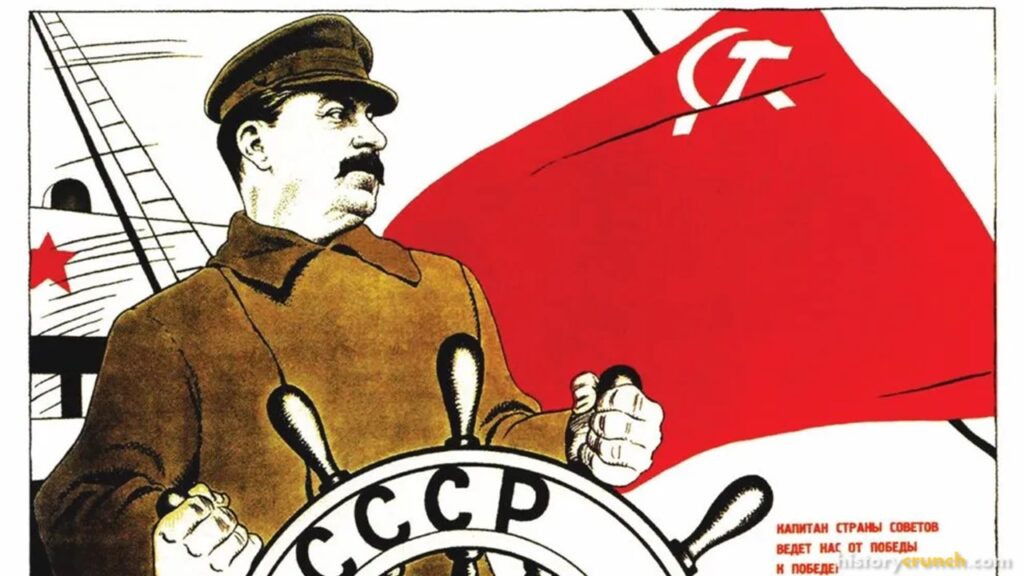
Because of the nature of command economies, they are often associated with dictatorships. A dictatorship is a form of government in which most or all authority of the country is in the hands of a single individual; the leader. Furthermore, command economies are also often associated with communist states. Communism is an economic and political system that is based on the principles of socialism, especially the earlier development of Marxism and the ideas of Karl Marx as expressed in the Communist Manifesto. Similar to Marxism, communism is centered on the idea of establishing a society based upon public ownership of the means of production and the removal of any form of social classes. As such, communist dictators often use a command economy as a way of further controlling their countries. One of the best examples of a command economy in history is the economy of the Soviet Union under communist dictator Joseph Stalin during the middle part of the 20th century. Stalin famously ruled over the Soviet Union as one of the most controlling dictators in all of history. For example, in the early 1930s he collectivized the farms of Ukrainians. This means the Soviet Union forced the farmers of Ukraine to give up their privately owned farms and instead the land came under the public (government) ownership of the Soviet Union. This event is famous for leading to the Ukraine Famine, which is also known as the Holodomor. Regardless, Stalin’s collectivization of the Ukrainian farmland displays a command economy because it shows a government trying to direct the means of production of the economy and taking ownership over private property for the state. There are many other examples of command economies throughout history, including: Fidel Castro in Cuba, Kim Jong-Un in North Korea and other periods in the history of the Soviet Union.
FactsthatCrunchIn the early 1930s, Stalin's Soviet government forced Ukrainian farmers off their privately owned land and placed all farmland under state ownership and control, stripping millions of people of the means to grow or keep their own food and triggering a famine known as the Holodomor.
Ukrainian farmers worked privately owned land and controlled their own harvests
State-controlled farms produced under government quotas, and the resulting famine killed an estimated 3.5 to 5 million Ukrainians between 1932 and 1933
Positives of a Command Economy
On the positive side, a command economy allows the government of a country to quickly respond to issues facing the nation. For example, in the years before World War II, Joseph Stalin carried out a series of plans to industrialize the Soviet Union which are referred to as his ‘Five Year Plans’. Because the Soviet Union was a command economy, it allowed Stalin to direct the economic output of the country towards industrializing as quickly as possible. Before this point, the Soviet Union was one of the least industrialized nations in Europe, which caused it to struggle during World War I. By controlling the economy of the Soviet Union, Stalin was able to better prepare the country for the conflict of World War II, and the resulting Cold War. Furthermore, a command economy also allows the leader of a country to respond to the individual needs of the citizens. For instance, the leader can direct the economy to produce a certain good or service if he feels it is needed by the citizens. This approach could be used to produce consumer goods, or to respond to an internal crisis such as a natural disaster. Another positive of a command economy is that it allows the government to have direct control over the distribution of the wealth in society. One of the key features of any economic system is how it distributes money (wealth) throughout the citizens of the country. Since the leader has direct control in a command economy, it means that he is able to more equally distribute the wealth among all citizens. One of the key issues with capitalism is its inability to meet the needs of all people from different classes. In a command economy, the wealth can, and often is, distributed between all citizens in a more equitable fashion. This approach could help reduce poverty and large income gaps that sometimes emerge in free market economies. Furthermore, command economies usually also have very low levels of unemployment. Again, because the economy is controlled by the government, the leadership has the ability to direct that all citizens will be provided with employment. This is related to the equitable distribution of the wealth because the government is ensuring that all citizens have the ability to generate an income and support themselves. Unfortunately, this is not always possible in countries that embrace capitalist values. The final positive aspect of a command economy, is that the control that the government has allows it the ability to look after the collective interest of the nation. This means that the government is able to provide goods and services that benefit everyone in society or the country as a whole and not just individual people or businesses. As a result, a command economy has the potential to better meet the needs of the country as a whole and avoid issues such as income disparity.
FactsthatCrunchCommand economies usually have very low unemployment.
Negatives of a Command Economy
Although there are several positive aspects of a command economy, there are also several negative aspects. First, since a command economy is controlled by the central government, it means that individuals and businesses have very little choice or influence on the overall economy. This could be a problem because it might be very difficult for the government to understand and act in the best interest of the people. If the government doesn’t understand the true needs of the people it risks not providing the exact goods and services required. Also, if the government in a command economy produces an unneeded good or service then it risks wasting resources and wealth on things that are not usable or wanted by the citizens. Therefore, a command economy could potentially lead to a lot of waste. Further to this idea, the lack of private ownership in a command economy could potentially be a major problem. In a free market economy, individual people and privately owned businesses are driven by self-interest, competition and the profit motiveThe drive for individuals and businesses to produce and compete in order to earn as much wealth as possible.. These three principles push people and businesses to produce at the highest level as they seek to compete for the most possible wealth. However, in a command economy these principles are not present because the government controls the economic decision-making. As a result, command economies struggle to motivate people and businesses to produce at high levels, since there is often little incentive to do so. In contrast, free market economies often produce at very high levels. Finally, related to the earlier negatives, in a command economy individual people often lack choice in terms of their career. While the government of a command economy promises full employment for its people, it does not promise employment in areas chosen by the people. Instead, citizens are often placed in careers that fit the needs of the country and not necessarily their own personal interests. This is related to the earlier ideas expressed, in that, with a lack of choice people may not produce to their best ability as they lack the incentive to do so.
FactsthatCrunchWhy do command economies struggle to motivate high production?
Key Vocabulary
Collectivism
Means of production
Supply and demand
Centrally planned economy
Collectivized
Profit motive
Frequently Asked Questions
What is a command economy in simple terms?
A command economy is a system where the government makes most economic decisions and controls the means of production. The leadership decides what gets made, how much workers earn, and the price of goods. Individual people and businesses have very little say in these choices.
What are examples of command economies in history?
The Soviet Union under Joseph Stalin is one of the best known examples of a command economy. Other examples include Cuba under Fidel Castro and North Korea under the Kim family. These systems are often linked to communist states and dictatorships.
How is a command economy different from a free market economy?
In a command economy the government sets prices and controls production, while a free market economy relies on supply and demand. Free markets let private businesses compete for profit, which can push output higher. A command economy instead focuses on collective interest and equal distribution of wealth.
What are the advantages of a command economy?
A command economy lets a government respond quickly to national problems and crises. It can also spread wealth more evenly and keep unemployment very low. Stalin used this control to industrialize the Soviet Union rapidly through his Five Year Plans.
What are the disadvantages of a command economy?
A command economy gives people and businesses little choice, which can lead to waste and low production. Without competition or the profit motive, there is often little reason to work at a high level. Citizens may also be placed in jobs that fit the country’s needs rather than their own interests.
Why is a command economy called a centrally planned economy?
It is called a centrally planned economy because the decisions are controlled by a single central force, the government leadership. Some economists argue the two terms differ slightly, saying a command economy involves more government ownership. Both still share a high degree of government control over the economy.
Cite This Article
To cite this article as a source, use one of the formats below.
MLA: Beck, Elias. “Command Economy: A Detailed Summary.” HistoryCrunch, 13 October 2026, https://historycrunch.com/command-economy/.
APA: Beck, E. (2026). Command Economy: A Detailed Summary. HistoryCrunch. https://historycrunch.com/command-economy/
Chicago: Beck, Elias. “Command Economy: A Detailed Summary.” HistoryCrunch. October 13, 2026. https://historycrunch.com/command-economy/
Sources
- State Department — Office of the Historian
- Wilson Center Digital Archive
- John Lewis Gaddis, The Cold War: A New History.