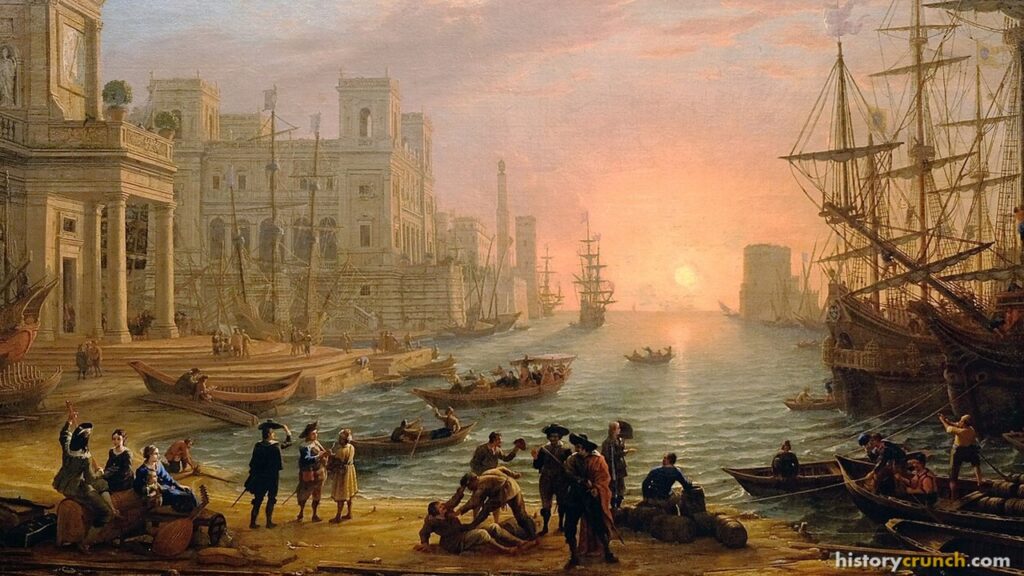
Mercantilism was the major economic system in Europe from the 16th to the 18th century. At its core, mercantilism held that national power and wealth were best served by maximizing exports in exchange for gold and silver. With that said, mercantilism had significant impacts on more than just economic activity and played an important role in trade, colonization, and political organization.
MERCANTILISM – WHEN AND WHERE DID IT BEGIN?
Mercantilism began during the rise of centralized monarchies in early modern Europe. For instance, as Europe emerged from the Middle Ages, it experienced several important changes, including: increased trade, growth of towns and cities, and the rise of wealthy merchants and bankers. At the same time, powerful monarchs in countries such as Spain, France and England sought to gain more control over their economies and expand their influence abroad, during the events of the Age of Exploration.
The European empires of the 16th through the 18th centuries were empires that existed primarily to increase trade and the wealth of the European nations. During this time, powerful European nations such as Spain, Portugal, England and France participated in intense economic and exploration based rivalries. The Age of Exploration shows this rivalry in the massive colonies that each European nation amassed, as they competed with each other for territories in the New World. At their height, these countries controlled large sections of the world as part of their vast empires. In fact, colonies were seen as essential sources of raw materials and captive markets for exports, all managed to benefit the mother country.
MERCANTILISM – WHAT WAS IT?
Historians generally argue that mercantilism was made up of several key factors. First, was the concept of ‘Bullionism’. This was the idea that the national wealth of a given country was measured by the amount of gold and silver that it had. As such it was the believed that the more bullion (gold and silver), the more powerful the nation.
At the center of the European rivalries, of the Age of Exploration, existed the economic system of mercantilism, which was the idea that colonies and trade should be strictly controlled to benefit the economy of the home (European) nation. These European nations believed that in order to ensure prosperity, the balance of trade must favor the home country. As such, it was believed that its exports must be higher than its imports. This caused captured territories, or colonies, to be viewed as a cheap source of raw materials. In particular, it was believed that a nation had to gain large amounts of gold and silver, and that a nation was only truly wealthy if it had more stored gold and silver than its rivals.
Under the mercantile system colonies existed to provide markets and natural resources for the industries of the home country. Laws often required a colony’s raw materials to be shipped to the home country. Colonial merchants and entrepreneurs were not allowed to set up factories and use the colony’s raw materials to manufacture goods, as all manufacturing would be carried out in the European nations themselves. The products made in the European nations would then be shipped back to the colony and sold in order to benefit the merchants and industrial cities in Europe. As well, to keep their own colonial markets strong, governments often prohibited colonies from importing goods from other European countries. This limited competition and meant that people in colonies could buy only goods made in the home country. In general, mercantilism is viewed as an economic system that favored heavy government control and regulation.
MERCANTILISM – REPLACED BY CAPITALISM
As the 18th century went along, some people began to reject the principles of mercantilism. For example, in 1776, Scottish economist Adam Smith published his famous written work “An Inquiry into the Nature and Causes of the Wealth of Nations” which is just often shortened to “Wealth of Nations”. The book challenged the idea that the government should control the economy and instead proposed the idea of free trade and competition with a lesser role of the government. The ideas of this book would eventually lay the foundation for the principles of capitalism, which is an economic system that supports the idea of free trade and choice as a way of achieving prosperity.
MERCANTILISM – SIGNIFICANCE
The economic principles of mercantilism were often associated with absolute monarchies and feudalism. An absolute monarchy is a form of government that was popular during medieval Europe and up until the end of the 18th century. It involved society being ruled over by an all-powerful king or queen. The monarch had complete control over all aspects of the society, including: political power, economics, and all forms of authority. The monarch was able to maintain absolute control over the society with the addition of feudalism, which involved people being placed into different estates of power, such as: clergy, nobility and peasants.
With this said, Mercantilist policies were not necessarily the same across the differing countries of Europe. For instance, in France, mercantilism centralized the power under King Louis XIV. In England, mercantilism played an important role in England becoming the largest empire in the world. For instance, mercantilism helped England dominate maritime trade and build its navy, turning it into a global power. In Spain, the inflow of silver from the Americas initially made it the richest European power, highlighting the importance of gold and silver to Mercantilist nations.
Regardless, the significance of mercantilism can best be seen in how it impacted global trade, helped increase European colonization, and led to rivalries among the main European nations. For instance, it encouraged European powers to compete for overseas territories, which led to the colonization of vast regions in the Americas, Africa, and Asia. Furthermore, the exploitation of colonies under Mercantilist systems contributed to the growth of the Transatlantic Slave Trade.
Finally, Mercantilism also impacted the role of government in economics. More specifically, it favored government intervention in the economy and linked economic policy directly to national power. This was a major shift from the economic systems of the Middle Ages, which were more less controlled by central authorities and focused more on local economies.