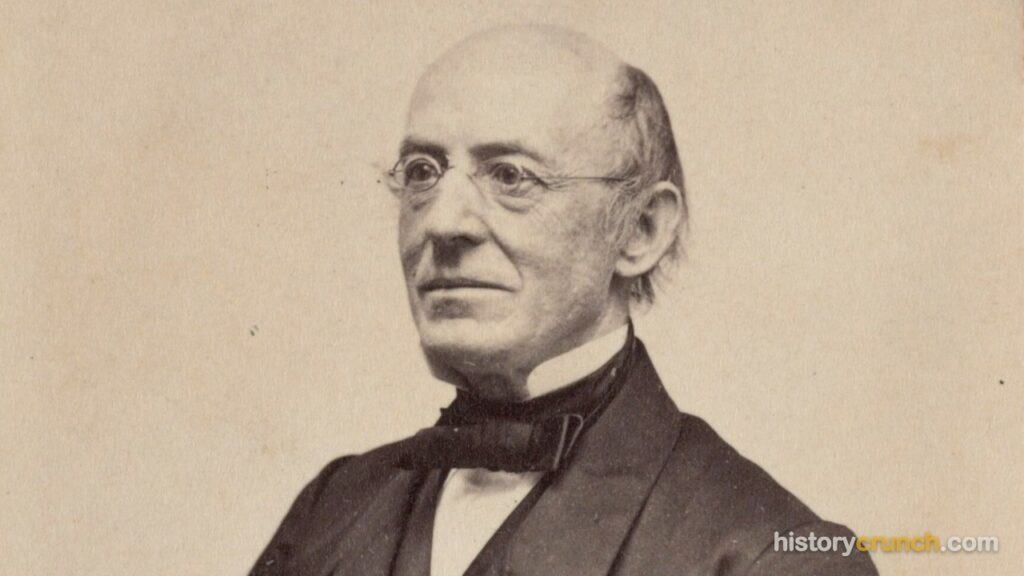
William Lloyd Garrison is one of the most important figures in the history of the American Abolitionist Movement and the fight to end slavery in the United States. As a journalist, editor, and reformer, he became famous for demanding the immediate and complete end of slavery at a time when even many people who opposed slavery believed it should end only slowly. Through his newspaper and the anti-slavery societies he helped create, Garrison pushed the issue of slavery to the center of American life in the decades before the American Civil War.
An abolitionist was a person who worked to abolish, or end, the practice of slavery. Some abolitionists wanted a gradual approach that would free enslaved people over many years, while others called for immediate emancipation, meaning slavery should be ended right away. Garrison belonged firmly to the second group, and he argued that slavery was a moral sin that no person had the right to defend or delay. This belief shaped everything he wrote and every organization he joined.
Early Life and Background
William Lloyd Garrison was born on December 10th, 1805, in Newburyport, Massachusetts. His father was a sailing captain who deserted the family when Garrison was still a very young child, leaving his mother to raise the children in poverty. As a boy, Garrison worked at small jobs, including selling homemade candy and delivering firewood, to help support the household. His mother was a devout Baptist who taught him a strict moral code that would later guide his views on slavery and reform.
Garrison received little formal schooling, but his life changed when he was about thirteen years old. At that age he became an apprentice to Ephraim Allen, the editor of a local newspaper called the Newburyport Herald. During this apprenticeship Garrison learned the printing trade, including how to set type by hand, which is the process of arranging metal letters to print a page. In fact, this skill was so natural to him that he later composed some of his articles directly in type without writing them out first.
By his early twenties, Garrison was already working in journalism and moving toward reform causes. In 1826 he started his own newspaper in Newburyport, but it failed soon after. He then moved to Boston, where he worked as a printer and editor, including a position at a newspaper that supported the temperance movement, which sought to reduce the drinking of alcohol. These early experiences gave him both the writing skills and the reforming spirit that would define his career.
Rise as an Abolitionist
Garrison first became involved in the anti-slavery cause during the 1820s. At the time, he supported the American Colonization Society, a group that wanted to end slavery gradually and then send free Black Americans to a colony in Africa. In 1828 he moved to Baltimore, Maryland, to help edit an anti-slavery newspaper alongside a Quaker abolitionist named Benjamin Lundy. Seeing slavery up close in Baltimore changed him deeply.
As stated above, Garrison came to reject the idea of gradual change and colonization entirely. He decided that slavery was wrong in every case and that it had to end immediately, with formerly enslaved people staying in the United States as free and equal citizens. This shift in thinking was uncommon in the 1830s, when even many opponents of slavery believed emancipation should happen slowly. Garrison’s demand for immediate emancipation set him apart and made him a leading voice of a new and more radical kind of abolitionism.
Garrison’s boldest step came at the very start of the following decade. On January 1st, 1831, he published the first issue of his own anti-slavery newspaper in Boston, called The Liberator. In its pages he declared his goal plainly and refused to soften his message. More specifically, Garrison insisted that he would be heard on the subject of slavery and would not back down, a stand that quickly made him one of the most famous and controversial reformers in the country.
The Liberator and Anti-Slavery Societies
The Liberator became the most influential anti-slavery newspaper in the United States, and Garrison published it weekly for thirty-five years, from 1831 until 1865. The paper reached only a small audience at first, with just a few hundred subscribers in its early years, and it depended heavily on support from free Black readers in the northern states. Even so, its powerful message spread far beyond its list of subscribers. Through The Liberator, Garrison condemned slavery as a sin and attacked any person or institution he believed helped it continue.
Garrison did not stop at publishing. In 1832 he helped form the New England Anti-Slavery Society, which was the first organization to call for the immediate emancipation of enslaved people. The group used a strategy sometimes called moral persuasion, which meant trying to change the hearts and minds of Americans by showing that slavery was morally wrong. This approach relied on pamphlets, lectures, and newspapers rather than on political parties or violence.
The following year, in 1833, Garrison helped organize the American Anti-Slavery Society in Philadelphia. This larger group brought together many leading abolitionists, including Arthur Tappan, Lewis Tappan, and Theodore Dwight Weld. As a founder and officer of the society, Garrison worked to build a national movement dedicated to ending slavery at once. To learn more about this organization and the wider cause, readers can visit the HistoryCrunch article on the American Abolitionist Movement.
Danger, Conflict, and Controversy
Garrison’s radical views made him many enemies, especially in the South. The state of Georgia even offered a large reward of several thousand dollars for his arrest and conviction. In the North he also faced danger from pro-slavery mobs. In October of 1835, an angry crowd in Boston seized Garrison, dragged him through the streets, and nearly killed him before the mayor and police were able to rescue him.
Garrison’s beliefs also created conflict within the anti-slavery movement itself. He argued that the United States Constitution was a proslavery document because it protected slavery, and he once called it a covenant with death. In fact, in 1854 he publicly burned a copy of the Constitution to protest the way it allowed slavery to survive. He even called for the free North to separate from the slaveholding South.
Because he distrusted politics as a world of compromise, Garrison refused to work through political parties or elections. This position divided abolitionists during the 1840s, and some broke away to form political groups that ran candidates for office. Garrison’s insistence on moral persuasion instead of political action was one of the deepest disagreements within the movement he had helped to build.
Connection to Frederick Douglass and Women’s Rights
One of Garrison’s most important contributions was helping to launch the career of Frederick Douglass. In the early 1840s Garrison discovered Douglass, a formerly enslaved man and gifted speaker, and encouraged him to share the story of his life in slavery before anti-slavery audiences. Douglass was inspired by Garrison and worked closely with him for years. In time, however, the two men split, partly because Douglass came to reject Garrison’s harsh view of the Constitution.
Garrison was also an early and outspoken supporter of women’s rights. He argued that women should be allowed to hold leadership positions in anti-slavery organizations and to take part fully in the movement. In 1840 he attended a major anti-slavery convention in London, and when the women in the American delegation were denied seats, Garrison refused to take his own seat and sat with them in protest instead. This willingness to link the causes of anti-slavery and women’s equality made him a pioneering reformer on more than one front.
Later Life
Garrison lived to see the cause he had championed finally succeed. During the American Civil War, he supported President Abraham Lincoln after the Emancipation Proclamation, and he witnessed the ratification of the Thirteenth Amendment, which ended slavery in the United States in 1865. That same year, believing his life’s work was complete, Garrison published the final issue of The Liberator after thirty-five years and stepped back from leadership of the American Anti-Slavery Society.
In his personal life, Garrison had married Helen Eliza Benson in 1834, and the couple raised a large family together. Even after slavery ended, he remained active in reform causes, speaking out for women’s suffrage, fair treatment of Native Americans, and other issues. He continued to write and lecture despite injuries that made physical activity difficult in his later years. William Lloyd Garrison died on May 24th, 1879, in New York City at the age of seventy-three.
Significance of William Lloyd Garrison
William Lloyd Garrison is remembered as one of the most important leaders of the American Abolitionist Movement. His demand for immediate emancipation helped change the debate over slavery, pushing the country away from slow, gradual plans and toward the idea that slavery had to end at once. Through The Liberator, he gave the anti-slavery cause a powerful and lasting voice that reached across the nation.
Garrison’s influence also came from the organizations he built and the reformers he inspired. The New England Anti-Slavery Society and the American Anti-Slavery Society helped turn abolition into a national movement, and figures such as Frederick Douglass rose partly through Garrison’s encouragement. In addition, his early support for women’s rights showed how reform movements of the 1800s were often linked together.
By insisting that slavery was a moral wrong that could not be excused or delayed, Garrison forced Americans to confront the issue directly. His uncompromising stand made him deeply controversial in his own time, but it also helped make slavery the central question in American politics before the Civil War. For these reasons, Garrison remains a key figure in the story of freedom and equality in the United States.
Frequently Asked Questions
Who was William Lloyd Garrison?
William Lloyd Garrison was an American abolitionist, journalist, and reformer who lived from 1805 to 1879. He is best known for editing the anti-slavery newspaper The Liberator and for demanding that slavery in the United States be ended immediately. He was one of the most important voices in the movement to abolish slavery before the American Civil War.
What was The Liberator?
The Liberator was an anti-slavery newspaper that Garrison founded in Boston in 1831 and published weekly until 1865. It became the most influential abolitionist paper in the country, even though it had only a small number of paying subscribers. Much of its early support came from free Black readers in the northern states, who helped keep the paper alive during its difficult first years.
Why did William Lloyd Garrison burn the Constitution?
Garrison burned a copy of the United States Constitution in 1854 because he believed it protected and supported slavery. He viewed the document as a proslavery agreement and once called it a covenant with death. This dramatic act showed how strongly he felt that the nation’s founding laws had failed to stand against slavery.
How were William Lloyd Garrison and Frederick Douglass connected?
Garrison helped launch Frederick Douglass’s public career in the early 1840s by encouraging him to speak about his life in slavery. Douglass admired Garrison and worked with him for several years within the anti-slavery movement. Later, the two men disagreed and split apart, in part because Douglass rejected Garrison’s belief that the Constitution was a proslavery document.
What did William Lloyd Garrison believe about ending slavery?
Garrison believed that slavery was a moral sin that had to be ended immediately rather than gradually. He also thought that formerly enslaved people should remain in the United States as free and equal citizens instead of being sent to Africa. He favored moral persuasion over political action, trying to change public opinion by convincing Americans that slavery was wrong.
Cite This Article
To cite this article as a source, use one of the formats below.
MLA: Millar, B. “William Lloyd Garrison: A Detailed Biography.” HistoryCrunch, 16 August 2026, https://historycrunch.com/william-lloyd-garrison/.
APA: Millar, B. (2026). William Lloyd Garrison: A Detailed Biography. HistoryCrunch. https://historycrunch.com/william-lloyd-garrison/
Chicago: Millar, B. “William Lloyd Garrison: A Detailed Biography.” HistoryCrunch. August 16, 2026. https://historycrunch.com/william-lloyd-garrison/
Sources
- J.M. Roberts & Odd Arne Westad, The Penguin History of the World.
- Jerry Bentley & Herbert Ziegler, Traditions & Encounters: A Global Perspective on the Past.