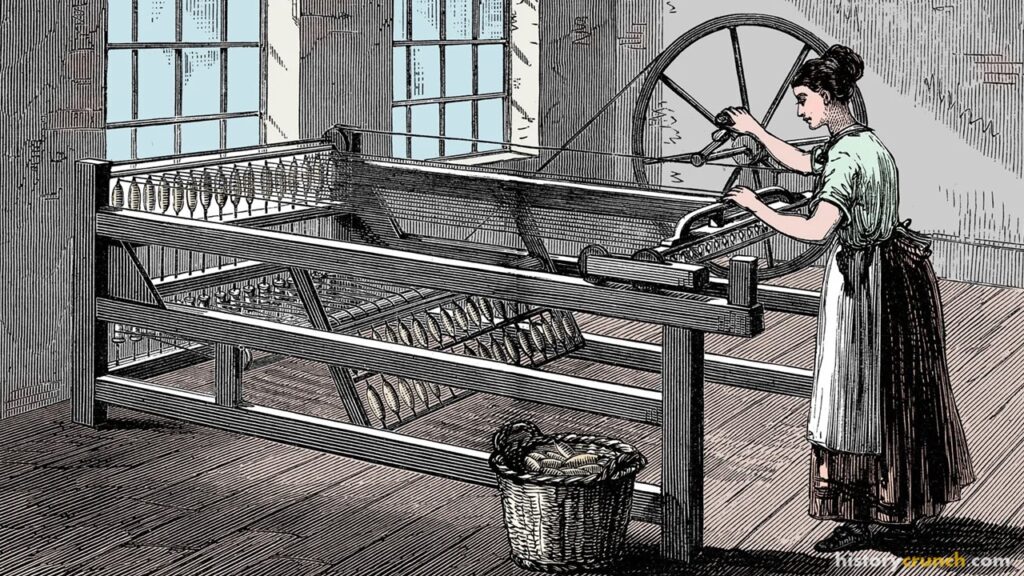
James Hargreaves was a significant figure in the timeframe of the Industrial Revolution and is remembered today as a noted inventor. For example, he invented the spinning jenny, which had a profound impact on production in England and around the world during the time of the Industrial Revolution. For instance, James Hargreaves’ spinning jennyA machine using a large wheel to spin many spindles of thread at once, greatly increasing how much thread could be made. transformed the textile industry by speeding up production.
 FactsthatCrunch
James Hargreaves invented the spinning jenny in 1764, a machine that used a large wheel to spin many spindles of thread at once, greatly increasing how much thread could be produced. His design influenced later inventors such as Richard Arkwright and Samuel Crompton, helping to transform the textile industry during the Industrial Revolution.

Furthermore, other inventors used Hargreaves’ design of the spinning jenny to produce other inventions. For example, Samuel Crompton used Hargreaves’ work to construct the spinning muleA machine invented by Samuel Crompton in 1779 that allowed fast production of yarn by combining earlier spinning machine ideas.. As such, James Hargreaves helped industrializationThe process by which a society shifts from hand-made production to large-scale manufacturing using machines. by inspiring other inventors.
James Hargreaves – Early Life
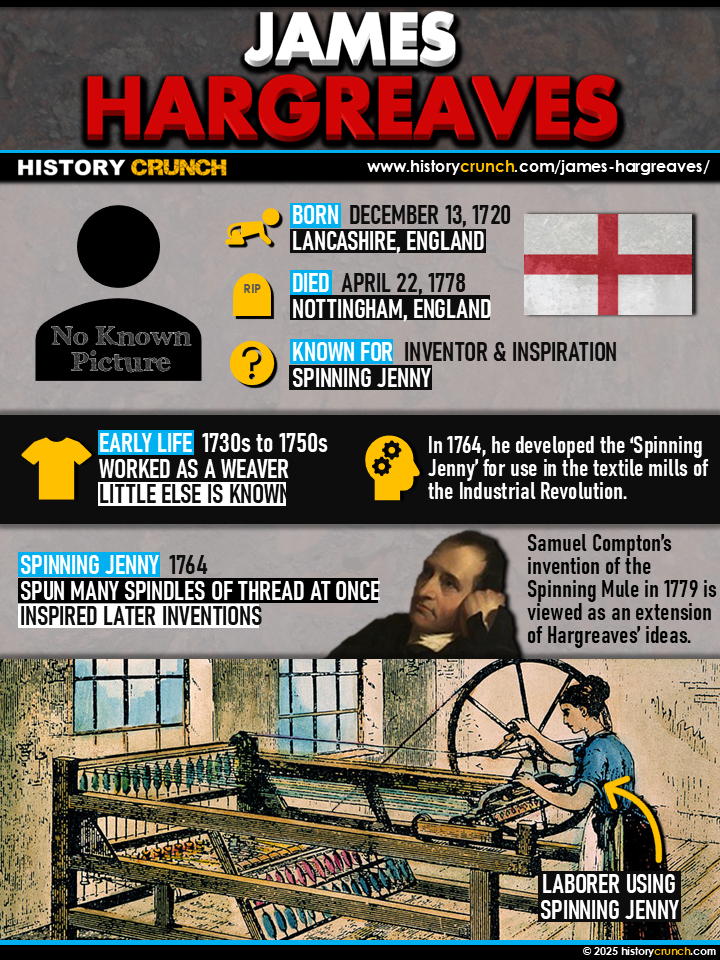
James Hargreaves was born around 1720 in Lancashire, England. Little is known of his early life, but he worked as a weaver, using a hand loom. In fact, he seems to have worked as a weaver for most of his life.
FactsthatCrunchJames Hargreaves – Invention of the Spinning Jenny
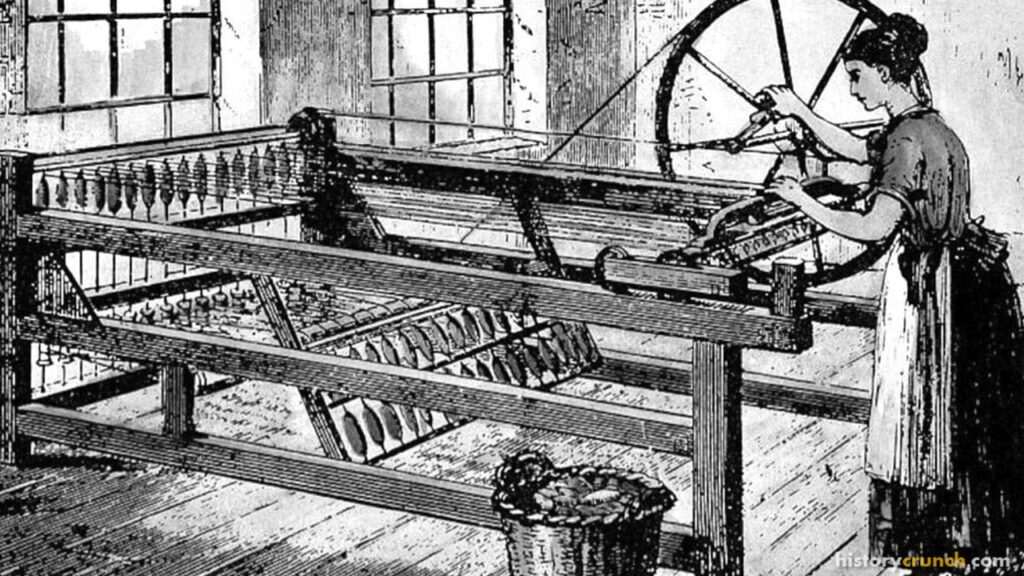
As stated above, James Hargreaves is famous for the invention of the spinning jenny in 1764. Simply put, the spinning jenny was a machine that used a large wheel to spin many spindlesRods or pins on a spinning machine onto which thread is wound as it is spun. of thread at once. The invention increased the production ability of textileRelating to cloth or fabric and the industry that makes it. manufacturers and was particularly important for cotton.
While Hargreaves sold his invention to several mills in the area, he made very little money from his work. Regardless, his invention had a profound impact on the Industrial Revolution as it inspired other inventors who built off of his ideas.
For example, Richard Arkwright invented the water frame in 1769. Arkwright’s invention was capable of producing strong yarn. The machine replaced the need for manual laborWork done by people using their hands rather than by machines. and enabled the production of inexpensive spun cotton by using the moving force of a creek or river that spun a shaft. This was important because the increased amount of energy meant that Arkwright’s water frameA machine invented by Richard Arkwright in 1769 that used the moving force of water to produce strong yarn. could produce at a higher level than Hargreaves’ spinning jenny. Next, historians identify the invention of the spinning mule in 1779 by Samuel Crompton, as an extension of the ideas of Hargreaves. The spinning mule essentially allowed the fast production of yarn using a spinning machine.
 FactsthatCrunch
James Hargreaves sold the spinning jenny to several mills in his area. What does his story show about how much money he made from those sales?
James Hargreaves – Death and Legacy
Hargreaves died on April 22nd, 1778, in Nottingham, England. Today he is remembered as a significant inventor of the Industrial Revolution and furthered the process of industrialization, especially in terms of the textile industry.
FactsthatCrunchHargreaves invented the spinning jenny in 1764, but angry spinners smashed his machines because they feared the jenny would take their jobs, forcing him to move from Lancashire to Nottingham in 1768.
Hand spinners across Lancashire saw the jenny as a direct threat to their livelihoods. Groups of them broke into Hargreaves's home and destroyed his machines. Only after moving to Nottingham did Hargreaves finally patent the spinning jenny, in 1770, six years after he first built it.
James Hargreaves – Infographic
Key Vocabulary
Spinning jenny
Spindles
Textile
Water frame
Spinning mule
Industrialization
Manual labor
Frequently Asked Questions
What did James Hargreaves invent?
James Hargreaves invented the spinning jenny in 1764. The machine used a large wheel to spin many spindles of thread at once. This let workers make far more thread than a single spinning wheel could, which was very useful for cotton.
Why was the spinning jenny important?
The spinning jenny was important because it sped up thread production during the Industrial Revolution. It transformed the textile industry and made it easier to meet the growing demand for cloth. The machine also inspired other inventors who built better spinning machines.
How did Hargreaves influence other inventors?
Hargreaves influenced other inventors by giving them ideas to improve on. Richard Arkwright built the water frame in 1769, which used water power to make strong yarn. Samuel Crompton then combined ideas to build the spinning mule in 1779.
Did James Hargreaves become rich from his invention?
No, James Hargreaves made very little money from the spinning jenny. He sold his invention to several mills in his area, but he earned only small returns. He had worked as a weaver for most of his life and stayed a man of modest means.
When and where was James Hargreaves born?
James Hargreaves was born around 1720 in Lancashire, England. Little is known about his early life beyond his work as a weaver. He later died on April 22nd, 1778, in Nottingham, England.
Cite This Article
To cite this article as a source, use one of the formats below.
MLA: Beck, Elias. “James Hargreaves: A Detailed Biography.” HistoryCrunch, 25 September 2026, https://historycrunch.com/james-hargreaves/.
APA: Beck, E. (2026). James Hargreaves: A Detailed Biography. HistoryCrunch. https://historycrunch.com/james-hargreaves/
Chicago: Beck, Elias. “James Hargreaves: A Detailed Biography.” HistoryCrunch. September 25, 2026. https://historycrunch.com/james-hargreaves/
Sources
- The Science Museum Group
- Emma Griffin, A Short History of the British Industrial Revolution.
- Fordham Modern History Sourcebook