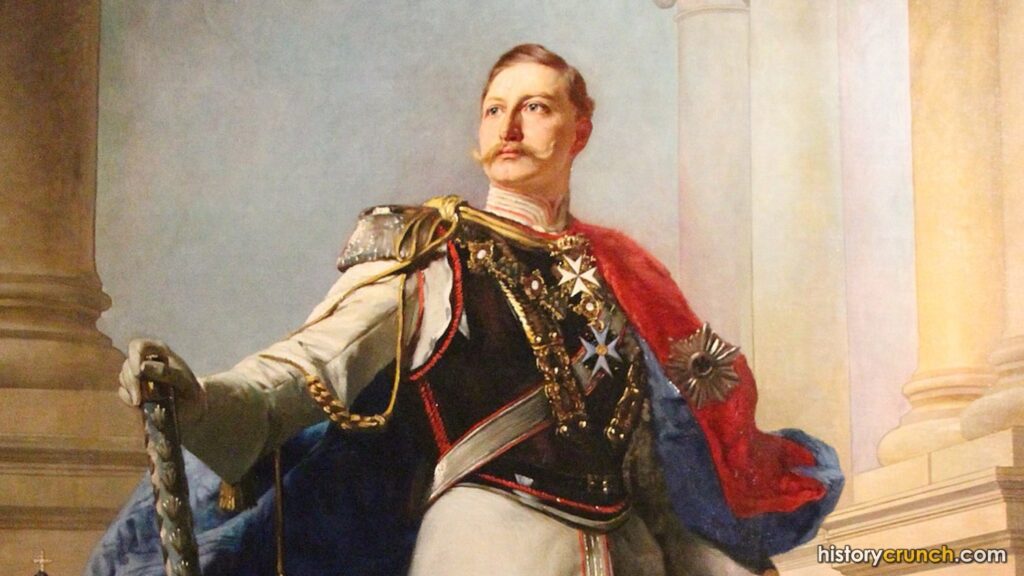
KaiserThe German word for emperor, derived from the Latin word Caesar used by rulers of ancient Rome. Wilhelm II was the Emperor of Germany and King of Prussia from 1888 until 1918 and one of the most significant political figures of World War I. He is remembered as an ambitious and often reckless ruler whose aggressive foreign policy and support for military expansion contributed to the outbreak of the First World War. His reign ended in humiliation when he was forced to abdicateTo formally give up a throne or high office, often under pressure or by force. the throne as Germany faced defeat in 1918 and spent the rest of his life in exile in the Netherlands.
 FactsthatCrunch
Wilhelm II took direct personal control of German foreign policy after forcing Chancellor Otto von Bismarck to resign in March of 1890 CE, removing the experienced diplomat who had carefully managed Germany's relationships with the other great powers for nearly thirty years. His aggressive push for German naval and military power, including his unconditional backing of Austria-Hungary in July of 1914 CE, made him a central figure in the chain of decisions that pulled Europe into World War I.
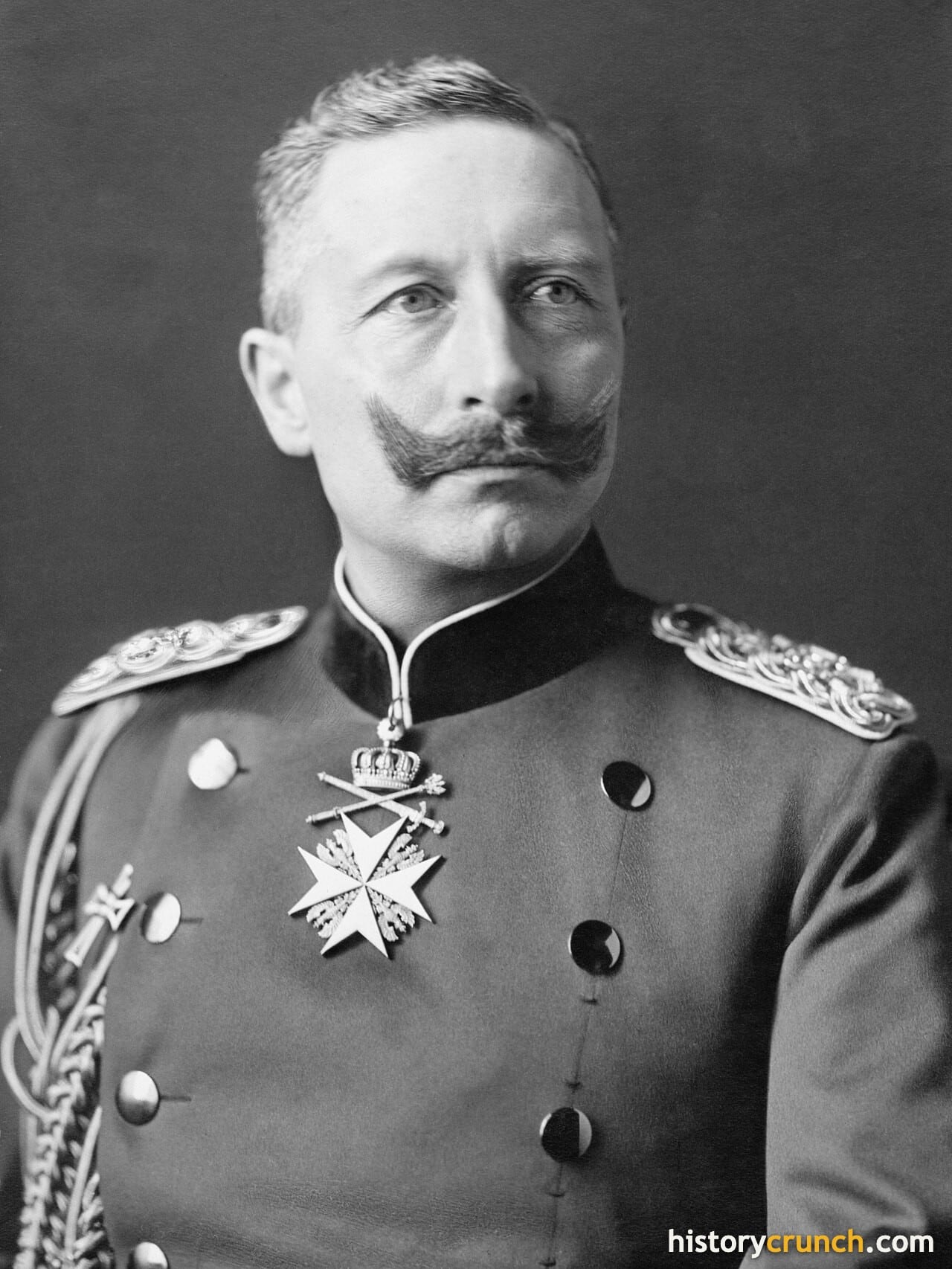
The word Kaiser is the German word for emperor, and it comes from the Latin word Caesar, which was the title used by the rulers of the ancient Roman Empire. Germany had only recently become a unified nation in 1871, just twelve years after Wilhelm was born, and it was still a young and ambitious empire trying to establish itself as one of the great powers of Europe. Wilhelm’s reign saw Germany grow rapidly in military strength and industrial power, but his aggressive and sometimes unpredictable style of leadership created enemies across Europe and ultimately helped to pull the continent into the most destructive war it had ever seen.
Kaiser Wilhelm II’s Early Life
Kaiser Wilhelm II was born on January 27th, 1859 CE in Potsdam, near Berlin, Germany. His full name was Friedrich Wilhelm Viktor Albert. His father was Frederick III, the Crown Prince of Germany and Prince of Prussia, and his mother was Victoria, the eldest daughter of Queen Victoria of Great Britain. This meant that Wilhelm was the oldest grandchild of Queen Victoria, making him a cousin of both King George V of Britain and Tsar Nicholas II of Russia, who would later become his enemies in World War I.
Wilhelm’s birth was difficult and resulted in a serious injury to his left arm, which was permanently damaged and shorter than his right. He spent much of his childhood and adult life trying to conceal this disability. For instance, he developed a habit of posing for photographs and portraits in ways that hid his withered arm, and he trained himself to use his right hand almost exclusively. Some historians believe that his insecurity about this disability contributed to his later need to prove himself as a strong and powerful ruler. Regardless, Wilhelm’s upbringing was strict and demanding. His education was rigorous and he was trained in both academic subjects and military affairs. He studied at the Gymnasium at Kassel and later at the University of Bonn. As such, by the time he reached adulthood, Wilhelm was an intelligent and well-educated young man, but also one with a quick temper, an impulsive personality and an intense desire to be seen as powerful and important.
FactsthatCrunchKaiser Wilhelm II's left arm was permanently damaged at birth and was noticeably shorter than his right, yet he spent decades carefully posing in photographs and portraits to hide it, training himself to hold gloves, props, or his right hand over the arm so viewers would not notice.
The injury happened during a difficult delivery on January 27th, 1859 CE in Potsdam, Germany. Wilhelm worked hard to appear physically powerful in public because he ruled an empire that prized military strength. Some historians connect his lifelong effort to conceal the disability to his intense need to project dominance, which shaped how he led Germany.
Kaiser Wilhelm II Becomes Emperor
Wilhelm became Emperor of Germany in 1888 CE under dramatic circumstances. That year is sometimes called the Year of Three Emperors because Germany went through three different rulers in the space of a single year. In March of 1888 CE, Wilhelm’s grandfather Emperor Wilhelm I died at the age of ninety. Wilhelm’s father Frederick III then became emperor, but he was already dying of throat cancer at the time and was unable to speak. Frederick III reigned for only ninety-nine days before dying in June of 1888 CE. As a result, Wilhelm became Emperor of Germany and King of Prussia at the age of twenty-nine.
One of the most significant early events of Wilhelm’s reign was his dismissal of Otto von Bismarck as Chancellor of Germany in March of 1890 CE. Bismarck was one of the most important political figures in European history and had been the dominant force in German politics for nearly thirty years. It was Bismarck who had masterminded the unification of the German states into a single German Empire in 1871 CE, and who had carefully managed Germany’s relationships with the other great powers of Europe through a complex system of alliances and diplomacy. Wilhelm, however, wanted to rule Germany himself and resented Bismarck’s dominance. The two men clashed repeatedly over both foreign and domestic policy, and Wilhelm eventually forced Bismarck to resign. After Bismarck’s departure, Wilhelm took much more personal control over the direction of German foreign policy, with results that would prove disastrous for Germany and for Europe.
FactsthatCrunchWilhelm II Becomes Emperor in the Year of Three Emperors
His grandfather Wilhelm I died in March 1888, and his father Frederick III died of throat cancer after only 99 days as emperor. At 29, Wilhelm II became German Emperor and King of Prussia, the third emperor in a single year.
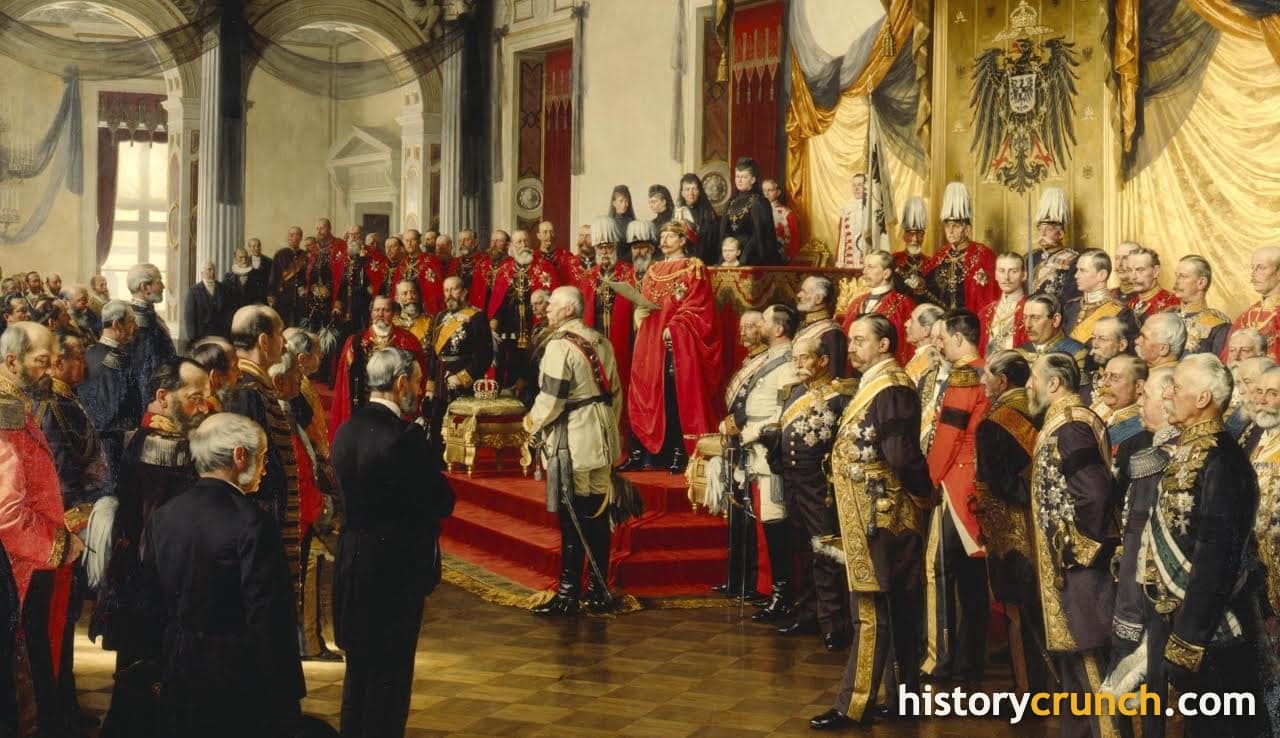
Kaiser Wilhelm II and German Militarism
One of the defining features of Wilhelm’s reign was his deep commitment to building up Germany’s military power, and in particular his determination to create a German naval fleet powerful enough to rival the Royal Navy of Great Britain. Militarism is the term used to describe the belief that a country should build up a strong military force and be willing to use it aggressively to advance its interests. During the late 19th and early 20th centuries, militarismThe belief that a country should build a powerful military and use it aggressively to advance its interests. was a powerful force across Europe, as the major powers competed with each other to build larger armies and navies. Wilhelm was one of the most enthusiastic supporters of this trend.
Wilhelm had developed a deep love of the sea and a strong admiration for the power of the British Royal Navy during childhood visits to his British relatives. This admiration quickly turned into envy and then into a determined ambition to build a German fleet that could match Britain’s. He supported the plans of his chief admiral, Alfred von Tirpitz, who argued that Germany needed a large fleet of warships stationed in the North Sea to give Germany diplomatic power over Britain. The result was a naval arms race between Germany and Britain that lasted for years and created enormous tension between the two countries. For instance, the British government responded to German naval expansion by financing a major program of warship construction of its own, and the rivalry between the two fleets became one of the most significant sources of tension in Europe in the years before World War I. As such, Wilhelm’s commitment to German naval expansion was a major factor in the deteriorating relationship between Germany and Britain in the years leading up to the war.
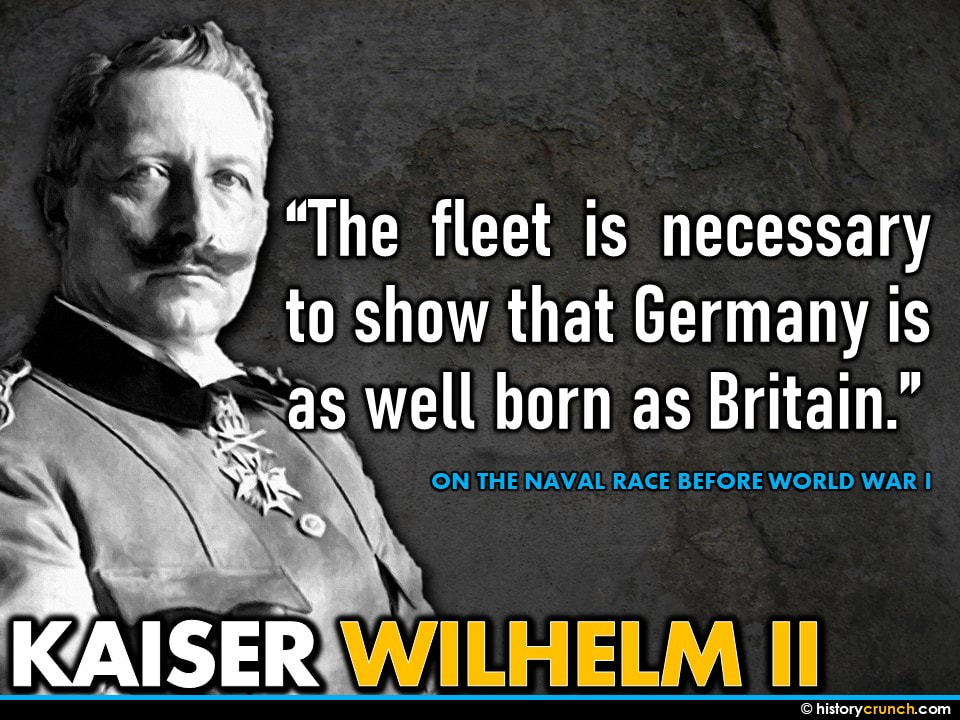
Kaiser Wilhelm II and the Road to War
In the decades before World War I, Wilhelm’s foreign policy created a series of international crises that steadily increased tensions across Europe. For instance, in 1896 CE he sent a telegram congratulating the Boer leader Paul Kruger after the defeat of a British raid in South Africa, which caused fury in Britain and was seen as deliberate provocation. In 1905 CE and again in 1911 CE, Wilhelm intervened in disputes over Morocco in North Africa in ways that threatened France and brought Europe close to war on both occasions. In 1908 CE, he gave an interview to the British newspaper the Daily Telegraph in which he made a series of tactless and inflammatory statements about Germany’s relationship with Britain, causing embarrassment to his own government and further damaging Germany’s international reputation.
Behind all of these incidents was Wilhelm’s desire to win what he called a place in the sun for Germany, by which he meant a position of power and influence in world affairs equal to or greater than that of Britain and France. Germany had arrived late as a unified nation compared to the other great powers, and Wilhelm was determined to make up for lost time by asserting German power as forcefully as possible. The problem was that his aggressive and unpredictable approach to foreign policy alarmed the other European powers and pushed them toward forming defensive alliances against Germany. In general, the system of alliances that existed in Europe by 1914 CE meant that a conflict involving any two major powers had the potential to quickly draw in all the others. As such, the diplomatic environment that Wilhelm had helped to create made a general European war far more likely than it would otherwise have been.
 FactsthatCrunch
After dismissing Chancellor Otto von Bismarck in March of 1890 CE, Kaiser Wilhelm II took personal control of German foreign policy and pursued an aggressive, unpredictable approach aimed at winning Germany a position of power equal to Britain and France.
Bismarck had kept Germany's relationships with other powers stable through careful diplomacy. Wilhelm rejected that approach and replaced it with one that repeatedly threatened neighboring countries, pushing them into alliances against Germany.
Kaiser Wilhelm II and World War I
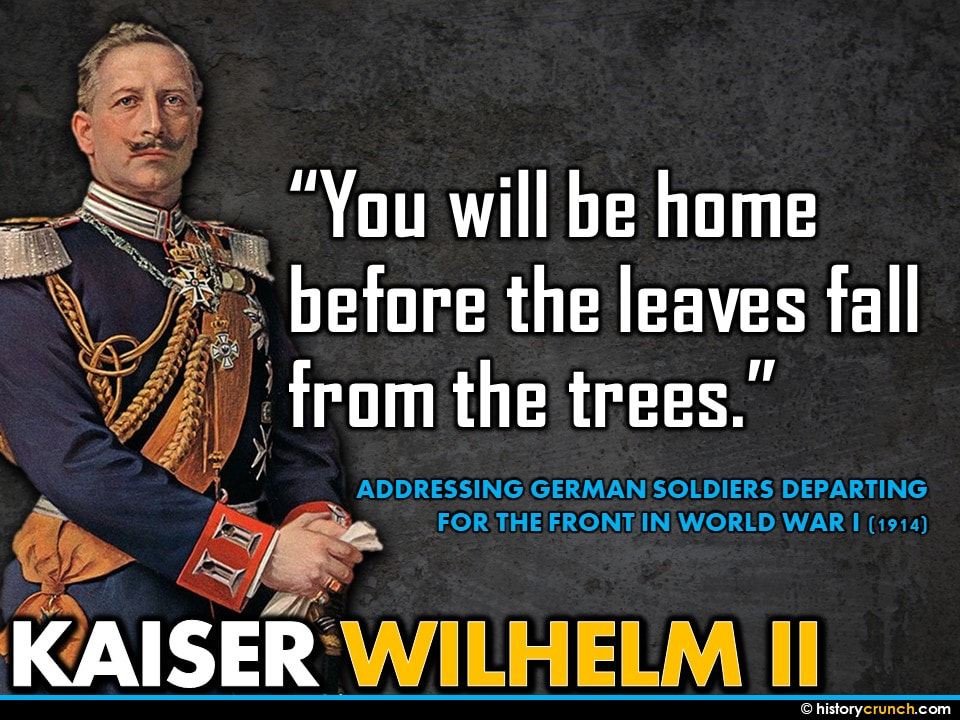
The immediate cause of World War I was the assassination of Archduke Franz Ferdinand of Austria-Hungary in Sarajevo on June 28th, 1914 CE. Franz Ferdinand was shot and killed by Gavrilo Princip, a Bosnian Serb nationalist and member of Young Bosnia, a group armed by the Black Hand, a secret Serbian nationalist organization. Following the assassination, Austria-Hungary issued a harsh ultimatum to Serbia. Before doing so, Austria-Hungary sought assurance from Germany that it would provide military support if Russia intervened on Serbia’s behalf. Wilhelm and his government gave Austria-Hungary what historians call a blank checkAn unconditional promise of support given by Germany to Austria-Hungary regardless of the consequences in 1914., meaning an unconditional promise of German support regardless of the consequences. This decision was one of the most significant of the entire war, because it effectively gave Austria-Hungary the confidence to take a hard line against Serbia knowing that Germany would back it up.
When Austria-Hungary declared war on Serbia on July 28th, 1914 CE, the system of European alliances quickly drew the other great powers into the conflict. Russia mobilized its forces in support of Serbia. Germany declared war on Russia and then on France. When Germany invaded neutral Belgium as part of its military strategy, Britain declared war on Germany. Within weeks, most of Europe was at war. World War I was one of the most destructive conflicts in human history. It lasted from 1914 until 1918 and resulted in the deaths of millions of soldiers and civilians across Europe and beyond.
During the war itself, Wilhelm’s actual role in military decision-making became increasingly limited. Although he held the title of Supreme War Lord, he tended to defer to his military commanders rather than directing strategy himself. For instance, powerful military figures such as General Paul von Hindenburg and General Erich Ludendorff effectively took control of Germany’s war effort by 1916 CE, while Wilhelm played a less and less significant role. As such, the man who had done so much to bring Germany into the war found himself sidelined once the fighting actually began.
FactsthatCrunchEmperor Francis Joseph may, however, rest assured that His Majesty will faithfully stand by Austria-Hungary, as is required by the obligations of his alliance and of his ancient friendship.
These words answered Emperor Francis Joseph's letter asking Germany to back Austria-Hungary against Serbia after the assassination of Archduke Franz Ferdinand. The open promise of support, later called the Blank Check, encouraged Vienna to send Serbia a harsh ultimatum that pushed Europe toward war.
Kaiser Wilhelm II’s Abdication and Exile
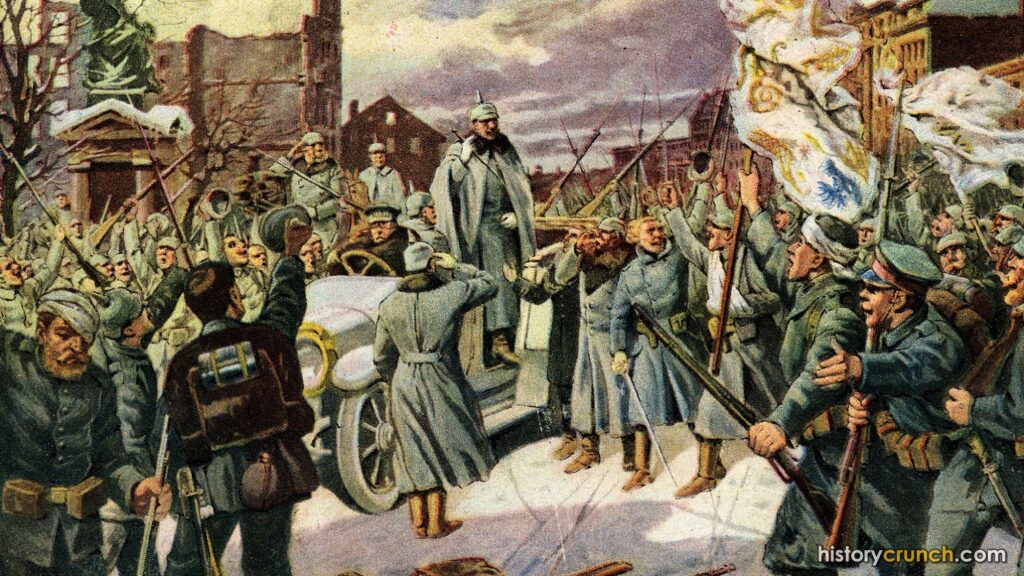
By late 1918 CE it was clear that Germany was losing the war. The entry of the United States into the conflict in April of 1917 CE had brought fresh troops and enormous resources to the Allied side, and Germany’s military position had become hopeless. Revolution broke out in Germany as soldiers mutinied and workers went on strike in cities across the country. On November 9th, 1918 CE, Chancellor Max von Baden announced Wilhelm’s abdication before Wilhelm had even formally agreed to it, in an attempt to calm the revolutionary situation in Berlin. Germany was proclaimed a republic later that same day. Wilhelm fled across the border into the neutral Netherlands on November 10th, 1918 CE, just one day before the armisticeA formal agreement between enemies to stop fighting, ending the combat of World War I on November 11, 1918. that ended World War I was signed on November 11th.
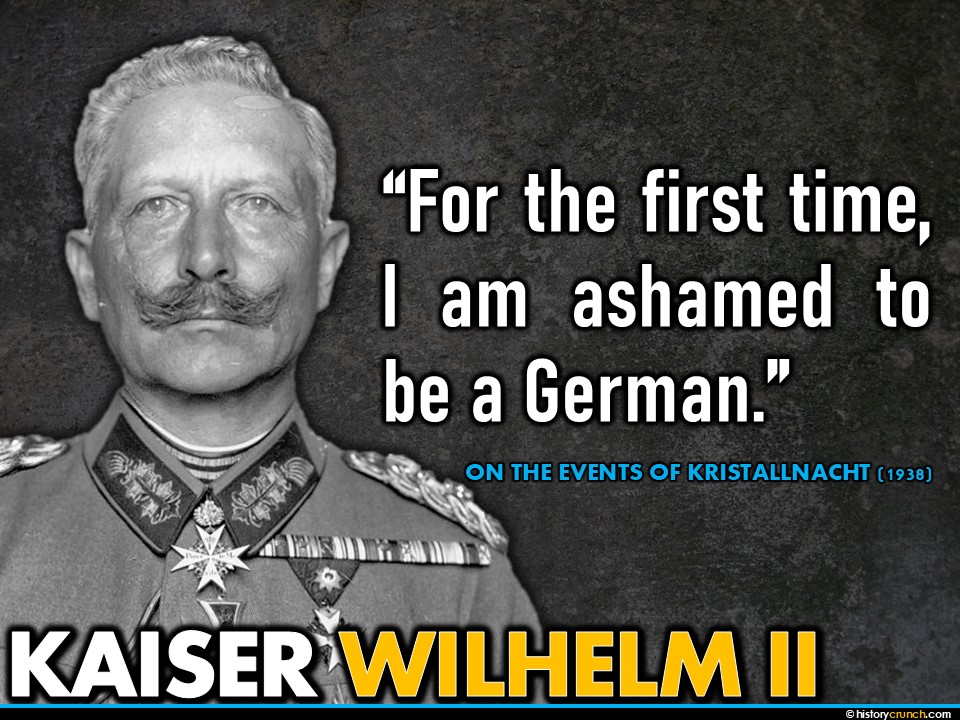
The Allied powers wanted to put Wilhelm on trial as a war criminal. However, the Dutch government refused to extraditeTo hand over a person accused of a crime to another country to face trial. him, and he was allowed to remain in the Netherlands. He eventually settled at Huis Doorn, a manor house in the town of Doorn, where he spent the rest of his life. His first wife Augusta died in 1921 CE and he later remarried. In the early 1930s, Wilhelm reportedly hoped that the rise of Adolf Hitler and the Nazi Party might lead to a restoration of the German monarchy, but Hitler had no interest in bringing back the Hohenzollern dynasty. As such, Wilhelm spent his final years as a largely forgotten figure, far removed from the world of power and politics that had defined his earlier life.
Kaiser Wilhelm II’s Death and Legacy
Kaiser Wilhelm II died on June 4th, 1941 CE at Huis Doorn in the Netherlands at the age of eighty-two. He died of natural causes and was buried in a mausoleum on the grounds of the estate, in accordance with his wish that he would never return to Germany until the monarchy was restored. His wish has never been fulfilled and he remains buried in the Netherlands to this day.
Kaiser Wilhelm II is remembered as one of the most controversial rulers of the modern era. His ambition, his militarism and his aggressive foreign policy contributed significantly to the conditions that made World War I possible. For instance, his blank check to Austria-Hungary in July of 1914 CE removed the last obstacle to Austria going to war with Serbia and set the chain of events in motion that drew all of Europe into conflict. With that said, historians continue to debate the exact degree of his personal responsibility for the war. Some argue that he was largely controlled by his military advisers and that the deeper causes of the war lay in the alliance system and the wider forces of nationalism and militarism that were shaping Europe at the time. Regardless, Wilhelm II remains one of the most significant and recognizable figures of World War I, and his reign stands as a warning about the dangers of aggressive nationalism and unchecked military power.
FactsthatCrunchIn the early 1930s, what did Kaiser Wilhelm II hope the rise of Adolf Hitler might bring about?
Explore World War I · 1914 – 1918
Keep exploring World War I with these History Crunch resources.
Key Vocabulary
Kaiser
Abdicate
Militarism
Blank check
Ultimatum
Extradite
Armistice
Frequently Asked Questions
Why did Kaiser Wilhelm II have a damaged arm?
Kaiser Wilhelm II injured his left arm during a difficult birth in 1859, leaving it permanently shorter than his right. He spent much of his life hiding the disability, often posing for photos in ways that concealed it. Some historians believe his insecurity about the arm pushed him to prove himself as a strong and powerful ruler.
Why did Kaiser Wilhelm II fire Otto von Bismarck?
Wilhelm forced Bismarck to resign in March of 1890 because he wanted to rule Germany himself. Bismarck had dominated German politics for nearly thirty years and had built a careful system of alliances across Europe. After his departure, Wilhelm took personal control of foreign policy, with results that proved harmful for Germany.
What was the “blank check” Germany gave Austria-Hungary?
The blank check was Germany’s unconditional promise to support Austria-Hungary against Serbia in July of 1914. This pledge gave Austria-Hungary the confidence to take a hard line, even if Russia stepped in. It is seen as one of the key steps that pulled all of Europe into World War I.
How did Kaiser Wilhelm II lose his throne?
Wilhelm lost his throne in November of 1918 as Germany faced defeat and revolution broke out at home. Chancellor Max von Baden announced his abdication on November 9th, before Wilhelm had even agreed to it. Germany was proclaimed a republic that same day, and Wilhelm fled to the Netherlands the next morning.
What happened to Kaiser Wilhelm II after World War I?
Wilhelm lived in exile in the Netherlands until his death on June 4th, 1941. The Dutch government refused to hand him over for trial as a war criminal, so he settled at Huis Doorn. He hoped the rise of Adolf Hitler might restore the monarchy, but Hitler had no interest in bringing it back.
Cite This Article
To cite this article as a source, use one of the formats below.
MLA: Millar, B. “Kaiser Wilhelm II: A Detailed Biography.” HistoryCrunch, 30 September 2026, https://historycrunch.com/kaiser-wilhelm-ii/.
APA: Millar, B. (2026). Kaiser Wilhelm II: A Detailed Biography. HistoryCrunch. https://historycrunch.com/kaiser-wilhelm-ii/
Chicago: Millar, B. “Kaiser Wilhelm II: A Detailed Biography.” HistoryCrunch. September 30, 2026. https://historycrunch.com/kaiser-wilhelm-ii/
Sources
- Fordham Modern History Sourcebook
- John Keegan, The First World War.
- Margaret MacMillan, The War That Ended Peace.
- Hew Strachan, The First World War.