The alliance systems before World War I refers to the two main alliance systems that divided the main powers of Europe and set the stage for the First World War. In short, this includes the Triple Alliance and the Triple Entente. These alliance systems were significant because they led to the eventual 1914 outbreak of World War I. As such, historians consider both the Triple Alliance and the Triple EntenteA French word meaning agreement or friendship, used to describe an informal understanding between nations. to be significant causes of World War I. They helped divide Europe in the early 20th century and created a tense situation that caused war to erupt following the assassination of Austrian Archduke Franz Ferdinand on June 28th, 1914. Click on the links below to read more about each topic related to the alliance systems before World War I.
 FactsthatCrunch
Alliance Systems Before World War I – Triple Alliance
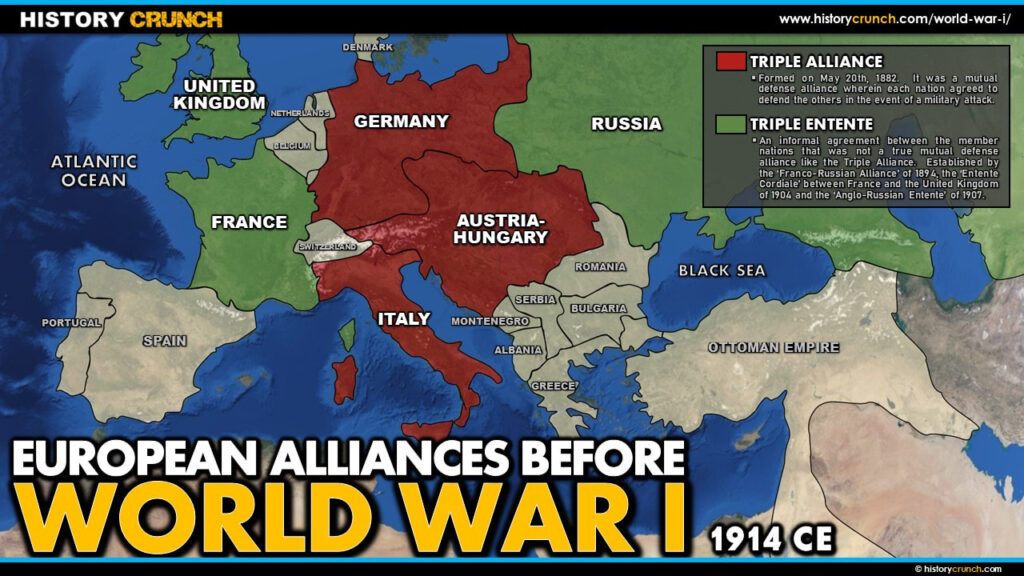
The Triple Alliance was a mutual defense allianceA formal agreement where member nations promise to militarily protect each other if any one of them is attacked. between the major European nations of Germany, Austria-Hungary and Italy. This means that each member nation agreed to come to the military aid and defense of the other member nations in the event that they were attacked. The Triple Alliance was first formally established by the member nations on May 20th, 1882. In the years leading up to 1914, which was the start of World War I, the main terms of the Triple Alliance were renegotiatedDiscussed and agreed upon again, often with updated or changed terms. and renewed several times.
The Triple Alliance was a major factor in dividing Europe between the European powers of the time. In fact, one of the main reasons why historians consider the alliance systems before World War I as a main cause for the outbreak of the war, is because it set the stage for hostilities between nations such as Germany and France. For example, the Triple Alliance eventually led to the informal agreement of the Triple Entente between Britain, France and Russia as a competing alliance system in Europe. Another issue related to the Triple Alliance and the outbreak of World War I, was that the main terms of the treaty were kept secret. This led to the start of World War I because it prevented the member nations of the Triple Entente from understanding how their actions impacted the military response from Germany. As a result, this caused the tensions between the nations to increase dramatically following the assassination of Austrian Archduke Franz Ferdinand.
While Italy was a member nation of the Triple Alliance, it is important to note that ultimately Italy sided with the Triple Entente when World War I began. This is because, following Ferdinand’s death, Austria-Hungary began taking aggressive actions against Serbia, which was located in the Balkans. Italy stayed neutralNot taking either side in a war or conflict. when the war began in 1914, then declared war on Austria-Hungary in May of 1915 and joined the Allied Powers alongside France, Britain and Russia.
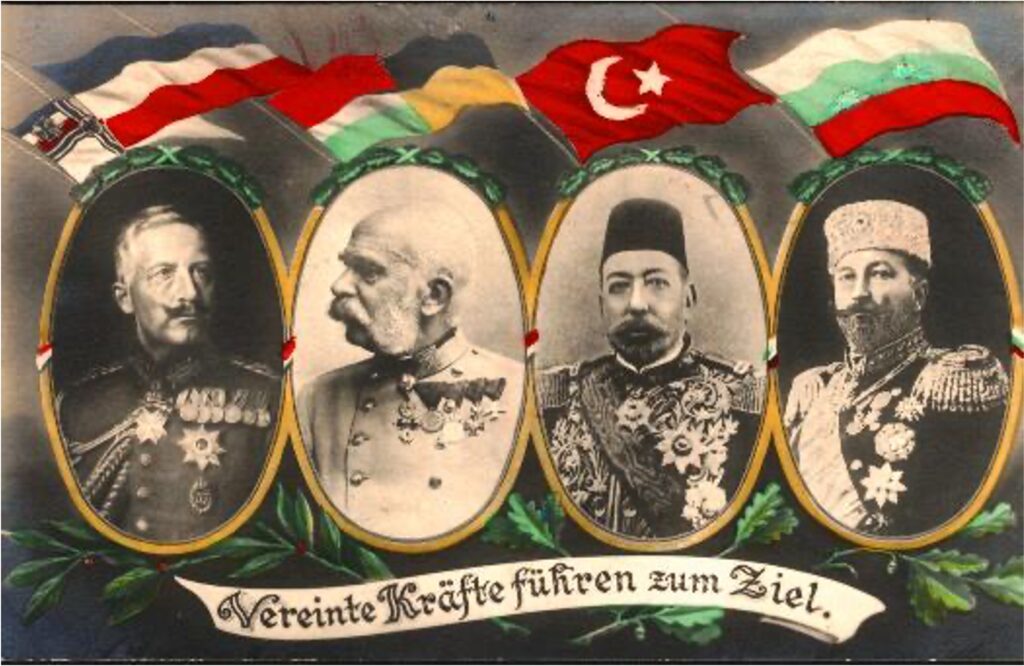
Italy fought alongside Germany and Austria-Hungary when World War I began in 1914.
Alliance Systems Before World War I – Triple Entente
The Triple Entente was an informal agreement between the European nations of France, Russia and the United Kingdom (Britain) in the years before the 1914 outbreak of World War I. The French term ‘entente’ means agreement or friendship, thus showing that the Triple Entente was an agreement of mutual support for the member nations. With that said, the Triple Entente was not necessarily a true military alliance as was its counterpartSomething that has a similar purpose or role but is a different version, often used for comparison., the Triple Alliance. The Triple Alliance was a mutual defense alliance between the major European nations of Germany, Austria-Hungary and Italy.
The first of these agreements was the Franco-Russian Alliance. The Franco-Russian Alliance was an economic and military alliance between France and Russia that was reached following a series of meetings and exchanges that occurred from 1891 until 1894. The next agreement that led to the development of the Triple Entente was the ‘Entente CordialeThe 1904 agreement between France and the United Kingdom that helped build the Triple Entente.’. The Entente Cordiale was an agreement between France and the United Kingdom that was finalized on April 8th, 1904. The Entente Cordiale was tested in the early 1900s with the events of the First Moroccan Crisis and the Second Moroccan Crisis. The last agreement that led to the development of the Triple Entente was the Anglo-Russian Entente. This agreement was made between the United Kingdom and Russia on August 31st, 1907. When combined with the earlier agreements of the Franco-Russian Alliance and the Entente Cordiale, the Anglo-Russian Entente finalized the informal alliance between France, Russia and the United Kingdom.
The member nations of the Triple Entente maintained their loyalty with one another and when war broke out in 1914, the three nations entered World War I as the Allied Powers. The Allied Powers of World War I faced off against the Central Powers, which included Germany, Austria-Hungary, Bulgaria and the Ottoman Empire. Italy, which had previously been a member of the Triple Alliance with Germany and Austria-Hungary flipped sides and instead joined the Allied Powers.
FactsthatCrunchBritain and France Sign the Entente Cordiale
On April 8th, 1904, France and Britain signed the Entente Cordiale in London. Lord Lansdowne signed for Britain and French Ambassador Paul Cambon signed for France. The agreement settled colonial disputes over Egypt and Morocco, giving Britain recognized control in Egypt and France recognized influence in Morocco. It was not a formal military alliance, but it established diplomatic support between the two nations and opened the door to military cooperation. This understanding became one of the three agreements that built the Triple Entente, the informal alliance that brought Britain, France, and Russia into World War I together on the Allied side.
Alliance Systems as a Cause of World War I
As shown above, the Triple Alliance and the Triple Entente helped set the stage for World War I. As such, historians consider these alliance systems to be major causes of the First World War. First, they divided Europe between two different sides. This increased tensions between the European powers including France and Germany. Second, they obligated the different nations to go to war once the tensions erupted over the assassination of Austrian Archduke Franz Ferdinand. As such, the alliance systems helped escalateTo grow larger or more serious in scope, especially referring to a conflict or crisis spreading beyond its starting point. the crisis once it began.
 FactsthatCrunch
World War I timeline · 1914 – 1918
Key Vocabulary
Mutual defense alliance
Renegotiated
Entente
Counterpart
Entente Cordiale
Escalate
Neutral
Frequently Asked Questions
What were the two main alliance systems before World War I?
The two main alliance systems were the Triple Alliance and the Triple Entente. The Triple Alliance linked Germany, Austria-Hungary, and Italy. The Triple Entente joined France, Russia, and the United Kingdom. Together they split the major powers of Europe into two opposing camps.
How did the alliance systems help cause World War I?
The alliance systems helped cause the war by dividing Europe into two hostile sides. This raised tensions between rivals such as France and Germany. The alliances also bound nations to fight once conflict began. After Archduke Franz Ferdinand was killed, the alliances pulled many countries into the war.
What was the difference between the Triple Alliance and the Triple Entente?
The Triple Alliance was a formal mutual defense treaty, while the Triple Entente was an informal agreement. Members of the Triple Alliance promised to defend each other if attacked. The Triple Entente was more of a friendship and understanding between nations. The French word “entente” means agreement or friendship.
Why did Italy leave the Triple Alliance?
Italy left because it objected to the aggressive actions Austria-Hungary took against Serbia. Italy stayed neutral when the war began in 1914 instead of aiding its former partners. In May of 1915, Italy declared war on Austria-Hungary. It then joined the Allied Powers alongside France, Britain, and Russia.
What agreements led to the Triple Entente?
Three separate agreements combined to form the Triple Entente. The Franco-Russian Alliance came first, built through meetings from 1891 until 1894. Next came the Entente Cordiale between France and Britain, finalized on April 8th, 1904. The Anglo-Russian Entente followed on August 31st, 1907, linking all three nations.
Cite This Article
To cite this article as a source, use one of the formats below.
MLA: Beck, Elias. “Alliance Systems Before World War I: A Detailed Summary.” HistoryCrunch, 28 September 2026, https://historycrunch.com/alliance-systems-before-world-war-i/.
APA: Beck, E. (2026). Alliance Systems Before World War I: A Detailed Summary. HistoryCrunch. https://historycrunch.com/alliance-systems-before-world-war-i/
Chicago: Beck, Elias. “Alliance Systems Before World War I: A Detailed Summary.” HistoryCrunch. September 28, 2026. https://historycrunch.com/alliance-systems-before-world-war-i/
Sources
- John Keegan, The First World War.
- Margaret MacMillan, The War That Ended Peace.