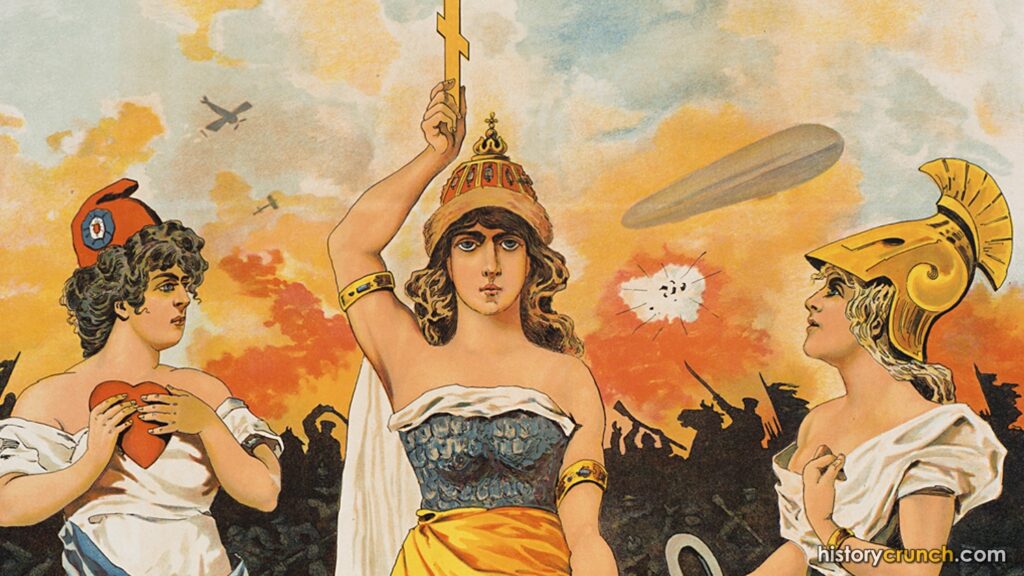
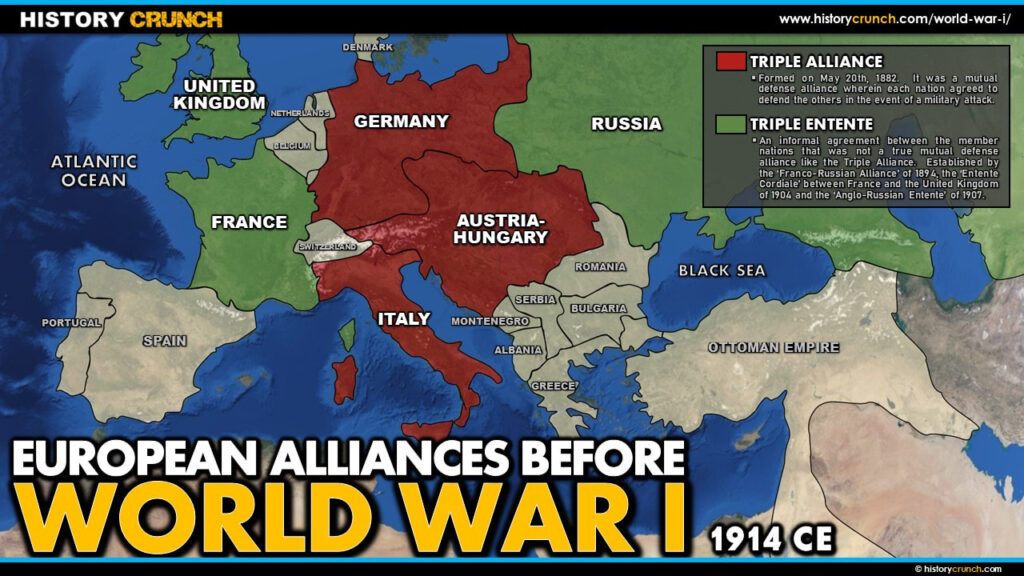
The Triple EntenteA French word meaning agreement or friendship, used to describe an informal understanding between countries. was an informalNot bound by a strict legal or military contract, unlike a formal alliance. agreement between the European nations of France, Russia and the United Kingdom (Britain) in the years before the 1914 outbreak of World War I. The French term ‘entente’ means agreement or friendship, thus showing that the Triple Entente was an agreement of mutual support for the member nations. With that said, the Triple Entente was not necessarily a true military alliance as was its counterpart – the Triple Alliance. The Triple Alliance was a mutual defense allianceA formal agreement where member countries promise to militarily protect each other if one is attacked. between the major European nations of Germany, Austria-Hungary and Italy. This means that each member nation of the Triple Alliance agreed to come to the military aid and defense of the other member nations in the event that they were attacked. Instead, the Triple Entente was informal in nature and based upon three smaller agreements between France, Russia and the United Kingdom.

The Franco-Russian Alliance and the Triple Entente
The first of these agreements was the Franco-Russian Alliance. The Franco-Russian Alliance was an economic and military alliance between France and Russia that was reached following a series of meetings and exchanges that occurred from 1891 until 1894. At the time, both countries were concerned about the growing strength of Germany in Europe and the creation of the Triple Alliance between Germany, Austria-Hungary and Italy in 1882. France was still upset with Germany over the events and outcome of the Franco-Prussian War, which lasted from 1870 until 1871. Prussia was the largest Germanic Kingdom at the time and later unified with other Germanic Kingdoms to form the country of Germany. As part of its defeat, France gave up a territory of its land called Alsace-Lorraine, which bordered with Germany. Germany’s control over Alsace-Lorraine was a major factor, which led to heightened tensions between Germany and France. As such, France wanted to construct a protective alliance with Russia. For its part, Russia was concerned about Germany’s ties to both Austria-Hungary and the Ottoman Empire. Russia bordered all three countries and was worried about control over trading routes and the growing influence that each nation had along its borders. Therefore, this led Russia to agree to the Franco-Russian Alliance, which linked the two countries economically and militarily.
FactsthatCrunchThe Entente Cordiale and the Triple Entente
The next agreement that led to the development of the Triple Entente was the ‘Entente CordialeAn agreement signed April 8, 1904, ending a century of tensions between France and the United Kingdom over overseas colonies.’. The Entente Cordiale was an agreement between France and the United Kingdom that was finalized on April 8th, 1904. The Entente Cordiale was significant because it essentially ended a century’s worth of tensions between the two countries and led to the eventual Triple Entente with Russia. The main focus of the Entente Cordiale was on overseas colonies and the rivalry that existed between France and the United Kingdom for these territories. In short, they each agreed to recognize each other’s spheres of influenceRegions where a powerful country claims special authority or control, especially over colonies or trade. in Africa and Asia, which united them in a common front against Germany. From Germany’s perspective, the Entente Cordiale was disappointing because it had used the previous French and English tensions as a way of asserting their own dominance in Europe.
The Entente Cordiale was tested in 1905 with the events of the First Moroccan Crisis. France considered Morocco to be in its colonial sphere of influence, which the United Kingdom recognized in the Entente Cordiale. In general, Germany was angered by French and English colonial expansion in Africa, since Germany was largely kept out and lacked the colonies that both France and the United Kingdom had at the time. This eventually led to Germany threatening France’s influence in Morocco, in March of 1905, when Kaiser Wilhelm II of Germany visited the African nation. In the end, France retained its influence over Morocco with the backing of the United Kingdom. The issues arose again in 1911 with the events of the Second Moroccan Crisis, which is also known as the ‘Agadir Crisis’. As before, the crisis was between France and Germany and centered on colonial expansion in Africa. When France sent troops into Morocco in April of 1911, the German government reacted by sending a gunboatA small, armed warship used to project military pressure, as Germany sent one to Morocco in 1911. (the SMS Panther) to Morocco. This again created heightened tensions between the two European nations and caused a brief international crisis. It was resolved once France concededGave something up, usually under pressure, as France gave Germany colonial territory in Central Africa to resolve a crisis. some of its colonial territory in Central Africa (Congo) to Germany. In turn, Germany agreed to recognize France’s claim to Morocco. Regardless, the two Moroccan crises highlight the increased tensions that existed between France and Germany in the years leading up to the 1914 outbreak of World War I. As such, this pushed the European nations further towards establishing and reinforcing their alliances, which set the stage for war.
Can you put these steps in the building of the Triple Entente in the order they happened?
The Anglo-Russian Entente and the Triple Entente
The last agreement that led to the development of the Triple Entente was the Anglo-Russian Entente. This agreement was made between the United Kingdom and Russia on August 31st, 1907. It primarily dealt with issues between the two nations in regard to their spheres of influence in Asia. For instance, both Russia and the United Kingdom considered Persia to be in their colonial sphere of influence. This caused tensions between the two nations, which were ultimately resolved with the Anglo-Russian Entente. The agreement essentially stated that northern Persia would be under Russia’s influence, while southern Persia would belong to the United Kingdom. As well, Russia agreed that Afghanistan was within the United Kingdom’s sphere of influence, and both nations agreed to stay out of Tibet. This agreement helped reduce the tensions between the two nations and led to the establishment of the Triple Entente. For instance, when combined with the earlier agreements of the Franco-Russian Alliance and the Entente Cordiale, the Anglo-Russian Entente finalized the informal alliance between France, Russia and the United Kingdom.
The member nations of the Triple Entente maintained their loyalty with one another and when war broke out in 1914, the three nations entered World War I as the Allied Powers. The Allied Powers of World War I faced off against the Central Powers, which included Germany, Austria-Hungary, Bulgaria and the Ottoman Empire. Italy, which had previously been a member of the Triple Alliance with Germany and Austria-Hungary, flipped sides and instead joined the Allied Powers.
FactsthatCrunchThe Anglo-Russian Entente of 1907 settled the rivalry between Britain and Russia over Persia, Afghanistan, and Tibet.
World War I timeline · 1914 – 1918
Key Vocabulary
Entente
Informal
Mutual defense alliance
Spheres of influence
Entente Cordiale
Gunboat
Conceded
Frequently Asked Questions
What was the Triple Entente?
The Triple Entente was an informal understanding between France, Russia, and the United Kingdom before World War I. It was based on three smaller agreements rather than one formal treaty. Because of this, it was not a true military alliance like the Triple Alliance.
What three agreements formed the Triple Entente?
The Triple Entente grew from the Franco-Russian Alliance, the Entente Cordiale, and the Anglo-Russian Entente. The Franco-Russian Alliance was reached between 1891 and 1894, and the Entente Cordiale was finalized on April 8th, 1904. The Anglo-Russian Entente followed on August 31st, 1907, completing the informal alliance.
How was the Triple Entente different from the Triple Alliance?
The Triple Entente was an informal agreement of mutual support, while the Triple Alliance was a formal military alliance. Members of the Triple Alliance, which were Germany, Austria-Hungary, and Italy, promised to defend one another if attacked. The Entente nations shared friendship and cooperation, but Britain made no firm pledge to defend France or Russia.
Why did France and Russia join together?
France and Russia joined together mainly because both feared Germany’s growing power in Europe. France was still angry over losing Alsace-Lorraine in the Franco-Prussian War of 1870 to 1871. Russia worried about Germany’s ties to Austria-Hungary and the Ottoman Empire along its borders.
What happened to the Triple Entente when World War I began?
The three nations entered World War I in 1914 as the Allied Powers. They faced the Central Powers, which included Germany, Austria-Hungary, Bulgaria, and the Ottoman Empire. Italy, once part of the Triple Alliance, switched sides and joined the Allied Powers.
Cite This Article
To cite this article as a source, use one of the formats below.
MLA: Beck, Elias. “The Triple Entente and World War I: A Detailed Summary.” HistoryCrunch, 28 September 2026, https://historycrunch.com/triple-entente-and-world-war-i/.
APA: Beck, E. (2026). The Triple Entente and World War I: A Detailed Summary. HistoryCrunch. https://historycrunch.com/triple-entente-and-world-war-i/
Chicago: Beck, Elias. “The Triple Entente and World War I: A Detailed Summary.” HistoryCrunch. September 28, 2026. https://historycrunch.com/triple-entente-and-world-war-i/
Sources
- Imperial War Museum
- Hew Strachan, The First World War.