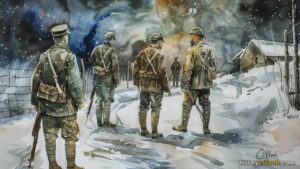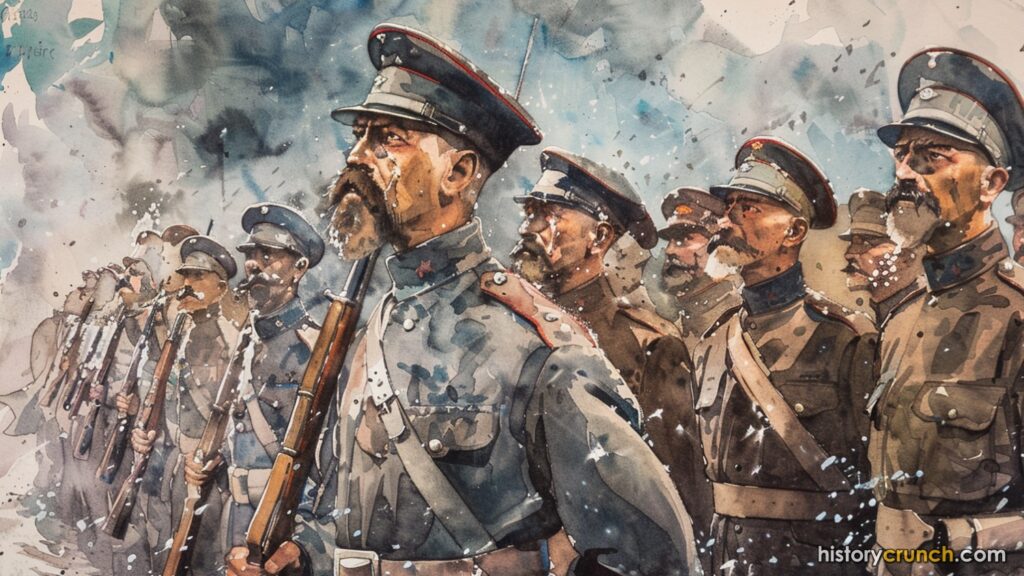
Austria-Hungary was one of the main nations involved in the events of World War I. In fact, the assassination of Austrian Archduke Franz Ferdinand in 1914 was the main short-term cause of the war and led to the events of the July Crisis. As well, Austria-Hungary participated in some of the most significant battles of the war. For example, during World War I, Austria-Hungary was one of the Central Powers alongside Germany, Bulgaria and the Ottoman Empire. Austria-Hungary was an important contributor to the war on the Italian Front (also known as the Alpine Front), and in the Balkans.
 FactsthatCrunch
The four Central Powers of World War I each joined the alliance at a different point in the conflict.
Austria-Hungary Enters World War I
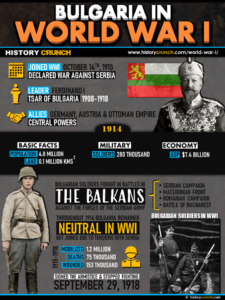
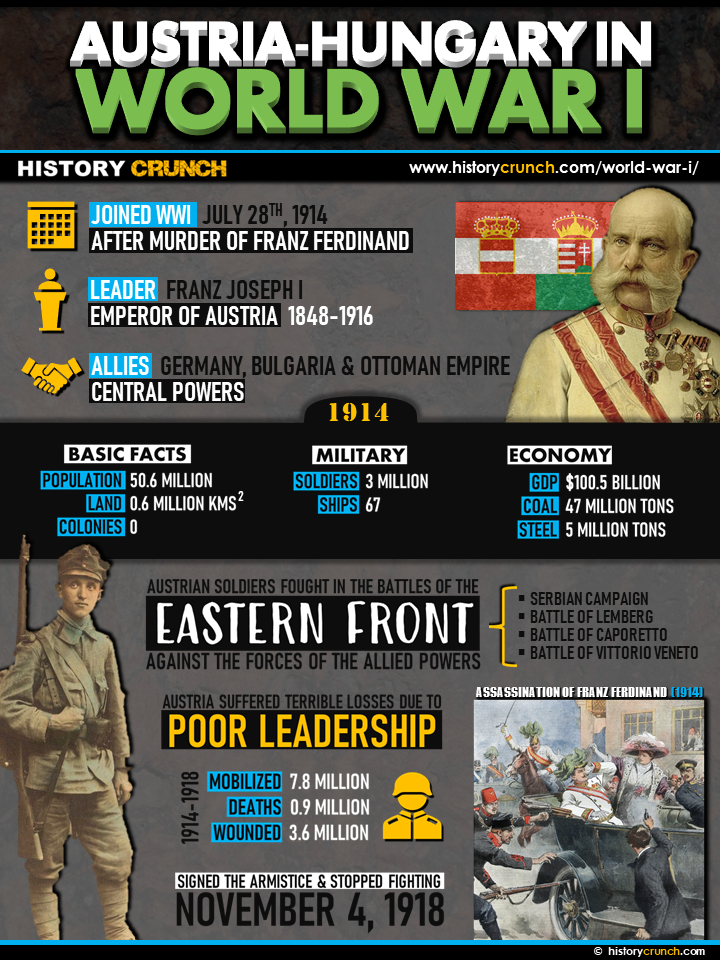
World War I erupted during the summer of 1914 in an event that historians refer to as the July Crisis. In short, this crisis was caused by the assassination of Austrian Archduke Franz Ferdinand, which led to the major European powers engaging in a conflict. As stated above, prior to the start of World War I, Austria-Hungary was a member nation of the Triple Alliance, alongside Germany and Italy. At the start of the war in 1914, Austria-Hungary and Germany formed the Central Powers. They were later joined by the Ottoman Empire in 1914 and Bulgaria in 1915.

Franz Ferdinand was the Archduke of Austria-Hungary and next in line to rule over the empire. Ferdinand and his wife Sophie were assassinated on June 28th, 1914 in Sarajevo, the capital of the Austro-Hungarian province of Bosnia and Herzegovina, while there on a visit to inspect the military forces. The assassin was Gavrilo Princip. Just nineteen years old at the time, Princip was a member of the Black Hand, which was a Serbian nationalist organization that existed in the early part of the 20th century.
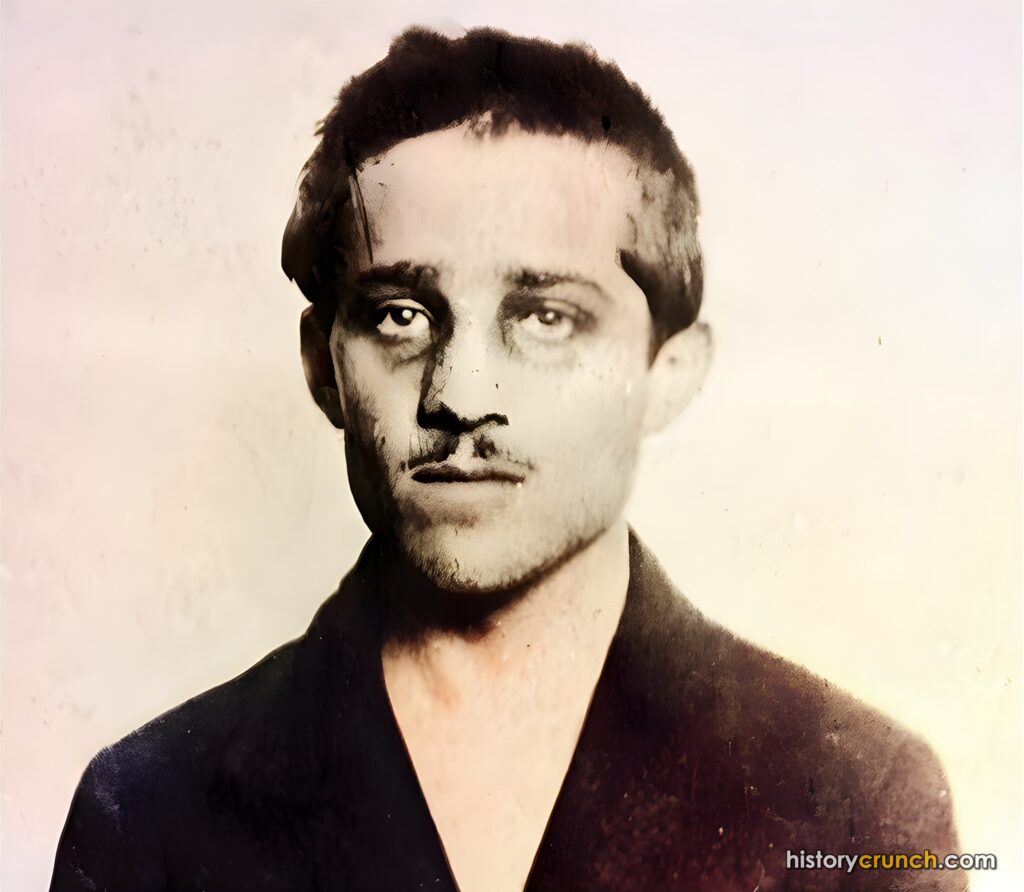
Following the assassination, Austrian authorities determined that the murder was carried out by the Black Hand and placed the blame for the killing on Serbia. In fact, rumors swirled at the time about the role of the Serbian government in the assassination. Since many of the prominent members of the Black Hand came from the Royal Serbian Army, the Austrian government wanted to investigate within Serbia to determine the role of the Serbian leadership. This situation between Austria-Hungary and Serbia is what essentially resulted in the July Crisis of 1914.
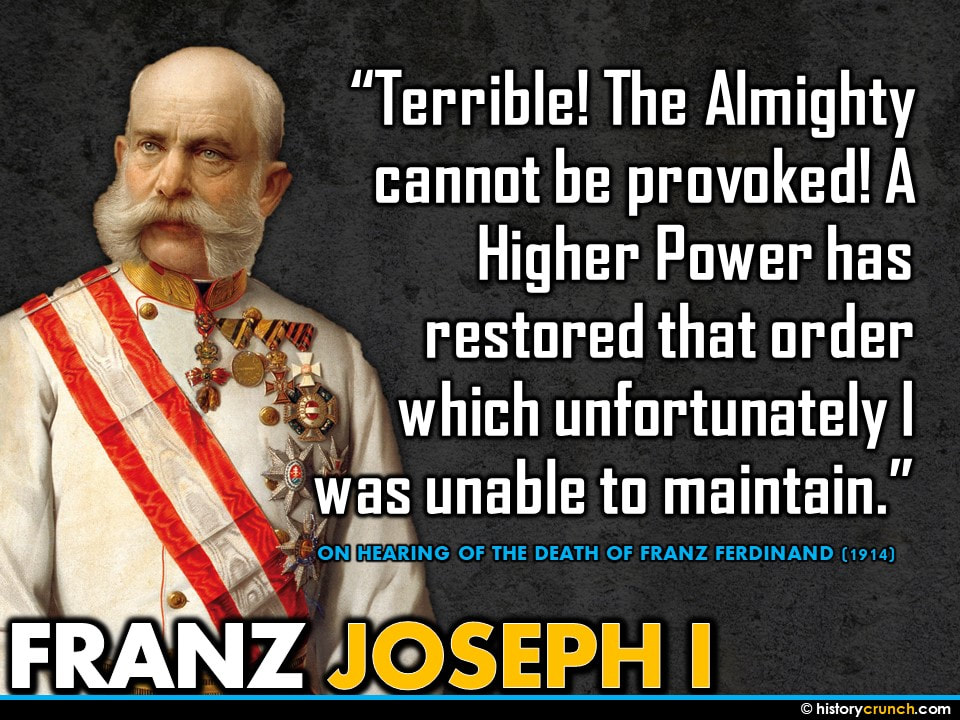
The tensions of the July Crisis heightened as Austria-Hungary began preparing an ultimatum for Serbia. An ultimatumA set of demands given to another country that will lead to war or serious consequences if not met. is a demand, that if not met would cause a conflict. As a result, Austria-Hungary was preparing to give Serbia a list of demands, and if not met, then Austria-Hungary would carry out a war against Serbia. Austria-Hungary’s hope was that in providing Serbia with an ultimatum, it would give more reason for Austria-Hungary to go to war. Although Austria-Hungary had the support of Germany, it was still worried about other European powers, and wanted to give the image that it was providing Serbia with an alternative to war. On the other hand, Austrian officials knew that Serbia would never meet the demands, and war would be the likely result. Austria-Hungary finally delivered its ultimatum to Serbia on July 23rd, 1914, and demanded an immediate response from the Serbian leadership.
Serbia was angered by the ultimatum and immediately sought assistance from Russia and its leader Tsar Nicholas II. Following a few last efforts to avoid a conflict, the July Crisis reached its height on July 24th, 1914. This is because Serbia’s reply on July 25th did not accept all of Austria-Hungary’s demands, and Serbia began to prepare for a potential war.
Officially, World War I started on July 28th, 1914, when Austria-Hungary declared war on Serbia. In response, Russia mobilizedWhen a country organizes and moves its military forces to prepare for war. its forces further on July 30th, 1914, and began to prepare for war with Austria-Hungary. Having heard of the Russian mobilization against Austria-Hungary, Wilhelm II of Germany ordered German mobilization on August 1st, 1914. German troops were readied to invade France, through Belgium.
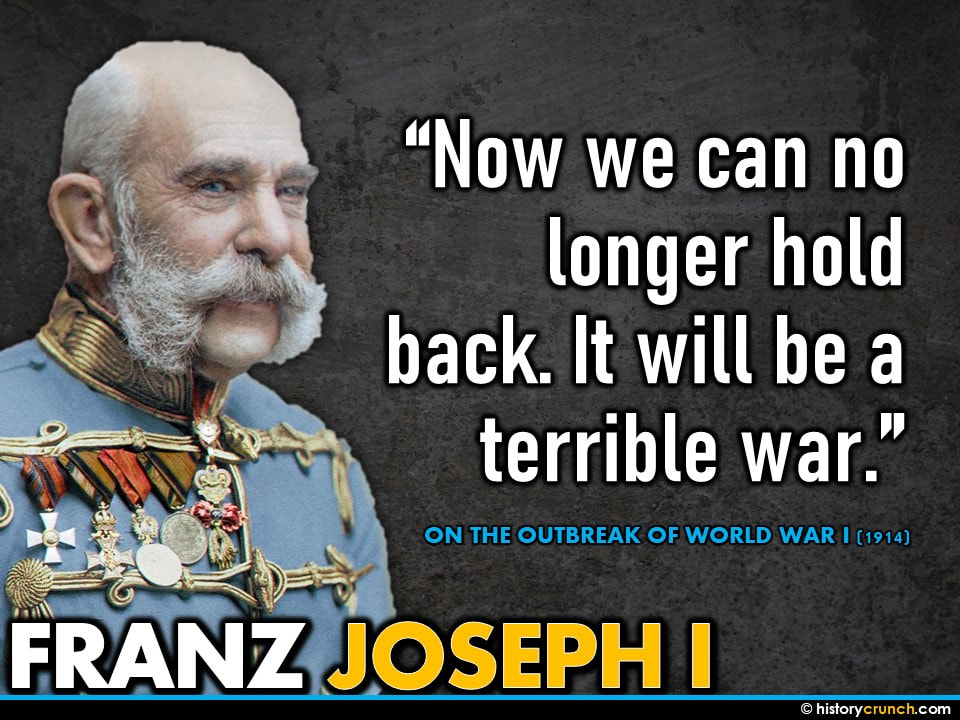
Austria-Hungary in World War I – Army
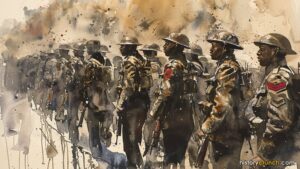
At the outbreak of World War I, in 1914, Austria-Hungary had approximately 3 million soldiers and by the end of the war 7.8 million had served in uniform. The Austro-Hungarian Army was divided into two main groups. First was the main armies of both Austria and Hungary. Since the empire was based on the union of the two nations, it still separated the armies for each country. For instance, alongside the empire’s shared Common Army, Austria went to war with its own ‘Landwehr’, while the Hungarians fielded the Royal Hungarian ‘Honvédség’. Both Austria and Hungary also had reserve or secondary forces that they mobilized in the war.
When Austria-Hungary entered the fighting of World War I in 1914, it had one of the least developed and prepared armies in all of Europe. In fact, the empire struggled to adequately supply and prepare its military forces before and during World War I. As such, Austria-Hungary’s army struggled in many of its most important conflicts. For example, at the start of World War I, Austria-Hungary had one of the smallest air forces in all of Europe and was much further behind its European rivals in terms of military equipment, such as artillery. These issues were worsened by the multi-ethnicMade up of many different cultural and national groups living under one government. nature of the Austro-Hungarian Army. Not only was Austria-Hungary an empire based on two separate nations, that existed in an uncertain union, but it was also a multi-ethnic empire with almost a dozen different cultures and languages represented among its people. This created major issues for not only the empire and leadership of Emperor Franz Joseph I, but also for the armed forces. For example, the multi-ethnic nature of the army created division within the ranks and made it more difficult for the commanders to organize and disperse the troops into battle.
In all, Austria-Hungary struggled to field a capable fighting force in World War I. Regardless, the Austro-Hungarian forces were led by several different commanders, including Austro-Hungarian Chief of Staff Franz Conrad von Hötzendorf.
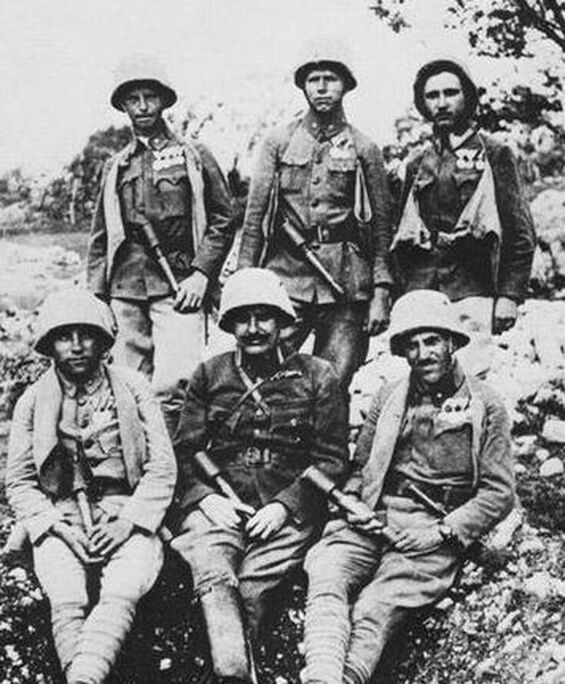
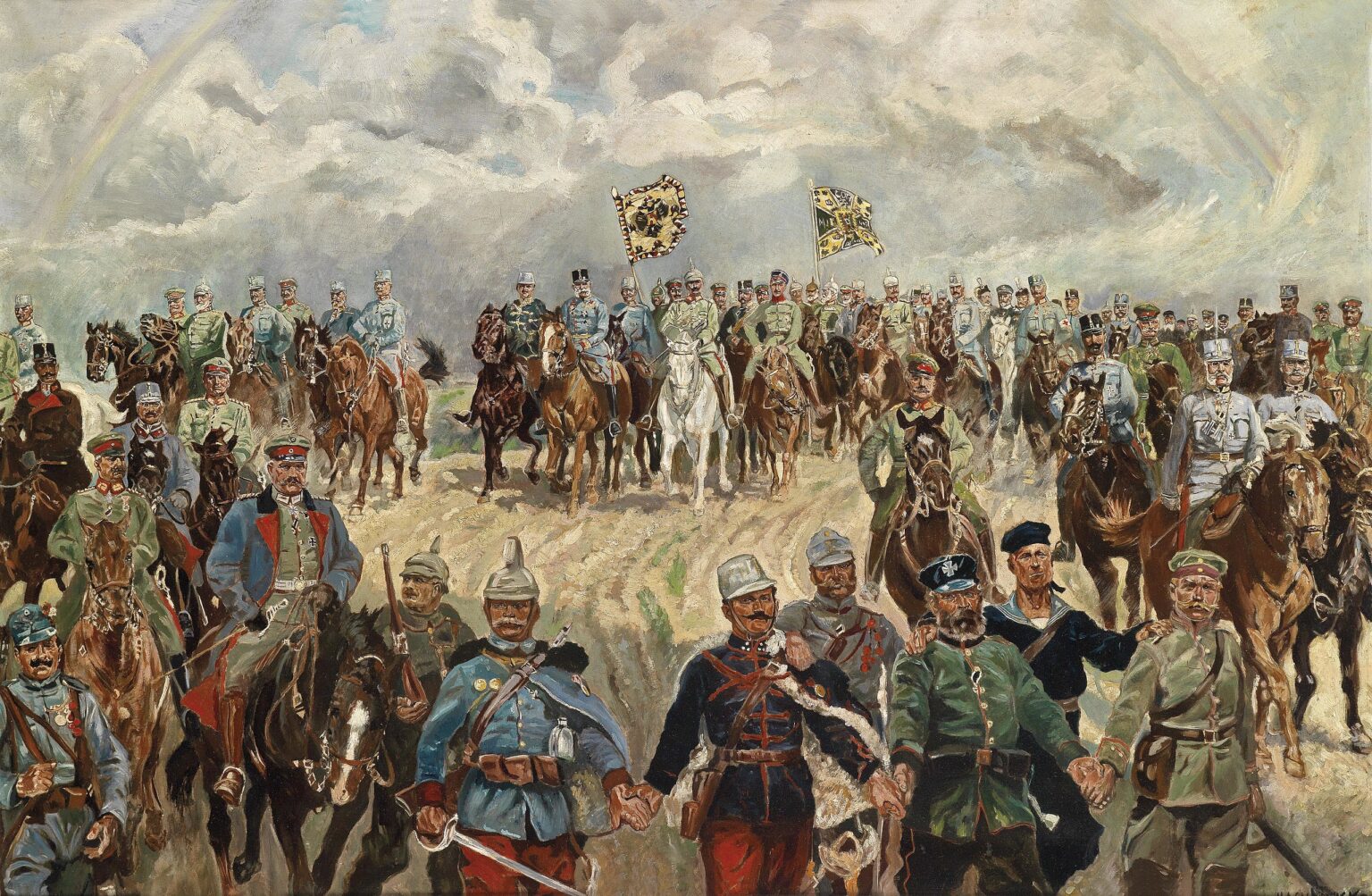
Austria-Hungary in World War I – Major Battles
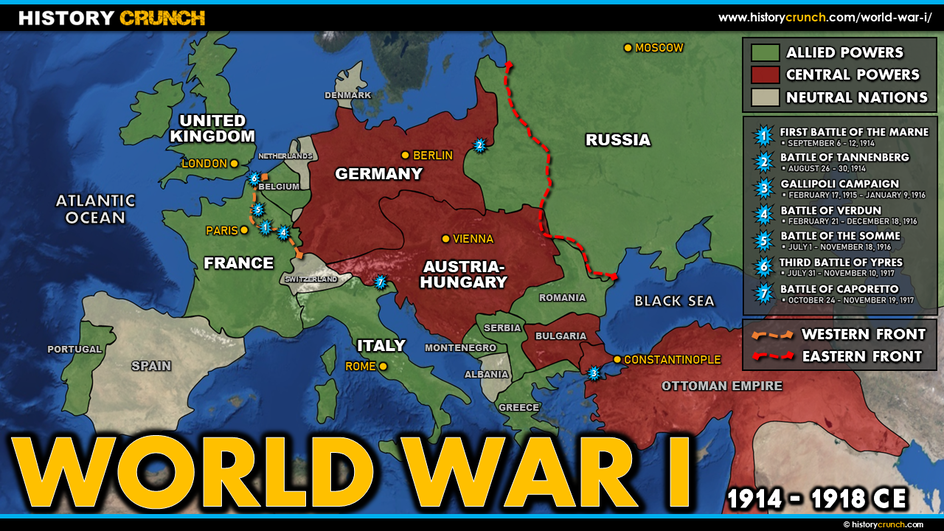
Austria-Hungary was one of the main forces that participated in the battles of World War I, but they were primarily active on the Italian Front (also known as the Alpine Front), Serbian Front and the Eastern Front.
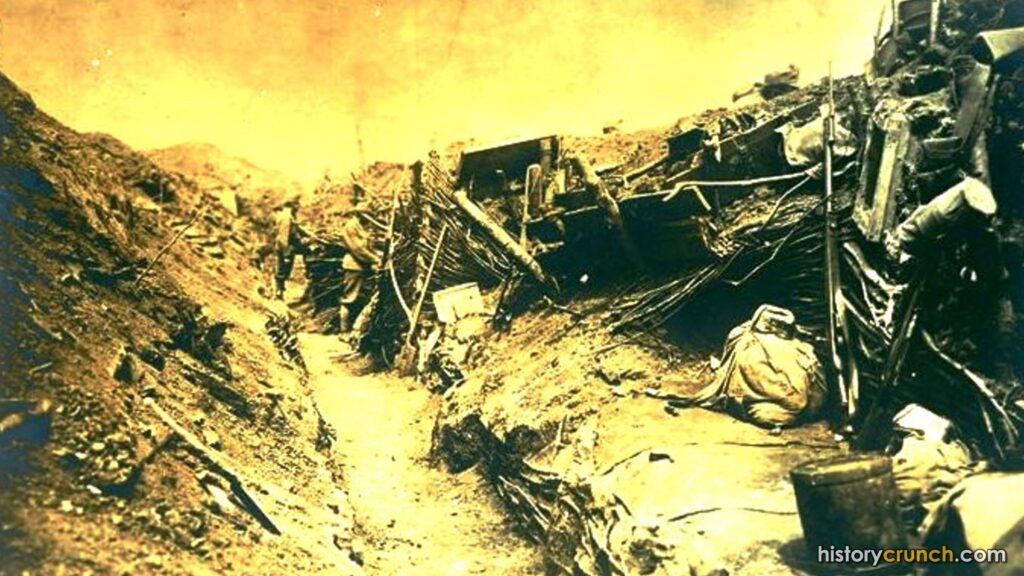
In general, the landscape of Europe in World War I was divided into a few different ‘fronts’. For instance, the Western Front was located on the western-half of Europe and included a line of trenches that stretched throughout much of northern France and Belgium. Whereas the Italian Front was along the border between Italy and Austria-Hungary. At the time, Italy wanted to gain control over sections of the region due to a rising sense of nationalism. The terrain of the region was very mountainous. As such, many of the battles that Austria-Hungary and Italy participated in occurred on mountain ranges and in valleys. The Serbian Front was fought along the southern border of the Austro-Hungarian Empire and the Eastern Front was fought on the eastern border against Russia.
As stated above, Austro-Hungarian forces participated in many battles of World War I. Some of the most significant battles of World War I that Austria-Hungary participated in included:
- Serbian Campaign
- Battle of Galicia
- Gorlice–Tarnów Offensive
- Battles of the Isonzo
- Battle of Caporetto
- Battle of Vittorio Veneto
 FactsthatCrunch
 Black & whiteColor
Austria-Hungary in the Serbian Campaign
From the start of World War I, Austria-Hungary was primarily concerned with invading Serbia and carrying out revenge for the assassination of Austrian Archduke Franz Ferdinand. As such, the Serbian Campaign of World War I was the first main military activity of the Austro-Hungarian forces in the war.
The Serbian Campaign, as carried out by Austria-Hungary, began on July 28th, 1914 when Austria-Hungary declared war against Serbia. The Austro-Hungarian forces were commanded by Oskar Potiorek, who was actually a passenger in the car carrying Archduke Franz Ferdinand of Austria and his wife Duchess Sophie of Hohenberg when they were assassinated on June 28th, 1914. In all, the Austro-Hungarian forces made three failed invasion attempts against Serbia in the Serbian Campaign. The failure of the Austro-Hungarian forces to defeat the Serbian Army was shocking due to Austria’s larger and more capable military. The two armies faced off in a series of battles, including: Battle of Cer, Battle of Drina, and the Battle of Kolubara. By the end of 1914, the fighting between Austria-Hungary and Serbia had produced little territorial changes, but had resulted in heavy losses for both sides. For example, historians estimate that the Austro-Hungarians had suffered as many as 215,000 casualtiesThe total number of soldiers killed, wounded, or captured during a battle or campaign. in the Serbian Campaign, while the Serbians likely suffered as many as 170,000 casualties. The Austro-Hungarian failure in the early stages of the Serbian Campaign was a humiliating defeat and resulted in Oskar Potiorek being replaced as commander of the Austro-Hungarian forces.
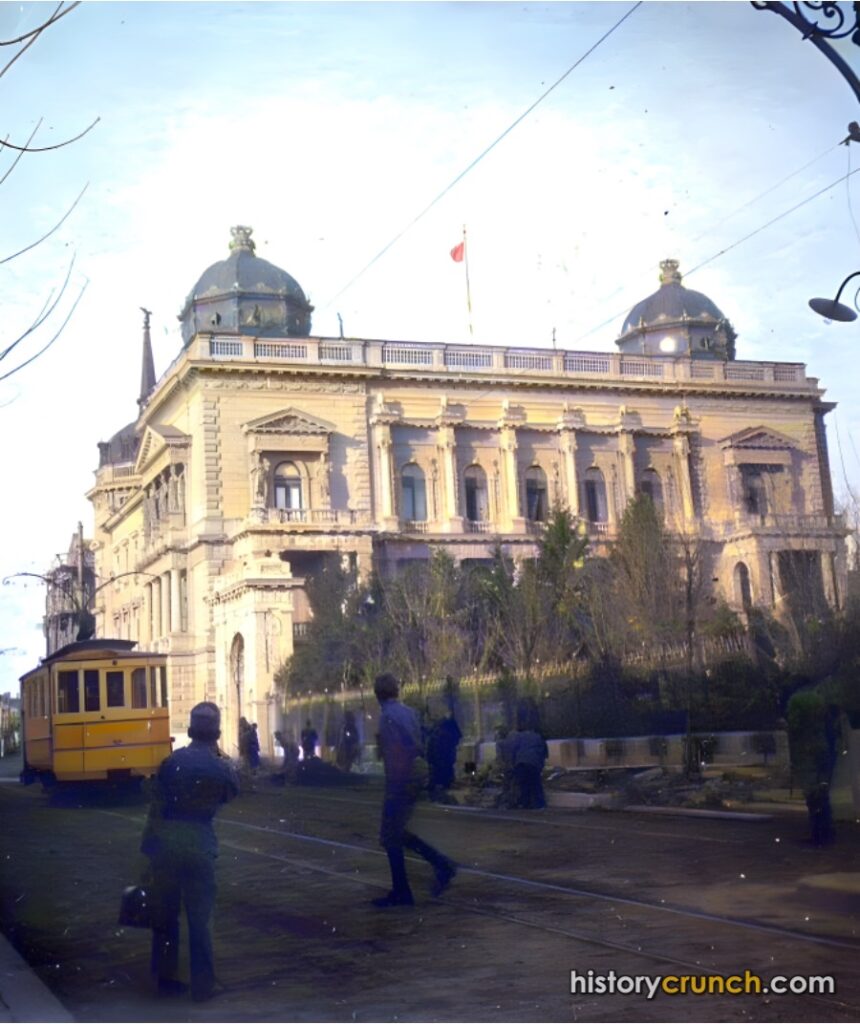
The Serbian Campaign continued throughout 1915, but both German and Bulgarian forces now supported Austria-Hungary. This proved valuable as the Central Powers were able to defeat Serbia and occupied the country for the remainder of World War I. The Serbian Campaign ended on November 24th, 1915 and Serbia wasn’t liberated until November 1st, 1918. Another important site of conflict for Austria-Hungary was along the Eastern Front, where it waged war against Russia.
From the outset of World War I, conflict between Austria-Hungary and Russia was guaranteed. This was due to several factors, but mostly because of the relationship between Russia and Serbia. For example, after Austria-Hungary threatened Serbia with an ultimatum, Russia was the European nation that came to Serbia’s defense. As a result, when World War I began in 1914, the Eastern Front, which was along Austria-Hungary’s eastern border with Russia, was a site of several significant conflicts including the Battle of Galicia.
 FactsthatCrunch
On which three fronts did Austria-Hungary fight in World War I?
Austria-Hungary in the Battle of Galicia
The Battle of Galicia, which is also known as the Battle of Lemberg, was a conflict that occurred between Austria-Hungary and Russia. It took place during the early weeks and months of World War I, from August 23rd until September 11th, 1914. Historians consider the Battle of Galicia to be one of the most significant battles of World War I along the Eastern Front. During the battle, the Austro-Hungarian First, Third and Fourth Armies faced off against the Russian Third, Fourth, Fifth and Eighth Armies. During the overall Battle of Galicia, these armies assaulted and defended against one another in a series of smaller conflicts, which included: Battle of Kraśnik, Battle of Komarów, Battle of Gnila Lipa, and the Battle of Rawa. In all, the Battle of Galicia was a failure for the Austro-Hungarians and was an important Russian victory on the Eastern Front. For example, in the Battle of Rawa, which took place from September 3rd to the 11th, 1914, the Austro-Hungarian forces on the Eastern Front were forced into a retreat and pushed back.
Meanwhile, Russia was able to advance its forces forward and captured significant amounts of territory around the city of Lemberg. The Battle of Galicia also saw heavy losses for both sides. For instance, historians estimate that Austria-Hungary suffered as many as 450,000 casualties in the Battle of Galicia. This includes as many as 100,000 deaths for Austria-Hungary as well. For their part, it is estimated that Russia suffered upwards of 300,000 casualties in the battle.
 FactsthatCrunch
Austria-Hungary suffered as many as 450,000 total casualties at the Battle of Galicia, and historians estimate that approximately 100,000 of those casualties were deaths.
The Battle of Galicia lasted from August 23rd to September 11th, 1914, making it one of the largest clashes of the war's opening weeks on the Eastern Front. The remaining casualties beyond the 100,000 deaths included soldiers who were wounded or captured during the fighting. Russia also paid a heavy price, suffering upwards of 300,000 casualties, but the battle ended as a clear Russian victory with Austro-Hungarian forces pushed into retreat.
Austria-Hungary in the Gorlice-Tarnow Offensive
Another important conflict involving Austria-Hungary on the Eastern Front was the Gorlice–Tarnów Offensive. This was a major military offensive carried out by the Central Powers of Germany and Austria-Hungary against Russia. The Gorlice–Tarnów Offensive took place from May 2nd to June 22nd, 1915 and occurred along the eastern border of Austria-Hungary. In general, the offensive was a major victory for Germany and Austria-Hungary. In fact, Germany was the major contributor to the success of the offensive for the Central Powers. At the time, Germany held a large superiority to Russia in the form of artillery technology, and was able to use its artillery to overwhelm the Russian forces on the Eastern Front. The Austro-Hungarian forces, under the command of General Franz Conrad von Hötzendorf, were able to push through the Russian defenses and caused the Russians to fall back in retreat. In fact, the Gorlice–Tarnów Offensive led to an event that historians refer to as the ‘Great Retreat’. This saw the Russian Army retreat out of the territory that they had previously captured in the Battle of Galicia. Regardless, the Gorlice–Tarnów Offensive was a major victory for the Central Powers.
FactsthatCrunchTap each impact to read what it led to.
Austria-Hungary in the Battles of Isonzo
The final front that was significant to Austria-Hungary in World War I was the Italian Front (also known as the Alpine front). As stated above, Italy was one of the main combatants that Austria-Hungary faced off against in World War I. With that said, Italy didn’t join the fighting of World War I until 1915. More specifically, Italy officially joined World War I on the side of the Allied nations on May 23rd, 1915 when it declared war against Austria-Hungary. This directly led to the fighting between the two nations on the Italian Front.
Luigi Cadorna, who was the Chief of Staff of the Italian Army, devised a plan of attack that included a series of offensives against the Austro-Hungarians. His hope was to push through the Austro-Hungarian defenses and besiege the Austrian capital of Vienna. In reality, the attack was doomed and led to a stalemateA situation in a battle or war where neither side can gain an advantage or make progress., similar to the other fronts of World War I.
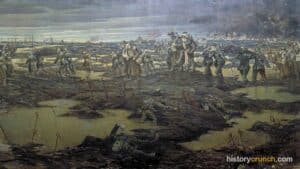
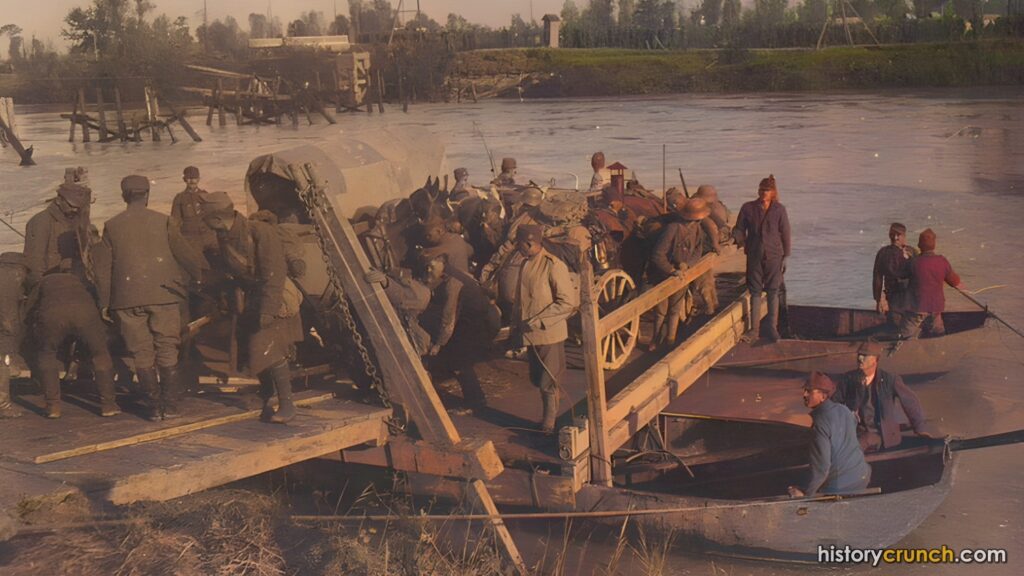
The first of these Italian offensives involved the Battles of the Isonzo. In all, there were 12 different Battles of the Isonzo, which were fought in modern Slovenia and along the Isonzo River. These 12 battles were fought between the Italian and Austro-Hungarian armies and lasted from 1915 until 1917. The fighting in the Battles of the Isonzo was brutal and difficult for both sides. The Austro-Hungarians were primarily the defenders and took up defensive positions in the mountains, while the Italian Army were the attackers. In general, the Italian army struggled to attack in the Battles of the Isonzo due to the mountainous terrain and the rivers. For instance, crossing the Isonzo River proved difficult for the Italians due to flooding and the inability to build a bridge (or other engineering solution) while simultaneously fighting the Austrian forces. As such, throughout the 12 Battles of the Isonzo, the two sides went back and forth and both suffered terrible losses. For instance, historians estimate that the Italian Army suffered over 950,000 casualties in the Battles of the Isonzo, while the Austro-Hungarians suffered approximately 520,000. In the end, the Austro-Hungarians achieved a decisive victory at the Twelfth Battle of the Isonzo (also known as the Battle of Caporetto), which ended in November of 1917.
 FactsthatCrunch
The Isonzo River is a waterway that runs through the mountainous border region between Italy and what was Austria-Hungary during World War I. It became the site of twelve major battles fought between the Italian and Austro-Hungarian armies from 1915 to 1917. The river was a serious military obstacle because flooding and enemy fire made it extremely hard for attacking forces to cross.
Crossing the Isonzo River was so difficult for Italian forces that flooding alone could stop an advance just as effectively as enemy artillery.
Austria-Hungary in the Battle of Caporetto
As stated above, the Twelfth Battle of the Isonzo was also referred to as the Battle of Caporetto. The battle occurred from October 24th to November 19th, 1917 and was the last and most significant of the Battles of the Isonzo. The Battle of Caporetto took place on the Italian Front of World War I, on the northeastern border of Italy. During the battle, Italian forces faced off against Austro-Hungarian forces that were also supported by elements of the German Army.
The arrival of German forces for the Battle of Caporetto was important, because by the fall of 1917, both the Italian and Austro-Hungarian forces were worn down from the previous 11 Battles of the Isonzo. In fact, Austria-Hungary hoped that the German support would allow them to advance through the Italian defenses and force the Italian Army back from the border.
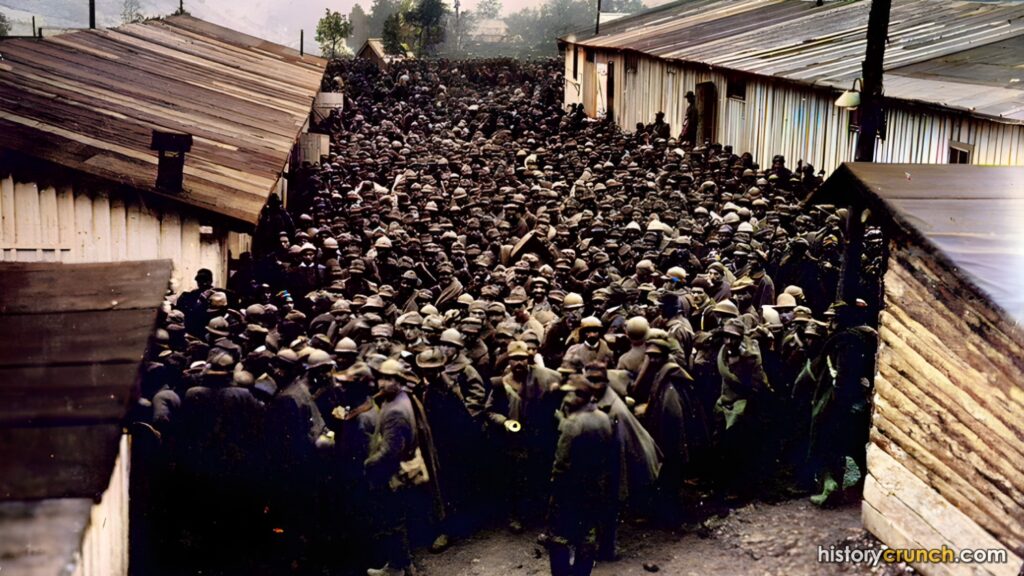
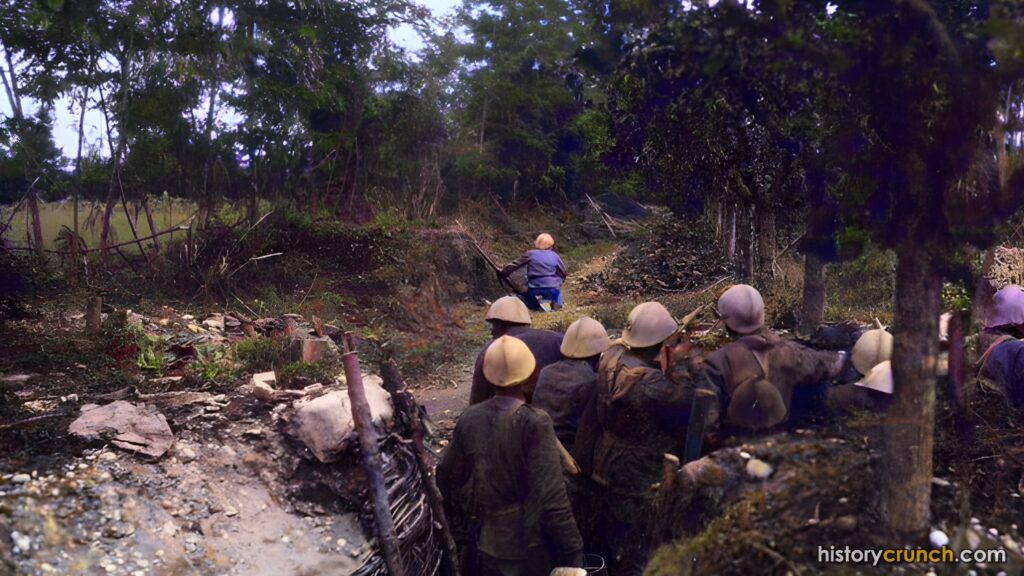
The Battle of Caporetto began on the early morning of October 24th when the Austrians and Germans carried out a series of poisonous gas attacks against the Italian trenches, which caused the Italian forces to retreat. The gas attack was followed by a heavy ‘stormtrooperA specialized assault soldier trained to attack quickly using weapons like grenades, flamethrowers, and machine guns.’ assault by the Austrians and Germans, which included use of flamethrowers, grenades, machine guns and mortars. This specialized assault allowed the two Central Power armies to advance quickly through the Italian-held area. In fact, the Austrian and German assault was so successful that they struggled to maintain supply lines with the advancing armies. This proved to be important as it limited the distance that the Central Powers could advance into Italy. The Battle of Caporetto ended on November 19th, 1917. As a result of the battle, Austria-Hungary gained control over new territories after Italy retreated 93 miles (150 km) and suffered thousands of losses. More specifically, historians estimate that in the Battle of Caporetto, 13,000 Italian soldiers died, another 30,000 were wounded and nearly 275,000 were captured as prisoners of war. On the other hand, historians estimate that Austria-Hungary suffered perhaps as many as 70,000 casualties in the battle. In all, the Battle of Caporetto was a terrible loss for Italy and massive victory for Austria-Hungary.
 FactsthatCrunch
At the Battle of Caporetto in October 1917, Germany and Austria-Hungary used stormtrooper assault tactics to break through Italian lines by moving fast and bypassing strong points instead of attacking them head-on.
Austria-Hungary in the Battle of Vittorio Veneto
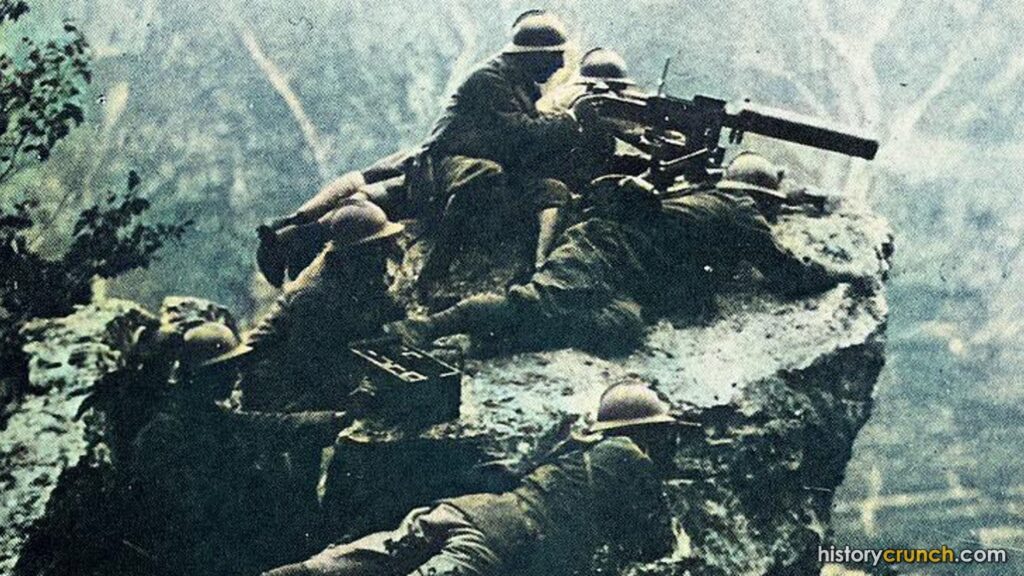
The final significant battle of World War I on the Italian Front was the Battle of Vittorio Veneto, which occurred from October 24th to November 4th, 1918. It resulted in Austria-Hungary accepting defeat in World War I. It took place in northern Italy near a town called Vittorio and was fought primarily between Italy and Austria-Hungary. Although Italy was also supported by British, French and American forces. The area was mountainous, which made the fighting difficult for the two sides. For instance, much of the fighting was centered around Monte Grappa, a 5,823 foot (1,775 meter) tall mountain in northern Italy.
The Battle of Vittorio Veneto began on the morning of October 24th, 1918, an exact year after the start of the Battle of Caporetto. In general, the Battle of Vittorio Veneto was an Italian attack against the Austro-Hungarian forces that had pushed into northern Italy as a result of the Battle of Caporetto. While the Battle of Caporetto was a massive failure for the Italian Army, the Battle of Vittorio Veneto was a decisive Italian victory.
The Battle of Vittorio Veneto began with intense artillery shelling from both sides. In fact, between October 24th and the 31st, 1918, Italy fired over 2.4 million shells. This proved successful and over the course of the battle, the Italian Army was able to dislodge the Austrians from their defensive positions in the mountains. The situation was made worse for the Austro-Hungarians as their empire began to fall apart during the timeline of the Battle of Vittorio Veneto. For instance, on October 31st, 1918, the Hungarian Parliament proclaimed their withdrawal from the union, which officially ended the Austro-Hungarian Empire. This new political reality, combined with their losses on the battlefield caused Austria to order a full retreat of its forces in the Battle of Vittorio Veneto, and led to Austria agreeing to an armistice. In fact, the Armistice of Villa Giusti was signed on November 3rd, 1918, and ended the conflict between Italy and Austria-Hungary on the Italian Front during World War I. The war for Italy and Austria-Hungary was over, as was the Austro-Hungarian Empire. During the battle, Italy suffered over 37,000 casualties, while Austria-Hungary lost approximately 30,000 soldiers killed and several hundred thousand more captured.
Austria-Hungary in World War I – Home Front
An important aspect of the First World War for all of the countries involved was the impact it had on the home front. This was also evident in the empire of Austria-Hungary, which experienced impacts on daily life for its citizens.Throughout World War I, a major factor on the Austro-Hungarian home front was the role of the government and the general makeup of the empire.
The Austro-Hungarian Empire (which is also referred to as the Dual Monarchy) was a union of two monarchies: the Austrian Empire and the Kingdom of Hungary. As well, the empire included several different groups of people including: Serbs, Poles, Ukrainians, Czechs, Slovakians, and more.
This made Austria-Hungary a multi-ethnic state that was ruled over by the Emperor of Austria – Franz Joseph I. In fact, Franz Joseph I ruled over the country from December 2nd, 1848 until November 21st, 1916, when he died.
As such, Franz Joseph I died in the midst of World War I, which impacted the political life for people on the Austro-Hungarian home front. After his death, the country was ruled over by his grandnephew Charles I.
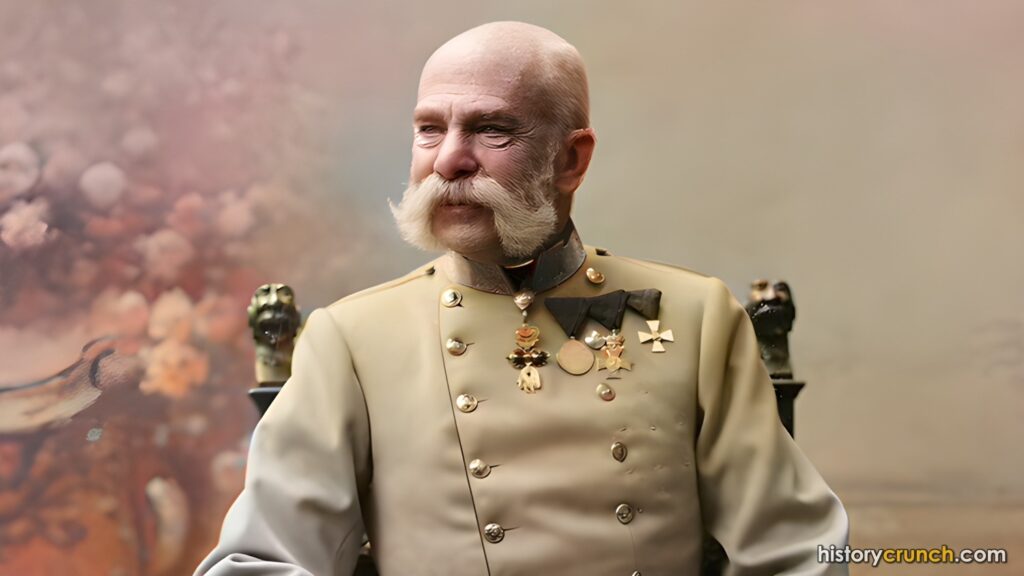
Charles I reigned as the Emperor of the Austro-Hungarian Empire until 1918, when Austria-Hungary was defeated at the end of World War I. Throughout 1917 and 1918, Charles I ruled over an empire that was deeply divided and struggling to contain its own internal issues. As stated above, Austria-Hungary was a multi-ethnic state, which put internal pressure on the nation. For instance, throughout the 1800s and early 1900s, nationalism was a growing force in Europe. As such, nationalist movements in the Austro-Hungarian Empire caused these different ethnicities (Czechs, Ukrainians, etc.) to push for their independence from the larger empire. As such, the country faced independence movements on the home front and internal conflict throughout the final years of World War I.
Another major aspect of the home front for Austria-Hungary in World War I centered on the economic realities of the country at the time. Before the war began, Austria-Hungary was primarily a rural country, although it did have several developed centers such as Vienna. As well, it is important to note that Austria-Hungary was more urbanized and industrialized than its main enemies in World War I.
With that said, Austria-Hungary struggled economically during the course of the war. It did not have the industrial base to build the artillery and other war equipment necessary for the conflict. While it made improvements, the country struggled to maintain its industrial capacity. As well, inflation was an ongoing concern throughout the war. Some estimates put inflation as rising by as much as 1000% during the war, which effectively destroyed people’s savings.
As well, similar to Germany, Austria-Hungary struggled to maintain its food supplies during World War I. It was the belief of military generals that well fed soldiers would help overcome the enemy and bring about an end to the war. As such, Austria-Hungary often rationed meat and other food on the home front in favor of supplying more to the soldiers on the front lines. This caused citizens on the home front to experience food shortages, including pork. However, the Hungarian half of the empire had a large farming base and was better fed, while cities in the Austrian half, such as Vienna, faced severe hunger by 1917 and 1918.
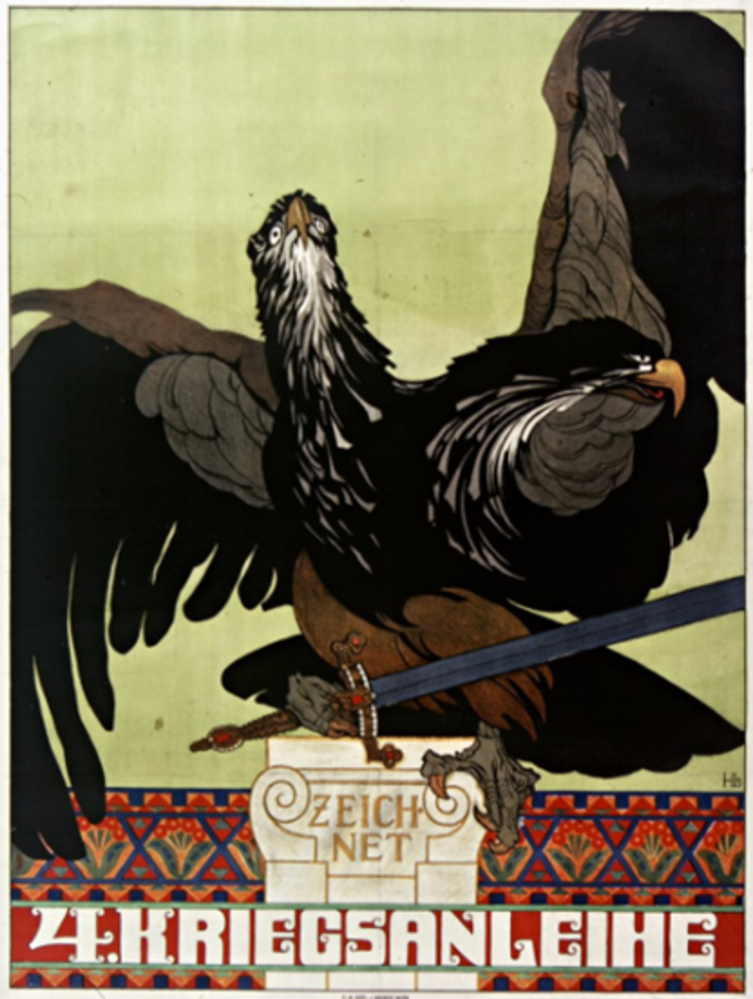
The final main impact of life on the home front for Austria-Hungary was the role of government propaganda. In order to promote support for the war and other initiatives, the government of the time used propagandaMessages or images spread by a government to influence what citizens believe and how they behave. to convince citizens of certain messages. For example, the Austro-Hungarian government issued propaganda that worked to recruit soldiers for the war, ration certain items and to demonize the enemy. Austro-Hungarian citizens on the home front were subjected to constant messaging to ensure they supported the war effort and to maintain the push towards victory.
 FactsthatCrunch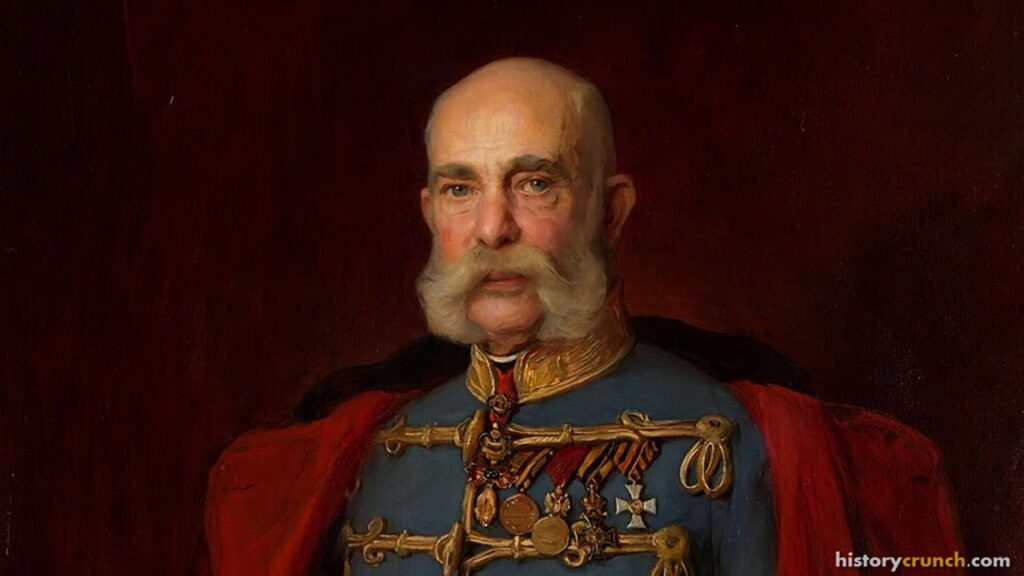
Austria-Hungary in World War I – Significance
World War I was a highly important event in the history of Austria-Hungary. First, and foremost, over 7.8 million Austro-Hungarian soldiers served during World War I. As well, approximately 1.2 million Austro-Hungarian soldiers died as a result of military action during the war.
Second, the terrible losses suffered by Austria-Hungary were characteristic of the overall nature of the fighting in World War I. As well, Austro-Hungarian armies fought on three distinct fronts: Serbian Front, Eastern Front and the Italian Front.
Beyond this, World War I was highly significant for the country of Austria-Hungary due to the outcome of the war and the result for the empire. As stated above, Austria-Hungary accepted its defeat in World War I following the Battle of Vittorio Veneto. The situation was made worse for the Austro-Hungarians as their empire began to fall apart during the timeline of the Battle of Vittorio Veneto. For instance, on October 31st, 1918, the Hungarian Parliament proclaimed their withdrawal from the union, which officially ended the Austro-Hungarian Empire. Furthermore, the Armistice of Villa Giusti was signed on November 3rd, 1918, and ended the conflict between Italy and Austria-Hungary on the Italian Front during World War I. The war for Italy and Austria-Hungary was over, as was the Austro-Hungarian Empire. In fact, the Austro-Hungarian Empire formally dissolved in the fall of 1918.
FactsthatCrunchWorld War I timeline · 1914 – 1918
Key Vocabulary
Ultimatum
Mobilized
Multi-ethnic
Casualties
Stalemate
Stormtrooper
Propaganda
Frequently Asked Questions
Why did Austria-Hungary start World War I?
Austria-Hungary declared war on Serbia on July 28th, 1914, which officially began World War I. This came after the assassination of Archduke Franz Ferdinand in Sarajevo. Austrian leaders blamed Serbia for the killing and issued a harsh ultimatum. When Serbia did not fully meet the demands, war followed.
Which side was Austria-Hungary on in World War I?
Austria-Hungary fought on the side of the Central Powers during World War I. Its allies included Germany, Bulgaria, and the Ottoman Empire. Before the war, Austria-Hungary had been part of the Triple Alliance with Germany and Italy. Italy, however, later joined the Allied nations and declared war on Austria-Hungary in 1915.
On which fronts did Austria-Hungary fight?
Austria-Hungary fought mainly on three fronts during World War I. These were the Serbian Front, the Eastern Front against Russia, and the Italian Front, also called the Alpine Front. The Italian Front was very mountainous, so many battles took place on ranges and in valleys. Fighting on the Eastern Front centered on Austria-Hungary’s border with Russia.
Why did Austria-Hungary’s army struggle in the war?
Austria-Hungary entered World War I with one of the least prepared armies in Europe. It fell behind rivals in equipment such as artillery and aircraft. The empire also struggled to supply its forces during the fighting. Its multi-ethnic makeup, with nearly a dozen languages, made it hard for commanders to organize troops.
What happened to Austria-Hungary at the end of the war?
Austria-Hungary accepted defeat after the Battle of Vittorio Veneto in the fall of 1918. On October 31st, 1918, the Hungarian Parliament withdrew from the union, which ended the empire. The Armistice of Villa Giusti was then signed on November 3rd, 1918. The Austro-Hungarian Empire formally dissolved in the fall of 1918.
How many soldiers did Austria-Hungary lose in World War I?
About 1.2 million Austro-Hungarian soldiers died from military action during World War I. In total, over 7.8 million men served in uniform by the end of the war. The empire suffered heavy losses on all three of its fronts. These losses reflected the brutal nature of the fighting across the whole conflict.
Cite This Article
To cite this article as a source, use one of the formats below.
MLA: Beck, Elias. “Austria-Hungary in World War I: A Detailed Summary.” HistoryCrunch, 29 September 2026, https://historycrunch.com/austria-hungary-in-world-war-i/.
APA: Beck, E. (2026). Austria-Hungary in World War I: A Detailed Summary. HistoryCrunch. https://historycrunch.com/austria-hungary-in-world-war-i/
Chicago: Beck, Elias. “Austria-Hungary in World War I: A Detailed Summary.” HistoryCrunch. September 29, 2026. https://historycrunch.com/austria-hungary-in-world-war-i/
Sources
- Imperial War Museum
- Margaret MacMillan, The War That Ended Peace.