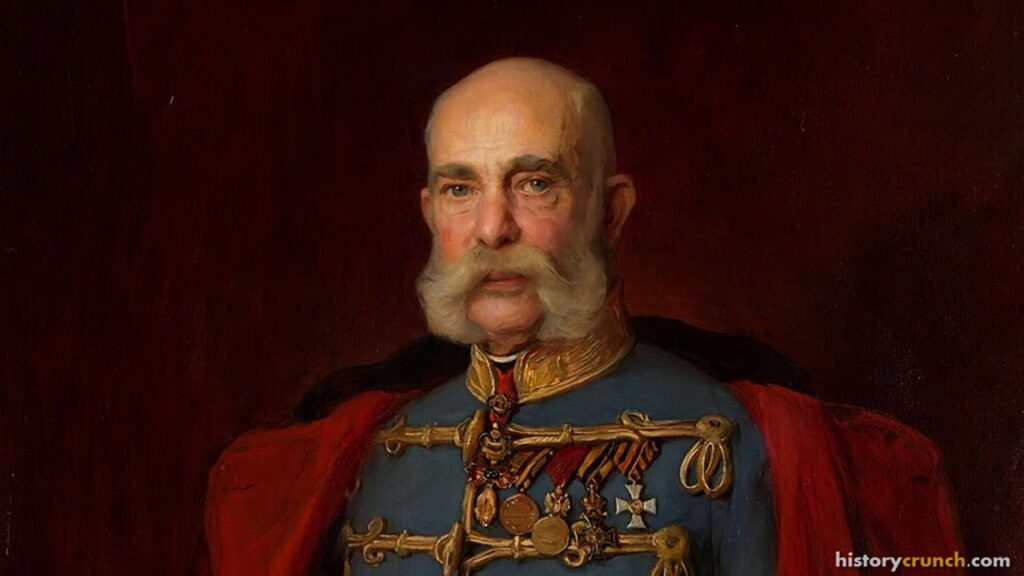
Franz Joseph I of Austria was one of the longest-reigning monarchs in European history and a central figure in the events that led to the outbreak of World War I. He ruled the Austrian Empire and later the Austro-Hungarian Empire for nearly sixty-eight years, from 1848 until his death in 1916. His long reign was marked by major military defeats, significant political changes and a series of devastating personal tragedies.
 FactsthatCrunch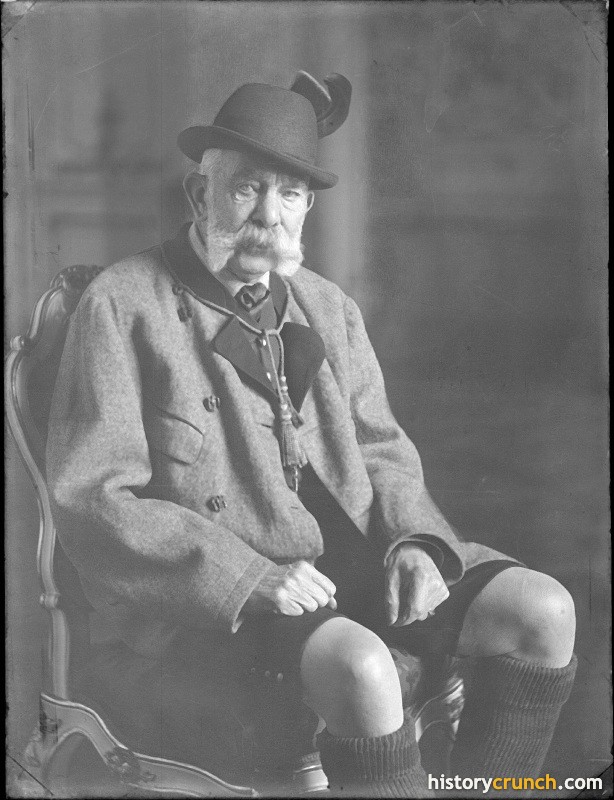
Franz Joseph I’s Early Life
Franz Joseph I was born on August 18th, 1830 CE in the Schönbrunn Palace in Vienna, Austria. His father was Archduke Franz Karl, the son of Emperor Francis I of Austria, and his mother was Archduchess Sophie, a princess of Bavaria. Franz Joseph was the eldest son of the family and was raised from a very young age with the expectation that he would one day become emperor. This was because his uncle, Emperor Ferdinand I, suffered from disabilities that left him unable to govern effectively, and his own father Franz Karl was considered unambitious and unsuited for leadership. As a result, it was Franz Joseph’s mother Sophie who took firm control of her son’s upbringing and education, shaping him into a future ruler with a strong emphasis on duty, discipline and devotion to the Habsburg dynasty.
Franz Joseph received a thorough education in all the subjects expected of a future emperor, including history, languages, law, military strategy and foreign affairs. He was raised to be deeply religious and held the Catholic faith as central to his identity throughout his life. He joined the Austrian army as a young teenager and from that point forward wore a military uniform every day for the rest of his life. His mother’s influence over his upbringing was enormous. She instilled in him a belief in the absolute authority of the Habsburg dynasty and a deep suspicion of any political change that might weaken that authority. As such, Franz Joseph grew into a conservative and dutiful ruler who believed strongly in the traditional order of things and was resistant to the forces of political reform and nationalismA political force in which people sharing a common identity seek their own independent nation or greater self-rule. that were transforming Europe around him.
FactsthatCrunchFranz Joseph I Becomes Emperor
Franz Joseph became emperor at the age of eighteen during one of the most turbulent periods in European history. In 1848 CE, a wave of revolutions broke out across Europe as ordinary people and political reformers demanded greater freedoms, national rights and constitutional governments from their rulers. These revolutions, sometimes called the Revolutions of 1848, shook the thrones of many European monarchs. Within the Austrian Empire, revolts broke out in Vienna, Hungary, Bohemia and northern Italy, threatening to tear the empire apart. The situation became so serious that Emperor Ferdinand I, who was too weak and unwell to manage the crisis, was persuaded by the imperial family to abdicateTo formally give up a throne or high office, usually under pressure or due to inability to rule. the throne. On December 2nd, 1848 CE, the eighteen-year-old Franz Joseph was proclaimed the new Emperor of Austria.
The young emperor immediately faced the enormous challenge of restoring order across the empire. He relied heavily on his able and forceful prime minister, Prince Felix von Schwarzenberg, who guided the government through the crisis with firm and effective action. In Hungary, the revolt proved particularly difficult to suppress, as Hungarian nationalists under the leadership of Lajos Kossuth declared independence from the Habsburg Empire and built up a significant military force. Sensing that the Austrian army alone could not defeat the Hungarians, Franz Joseph made the decision to ask Tsar Nicholas I of Russia for military assistance. Russia sent a large army into Hungary, and with this support the rebellion was finally crushed in 1849 CE. As such, Franz Joseph’s reign began in crisis and his early actions established him as a determined defender of Habsburg authority, willing to use whatever means were necessary to hold the empire together.
FactsthatCrunchIt is the spring of 1849, and you are Emperor Franz Joseph I of Austria. Your empire is in crisis: Hungarian rebels, inspired by the revolutionary wave sweeping Europe, have declared independence and are driving your army back on multiple fronts. This decision sits at a root cause of the tensions that would eventually feed into World War I, because how great powers chose to help or pressure each other shaped the alliance system that made 1914 possible. If Hungary breaks free, your multi-ethnic empire could fracture entirely, and your young reign, which began only in December 1848, may be over before it truly starts.
Franz Joseph I and the Dual Monarchy
One of the most significant political developments of Franz Joseph’s long reign was the creation of the Austro-Hungarian Dual MonarchyA political arrangement joining two states as equal partners under one ruler, each keeping its own government and laws. in 1867 CE. This came about as a direct result of a series of military defeats that had seriously weakened Austria’s position in Europe. In 1859 CE, Austria was defeated by France and the Kingdom of Sardinia in northern Italy and was forced to give up the important territory of Lombardy. Then in 1866 CE, Austria was defeated by Prussia in the Austro-Prussian War, also known as the Seven Weeks’ War. This defeat was particularly significant because it effectively ended Austria’s influence over the other German states and allowed Prussia to go on to unify Germany under its own leadership, leaving Austria excluded from the new German nation. These defeats forced Franz Joseph to rethink the structure of his empire and respond to the growing demands of his Hungarian people.
Hungary had long sought greater independence from Vienna, and the military defeats of the 1860s gave Hungarian political leaders the leverage they needed to push for major changes. After negotiations between the Austrian and Hungarian governments, both sides agreed to the Compromise of 1867 CE, known in German as the AusgleichThe German word for the 1867 Compromise that created the Austro-Hungarian Dual Monarchy.. Under this agreement, the Austrian Empire was reorganized into a dual monarchy in which Austria and Hungary were equal partners under a single monarch. Franz Joseph would serve as both Emperor of Austria and King of Hungary, but the two states would each have their own separate governments, parliaments and laws. The arrangement was intended to hold the empire together by giving Hungary the autonomy it demanded. With that said, the compromise created new tensions. The empire’s many other national groups, including Czechs, Slovaks, Croats and Serbs, felt excluded from the new arrangement and resented that only the Hungarians had been given special treatment. This resentment among the Slavic peoples of the empire would grow throughout the rest of Franz Joseph’s reign and become one of the major factors leading to World War I.
FactsthatCrunchTap each impact to read what it led to.
Franz Joseph I’s Personal Tragedies
Despite his position as one of the most powerful rulers in Europe, Franz Joseph’s personal life was marked by a series of devastating losses. In 1854 CE he married his cousin Elisabeth of Bavaria, who was widely regarded as one of the most beautiful women in Europe. The marriage was in many ways a difficult one, as Elisabeth was free-spirited and independent and found the rigid formality of the Habsburg court suffocating. She spent much of her time travelling across Europe and was often absent from Vienna for long periods. Regardless, the couple had four children together: Sophie, Gisela, Rudolf and Marie Valerie.
The personal tragedies began in earnest in the 1880s and 1890s. In January of 1889 CE, Franz Joseph’s only son and heir, Crown Prince Rudolf, was found dead alongside a young baroness named Mary Vetsera at his hunting lodge at Mayerling. The deaths were ruled a murder-suicide, with Rudolf shooting both himself and Mary Vetsera after the two had entered into a suicide pact. The loss of his son and heir was a devastating blow to Franz Joseph both personally and politically. Then, in September of 1898 CE, Empress Elisabeth was assassinated in Geneva, Switzerland by an Italian anarchistA person who rejects all forms of government authority and may use violence to oppose it. named Luigi Lucheni, who stabbed her with a sharpened file as she was walking near the waterfront. Franz Joseph was deeply saddened by her death and reportedly said that she had no idea how much he had loved her. As well, his brother Maximilian had earlier been executed in Mexico in 1867 CE after a failed attempt to rule that country as emperor with French support. As such, by the later years of his reign Franz Joseph had outlived many of those closest to him and had become increasingly lonely and isolated.
Franz Joseph I and the Bosnian Crisis
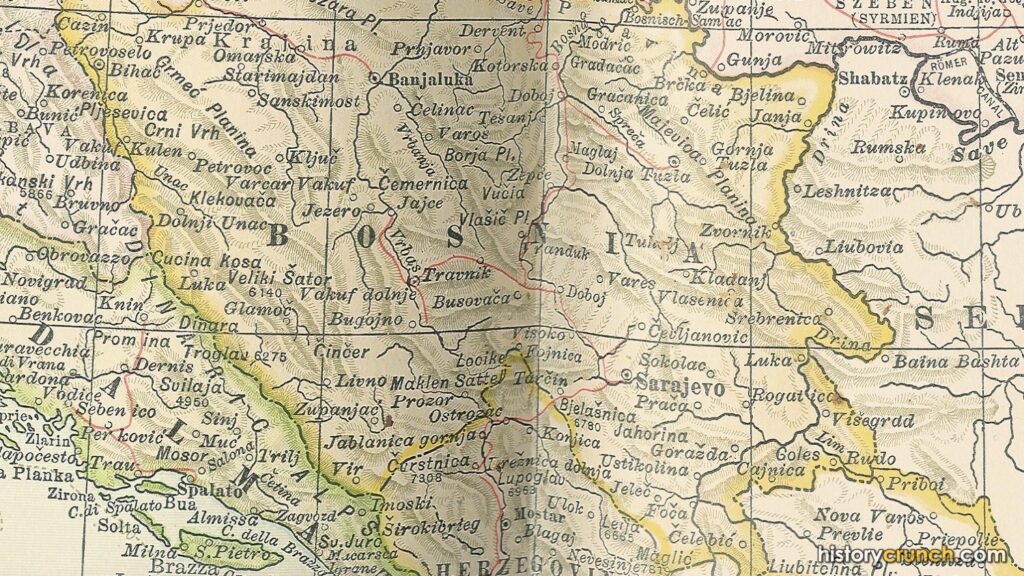
One of the most significant political decisions of Franz Joseph’s later reign was the formal annexationThe act of a country formally taking control of a territory and adding it to its own lands. of Bosnia and Herzegovina in 1908 CE. Bosnia and Herzegovina were two territories in the western Balkans that had been under Austrian military occupation since 1878 CE as a result of decisions made at the Congress of Berlin. The Balkans is the name for the region of southeastern Europe that includes countries such as Serbia, Bulgaria, Romania, Greece and Bosnia. During the late 19th and early 20th centuries, the Balkans was a major source of international tension because of conflicting interests between Austria-Hungary, the Ottoman Empire and Russia. Many of the people living in the region were Slavic, and Russia considered itself the natural protector of Slavic peoples in Europe.
When Franz Joseph formally annexed Bosnia and Herzegovina in 1908 CE, it caused an immediate international crisis. Serbia, which had hoped to eventually incorporate Bosnia and Herzegovina into a greater Serbian state as part of a movement to unite the South Slavic peoples of the Balkans, was furious at the move. Russia was also deeply unhappy. The crisis eventually passed without a war, but it left a lasting legacy of resentment. For instance, Serbian nationalists became increasingly determined to challenge Austrian power in the Balkans, and the annexation directly inspired the growth of radical nationalist groups in the region. One of these groups was the Black Hand, a secret Serbian nationalist organization, with which Gavrilo Princip was associated. As such, the Bosnian Crisis of 1908 CE was an important step on the road to the outbreak of World War I six years later.
Franz Joseph I and World War I
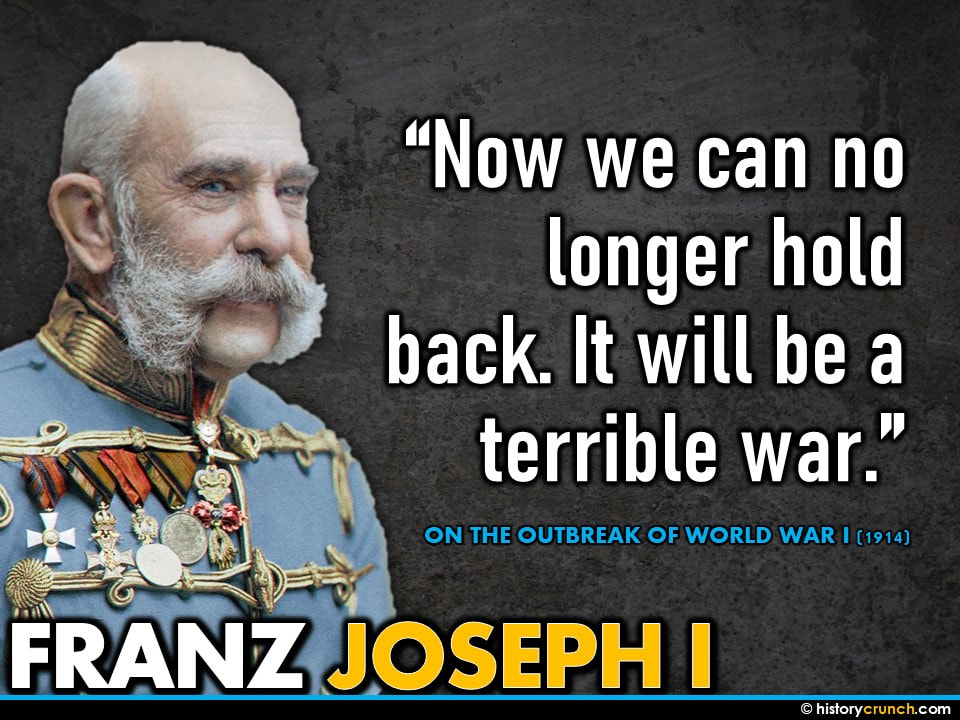
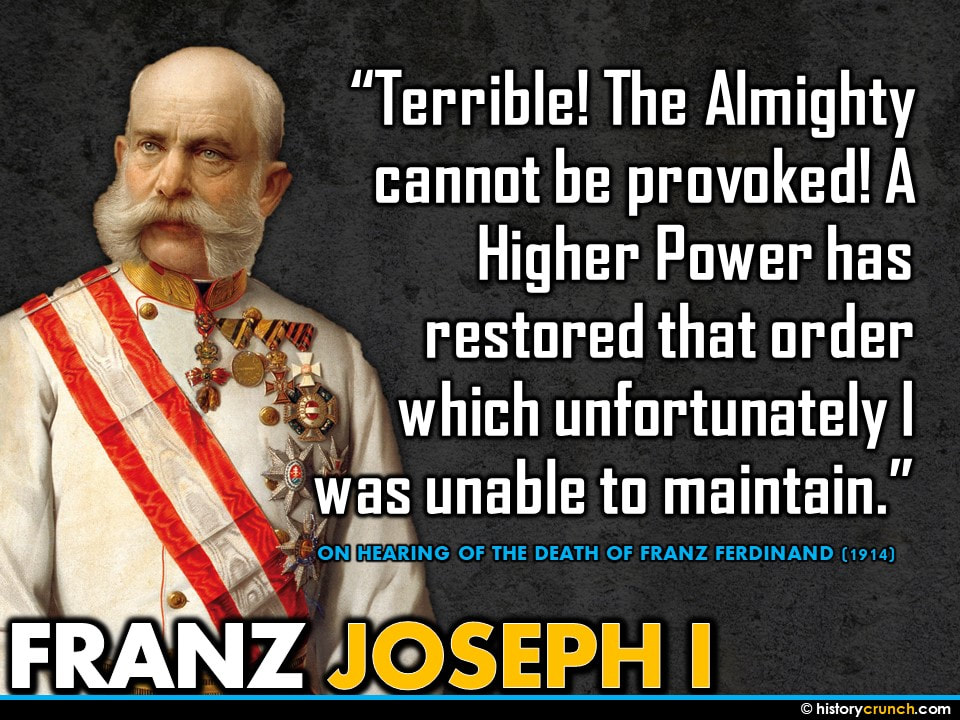
The event that finally brought Europe into war was the assassination of Franz Joseph’s nephew and heir, Archduke Franz Ferdinand, on June 28th, 1914 CE. Franz Ferdinand and his wife Sophie were shot and killed in Sarajevo, the capital of the Austro-Hungarian province of Bosnia and Herzegovina, by Gavrilo Princip, a Bosnian Serb nationalist with ties to the Black Hand organization. The assassination shocked the Austrian government and gave those within it who had long wanted to crush Serbia a reason to act. Franz Joseph himself was hesitant about going to war, but he accepted the advice of his foreign minister and his military commanders. Austria-Hungary issued a harsh ultimatum to Serbia containing demands that Serbia could not fully accept without surrendering its independence. When Serbia’s response was deemed insufficient, Austria-Hungary declared war on Serbia on July 28th, 1914 CE.
The declaration of war triggered a chain reaction of alliances across Europe. Russia mobilized its forces in support of Serbia. Germany declared war on Russia in support of Austria-Hungary. France entered the war alongside Russia. Britain joined after Germany invaded neutral Belgium. Within a matter of weeks, what had begun as a conflict between Austria-Hungary and Serbia had become a massive European war. Franz Joseph lived to see the war begin but did not live to see it end. He left the conduct of the war largely to his military commanders, though by 1916 CE he reportedly believed that Austria-Hungary could not win and that the breakup of his empire was likely. As such, the war that Franz Joseph had set in motion would ultimately destroy the empire he had spent his entire life trying to preserve.
What did Franz Joseph I do after Serbia's response to the Austrian ultimatum in July 1914?
Franz Joseph I’s Death and Legacy
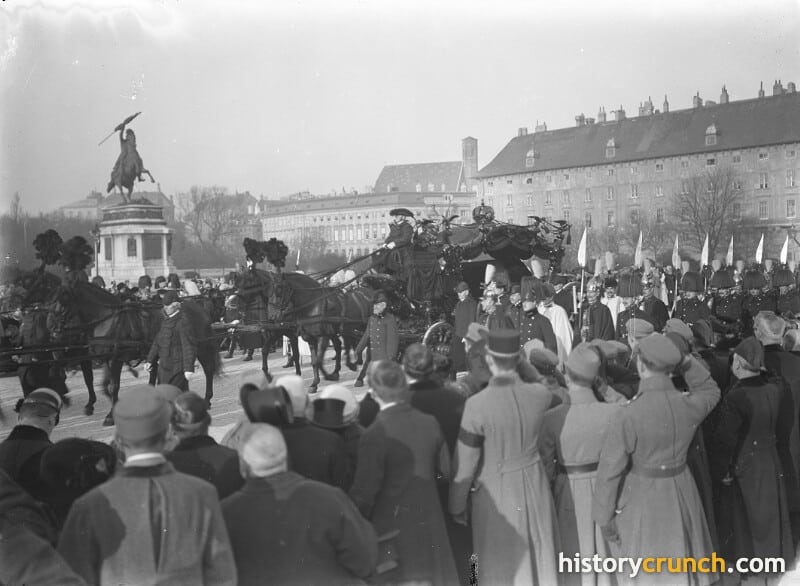
Franz Joseph I died on November 21st, 1916 CE in the Schönbrunn Palace in Vienna at the age of eighty-six. He died of pneumonia after catching a cold while walking in the palace park. He had reigned for nearly sixty-eight years, making his one of the longest reigns in European history. He was succeeded by his grand-nephew Charles I, who became the last Habsburg emperor and ruled until the collapse of the Austro-Hungarian Empire at the end of World War I in 1918 CE. The empire that Franz Joseph had worked his entire life to hold together ceased to exist just two years after his death.
Franz Joseph I left behind a complex and difficult legacy. On one hand, he was a devoted and hard-working ruler who maintained a vast and diverse empire for nearly seven decades, ran an efficient civil administration and was genuinely respected and even beloved by many of his subjects in his later years. For instance, he reportedly rose at four in the morning every day and worked at his desk for many hours, taking his responsibilities as emperor extremely seriously. On the other hand, his conservative resistance to political reform, his failure to address the national aspirations of the Slavic peoples within his empire and his decision to issue the ultimatumA set of demands given to another country with the warning that refusal will lead to serious consequences such as war. to Serbia in 1914 all contributed directly to the outbreak of World War I and the eventual destruction of the empire he served. As such, Franz Joseph I was one of the most significant rulers of the late 19th and early 20th centuries, and his reign had a lasting and profound impact on the history of Europe.
Explore World War I · 1914 – 1918
Keep exploring World War I with these History Crunch resources.
Key Vocabulary
Abdicate
Dual Monarchy
Ausgleich
Annexation
Ultimatum
Nationalism
Anarchist
Frequently Asked Questions
How long did Franz Joseph I rule?
Franz Joseph I ruled for nearly sixty-eight years, from 1848 until his death in 1916 CE. This made his reign one of the longest in European history. He became emperor at just eighteen years old and remained on the throne into his eighties.
What was the Austro-Hungarian Dual Monarchy?
The Dual Monarchy was a 1867 CE agreement that made Austria and Hungary equal partners under one ruler. It was created through the Compromise of 1867, known in German as the Ausgleich. Each state kept its own government, parliament and laws, while Franz Joseph served as both Emperor of Austria and King of Hungary.
How did Franz Joseph I contribute to World War I?
Franz Joseph approved the harsh ultimatum to Serbia that led Austria-Hungary to declare war on July 28th, 1914 CE. That declaration triggered a chain of alliances that pulled Europe into a massive war. His earlier annexation of Bosnia and Herzegovina in 1908 also fueled the Serbian resentment behind the conflict.
What personal tragedies did Franz Joseph I face?
Franz Joseph lost many close family members during his long reign. His only son, Crown Prince Rudolf, died in an apparent murder-suicide in 1889 CE. His wife, Empress Elisabeth, was assassinated in 1898 CE, and his brother Maximilian was executed in Mexico in 1867 CE.
Who succeeded Franz Joseph I?
Franz Joseph was succeeded by his grand-nephew Charles I after his death in 1916 CE. Charles became the last Habsburg emperor. He ruled only until 1918 CE, when the Austro-Hungarian Empire collapsed at the end of World War I.
How did Franz Joseph I die?
Franz Joseph I died of pneumonia on November 21st, 1916 CE at the age of eighty-six. He caught a cold while walking in the park at the Schönbrunn Palace in Vienna. He did not live to see the end of the war or the fall of his empire.
Cite This Article
To cite this article as a source, use one of the formats below.
MLA: Millar, B. “Franz Joseph I of Austria: A Detailed Biography.” HistoryCrunch, 30 September 2026, https://historycrunch.com/franz-joseph-i-of-austria/.
APA: Millar, B. (2026). Franz Joseph I of Austria: A Detailed Biography. HistoryCrunch. https://historycrunch.com/franz-joseph-i-of-austria/
Chicago: Millar, B. “Franz Joseph I of Austria: A Detailed Biography.” HistoryCrunch. September 30, 2026. https://historycrunch.com/franz-joseph-i-of-austria/
Sources
- Hew Strachan, The First World War.
- Margaret MacMillan, The War That Ended Peace.
- John Keegan, The First World War.
- Fordham Modern History Sourcebook