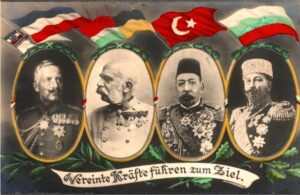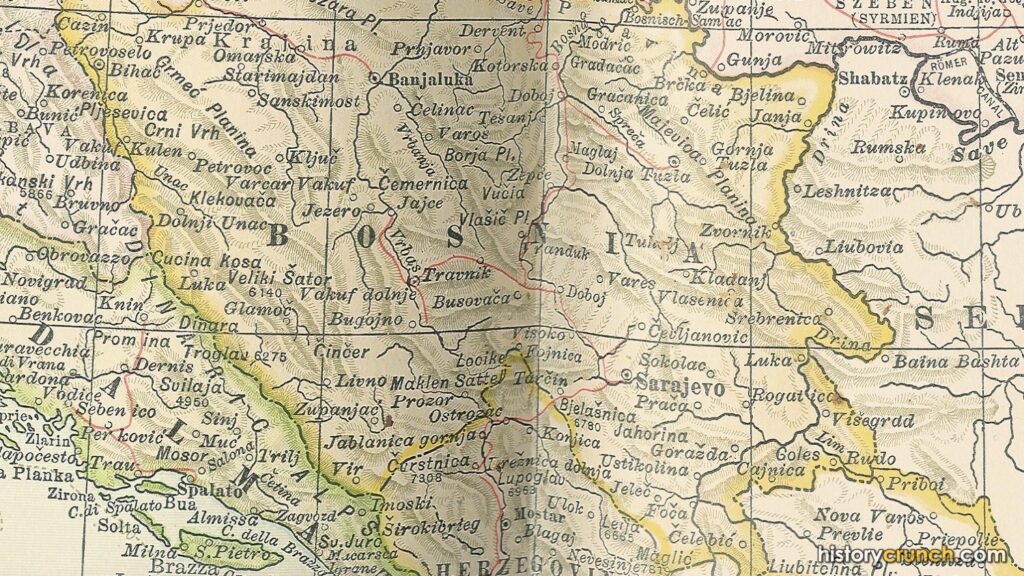
The Bosnian Crisis of 1908 was a significant event that is considered important to the history of the Balkans. In fact, the Bosnian Crisis took place in the Balkan Peninsula, which is a region in southeastern Europe. In general, the Bosnian Crisis involved the annexationWhen one country takes control of another territory and adds it to its own lands. of Bosnia and Herzegovina by Austria-Hungary. Due to the timeframe in which it occurred, the Bosnian Crisis of 1908 is considered to be important to the two Balkan Wars (First Balkan War and Second Balkan War) as well as World War I. World War I began in 1914 following the assassination of Austrian Archduke Franz Ferdinand.


What Led to the Bosnian Crisis of 1908?
The 19th century was a period of continuous change and competition in Europe. Not only was it the height of European imperialismWhen powerful nations expand their control over weaker territories, usually for political or economic gain., but it also saw the rise of nationalism, which swept across the continent. For instance, Italy formally unified as a country in 1861, and Germany did the same in 1871. In both cases, smaller kingdoms unified into one larger country and saw the people of each country identify with each other nationalistically. This wave of nationalismA strong feeling of pride and loyalty toward one’s country or ethnic group, often driving people to unify or seek independence. also swept across the Balkans.
For centuries, much of the Balkans was ruled by the Ottoman Empire. The Ottoman Empire dated back to around the year 1300 and at its height stretched across the Middle East, Northern Africa, and large sections of Europe. It was a Sunni Islamic state that was based mainly out of modern-day Turkey. For example, the capital of the Ottoman Empire was the city of Constantinople, which today is called Istanbul. While the Ottoman Empire ruled over the Balkans for centuries, by the early 20th century, it was beginning to lose power over the region. This became most evident in 1908 when Austria exerted its influence in the Balkans with the Bosnian Crisis of 1908.
 FactsthatCrunch
What Happened During the Bosnian Crisis of 1908?
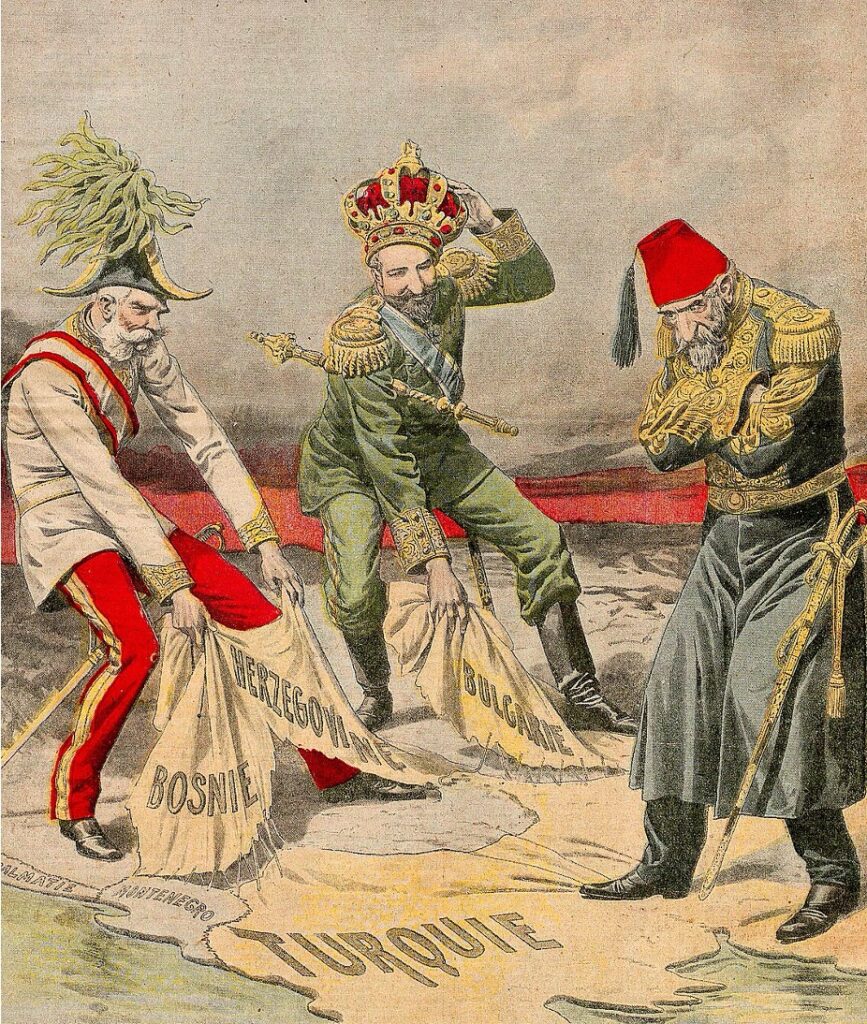
The Bosnian Crisis began in October of 1908 with the Austrian annexation of Bosnia and Herzegovina. This means that Austria took control over the two territories. Previously they had belonged to the Ottoman Empire, although Austria-Hungary had occupied and run them since 1878, and by this time the Ottoman Empire was in declineA gradual loss of power, strength, or influence over time. and losing its authority in the region. In fact, at the same time, the Balkan state of Bulgaria declared its independence from the Ottoman Empire. Austria’s annexation of Bosnia and Herzegovina created a crisis not only with the leadership of the Ottoman Empire, but also with other surrounding European nations including Italy, Russia and Serbia. This eventually set the stage for the events of the First Balkan War in 1912 and the outbreak of World War I in 1914. In fact, when World War I began in July of 1914, Austria-Hungary found itself at war with Russia and Serbia, and Italy joined their side in 1915.
Bulgaria declared its independence from the Ottoman Empire in 1908, the same year Austria-Hungary annexed Bosnia and Herzegovina.
World War I timeline · 1914 – 1918
Key Vocabulary
Annexation
Nationalism
Imperialism
Decline
Assassination
Frequently Asked Questions
What was the Bosnian Crisis of 1908?
The Bosnian Crisis of 1908 was Austria-Hungary’s annexation of Bosnia and Herzegovina. These two territories had legally belonged to the Ottoman Empire, although Austria-Hungary had occupied and run them since 1878. The move angered several nearby nations and raised tension across the Balkans in southeastern Europe.
When did the Bosnian Crisis of 1908 begin?
The Bosnian Crisis began in October of 1908 with the Austrian annexation of Bosnia and Herzegovina. At the same time, Bulgaria declared its independence from the Ottoman Empire. Both events showed how quickly Ottoman power in the Balkans was fading.
Why did Austria-Hungary annex Bosnia and Herzegovina?
Austria-Hungary annexed Bosnia and Herzegovina to expand its influence in the Balkans as the Ottoman Empire weakened. The 19th century had brought a rise in imperialism and nationalism across Europe. Austria-Hungary wanted to lock in control before rivals such as Russia or Serbia could gain ground.
Which countries were upset by the annexation?
The annexation angered the Ottoman Empire along with Italy, Russia, and Serbia. Serbia saw Bosnia as home to many Slavic people and hoped to unite them one day. This rivalry between Austria-Hungary and Serbia grew sharper in the years that followed.
How did the Bosnian Crisis connect to World War I?
The Bosnian Crisis deepened the bitter split between Austria-Hungary and Serbia that later helped spark World War I. In 1914 Archduke Franz Ferdinand was assassinated in Sarajevo, Bosnia, by Gavrilo Princip. That killing pushed Austria-Hungary into war with Russia and Serbia.
Cite This Article
To cite this article as a source, use one of the formats below.
MLA: Beck, Elias. “Bosnian Crisis of 1908: A Detailed Summary.” HistoryCrunch, 28 September 2026, https://historycrunch.com/bosnian-crisis-of-1908/.
APA: Beck, E. (2026). Bosnian Crisis of 1908: A Detailed Summary. HistoryCrunch. https://historycrunch.com/bosnian-crisis-of-1908/
Chicago: Beck, Elias. “Bosnian Crisis of 1908: A Detailed Summary.” HistoryCrunch. September 28, 2026. https://historycrunch.com/bosnian-crisis-of-1908/
Sources
- John Keegan, The First World War.
- Hew Strachan, The First World War.