One of the most important causes of World War I was the system of alliances that had divided Europe into two armed camps in the decades before 1914. On one side was the Triple Alliance, consisting of Germany, Austria-Hungary and Italy, and on the other was the Triple Entente, consisting of Britain, France and Russia. When the assassination of Archduke Franz Ferdinand triggered a diplomatic crisis in the summer of 1914, these alliance obligations pulled the major powers of Europe into war within weeks. This map was created by History Crunch to help students visualize the geographic distribution of the two alliances and is based on the History Crunch articles on the Alliance Systems Before World War I.
World War I Alliances Map
About This Map
This World War I alliances map was created by the History Crunch team to help students and teachers understand how the alliance systems divided Europe in the years before and during the First World War. It is designed as a visual learning tool to accompany our full articles on the Alliance Systems Before World War I. Teachers may use it as a classroom display, a geography activity, or a discussion starter about how the alliance systems turned a regional crisis into a world war.
What This Map Shows
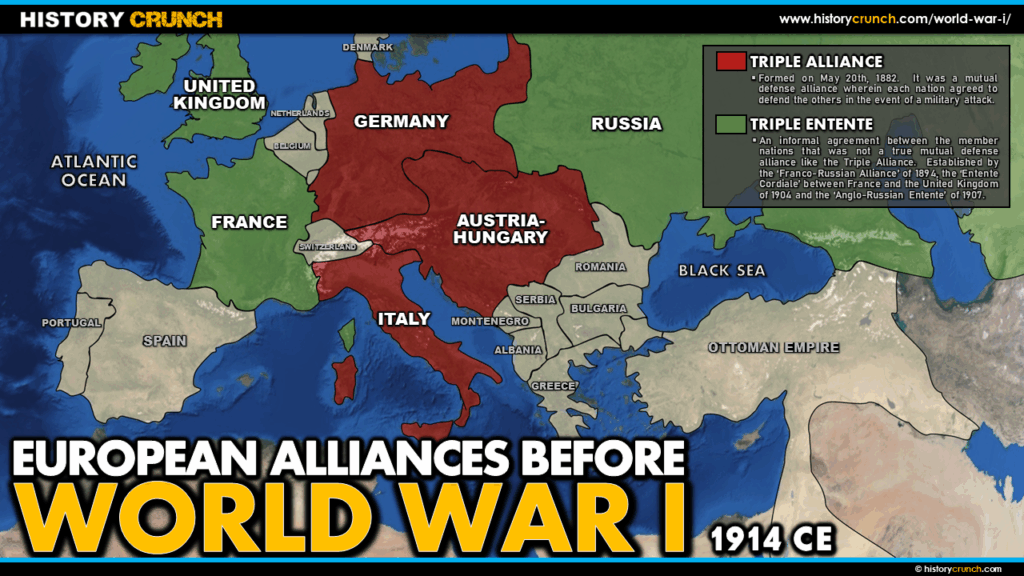
The map shows the geographic distribution of the two main alliance systems that divided Europe before the outbreak of World War I in 1914, with member nations of each alliance color-coded to show the two opposing blocs.
The Triple Alliance was formally established on May 20th, 1882 and consisted of Germany, Austria-Hungary and Italy. Germany was the driving force behind the creation of the alliance. The main terms of the Triple Alliance committed each member nation to come to the military aid and defense of the others in the event of attack. Importantly, the main terms of the treaty were kept secret, which prevented the opposing nations from fully understanding how their actions might trigger a military response from Germany and its allies. This secrecy contributed to the escalation of tensions in the crisis following the assassination of Franz Ferdinand. The map illustrates the geographic position of the Triple Alliance nations, with Germany and Austria-Hungary forming a central bloc in the heart of Europe and Italy positioned on the southern flank.
The Triple Entente was an informal alliance between Britain, France and Russia that developed through a series of separate agreements. The Franco-Russian Alliance was established first, followed by the Entente Cordiale between France and Britain finalized on April 8th, 1904, and then the Anglo-Russian Entente between Britain and Russia on August 31st, 1907. Together these three agreements created an informal but powerful counterweight to the Triple Alliance. The map shows how the Triple Entente effectively surrounded the Triple Alliance nations geographically, with France to the west, Russia to the east and Britain’s naval power controlling the seas.
The map also shows a key shift that occurred when war actually broke out. Italy, despite being a member of the Triple Alliance, sided with the Triple Entente when war began in 1914, officially leaving the Triple Alliance on May 3rd, 1915. Italy considered Austria-Hungary to be the aggressor following the assassination of Franz Ferdinand and ultimately joined the Allied Powers alongside France, Britain and Russia. Meanwhile the Central Powers that fought the war were Germany and Austria-Hungary, later joined by the Ottoman Empire and Bulgaria. The map therefore helps students understand both the pre-war alliance structure and the actual wartime alignment of nations.
The map highlights how the alliance systems transformed what began as a regional crisis in the Balkans into a continent-wide war. When Austria-Hungary threatened Serbia following the assassination of Franz Ferdinand, Russia came to Serbia’s defense. Germany then pledged unlimited support to Austria-Hungary. This triggered the Franco-Russian Alliance, drawing France into the conflict, and Germany’s invasion of neutral Belgium brought Britain in as well. Within weeks the alliance systems had transformed a local dispute into the First World War.
How to Use This Map in the Classroom
This map works well as a visual introduction to the alliance systems before students read the full articles. It can be used as a geography activity asking students to identify each alliance member on the map and describe the geographic relationship between the two blocs. Teachers may also use it as a discussion prompt asking students to consider whether the alliance systems made World War I more or less likely, and how the geographic position of Germany surrounded by potential enemies on two sides shaped its decision-making. It pairs particularly well with the main WWI map and the WWI causes articles.
Related Articles
To learn more about the topics covered in this map, visit the following History Crunch articles: