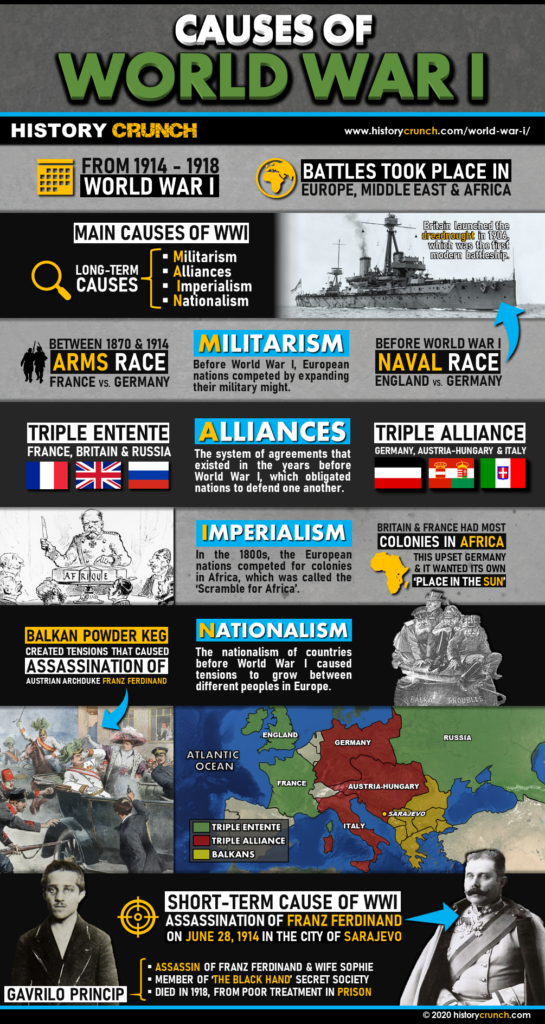
World War I was one of the most devastating conflicts in human history, but the war did not begin suddenly or without warning. Historians have identified a combination of long-term tensions that had been building across Europe for decades alongside a specific short-term trigger that set off the fighting in the summer of 1914. The four main long-term causes are often remembered using the acronym M.A.I.N., which stands for Militarism, Alliance systems, Imperialism and Nationalism. The short-term cause was the assassination of Austrian Archduke Franz Ferdinand on June 28th, 1914. This infographic was designed for students to visually summarize the main causes of World War I and is based on the History Crunch articles on the Causes of World War I.
Causes of World War I – Infographic
About This Infographic
This Causes of World War I infographic was created by the History Crunch team to help students and teachers quickly understand the factors that combined to produce the most destructive war Europe had ever seen. It is designed as a visual learning and study tool, summarizing the essential information covered in our full articles on the Causes of World War I. Teachers may use it as a classroom display, a discussion prompt, or a study aid for students preparing for assessments.
What This Infographic Covers
The infographic covers the four M.A.I.N. long-term causes of World War I.
Militarism was the first major long-term cause. In the decades before 1914, the major European nations engaged in intense arms races and military buildups. France and Germany both doubled their armies between 1870 and 1914, with France reaching approximately 4 million soldiers and Germany over 4.5 million by the outbreak of war. Britain and Germany also engaged in a fierce naval race, each competing to build more powerful warships including the new class of dreadnought battleships. This arms buildup created an atmosphere of mutual distrust and suspicion across Europe and made the continent far more dangerous when the July Crisis of 1914 erupted.
Alliance systems were the second major long-term cause. Europe had divided itself into two competing alliance blocs before the war. The Triple Alliance linked Germany, Austria-Hungary and Italy. The Triple Entente was an informal alliance linking Britain, France and Russia. These alliance systems were designed as defensive agreements, but in practice they meant that a conflict between any two nations could rapidly drag the entire continent into war. Furthermore, the main terms of the Triple Alliance were kept secret, which prevented the opposing nations from fully understanding how their actions might trigger a German military response. When Austria-Hungary declared war on Serbia in July 1914, the alliance systems pulled one nation after another into the fighting within just a few weeks.
Imperialism was the third major long-term cause. By the early 20th century the major European powers had built vast colonial empires across Africa, Asia and other regions of the world. Competition for colonies and resources created rivalries and tensions between the European powers. For example, France and Germany clashed over influence in Morocco in both 1905 and 1911, in events known as the First and Second Moroccan Crises. These imperial rivalries increased tensions and distrust between the major powers and contributed to the arms race and alliance building that defined pre-war Europe.
Nationalism was the fourth major long-term cause. A powerful wave of nationalism swept through Europe in the 19th and early 20th centuries, causing people to identify strongly with their own nation and sometimes to resent the influence of others. In the Balkans this was especially intense, where different ethnic groups sought independence from the Ottoman and Austro-Hungarian empires. Historians use the term Balkan Powder Keg to describe the dangerous nationalistic tensions in the region in the years before the war. The rise of Pan-Slavism, the idea that the Slavic peoples of Eastern Europe should unite in mutual support, drew Russia into the conflict when Austria-Hungary threatened Serbia.
The infographic also covers the short-term trigger: the assassination of Archduke Franz Ferdinand. On June 28th, 1914, Franz Ferdinand, the heir to the Austro-Hungarian throne, and his wife Sophie were assassinated in Sarajevo by Gavrilo Princip, a 19-year-old member of the Black Hand, a Serbian nationalist organization. Austria-Hungary blamed Serbia and issued a threatening ultimatum. When Serbia did not fully comply, Austria-Hungary declared war on July 28th, 1914. Russia mobilized in Serbia’s defense, Germany pledged support to Austria-Hungary, and through the alliance systems the major European powers were at war within days. World War I had begun.
How to Use This Infographic in the Classroom
This infographic works well as a visual introduction to the causes of World War I before students read the full articles on each cause. It can also be used as a review tool before an assessment, or as a discussion prompt asking students to consider which of the four M.A.I.N. causes they think was most significant and why. Teachers may also use it alongside the WWI alliances map to help students see the geographic dimensions of the alliance system cause, and alongside articles on the assassination of Franz Ferdinand to explore how the short-term trigger connected with the long-term tensions.
Related Articles
To learn more about the topics covered in this infographic, visit the following History Crunch articles:
- Causes of World War I
- Militarism as a Cause of World War I
- Alliance Systems Before World War I
- Nationalism as a Cause of World War I
- Imperialism as a Cause of World War I
- Assassination of Franz Ferdinand
- July Crisis of 1914
- Triple Alliance and World War I
- Triple Entente and World War I
- Balkan Powder Keg and World War I
- World War I Overview