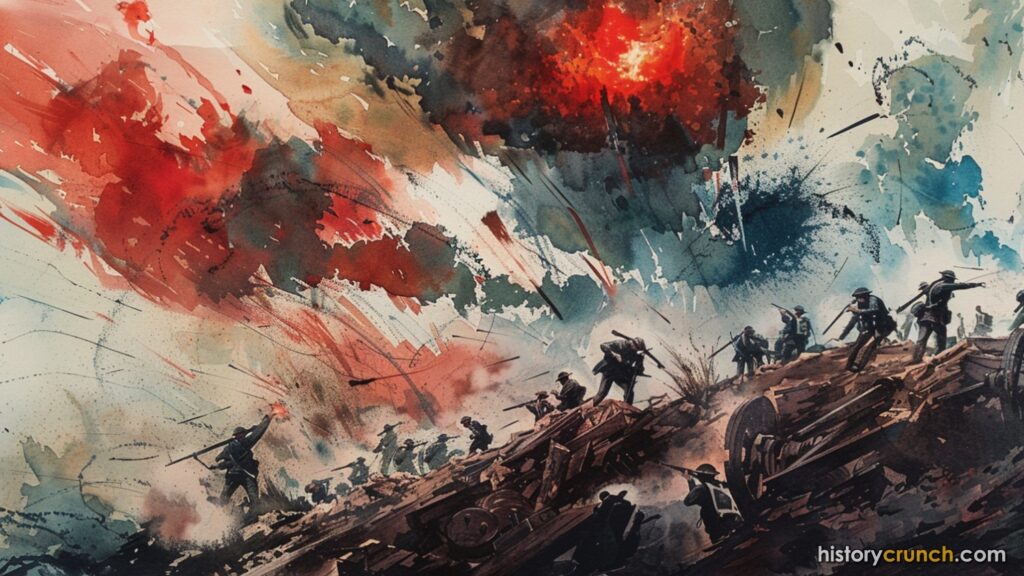
World War I began in July of 1914, and is considered to have five major causes that led to the outbreak of the war. These five causes include the four long-term causes (militarism, alliances, imperialism and nationalism) discussed in this reading and one short-term cause (the assassination of Franz Ferdinand). The four long-term causes each occurred in the years and decades before the actual outbreak of World War I, and all combined to set the stage for war in 1914. Most people think of these as the M.A.I.N. causes of World War I as an easy to remember acronym.
 FactsthatCrunch
What were the four long-term causes of World War I?
Militarism as a Cause of World War I
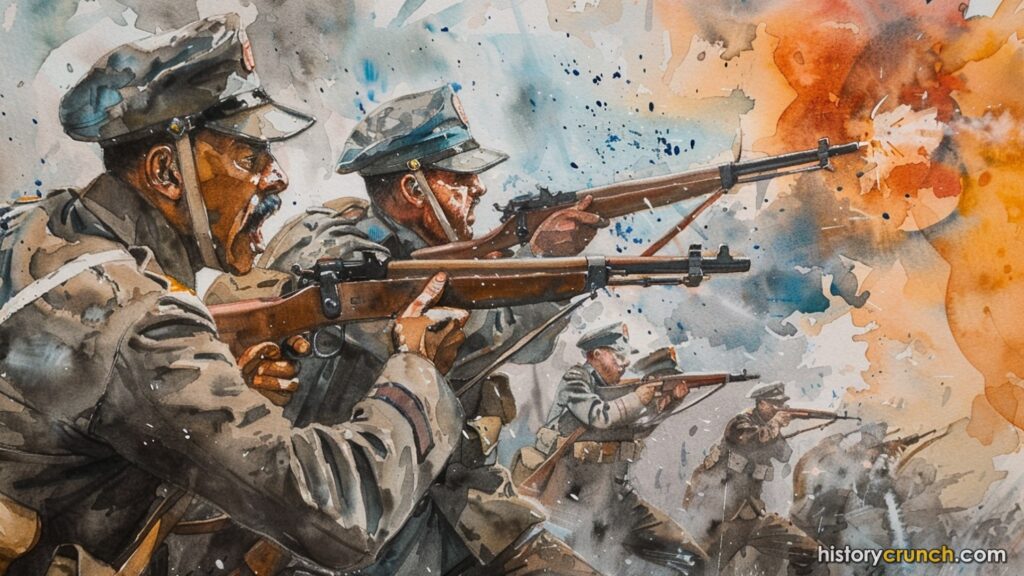
The first long-term cause of World War I is militarismThe buildup or expansion of a country’s military forces and ability to wage war.. Militarism can best be understood as the buildup or expansion of the ability of a country’s military to wage war. In the decades before World War I many European countries began to practice militarism and worked to expand and strengthen their military forces. For example, there was an intense arms raceWhen rival nations compete to grow their armies and weapons faster than each other. and naval race between several European nations in the buildup to World War I. Specifically, France and Germany were heavily involved in an arms race in which each country doubled their armies between 1870 and 1914. Both nations had a history of war against each other and their rivalry caused them to expand their military forces. At the outbreak of fighting in 1914, France had approximately 4 million soldiers while Germany had over 4.5 million. This arms race showed the distrust between the nations of Europe and when war did break out in 1914 it allowed the countries to go to war more easily.
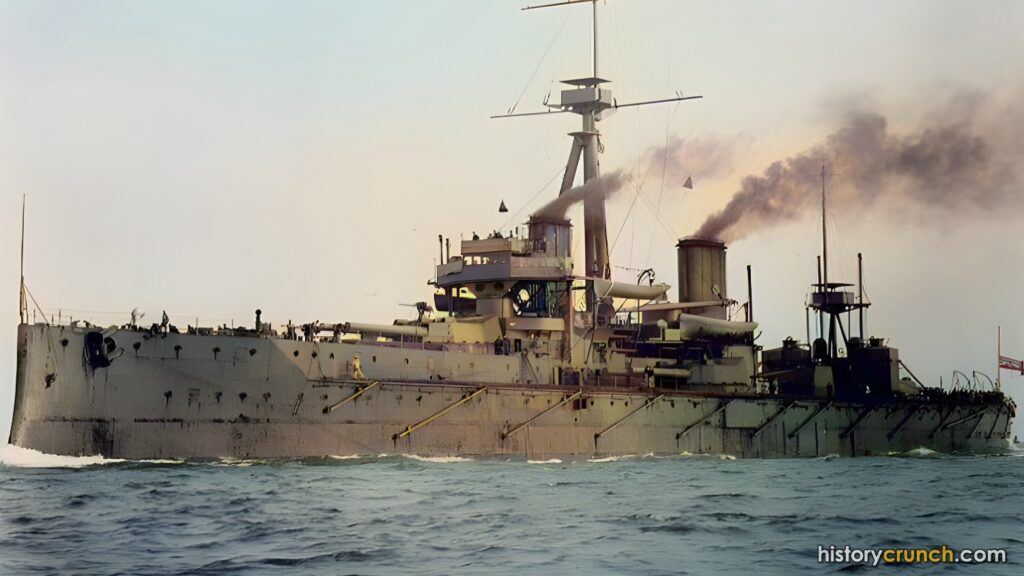
In addition to the arms race, there was also a competitive naval race between Britain and Germany in the years leading up to World War I. Britain had the largest navy in the world at the time, which it needed to maintain its vast colonial empire. Germany viewed the British navy as a threat and sought to develop its own navy to match the powerful British navy. Mostly Germany needed a strong navy to challenge British ships in the North Sea. The North Sea was Germany’s only coastal access but was difficult for Germany since the North Sea was connected to Britain and the British navy dominated the area. Also related to the naval race was the development of the dreadnoughtA powerful new type of battleship launched by Britain in 1906, faster and with larger guns than earlier ships.. Britain developed and launched the dreadnought in 1906 which was the first battleship to be developed in the 20th century. The British dreadnought was notable for having larger caliber guns and for being faster on open water than any other earlier battleships. In response, Germany developed its own version of the dreadnought and worked to challenge the power of the British. By the outbreak of war in 1914, Britain had 29 dreadnoughts and Germany had 17.
In general, militarism showed the rivalry that existed between the nations of Europe in the years before the outbreak of World War I. Also, militarism created the large forces that easily allowed the European nations to go to war in 1914. If they had not built such large armies then the war may not have been so easy to begin and so devastating.
 FactsthatCrunch
Britain held a clear lead in dreadnoughts by 1914, with 29 to Germany's 17, while Germany held the edge in total army size. The two sides built up their forces in direct response to each other, deepening the rivalry that helped push Europe toward war.
Alliance Systems Before World War I
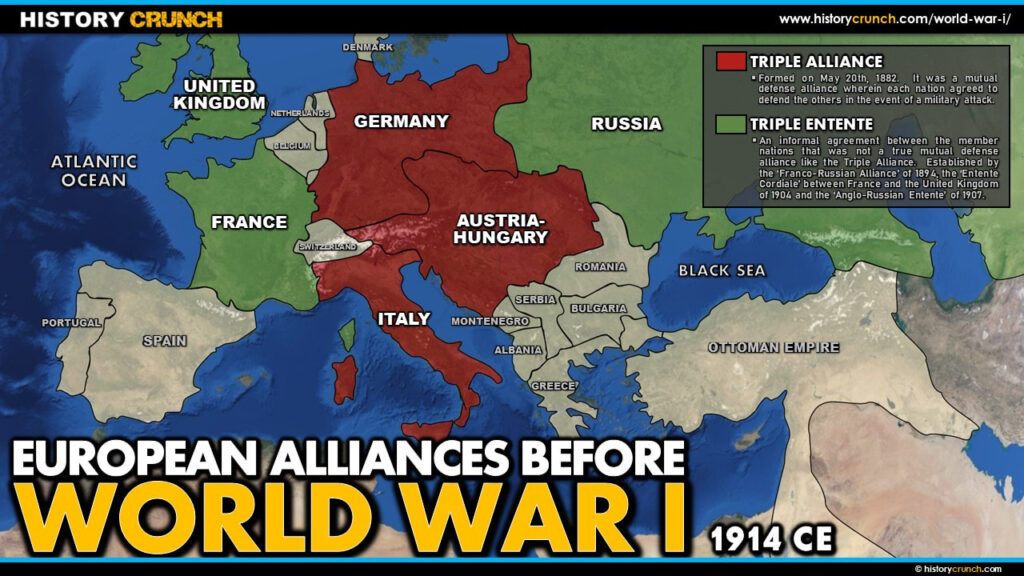
The second long-term cause of World War I was the system of alliances that existed in the years before the outbreak of war in 1914. When World War I began Europe divided between two separate alliance systems. Britain, France and Russia made up the Triple Entente while Germany, Austria-Hungary and Italy made up the Triple Alliance. Both sets of alliances were created in the years and decades before World War I between the partnering countries. The assassination of Austro-Hungarian archduke Franz Ferdinand and the resulting crisis between Serbia and the Austro-Hungarian Empire caused each system of alliances to activate, and World War I began.
To understand how the system of alliances led to the start of World War I, we first need to understand the series of events that unfolded after the assassination of Franz Ferdinand in June of 1914. Immediately after the assassination, which was carried out by Gavrilo Princip, a member of a Serbian nationalist organization called the Black Hand, Austria-Hungary blamed Serbia and began to threaten Serbia. In response, Russia came to the defense of Serbia. Russia did this as part of its larger movement for Pan-SlavismA movement promoting unity and support among all Slavic peoples, such as Russians and Serbians.. Pan-Slavism was the theory that supported the promotion of all Slavic people, of whom Russians and Serbians were both. As such, Russia wanted to support the Serbians against Austro-Hungarian aggression because Russia viewed Serbians as sharing a similar ethnic heritage. After Russia came to the defense of Serbia, Germany pledged its support to Austria-Hungary in the form of a ‘blank check’, meaning Germany was offering Austria-Hungary its unlimited support. This act by Germany caused an alliance between Russia and France to take effect and both France and Britain were pulled into the conflict in support of Russia. Italy was then also pulled into the conflict, but on the side of the Triple Entente and fought extensively against the Austro-Hungarian Empire in the Alps. Italy didn’t enter the fighting until a year after World War I began, but ultimately entered on the side of the Triple Entente after a period of secret negotiations. What had begun as a conflict between Austria-Hungary and Serbia had expanded to include all of the major powers in Europe.
Ultimately, the alliance systems that existed before the start of World War I obligated countries to go to war in defense of their allies. This obligation is how countries such as Britain, France, Germany and Italy were pulled into the conflict.
 FactsthatCrunch
Which fact matches each nation in the alliances before World War I?
Imperialism as a Cause of World War I
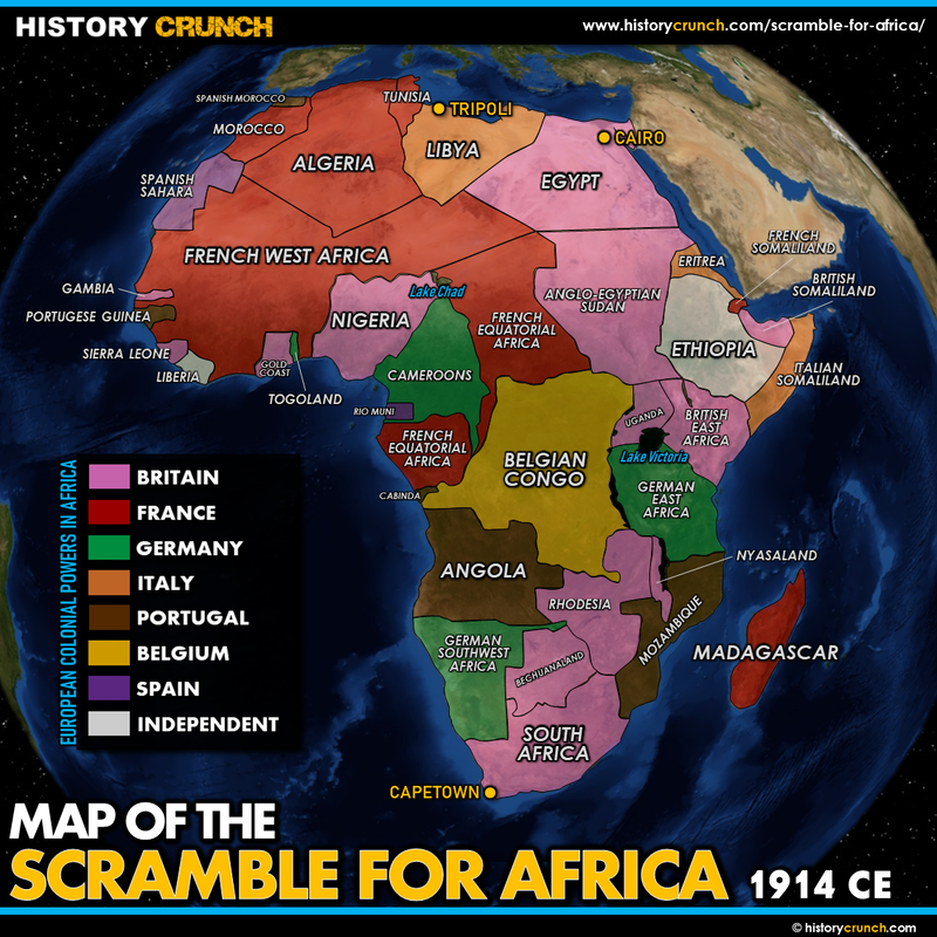
The third main cause of World War I was European imperialism that occurred in the 1800s and early 1900s before World War I erupted in 1914. Imperialism is understood as a process in which a country overtakes another country or region’s political, economic or social life. ImperialismA process in which a powerful country takes over another country or region’s political, economic, or social life. was carried out by the powerful European nations against the rest of the world in the decades before World War I began. For example, in the 19th century European nations carried out massive campaigns of imperialism against the regions of Africa in an event known as the Scramble for AfricaThe intense competition among European nations in the 1800s to claim and control territories across Africa.. The Scramble for Africa led to the start of World War I because it increased rivalry between the European nations as they fought against each other for territory in Africa and control over different regions. For example, in 1884, German leader Otto von Bismarck called the Berlin Conference which had the European powers meet to discuss the division of Africa into regions controlled by the European nations. The purpose of the meeting was to avoid starting a major European conflict and to lessen tensions because the Scramble for Africa was leading to an intense rivalry and distrust between the European powers. The peace created at the Berlin Conference did not last as the rivalry between the European powers increased as they approached 1914.
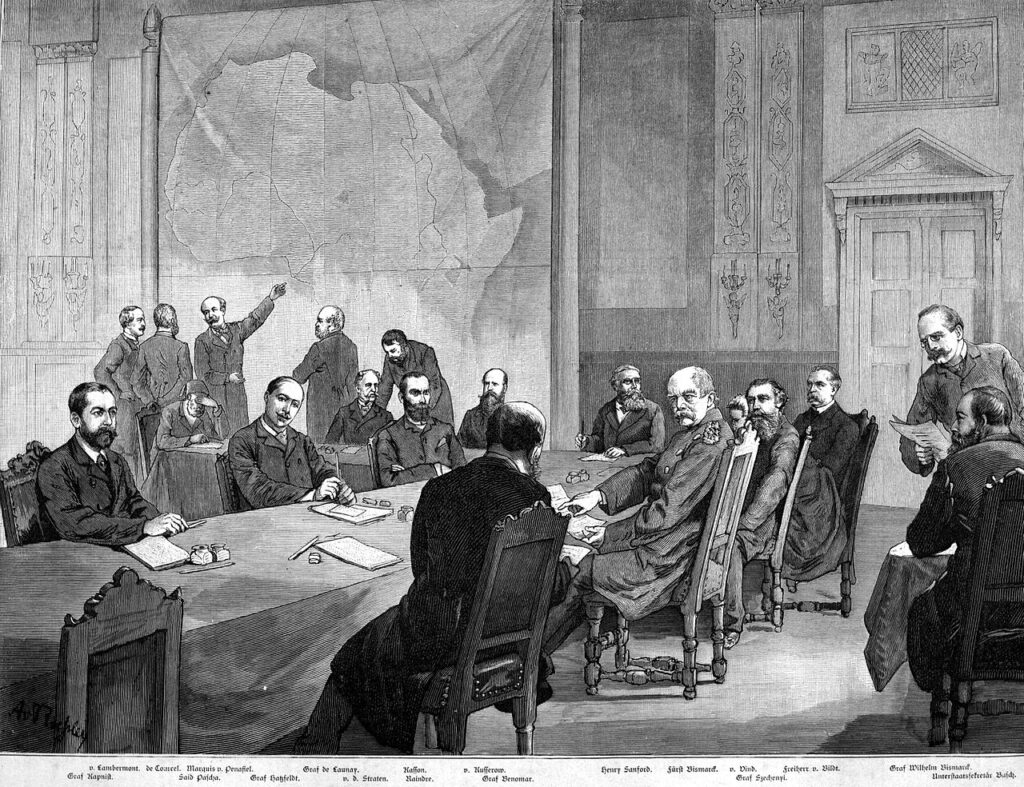
For instance, Britain and France were the two European nations that had control over the largest regions of Africa during the Scramble for Africa and this caused tension with Germany. Germany was angry that it lacked the colonies in Africa that both Britain and France had and resented their general role in Africa. This anger by Germany would lead to the two Moroccan Crises that occurred before World War I. Both crises occurred in the ten years before the outbreak of World War I and both involved France trying to gain control over Morocco while Germany worked to prevent France. For example, the Second Moroccan Crisis, which occurred in 1911, began when Germany sent its warship (Panther) to Agadir, Morocco in July of that year. The incident enraged the French who were considered to have a major interest in the region and both countries began threatening each other and talking of war. While the two sides would eventually end the crisis through negotiations it still showed the level of rivalry and tensions that imperialism in Africa caused among the European nations.
Ultimately, these tensions led to a sense of anger and distrust among the European powers that helped to set the stage for war in 1914.
Nationalism as a Cause of World War I
The fourth and final long-term cause of World War I was the growth of nationalism that occurred in Europe in the decades before World War I and the tensions it caused. Nationalism is best understood as when a group of people identify with each other and display a loyalty to their nation or country. Nationalism grows when people share similar beliefs, values, ethnic heritage, relationship to land, language, culture and customs. For example, both Germany and Italy unified from many separated kingdom states into unified nation-states in the late 1800s. These separate kingdoms unified as the people in those regions began to identify with each other and as nationalism swept across the people of Europe.
Nationalism was a major cause of World War I because it caused tensions and unrest to grow in certain parts of Europe. For example, the Austro-Hungarian Empire was not made up of one single nation, but rather consisted of many different groups. Many of these groups sought to have control over themselves and wanted sovereigntyThe right of a group or nation to govern itself independently, free from outside rule. from the rule of the Austro-Hungarian Empire. This created a great deal of unrest in the empire. This was especially apparent in the Balkans, which is a region in Southeast Europe that contains many different nation-states.
In the years before World War I, the Balkans was under intense nationalistic tensions. This was primarily due to the rise of nationalism in Europe and the influence of Austria-Hungary in the region. The Austro-Hungary Empire extended into the Balkans on its southern borders and in the years before World War I it attempted to extend its control over the region. Many historians now refer to the nationalistic tensions that were created in the region as a ‘powder keg‘, meaning that the tensions were so extreme that they were like a bomb ready to explode at any moment.
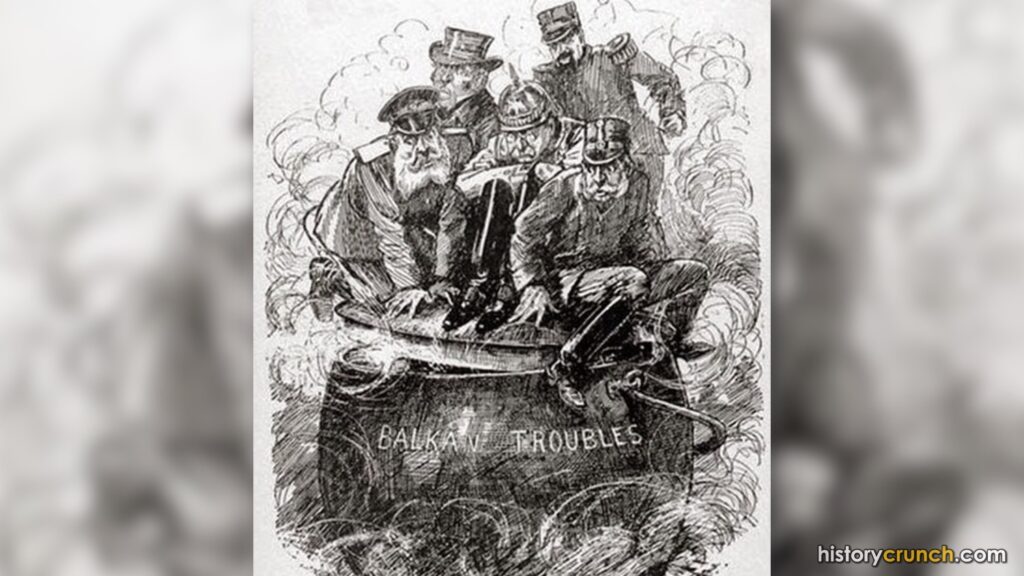
Ultimately, the assassination of Austro-Hungarian archduke Franz Ferdinand in June of 1914 was the ‘spark’ that lit the match of the Balkans Powder KegA situation so full of tension it could explode into conflict at any moment, like a bomb ready to go off. and plunged Europe into World War I. Nationalism as a movement in Europe in the years before World War I, created the tensions necessary for a small event like the assassination of Franz Ferdinand to explode into the worldwide conflict that it became.
 FactsthatCrunch
A powder keg is a situation so full of tension that it could explode into open conflict at any moment. The term comes from the small barrels used to store gunpowder, which needed only a spark to cause a massive explosion. Historians use it to describe places or periods where many pressures have built up and a single small event can start a war.
"Historians call the Balkans before World War I a powder keg because rising nationalism and rivalry between empires meant almost any incident could trigger a larger conflict."
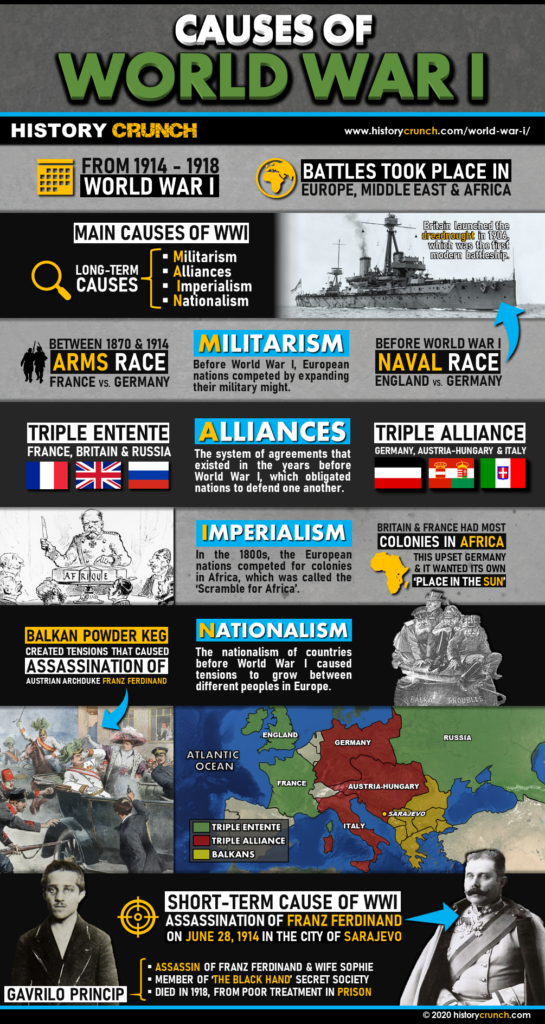
Causes of World War I – Infographic
Key Vocabulary
Militarism
Arms race
Dreadnought
Pan-Slavism
Imperialism
Scramble for Africa
Sovereignty
Powder keg
Frequently Asked Questions
What are the M.A.I.N. causes of World War I?
The M.A.I.N. causes of World War I are militarism, alliances, imperialism, and nationalism. These four long-term causes built up over the years and decades before the war. Together they created tension across Europe and set the stage for fighting to begin in 1914.
How did militarism help cause World War I?
Militarism helped cause World War I by building huge armies and navies that made war easier to start. France and Germany each doubled their armies between 1870 and 1914. Britain and Germany also raced to build powerful battleships called dreadnoughts, which showed the deep distrust between them.
What were the two main alliance systems before World War I?
The two main alliance systems were the Triple Entente and the Triple Alliance. Britain, France, and Russia made up the Triple Entente, while Germany, Austria-Hungary, and Italy formed the Triple Alliance. These alliances obligated countries to defend their partners, which pulled all the major powers into the war.
How did imperialism increase tension in Europe?
Imperialism increased tension because European nations competed fiercely for land and power overseas. The Scramble for Africa was a major example, as countries fought for control of African territory. Germany resented that Britain and France held the largest colonies, which led to the two Moroccan Crises.
Why is the Balkans called a powder keg?
The Balkans is called a powder keg because nationalist tensions there were so extreme they were ready to explode. Many groups wanted freedom from the Austro-Hungarian Empire, which raised unrest across the region. The assassination of Archduke Franz Ferdinand in 1914 became the spark that set it off.
When did World War I begin?
World War I began in 1914 after the assassination of Archduke Franz Ferdinand in Sarajevo. His death set off a crisis between Austria-Hungary and Serbia that quickly drew in the alliance systems. The four long-term causes had already made Europe ready for a large conflict.
Cite This Article
To cite this article as a source, use one of the formats below.
MLA: Beck, Elias. “Long-Term Causes of World War I: A Detailed Summary.” HistoryCrunch, 28 September 2026, https://historycrunch.com/long-term-causes-of-world-war-i/.
APA: Beck, E. (2026). Long-Term Causes of World War I: A Detailed Summary. HistoryCrunch. https://historycrunch.com/long-term-causes-of-world-war-i/
Chicago: Beck, Elias. “Long-Term Causes of World War I: A Detailed Summary.” HistoryCrunch. September 28, 2026. https://historycrunch.com/long-term-causes-of-world-war-i/
Sources
- Margaret MacMillan, The War That Ended Peace.
- Hew Strachan, The First World War.