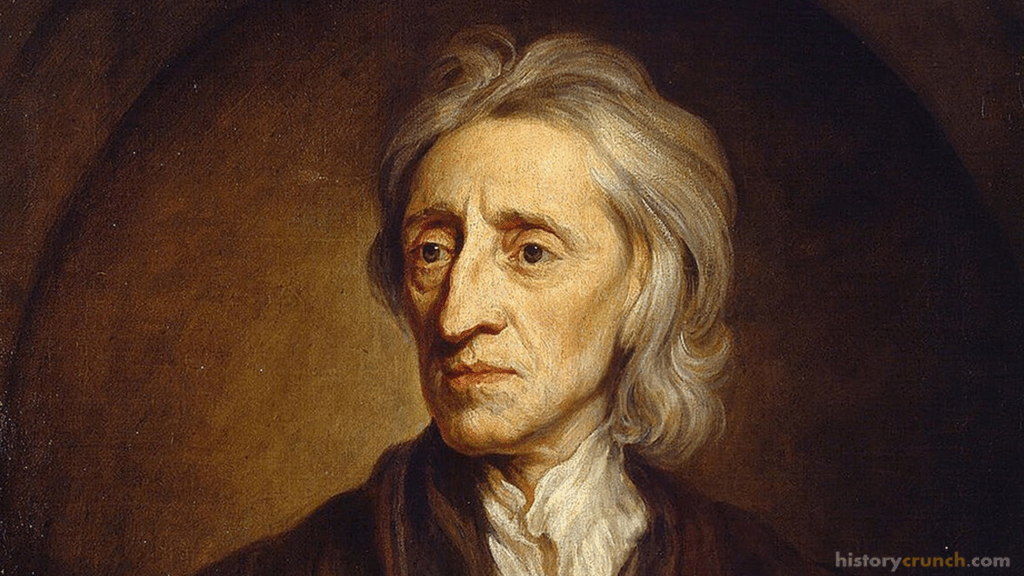
John Locke was a British philosopher who had a profound impact on modern political thought, liberalism, and the Age of Enlightenment. Known as the ‘Father of Liberalism’, Locke’s theories on natural rights, the social contract, government by consent impacted how people understood authority, especially in relation to the role of government. His work influenced Enlightenment thinkers across Europe and had a direct impact on revolutionary movements, including the American Revolution and the formation of modern democracies. As such, historians consider him to be one of the most significant voices during the Age of Enlightenment, alongside others, such as: Baron de Montesquieu, Jean-Jacques Rousseau and Voltaire.
JOHN LOCKE – EARLY LIFE
John Locke was born in Wrington, Somerset, England on the 29th of August in 1632. His father was a lawyer who served during the English Civil War. The family were strict Puritans, and were based in Somerset. Locke was sponsored to attend Westminster School, and then went to study at the University of Oxford. However, Locke was frustrated by much of the classical curriculum, and was far more interested by the writings of philosophers like Rene Descartes, which set the stage for the rest of Locke’s life.
Locke later studied medicine and became closely associated with prominent scientists and intellectuals, including Robert Boyle and Isaac Newton. His scientific background influenced his emphasis on ’empiricism’, which is the idea that knowledge comes from sensory experience rather than innate ideas or divine revelation.
JOHN LOCKE – AGE OF ENLIGHTENMENT
John Locke is best known for being a philosopher and is thought to be one of the most influential thinkers of his time. He was one of the first empiricists, which means that he thought that knowledge can only come through experience, and that evidence is needed to prove theories. Many of his ideas and theories followed the thoughts, and traditions of Sir Francis Bacon, who was one of the first influential philosophers.
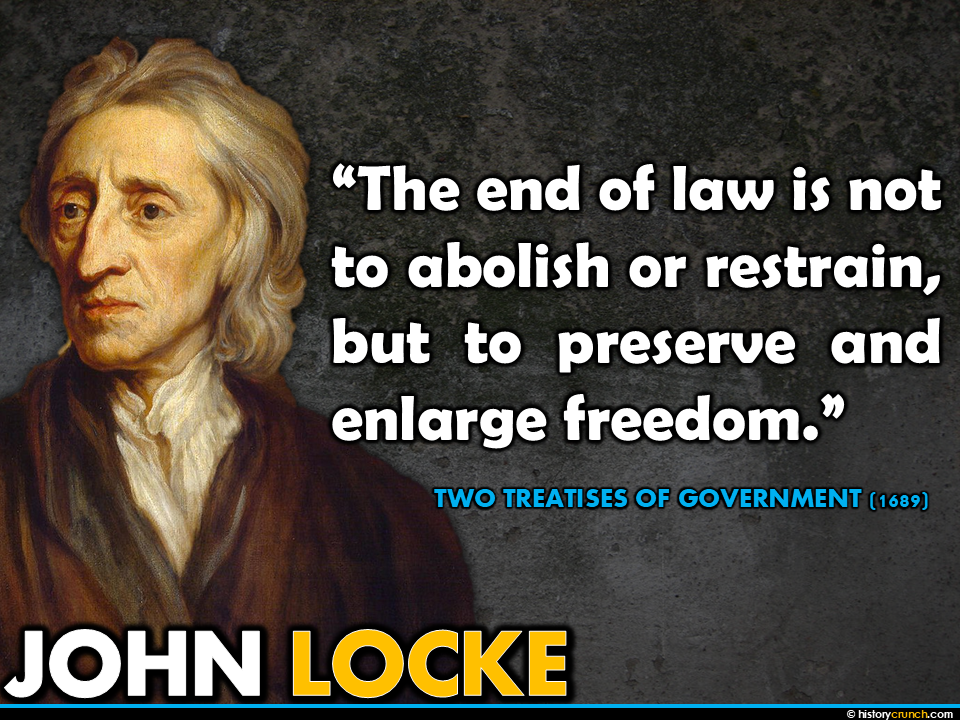
A key area that Locke developed was the social contract theory, which is the view that people have to agree to follow the rules, and regulations set by an authority figure in order to form a functioning community. In his famous work, ‘Two Treatises on Government’, he argued against the rule of an absolute monarchy, which was common at the time, and instead favored a monarch that ruled with the consent of the citizens. These ideas were considered revolutionary in his time and generally viewed as major inspirations of the Age of Enlightenment.
Furthermore, John Locke’s ‘theory of mind’, is another influential and important theory because it helped people to understand the concept of identity. The theory also explained how the ‘self’ can be defined via a number of stages of consciousness, whereby babies are born with a mind that is blank, and experiences let us learn. This theory was contrary to pre-existing ideas from Cartesian philosophy and as a result, like many of Locke’s theories, the theory of self was used later by philosophers like Hume and Kant.
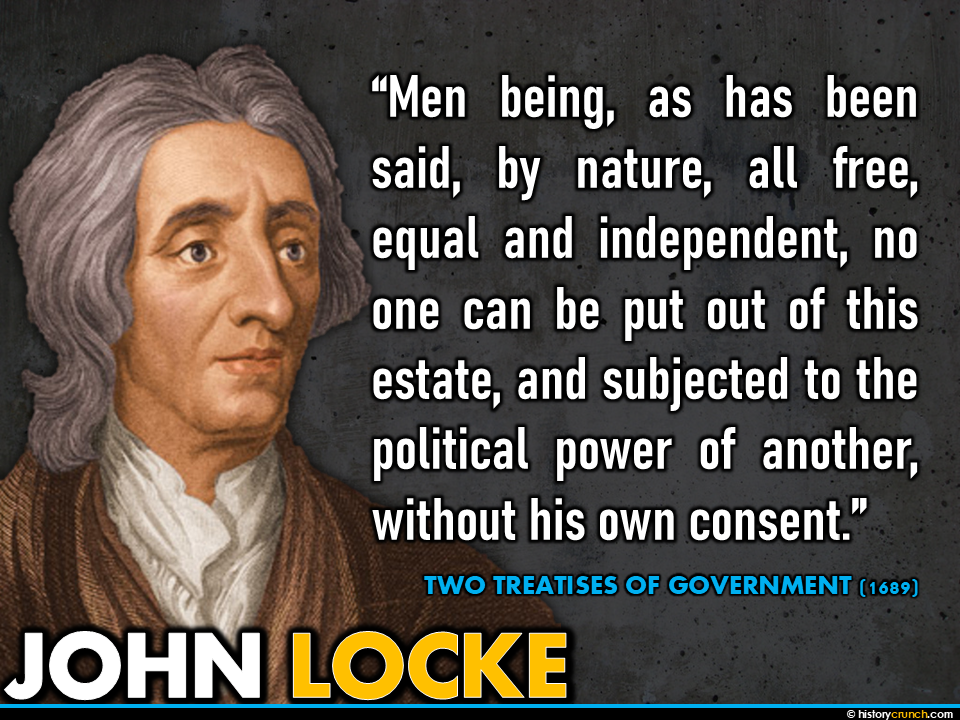
As a philosopher, Locke produced several significant written works. Likely the most significant was ‘Two Treatises of Government’, which was published in 1689. This political work was revolutionary. In it, Locke rejected the idea of divine right monarchy and proposed a new theory of government that centered on a few main principles. First, was the idea that all individuals are born with natural rights, such as: life, liberty, and property.
Second, Locke argued that governments exist only with the consent of the governed. Finally, if a government fails to protect those rights, citizens have the right to revolt. As stated above, these ideas were revolutionary and had a profound impact on the course of history in Europe and beyond. As a result, John Locke is considered to be one of the most important philosophers in all of world history.
JOHN LOCKE – LATER LIFE AND DEATH
John Locke spent his final years in the countryside at the home of a friend, where he continued writing and corresponding with other thinkers. He died on October 28th, 1704, in Essex, England, at the age of 72.
JOHN LOCKE – SIGNIFICANCE
As mentioned previously, John Locke was one of the most significant thinkers of the Age of Enlightenment. In fact, his ideas were central to Enlightenment philosophy, which emphasized reason, individual liberty, scientific progress, and skepticism of authority.
As a result of his influence, and revolutionary thought, Locke is often called the ‘Father of Liberalism’. Many of his writings have heavily influenced later philosophers like Jean-Jacques Rousseau and Voltaire, as well as the liberal theory that was used to create the United States Declaration of Independence. For instance, Thomas Jefferson adapted Locke’s concept of natural rights in the Declaration of Independence, changing “life, liberty, and property” to “life, liberty, and the pursuit of happiness.”
As well, many historians have argued that Locke’s ideas helped lead to and influence the outbreak of the French Revolution and the central principles of the Declaration of the Rights of Man. In fact, Locke’s ideas supported the revolutionary demand for equality, justice, and the end of absolutist rule.
Finally, John Locke’s ideas are considered foundational to modern democracies around the world. More specifically, he argued for several principles that are considered central to modern democracies, such as: limited government, the rule of law, separation of powers, and the establishment of civil liberties.