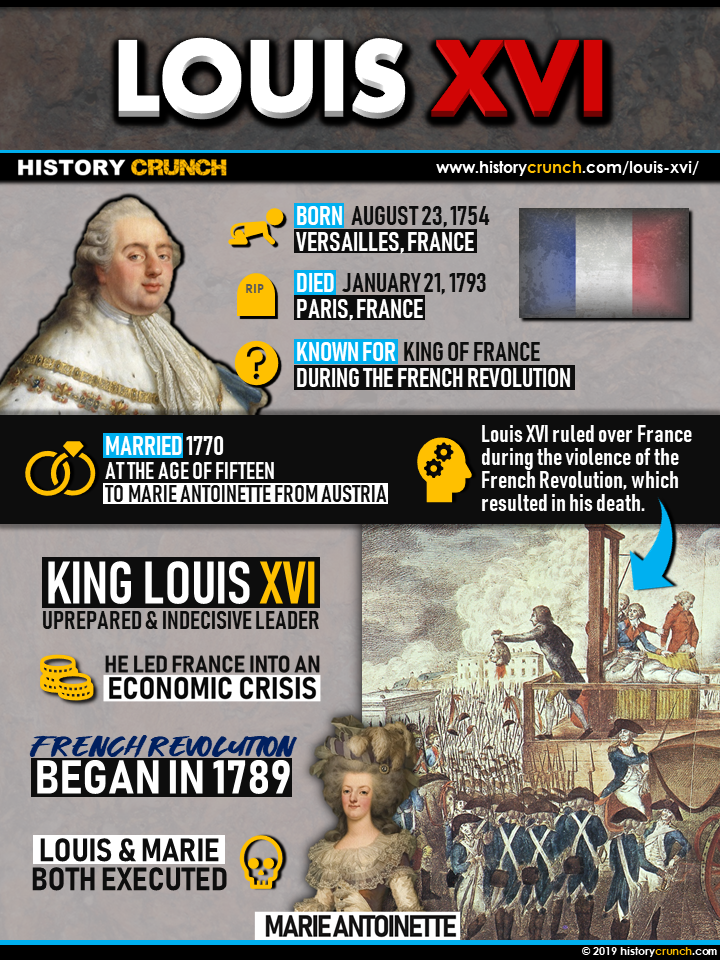
Louis XVI was the absolute monarch of France from 1774 until his execution by guillotine on January 21st, 1793. Born at the Palace of Versailles on August 23rd, 1754, he came to the throne at a time of growing crisis in France and proved unable to manage the deep social, economic and political tensions that ultimately led to the French Revolution. His reign ended with the abolition of the French monarchy, the establishment of the republic and his own death, making him one of the most significant and tragic figures in French history. This infographic was designed for students to visually summarize the key aspects of Louis XVI’s life and significance and is based on the History Crunch article titled Louis XVI.
Louis XVI – Infographic
About This Infographic
This Louis XVI infographic was created by the History Crunch team to help students and teachers quickly understand the life and significance of the king whose reign ended with the French Revolution. It is designed as a visual learning and study tool, summarizing the essential information covered in our full article on Louis XVI. Teachers may use it as a classroom display, a discussion prompt, or a study aid for students preparing for assessments.
What This Infographic Covers
The infographic begins with Louis XVI’s background and early life. He was born on August 23rd, 1754 at the Palace of Versailles as Louis-Auguste, the son of the heir to the French throne. His father died in 1765 before becoming king, and Louis became heir to the throne of his grandfather Louis XV. He received a strict education focused on history, languages and religion but was described as shy, indecisive and more interested in solitary hobbies such as locksmithing, reading and hunting than in the business of governing. In 1770, at the age of 15, he married Marie Antoinette, the 14-year-old daughter of the Emperor and Empress of Austria, in a politically arranged marriage designed to strengthen the alliance between France and Austria. He became King of France in 1774 when Louis XV died.
The infographic covers the growing crisis that defined Louis XVI’s reign. France’s finances were already strained when he took the throne, and they worsened considerably when he chose to support the American Revolution financially, draining the French treasury further. He attempted to solve the crisis by imposing new taxes, including taxes on the nobility, but faced fierce resistance. The French nobility blocked his reforms while the Third Estate’s anger at the absolute monarchy and the inequality of the Estates System continued to grow. Widespread poverty, poor harvests in the 1780s and resentment at the perceived extravagance of the royal court fueled popular anger. In May 1789 Louis XVI called the Estates-General in an attempt to address the crisis, but the meeting collapsed in failure and triggered the outbreak of the French Revolution.
The infographic covers the key events of Louis XVI’s role in the revolution. As the National Assembly took power and passed the Declaration of the Rights of Man and of the Citizen, Louis XVI’s authority was steadily stripped away. He and his family were forced to return to Paris from Versailles by a mob of working class women in October 1789 and were effectively held as prisoners in the Tuileries Palace. In June 1791, Louis XVI, Marie Antoinette and their children attempted to flee France in secret, disguised as servants, hoping to reach Austria and gather foreign support against the revolution. The carriage was stopped in the small town of Varennes and the royal family was recognized and returned to Paris. This failed flight was a decisive turning point, as it convinced many revolutionaries that Louis XVI was a traitor who could not be trusted.
The infographic concludes with the trial and execution of Louis XVI. The more radical National Convention put him on trial for treason in December 1792. He was found guilty on January 15th, 1793, and executed by guillotine on January 21st, 1793. His execution marked the definitive end of France’s absolute monarchy, which had lasted over a thousand years, and sent shockwaves across Europe, deepening the fears of other monarchies about the spread of revolutionary ideas and contributing to the radicalization of the revolution that led to the Reign of Terror.
How to Use This Infographic in the Classroom
This infographic works well as a visual introduction to Louis XVI before students read the full biography article. It can also be used as a review tool before an assessment, or as a discussion prompt asking students to consider whether Louis XVI was primarily a victim of circumstances beyond his control or whether his own decisions and character contributed significantly to his downfall. It pairs particularly well with the French Revolution Overview infographic and the article on the Execution of Louis XVI to give students a complete picture of the king’s role in the revolution.
Related Articles
To learn more about the topics covered in this infographic, visit the following History Crunch articles: