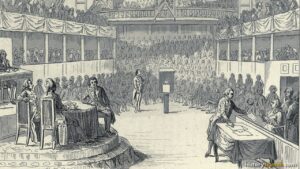
Tennis Court Oath: A Detailed Summary

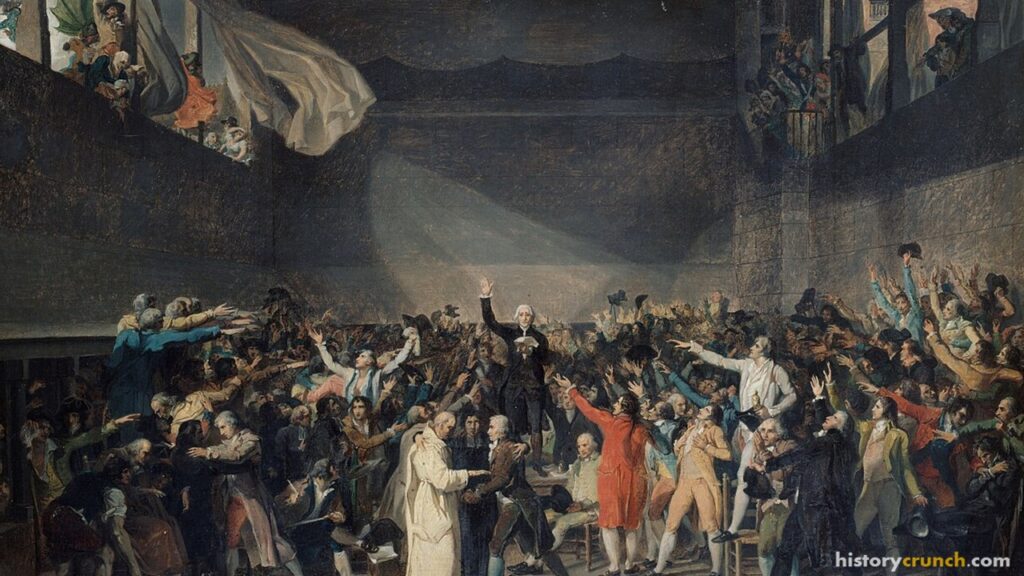
Le Serment du Jeu de paume, Jacques-Louis David painting of the 1789 Tennis Court Oath
'Le Serment du Jeu de paume' by Jacques-Louis David (1790). It shows the events of the Tennis Court Oath in the French Revolution.

Table of Contents

The Tennis Court Oath was one of the most significant events of the French Revolution. This article details the history and significance of the Tennis Court Oath.

The Tennis Court Oath in the French Revolution took place on June 20th, 1789, when members of the Third EstateThe social class representing about 98% of the French population, excluding the clergy and nobility. were locked out of a meeting of the Estates-General of 1789. In response, they gathered in a nearby indoor tennis court and pledged not to disband until they had written a new constitutionA written document that establishes the fundamental laws and principles governing a country. for France. This bold act marked the first time the people formally stood against the authority of the king and the traditional social order of France.

French RevolutionNotebook Definition
Facts that CrunchFactsthatCrunch
Estates-General
(noun)
The Estates-General was a representative assembly in France made up of delegates from the three social groups, called estates: the clergy, the nobility, and the commoners. The king could call it into session to advise on major decisions, but it had not met since 1614 before Louis XVI summoned it again in May 1789.
in a sentence: When France faced a serious debt crisis, Louis XVI called the Estates-General to Versailles to discuss new taxes.
Source: Archives nationales de France© factsthatcrunch.comMore French Revolution Facts →

What Was the French Revolution?

The French Revolution was a major event in the history of Western societies, and had a profound effect on the world today.  Beginning in 1789, the revolution saw the French people overthrow their absolute monarchy and bring about a republic that was based on the principles of equality, liberty and fraternity.  The revolution unfolded as a series of major events beginning when Louis XVI called the Estates-General in May of 1789.  However, the Estates-GeneralA meeting of representatives from all three social classes of France, called by the king to address major issues. failed due to divisions between the representatives of the estates and poor decision-making of the king. As such, the failure of the Estates-General ultimately led to the events of the Tennis Court Oath.
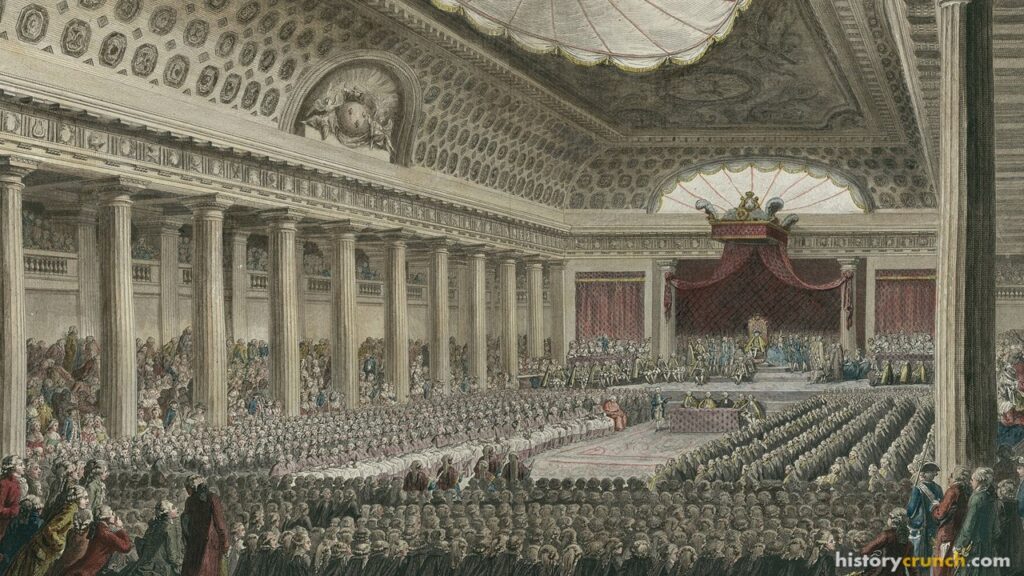
Opening of the Estates-General, May 5, 1789, Versailles, large formal assembly hall
The opening of the Estates-General on May 5th, 1789 in Versailles.

Tennis Court Oath – Summary

Once the Estates-General of 1789 failed, the representatives of the Third Estate and their newly created National AssemblyThe first revolutionary government formed by the Third Estate on June 17th, 1789, to replace the Estates-General. moved to the nearby tennis court in order to carry out their own discussions.  The representatives of the Third Estate were angered with the inaction of the Estates-General and upset with their position in French society.  They resented the Estates System and the absolute monarchyA system of government where a king or queen holds total power with no limits from a constitution or parliament. of Louis XVI. For instance, the Estates System limited the power and privilege of the Third Estate, which made up approximately 98% of the French population. Furthermore, the absolute monarchy of Louis XVI angered many French citizens, since they lacked the ability to have input in the governance of their country.

On June 17th, 1789 the Third Estate declared itself the National Assembly, the new revolutionary government. Three days later, locked out of their hall, its members met in the tennis court and pledged “not to separate, and to reassemble wherever circumstances require, until the constitution of the kingdom is established.”
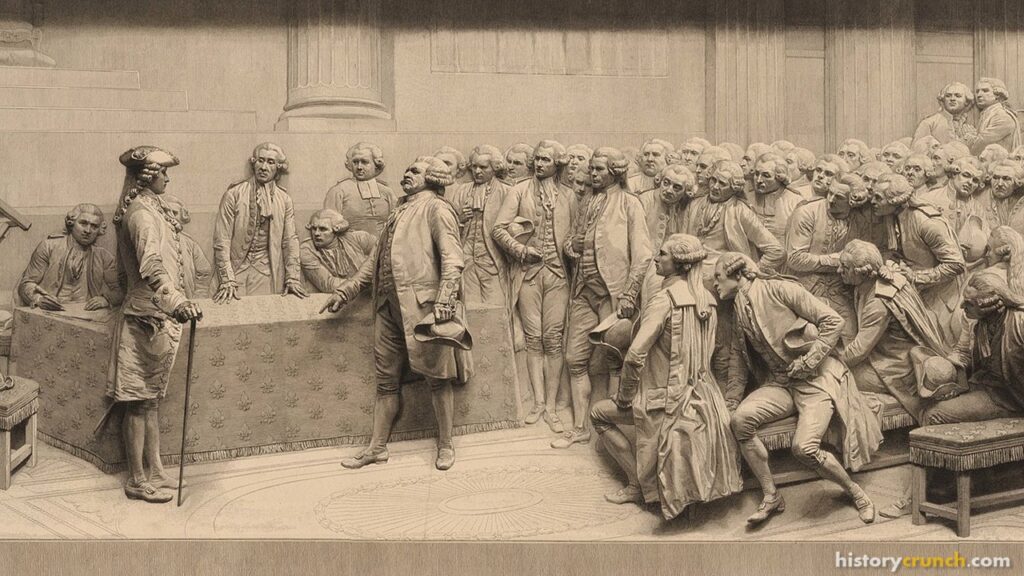
Members of the French National Assembly gathered together, etching by Alphonse Lamotte, 1889
Etching engraved in 1889 by Alphonse Lamotte. The National Assembly was the first revolutionary government of the French Revolution and existed from June 17th to July 9th in 1789.
“Never to separate until the constitution of the kingdom is established”
Deputies of the National Assembly, indoor tennis court, Versailles, June 20th, 1789
Locked out of their usual meeting hall at Versailles, the deputies moved to a nearby indoor tennis court and swore this pledge on June 20th, 1789. Their president, Jean-Sylvain Bailly, read the Tennis Court Oath aloud, and only one deputy, Joseph Martin-Dauch, refused to sign, so the vow told King Louis XVI that the Assembly would not back down.
Source: Archives nationales de France© factsthatcrunch.comFacts that Crunch

Tennis Court Oath – Significance

The Tennis Court Oath was significant because it showed the growing unrest against Louis XVI and laid the foundation for later events, including: the Declaration of the Rights of Man and of the Citizen and the storming of the Bastille. For instance, the Tennis Court Oath was the first formal act of defianceOpen resistance or refusal to obey an authority or power. by the Third Estate against the authority of the monarchy during the French Revolution. It demonstrated the unity and determination of the common people to demand political representation and constitutional reformChanges to the basic laws and structure of government to limit or redistribute power.. By vowing not to separate until a new constitution was established, the Tennis Court Oath laid the foundation for the National Assembly and the beginning of a new political era in France. It challenged the legitimacy of absolute monarchy and inspired revolutionary actions across France. For instance, historians consider the Tennis Court Oath to be significant in relation to the Storming of the Bastille, which took place just a few weeks later on July 14th of 1789.
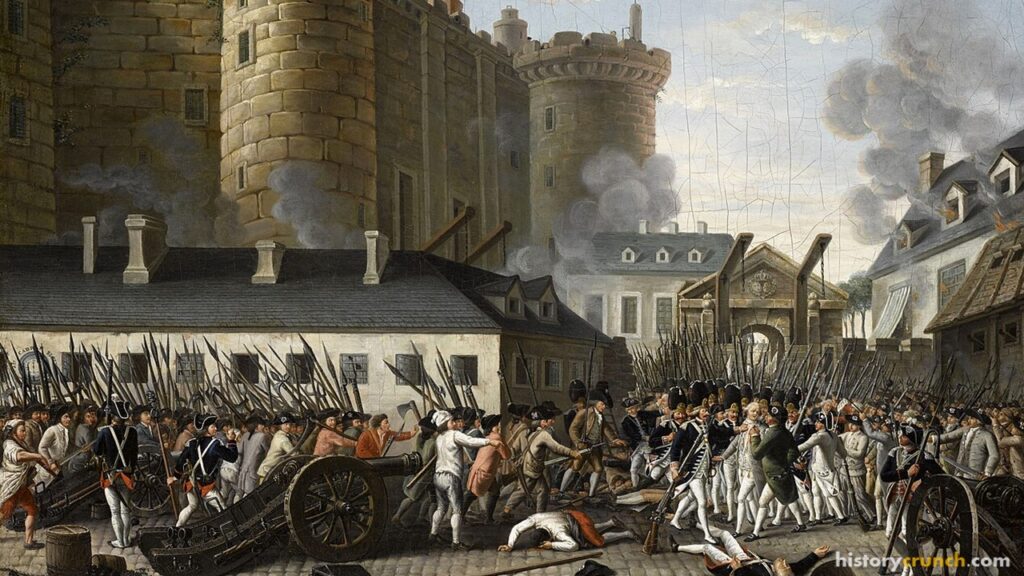
Storming of the Bastille painting showing crowds attacking the fortress in 1789
‘Storming of the Bastille’ by an unknown artist. Shows the events of the Storming of the Bastille during the early days of the French Revolution.
French RevolutionSource QuestionInteractive
Facts that CrunchFactsthatCrunch
On June 20th, 1789, deputies of the Third Estate found the doors of their regular meeting hall at Versailles locked by royal order, so they moved to a nearby indoor tennis court and swore this oath together, declaring themselves the rightful voice of the French nation at a moment when King Louis XVI had not yet recognized their new National Assembly.
“

We swear never to separate ourselves from the National Assembly, and to reassemble wherever circumstances require, until the constitution of the realm is drawn up and fixed upon solid foundations.

Tennis Court Oath, sworn by 576 deputies of the National Assembly · Royal Tennis Court, Versailles · June 20th, 1789

What does the passage reveal about the source of political authority the deputies were claiming for themselves?

Tap an option.
ExplanationThe oath states that the National Assembly exists wherever its members gather, regardless of where the king allows them to meet. This directly claimed that sovereignty belonged to the nation's representatives, not to the crown, which was the core idea driving the French Revolution's break from royal rule.
Source: Archives nationales de France, Tennis Court Oath decree, June 20th, 1789© factsthatcrunch.comMore French Revolution Facts →

French Revolution timeline · 1789 – 1799

Ten years in which France destroyed its monarchy, tried to build a republic, and ended under Napoleon. The timeline runs from the Estates General to the coup that closed the revolution.
View Timeline →

Key Vocabulary

Estates-General
A meeting of representatives from all three social classes of France, called by the king to address major issues.
Third Estate
The social class representing about 98% of the French population, excluding the clergy and nobility.
Absolute monarchy
A system of government where a king or queen holds total power with no limits from a constitution or parliament.
National Assembly
The first revolutionary government formed by the Third Estate on June 17th, 1789, to replace the Estates-General.
Constitution
A written document that establishes the fundamental laws and principles governing a country.
Defiance
Open resistance or refusal to obey an authority or power.
Constitutional reform
Changes to the basic laws and structure of government to limit or redistribute power.

Frequently Asked Questions

When did the Tennis Court Oath take place?

The Tennis Court Oath took place on June 20th, 1789, in Versailles, France. Members of the Third Estate found themselves locked out of their meeting hall. They moved to a nearby indoor tennis court and made their pledge there.

What did the members promise in the Tennis Court Oath?

They promised not to separate until they had written a new constitution for France. This showed their firm plan to change how the country was governed. The oath stood against the absolute power of King Louis XVI.

Who took part in the Tennis Court Oath?

Members of the Third Estate took part, along with a few members from the other estates. The Third Estate made up about 98 percent of the French population. These members had recently declared themselves the National Assembly on June 17th, 1789.

Why is the Tennis Court Oath important?

The Tennis Court Oath was the first formal act of defiance by the Third Estate against the monarchy. It showed the unity of common people who demanded political rights and reform. The event helped set the stage for later actions in the French Revolution.

What events followed the Tennis Court Oath?

The Storming of the Bastille followed just weeks later, on July 14th, 1789. The Tennis Court Oath also helped lead to the Declaration of the Rights of Man and of the Citizen. These events marked the start of a new political era in France.

Cite This Article

To cite this article as a source, use one of the formats below.

MLA: Beck, Elias. “Tennis Court Oath: A Detailed Summary.” HistoryCrunch, 21 September 2026, https://historycrunch.com/tennis-court-oath-in-the-french-revolution/.

APA: Beck, E. (2026). Tennis Court Oath: A Detailed Summary. HistoryCrunch. https://historycrunch.com/tennis-court-oath-in-the-french-revolution/

Chicago: Beck, Elias. “Tennis Court Oath: A Detailed Summary.” HistoryCrunch. September 21, 2026. https://historycrunch.com/tennis-court-oath-in-the-french-revolution/

Sources

  • J.M. Roberts & Odd Arne Westad, The Penguin History of the World.
  • Jerry Bentley & Herbert Ziegler, Traditions & Encounters: A Global Perspective on the Past.

Facebook
X
Reddit
Pinterest
LinkedIn

We strive to produce educational content that is accurate, engaging and appropriate for all learners. If you notice any issues with our content, please contact us and let us know!

AUTHOR INFORMATION
Picture of Elias Beck

Elias Beck

I'm a passionate history and geography teacher with over 15 years of experience working with students in the middle and high school years. I have an Education Degree with a focus in World History. I have been writing articles for History Crunch since 2015 and love the challenge of creating historical content for young learners!
Impacts of the French Revolution
French Revolution

Impacts of the French Revolution: A Detailed Summary

The French Revolution had wide-ranging impacts on France and the rest of the world. The revolution ended the absolute monarchy of Louis XVI, brought about republican government, and spread the ideals of liberty and equality across Europe. This article details the main impacts of the French Revolution.

Governments of the French Revolution
French Revolution

Governments of the French Revolution: A Detailed Summary

The governments of the French Revolution show how quickly political power changed in France between 1789 and 1799. As the Revolution deepened, each new government tried to solve problems left behind by the one before it. This article details the history and significance of the various governments of the French Revolution.

Nationalism in France.
Age of Nationalism

Nationalism in France: A Detailed Summary

Nationalism in France helped invent the modern idea of the nation and spread it across the world. Beginning with the French Revolution of 1789, French people came to see themselves as citizens of a nation rather than subjects of a king, and this powerful idea later shaped the whole of Europe.

Significance of the French Revolution.
French Revolution

Significance of the French Revolution: A Detailed Summary

The French Revolution was one of the most important turning points in world history. Beginning in 1789, it ended absolute monarchy in France and spread ideas about liberty, equality, and democracy. Its effects reached far beyond France and helped shape the modern world.

Absolutism in France
Age of Absolutism

Absolutism in France: A Detailed Summary

Absolutism in France was the system of government in which French monarchs held total political power, reaching its height under Louis XIV. This article details the history and significance of absolutism in France.

Napoleon Bonaparte
French Revolution

Napoleon Bonaparte: A Detailed Biography

Napoleon Bonaparte was a skilled military leader who rose to become Emperor of France. He is known for his vast European conquests and lasting reforms, including the Napoleonic Code. This article details the life and significance of Napoleon Bonaparte.