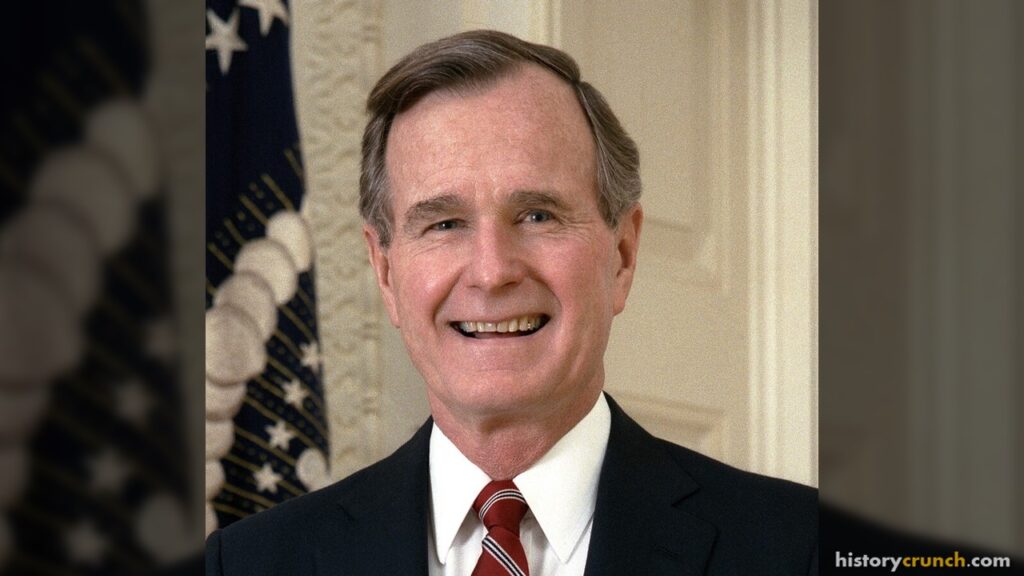
George H.W. Bush was one of the most experienced foreign policy presidents in American history, having served as a congressman, ambassador, CIA director, and vice president before reaching the White House. His presidency coincided with some of the most dramatic events of the late 20th century, including the fall of the Berlin Wall, the collapse of the Soviet Union, and the liberation of Kuwait in the Gulf War. He served as the 41st president of the United States from January 20th, 1989 to January 20th, 1993.
 FactsthatCrunch
Bush brought an unusually broad set of government jobs to the presidency, having served as a congressman, U.S. Ambassador to the United Nations, envoy to China, CIA director, and two-term vice president before taking office. He was elected to the House of Representatives from Texas in 1966 and served two terms in Congress before taking on those later roles. He led a coalition of more than 30 nations to liberate Kuwait in the Gulf War of 1991 and carefully managed the end of the Cold War, German reunification, and the collapse of the Soviet Union without military conflict.
George H.W. Bush – Early Life
George Herbert Walker Bush was born on June 12th, 1924, in Milton, Massachusetts. He grew up in Greenwich, Connecticut, in a wealthy and politically connected family. His father, Prescott Bush, later served as a United States Senator from Connecticut. Bush attended Phillips Academy, a prestigious preparatory school in Andover, Massachusetts, where he excelled academically and as an athlete.
When Japan attacked Pearl Harbor in December of 1941, Bush was 17 years old and still in school. He was determined to serve his country and on his 18th birthday he enlisted in the United States Navy, becoming one of the youngest naval aviators in American history at the time. He flew torpedo bombersMilitary aircraft designed to drop torpedoes, used to attack enemy ships during World War II. in the Pacific Theater of World War II and completed 58 combat missions. In September of 1944, his plane was shot down by Japanese anti-aircraft fire over the Pacific Ocean. Bush parachuted from the stricken aircraft and was rescued from the ocean by an American submarine. He was awarded the Distinguished Flying CrossA military medal given to American service members for heroic or extraordinary achievement in aerial flight. for his service. His wartime experience shaped his sense of duty and patriotism and remained an important part of his personal identity throughout his life.
After the war Bush enrolled at Yale University, where he studied economics and graduated in 1948. He then moved to Texas, where he entered the oil business and became a successful businessman in the Texas oil industry during the 1950s.
FactsthatCrunchGeorge H.W. Bush flew 58 combat missions in the Pacific during World War II as one of the youngest naval aviators in the U.S. Navy.
George H.W. Bush – Enters Politics
George H.W. Bush entered politics in the 1960s, transitioning from business to public service. He was elected to the United States House of Representatives from Texas in 1966 and served two terms in Congress. He developed a reputation as a moderate and capable legislator, though his career in Congress was relatively brief compared to his later roles in the executive branch.
In the years that followed, Bush took on a series of important positions that gave him an exceptionally broad base of experience in government and foreign affairs. President Richard Nixon appointed him as the United States Ambassador to the United Nations in 1971, a role in which Bush represented American interests on the world stage during a particularly complex period of Cold War diplomacy. He later served as chairman of the Republican National Committee during the difficult period of the Watergate scandal, a position that required considerable political skill and loyalty. President Gerald Ford then appointed Bush as the United States envoyAn official government representative sent to handle diplomatic relations with another country. to China in 1974, giving him direct experience with one of the most sensitive and important diplomatic relationships in American foreign policy. Ford then appointed him as director of the Central Intelligence Agency in 1976, a role that placed Bush at the center of American intelligence gathering and covert operationsSecret missions carried out by intelligence agencies, hidden from the public and foreign governments. during the Cold War.
Bush sought the Republican presidential nomination in 1980 but lost to Ronald Reagan. However, Reagan selected Bush as his vice presidential running mate, and the two won the election of 1980. Bush served as vice president for two full terms under Reagan, from 1981 to 1989, during which time he was closely involved in the major foreign and domestic policy decisions of the Reagan administration. This experience gave him an unparalleled understanding of the presidency and positioned him as the natural successor to Reagan. In 1988 Bush won the Republican presidential nomination and defeated Democratic candidate Michael Dukakis in the general election, becoming the 41st president of the United States.
FactsthatCrunchGeorge H.W. Bush – President of the United States
George H.W. Bush assumed the presidency on January 20th, 1989, at one of the most consequential moments in modern history. The Cold War that had defined international relations for nearly half a century was entering its final phase, and Bush found himself presiding over its conclusion.
The most dramatic events of the early Bush presidency came in 1989 and 1990 as communist governments across Eastern Europe collapsed one after another in the face of popular uprisings. Poland, Hungary, Czechoslovakia, Bulgaria, Romania, and East Germany all underwent dramatic political changes within the space of a few months. The most iconic moment came in November of 1989 when the Berlin Wall, which had divided East and West Berlin since 1961 and had become the defining symbol of the Cold War, was torn down as crowds stormed it from both sides. Bush responded to these events with deliberate caution, avoiding any rhetoricLanguage chosen for its persuasive or emotional effect, especially in political speeches or statements. that might have destabilized the situation or embarrassed Mikhail Gorbachev, whom Bush considered a crucial partner in managing the transition peacefully. German reunification followed in 1990, uniting East and West Germany into a single country for the first time since the end of World War II.
Bush worked closely with Gorbachev throughout this period, and the two leaders developed a productive working relationship that helped ensure the end of the Cold War occurred without military conflict. In December of 1991 the Soviet Union formally dissolved, and Bush presided over the United States during this extraordinary moment of transition, managing American relations with the newly independent states that emerged from the Soviet collapse.
The other defining event of the Bush presidency was the Gulf War. In August of 1990, Iraqi dictator Saddam Hussein ordered the invasion and occupation of the neighboring country of Kuwait. Bush responded by assembling an extraordinary international coalition of more than 30 nations, including Arab states such as Saudi Arabia and Egypt, to oppose the Iraqi aggression. He secured a United Nations resolution authorizing the use of force to liberate Kuwait and spent months building the diplomatic and military coalition needed for the operation. The Gulf War began on January 17th, 1991, with a massive Allied air campaign against Iraqi military targets. The ground campaign that followed in late February of 1991 lasted just 100 hours before Kuwait was liberated and Iraqi forces were driven out of the country. The swift and decisive victory was one of the most impressive military and diplomatic achievements of the post-Cold War era and demonstrated that the United States could lead a broad international coalition in a major military operation.
Bush chose not to advance Allied forces into Iraq itself to remove Saddam Hussein from power, a decision that was debated both at the time and in subsequent years. His reasoning was that the United Nations mandate authorized only the liberation of Kuwait, and that going beyond that mandate would have broken apart the coalition and drawn the United States into a costly occupation of Iraq. Despite this decision, the Gulf War was widely considered a major success and drove Bush’s approval ratings to historic highs in the spring of 1991.
Domestically, Bush’s presidency was marked by a significant economic recessionA period of significant economic decline when businesses slow, unemployment rises, and incomes fall. that began in 1990 and persisted into 1992. In 1990 Bush agreed to a budget deal with the Democratic-controlled Congress that included tax increases, breaking a famous campaign pledge he had made in 1988 in which he declared “Read my lips: no new taxes.” While the budget deal was considered responsible governance by many economists, it angered many conservative Republicans and damaged his political standing significantly. By the time of the 1992 election, the combination of the economic recession, the broken tax pledge, and a strong independent candidacy from businessman Ross Perot had eroded Bush’s political support enough that he lost the election to Democratic challenger Bill Clinton.
FactsthatCrunchGeorge H.W. Bush – Later Life and Death
After leaving the White House in January of 1993, George H.W. Bush retired from politics and returned to private life in Texas and Maine. He remained a respected elder statesman and stayed in the public eye through occasional appearances and charitable work. He developed a particularly close personal friendship with his former political adversary Bill Clinton, and the two worked together on several humanitarian causes in the years after both had left office.
Bush’s later years also brought personal sadness in the form of declining health. His wife Barbara Bush, whom he had married in 1945 and with whom he had six children, died in April of 2018. George H.W. Bush died on November 30th, 2018, in Houston, Texas, at the age of 94, just seven months after his wife. He was buried at the George Bush Presidential Library in College Station, Texas.
George H.W. Bush – Significance
George H.W. Bush was a significant president because his tenure coincided with some of the most dramatic changes in the international order since the end of World War II. His careful and experienced management of the end of the Cold War, the fall of the Berlin Wall, German reunification, and the collapse of the Soviet Union helped ensure that these enormously consequential events unfolded without major military conflict. His skill in building and leading the international coalition that liberated Kuwait in the Gulf War demonstrated a mastery of diplomacy and multilateralInvolving three or more countries working together toward a shared goal. leadership that historians have consistently admired.
Bush is sometimes described as an underappreciated president whose considerable achievements in foreign policy were overshadowed by domestic economic difficulties and a single election defeat. His background in diplomacy, intelligence, and international affairs made him one of the best-prepared presidents in American history for the foreign policy challenges he faced, and the manner in which he navigated the end of the Cold War is widely regarded as one of the most skillful examples of presidential diplomacy in the modern era. For all of these reasons, George H.W. Bush is remembered as an important and consequential figure in the history of the United States and of the 20th century world.
FactsthatCrunchBush's sequence of jobs in government, from UN ambassador to CIA director to vice president, made him exceptionally ready to handle foreign policy in a way few presidents before him had been.
Key Vocabulary
Torpedo bombers
Distinguished Flying Cross
Envoy
Covert operations
Rhetoric
Multilateral
Recession
Frequently Asked Questions
Which number president was George H.W. Bush?
George H.W. Bush was the 41st president of the United States. He served one term, from January 20th, 1989 to January 20th, 1993. Before that, he served two terms as Ronald Reagan’s vice president. His son, George W. Bush, later became the 43rd president.
What jobs did George H.W. Bush hold before becoming president?
George H.W. Bush held an unusually wide range of government posts before the White House. He served as a congressman from Texas, ambassador to the United Nations, and envoy to China. He also led the Republican National Committee and the Central Intelligence Agency. This made him one of the best-prepared presidents for foreign affairs in American history.
What did George H.W. Bush do during the Gulf War?
Bush built an international coalition of more than 30 nations to drive Iraq out of Kuwait in 1991. Iraqi leader Saddam Hussein had invaded Kuwait in August of 1990. The ground campaign lasted just 100 hours before Kuwait was freed. Bush chose not to push into Iraq, saying the United Nations mandate covered only Kuwait’s liberation.
Why did George H.W. Bush lose the 1992 election?
Bush lost to Democrat Bill Clinton mainly because of a weak economy. A recession that began in 1990 lasted into 1992 and hurt his support. He had also broken his famous 1988 pledge, “Read my lips: no new taxes.” A strong independent run by Ross Perot further split the vote against him.
How did George H.W. Bush respond to the fall of the Berlin Wall?
Bush responded with careful restraint when the Berlin Wall came down in November of 1989. He avoided bold statements that might have embarrassed Soviet leader Mikhail Gorbachev or caused unrest. This caution helped the Cold War end without major fighting. German reunification followed in 1990, and the Soviet Union dissolved in December of 1991.
Cite This Article
To cite this article as a source, use one of the formats below.
MLA: Millar, B. “George H.W. Bush: A Detailed Biography.” HistoryCrunch, 12 October 2026, https://historycrunch.com/george-h-w-bush/.
APA: Millar, B. (2026). George H.W. Bush: A Detailed Biography. HistoryCrunch. https://historycrunch.com/george-h-w-bush/
Chicago: Millar, B. “George H.W. Bush: A Detailed Biography.” HistoryCrunch. October 12, 2026. https://historycrunch.com/george-h-w-bush/
Sources
- Vladislav Zubok, A Failed Empire.
- John Lewis Gaddis, The Cold War: A New History.