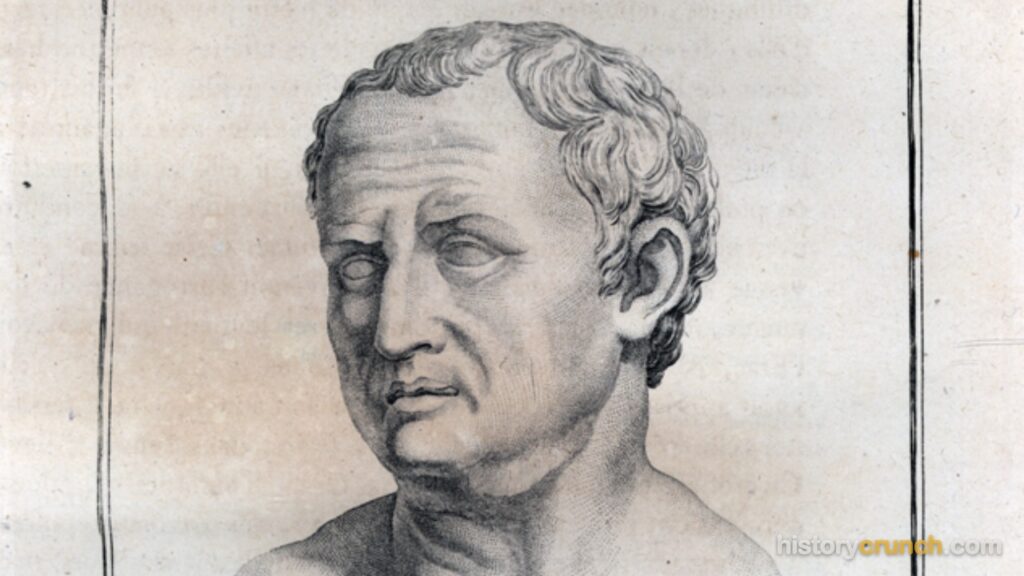
Marcus Tullius Cicero was one of the most important political thinkers, lawyers, and writers of the ancient world, and his life gives a window into the final, dramatic years of the Roman Republic. Living from 106 BCE to 43 BCE, he rose from a modest family in a small hill town to become a consul, the highest office in Rome, and later a fierce defender of the Republic against the ambitions of powerful generals. His speeches and letters survived for centuries and shaped the way later civilizations thought about government, law, and public duty.
Cicero belonged to the story of the Roman Republic, the period of Ancient Rome that lasted from 509 BCE to 27 BCE. The Roman Republic was governed by elected officials rather than a king, and it built a system of checks and balances designed to stop any single person from gaining too much power. Cicero spent his career trying to protect that system at the very moment it was breaking down, which is why his life is remembered as closely tied to the fall of the Republic itself.
Early Life and Background
Cicero was born on January 3rd, 106 BCE, in the hill town of Arpinum, located about 62 miles (100 km) southeast of Rome. His family was wealthy but did not belong to the old aristocratic families that had dominated Roman politics for generations. This made his later rise all the more remarkable, since the highest offices were almost always held by a small circle of noble families who passed power down through the years.
His father was a member of the equestrian order, a class of well-off Romans below the senatorial elite, and he had good connections in the capital. Recognizing his sons’ talents, the father paid to educate Cicero and his younger brother Quintus in Rome and in Greece. There Cicero studied law, public speaking, and philosophy, subjects that would define the rest of his life.
As a young man, Cicero served briefly in the military during the Social War, a conflict between Rome and its Italian allies. He was not a natural soldier and disliked warfare, so he chose the law instead of a military career. In reality, this decision suited the Roman world perfectly, because a skilled lawyer could gain fame, make important friends, and use the courtroom as a stepping stone into politics.
Rise to Power
Cicero first made a name for himself as a lawyer in the courts of Rome. In 80 BCE he defended a man accused of murdering his own father, and his skillful, courageous argument won the case and established his reputation. Taking on such a case was risky, since it meant challenging powerful figures connected to the dictator Sulla, who ruled Rome at the time.
After further study in Greece, Cicero returned to Rome and began climbing the ladder of public offices known as the cursus honorum. He was elected quaestor, an official who managed public finances, and later served as aedile and praetor, a judge with great authority. Remarkably, he was elected to each office on his first attempt and at the youngest age the law allowed, a sign of both his talent and his ambition.
One of his most famous cases came when he prosecuted Verres, a corrupt Roman governor of Sicily who had robbed the people he was supposed to protect. Cicero’s powerful arguments were so convincing that Verres fled into exile before the trial even ended. The case cemented Cicero’s reputation as an honest man and one of the finest public speakers in Rome.
In 63 BCE Cicero reached the top of the cursus honorum when he was elected consul, one of the two chief magistrates who led the government and commanded the army. This was an extraordinary achievement, because he was a novus homo, meaning a “new man” whose family had never held the office before. Winning the consulship without the backing of a noble family placed him among the most powerful men in the Republic, even though the old aristocracy always looked down on him for his humble origins.
Major Achievements
The most famous moment of Cicero’s consulship came when he uncovered the Catiline Conspiracy. A senator named Catiline had formed a secret plot to seize control of the government by force, which could have thrown Rome into another civil war. Cicero exposed the plan and delivered a series of powerful speeches in the Senate, warning the state of the danger it faced.
Under emergency powers granted by the Senate, Cicero had several of the conspirators put to death without a formal trial. In the moment, the grateful Romans hailed him as a savior of the Republic, and he was honored with the title pater patriae, meaning “father of the country.” For Cicero, this was the proudest achievement of his political life.
However, executing Roman citizens without a trial was a serious violation of Roman law, and it later left Cicero exposed to his enemies. In fact, that single decision would come back to haunt him and force him from the city he had tried so hard to protect. It showed how difficult it was to defend the rule of law while also fighting those who threatened the state.
Beyond the courtroom and the Senate, Cicero’s greatest lasting achievement was his writing. He produced an enormous number of speeches, letters, and works on philosophy and government. More specifically, he introduced Roman readers to the ideas of Greek philosophy and created a Latin vocabulary for discussing them, which helped make Latin a language of serious thought for centuries to come.
Later Life and Death
Cicero’s later years were shaped by the rising power of ambitious generals who threatened the Republic he loved. A political enemy used the illegal executions from the Catiline affair as a weapon against him, and in 58 BCE Cicero was forced into exile. His homes were destroyed while he was gone, but he was recalled to Rome the following year and welcomed back by the people.
During these years, real power in Rome was increasingly held by a small group of military strongmen, especially Julius Caesar and Pompey. When civil war broke out between the two men, Cicero sided with Pompey, whom he saw as the defender of the Republic. After Caesar won the war, he pardoned Cicero and welcomed him back, but Cicero largely withdrew from politics and focused on his writing.
Everything changed when Caesar was assassinated in 44 BCE. Cicero saw the death of the dictator as a chance to restore the traditional Republic, and he threw himself back into public life. He attacked Mark Antony, one of Caesar’s most powerful supporters, in a series of fierce speeches, hoping to rally the Senate against him.
This proved to be a fatal gamble. When Antony joined with Octavian, Caesar’s heir, and a general named Lepidus to form the Second Triumvirate, they drew up a list of enemies to be killed. Cicero’s name was on it, and in December of 43 BCE he was caught and executed by Antony’s soldiers. As a final act of revenge, his head and hands were cut off and displayed in the Roman Forum, a grim warning against anyone who dared to speak out.
Significance of Cicero
Cicero’s significance comes above all from his writings, which survived long after his death and influenced the course of Western civilization. His speeches, letters, and treatises gave later generations a detailed, personal view of the last years of the Roman Republic, written by someone who lived through and shaped those events. As stated above, he also introduced Greek philosophy to Roman readers and shaped the Latin language into a tool for serious ideas.
Centuries later, his rediscovered writings helped spark the Renaissance in Europe. The Italian scholar Petrarch found a collection of Cicero’s letters in the 14th century, and this discovery inspired scholars to look back to ancient texts for new norms and values. In this way, Cicero became a key link between the ancient world and the birth of Renaissance humanism.
Cicero’s ideas about law, government, and civic duty also reached far into the modern era. Thinkers of the Enlightenment studied his defense of the rule of law and his belief that no leader should stand above it. Many of these ideas influenced the founders of modern democratic governments, meaning that Cicero’s voice still echoes in the political systems of today.
Frequently Asked Questions
Who was Cicero and why was he important?
Cicero was a Roman lawyer, politician, and writer who lived from 106 BCE to 43 BCE and became one of the greatest public speakers in Roman history. He is important because he defended the Roman Republic during its final years and left behind writings that shaped law, philosophy, and government for centuries. His work later inspired thinkers of both the Renaissance and the Enlightenment.
What was the Catiline Conspiracy?
The Catiline Conspiracy was a secret plot led by a senator named Catiline to overthrow the Roman government by force in 63 BCE. Cicero, who was consul that year, discovered the plot and exposed it in a series of famous speeches to the Senate. The plotters who were captured were executed, and although Cicero was praised at the time, the executions without trial later caused him serious legal trouble.
Why was Cicero killed?
Cicero was killed in 43 BCE because he had made a powerful enemy of Mark Antony, whom he had attacked in a series of speeches after the assassination of Julius Caesar. When Antony joined with Octavian and Lepidus to form the Second Triumvirate, they placed Cicero on a list of enemies to be executed. Soldiers caught and killed him, and his head and hands were displayed in the Roman Forum.
What did Cicero write?
Cicero wrote a huge collection of speeches, personal letters, and books on philosophy, government, and public speaking. His letters are especially valuable because they reveal the private thoughts of Roman leaders during a time of political crisis. Many of his works survived and were copied by hand for centuries, which is why so much of his writing can still be read today.
What does “novus homo” mean and why did it apply to Cicero?
The term novus homo means “new man” in Latin, and it described a Roman who reached the consulship even though no one in his family had held the office before. It applied to Cicero because his family came from a small town and was not part of Rome’s old ruling aristocracy. Rising to consul as a new man was a rare achievement that showed his exceptional talent, though the noble families never fully accepted him.
Cite This Article
To cite this article as a source, use one of the formats below.
MLA: Millar, B. “Cicero: A Detailed Biography.” HistoryCrunch, 7 July 2026, https://historycrunch.com/cicero/.
APA: Millar, B. (2026). Cicero: A Detailed Biography. HistoryCrunch. https://historycrunch.com/cicero/
Chicago: Millar, B. “Cicero: A Detailed Biography.” HistoryCrunch. July 7, 2026. https://historycrunch.com/cicero/
Sources
- J.M. Roberts & Odd Arne Westad, The Penguin History of the World.
- Jerry Bentley & Herbert Ziegler, Traditions & Encounters: A Global Perspective on the Past.