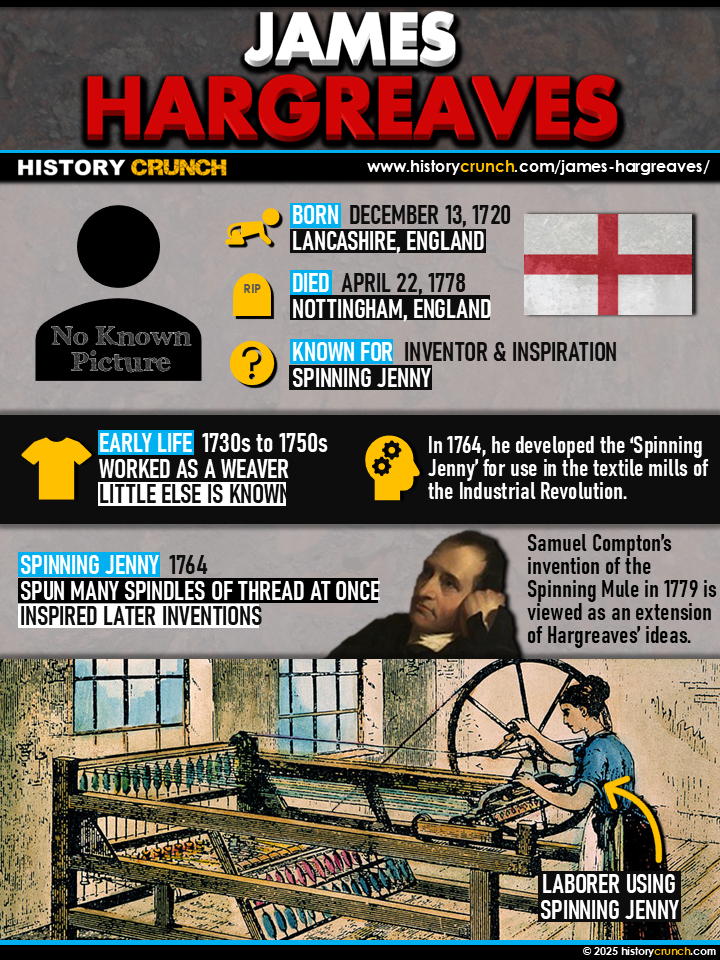
James Hargreaves was one of the most important inventors of the Industrial Revolution. An English weaver by trade, Hargreaves is best remembered for inventing the spinning jenny in 1764, a machine that allowed a single worker to spin multiple spools of thread at the same time and dramatically increased the output of the textile industry. His invention helped transform textile manufacturing in Britain and inspired a wave of further innovations that shaped the course of the Industrial Revolution. This infographic was designed for students to visually summarize the key aspects of James Hargreaves’s life and significance and is based on the History Crunch article titled James Hargreaves.
James Hargreaves – Infographic
About This Infographic
This James Hargreaves infographic was created by the History Crunch team to help students and teachers quickly understand the life and significance of one of the key inventors of the early Industrial Revolution. It is designed as a visual learning and study tool, summarizing the essential information covered in our full article on James Hargreaves. Teachers may use it as a classroom display, a discussion prompt, or a study aid for students preparing for assessments.
What This Infographic Covers
Very little is known about the early life of James Hargreaves. He worked for much of his life as a weaver, using a handloom to produce textiles in the traditional way. This hands-on experience with textile production gave him a practical understanding of the limitations of existing methods and the need for a faster, more efficient approach to spinning thread.
The infographic covers Hargreaves’s most important contribution to the Industrial Revolution, the invention of the spinning jenny in 1764. Before the spinning jenny, spinning thread was a slow process done by hand, with a single worker able to spin only one spool of thread at a time. The spinning jenny used a large wheel to drive multiple spindles simultaneously, meaning a single worker could now spin many threads at once. This dramatically increased the production capacity of textile manufacturers and was particularly important for cotton production, which was one of the most important industries of the Industrial Revolution.
The infographic also covers the broader impact of the spinning jenny on the textile industry and on further innovation. Richard Arkwright built on Hargreaves’s ideas to develop the water frame in 1769, a machine that used water power to drive spinning and was capable of producing stronger yarn at an even greater scale. Samuel Crompton followed with the spinning mule in 1779, which combined elements of both the spinning jenny and the water frame to allow even faster production of yarn. Together these inventions transformed the textile industry and helped establish the factory system as the dominant method of production in industrial Britain.
Despite the enormous impact of his invention, Hargreaves made very little money from the spinning jenny. He sold his invention to several mills in his local area but did not profit significantly from its widespread adoption. He died in 1778, before many of the larger transformations his invention had helped set in motion were fully realized. Today he is remembered as one of the pioneering inventors of the Industrial Revolution whose work helped launch the age of mechanized textile production.
How to Use This Infographic in the Classroom
This infographic works well as a visual introduction to James Hargreaves before students read the full biography article or the article on the spinning jenny. It can also be used as a review tool before an assessment, or as a discussion prompt asking students to consider why inventors like Hargreaves often failed to profit from inventions that had such a large impact on society. Teachers may also use it alongside related articles on the spinning jenny, textile manufacturing and other inventors of the Industrial Revolution to help students trace how one invention inspired and connected to the next.
Related Articles
To learn more about the topics covered in this infographic, visit the following History Crunch articles:
- James Hargreaves
- Spinning Jenny Invention in the Industrial Revolution
- Industrial Revolution Overview
- Inventions and Inventors of the Industrial Revolution
- Textile Manufacturing in the Industrial Revolution
- Richard Arkwright
- Edmund Cartwright
- Power Loom Invention in the Industrial Revolution
- Factory System in the Industrial Revolution