The Industrial Revolution was driven by a wave of remarkable inventions that transformed how goods were produced, how people traveled and how societies functioned. From the spinning jenny to the steam engine, the inventors of the Industrial Revolution changed the world in ways that are still felt today. This infographic was designed for students to visually summarize the key inventions and inventors of the Industrial Revolution and is based on the History Crunch article titled Industrial Revolution Inventions and Inventors.
Industrial Revolution Inventions and Inventors – Infographic
About This Infographic
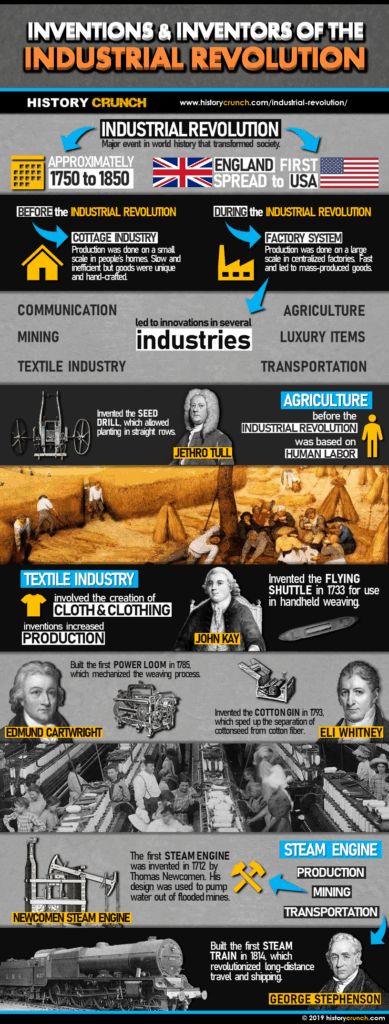
This Industrial Revolution inventions and inventors infographic was created by the History Crunch team to help students and teachers quickly understand the most important technological developments of the industrial era. It is designed as a visual learning and study tool, summarizing the essential information covered in our full article on Industrial Revolution Inventions and Inventors. Teachers may use it as a classroom display, a discussion prompt, or a study aid for students preparing for assessments.
What This Infographic Covers
Before the Industrial Revolution, most goods were produced slowly by hand in a system known as the cottage industry. The inventors of the Industrial Revolution changed this forever by developing machines that could produce goods faster, more efficiently and on a much larger scale than was ever previously possible.
The infographic covers the key inventions in the textile industry, which was one of the first industries to be transformed by the Industrial Revolution. James Hargreaves invented the spinning jenny in 1764, a machine that allowed a single worker to spin multiple threads at the same time, dramatically increasing the output of yarn. Richard Arkwright followed with the water frame, which used water power to drive spinning machines and led to the establishment of large-scale textile factories. The power loom, developed by Edmund Cartwright, mechanized the weaving process and further accelerated textile production. Together these inventions transformed Britain’s textile industry and helped establish the factory system as the dominant method of production.
The steam engine is perhaps the single most important invention of the entire Industrial Revolution. Originally developed by Thomas Newcomen to pump water out of coal mines, it was significantly improved by James Watt in the late 1760s. Watt’s steam engine could be applied to a wide range of tasks and was eventually used to power factories, locomotives and ships. George Stephenson built on this foundation by developing the first practical steam locomotive, launching the age of railway travel and dramatically changing how goods and people moved across the country.
The infographic also covers key figures in the iron and coal industries. Abraham Darby developed a process for smelting iron using coke rather than charcoal, making iron production cheaper and more efficient. This made high-quality iron widely available and enabled the construction of machinery, bridges, railways and buildings on a scale that had never been seen before.
Finally the infographic touches on some of the key inventors of the Second Industrial Revolution, which built on the foundations of the first. Thomas Edison’s invention of the incandescent light bulb and Alexander Graham Bell’s development of the telephone transformed how people lived and communicated, while Henry Bessemer’s steel production process enabled the construction of modern cities.
How to Use This Infographic in the Classroom
This infographic works well as a visual introduction to a lesson or unit on Industrial Revolution inventions, helping students connect key inventors to their inventions before reading the full article. It can also be used as a review tool before an assessment or as a research springboard, with students choosing one inventor from the infographic to investigate further. Teachers may also use it as a discussion prompt, asking students which invention they think had the greatest overall impact on the modern world and why.
Related Articles
To learn more about the topics covered in this infographic, visit the following History Crunch articles:
- Industrial Revolution Inventions and Inventors
- Industrial Revolution Overview
- Factory System in the Industrial Revolution
- First Industrial Revolution
- Second Industrial Revolution
- Why Was Britain the First Country to Industrialize?
- Spinning Jenny Invention in the Industrial Revolution
- James Watt and the Steam Engine
- James Hargreaves