Child Labor in the Industrial Revolution: Infographic

This child labor infographic was created by History Crunch to help students and teachers understand the working conditions faced by children during the Industrial Revolution. It covers why child labor was so common, the dangers children faced, and how the movement to end child labor developed. Designed for students in grades 5 to 12.

Table of Contents

Child labor was one of the most significant and troubling aspects of the Industrial Revolution. Children as young as four years old were employed in factories, mines and mills, working long hours in dangerous conditions for very low wages. This infographic was designed for students to visually summarize the key aspects of child labor during the Industrial Revolution and is based on the History Crunch article titled Child Labor in the Industrial Revolution.

Child Labor in the Industrial Revolution: Infographic
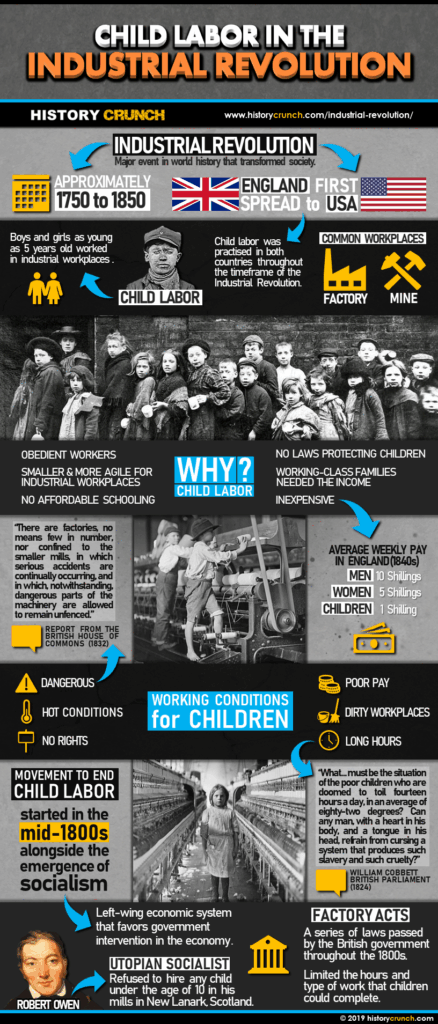
Industrial Revolution Child Labor Infographic
Industrial Revolution Child Labor Infographic by History Crunch

About This Infographic

This child labor in the Industrial Revolution infographic was created by the History Crunch team to help students and teachers quickly understand one of the most important social issues of the industrial era. It is designed as a visual learning and study tool, summarizing the essential information covered in our full article on Child Labor in the Industrial Revolution. Teachers may use it as a classroom display, a discussion prompt, or a study aid for students preparing for assessments.

What This Infographic Covers

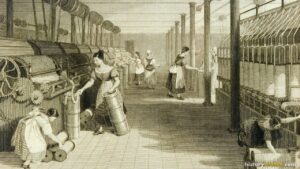
Child labor was especially common during the late 18th century in the early years of the Industrial Revolution. As industrial cities grew rapidly, working-class families depended on the wages earned by their children to survive. Factory owners actively sought out child workers because they could be paid far less than adults, were easier to control, and their small bodies were ideal for working in tight spaces around machinery and inside coal mines.

The infographic highlights the dangerous conditions that children faced in the workplace. Factories were hot, cramped and poorly ventilated, with spinning machines and other equipment left largely unguarded. Children suffered serious injuries to their hands and fingers on a regular basis. Those who worked in coal mines faced the additional dangers of collapsing mine shafts and severely poor air quality that caused lasting damage to their lungs.

The infographic also covers the political context that allowed child labor to flourish. The dominant ideology of the time was classical liberalism, which favoured laissez-faire capitalism and minimal government involvement in the economy. This meant there were very few rules or protections for workers of any age, leaving children entirely vulnerable to exploitation by factory owners.

The movement to end child labor is also represented. Reformers including Robert Owen, Karl Marx and Charles Dickens were among those who publicly criticized the treatment of child workers. Their efforts, combined with growing public awareness, eventually led to a series of Factory Acts passed by the British parliament throughout the 1800s. These acts gradually limited the hours children could work and set minimum age requirements for employment, marking the beginning of meaningful protections for child workers.

How to Use This Infographic in the Classroom

This infographic works well as a visual introduction to the topic of child labor before students read the full article. It can also be used as a review tool before an assessment, or as a discussion prompt asking students to consider whether the conditions described were justified at the time or represent a clear moral failure. Teachers may also pair it with primary source documents, such as the factory reports and eyewitness accounts referenced in the full article, to help students analyze the human impact of industrialization in depth.

Related Articles

To learn more about the topics covered in this infographic, visit the following History Crunch articles:

Facebook
X
Reddit
Pinterest
LinkedIn

We strive to produce educational content that is accurate, engaging and appropriate for all learners. If you notice any issues with our content, please contact us and let us know!

AUTHOR INFORMATION
Picture of Luke Kirkby

Luke Kirkby

Hi! I'm a graphical designer that has been contributing to History Crunch since 2015. I'm inspired by helping others learn new information in simple and engaging ways. Thanks for taking the time to visit some of my creations!
Edmund Cartwright Infographic
Infographics

Edmund Cartwright: Infographic

This Edmund Cartwright infographic was created by History Crunch to help students and teachers quickly understand the life, invention and historical significance of the English inventor who revolutionized textile manufacturing during the Industrial Revolution. It covers his early life, his invention of the power loom and his lasting impact on industrial production. Designed for students in grades 5 to 12.

Christopher Columbus Infographic
Infographics

Christopher Columbus: Infographic

This Christopher Columbus infographic was created by History Crunch to help students and teachers quickly understand the life, voyages and historical significance of one of the most important and controversial figures of the Age of Exploration. It covers his early life, all four voyages to the New World, the Columbian Exchange and his lasting legacy. Designed for students in grades 5 to 12.

Charles Dickens Infographic
Infographics

Charles Dickens: Infographic

This Charles Dickens infographic was created by History Crunch to help students and teachers quickly understand the life, works and historical significance of one of the greatest writers of the Victorian era. It covers his early life, his experience as a child laborer, his career as a journalist and novelist, and his lasting legacy as a social critic of the Industrial Revolution. Designed for students in grades 5 to 12.

Daily Life in the Industrial Revolution
Industrial Revolution

Daily Life in the Industrial Revolution: A Detailed Summary

Daily life during the Industrial Revolution was marked by long working hours in factories, harsh living conditions in overcrowded urban areas, and significant social and economic changes as people adapted to rapid industrialization.

Britain in World War I Infographic
Infographics

Britain in World War I: Infographic

This Britain in World War I infographic was created by History Crunch to help students and teachers quickly understand Britain’s role in the First World War. It covers why Britain entered the war, its army and navy, major battles on the Western Front, the home front experience and Britain’s lasting legacy from the conflict. Designed for students in grades 5 to 12.

Adam Smith
Industrial Revolution

Adam Smith: A Detailed Biography

Adam Smith, an important figure in economics, is best known for his influential work ‘Wealth of Nations’, that shaped the field of modern economics. Smith’s ideas on free markets, the division of labor, and the ‘invisible hand’ have become fundamental economic principles.