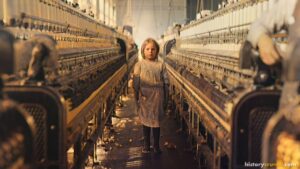
Charles Dickens was one of the most important writers of the Industrial Revolution era and remains one of the most celebrated authors in the English language. Born in England in 1812, Dickens drew on his own difficult childhood experiences to write stories that criticized the harsh realities of life for working-class people in industrial Britain. His most famous works, including Oliver Twist, A Christmas Carol, A Tale of Two Cities and Great Expectations, are still read and studied around the world today. This infographic was designed for students to visually summarize the key aspects of Charles Dickens’s life and significance and is based on the History Crunch article titled Charles Dickens.
Charles Dickens – Infographic
About This Infographic
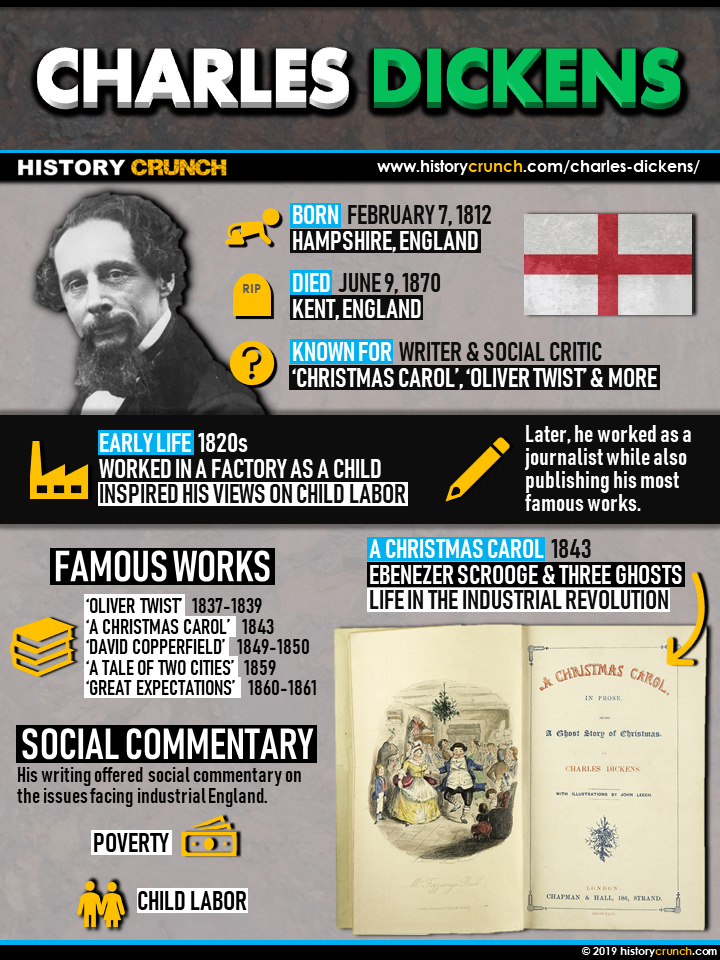
This Charles Dickens infographic was created by the History Crunch team to help students and teachers quickly understand the life and significance of one of the most important social critics of the Industrial Revolution. It is designed as a visual learning and study tool, summarizing the essential information covered in our full article on Charles Dickens. Teachers may use it as a classroom display, a discussion prompt, or a study aid for students preparing for assessments.
What This Infographic Covers
Charles Dickens was born in Portsmouth, England on February 7th, 1812. His early childhood was relatively comfortable, supported by his father’s work as a Navy Pay Officer. However, the family lived beyond their means and accumulated significant debt, and by the time Charles was twelve years old his father had been sent to prison for failing to repay those debts. Charles was sent to work in a blacking factory, putting labels on pots for just six shillings per week in cold and miserable conditions. This experience as a child laborer had a profound impact on him and served as direct inspiration for several of his most famous stories, including Oliver Twist and A Christmas Carol.
The infographic covers Dickens’s career as a journalist, which began after he returned to school and eventually graduated. He worked for several newspapers through the early 1830s, developing his writing skills and eventually publishing creative works under the pseudonym Boz. In 1836 he published the first edition of the Pickwick Papers, which quickly became popular and launched his career as a novelist.
A central focus of the infographic is Dickens’s work as a writer and social critic. His novels, including Oliver Twist, David Copperfield and Great Expectations, were inspired by his own childhood experiences and his observations of life in industrial England. His stories highlighted the enormous gap between the wealthy and the working-class poor, criticized the treatment of children in factories and workhouses, and challenged the government policies that allowed such conditions to exist. Dickens became a celebrity in his own lifetime, recognized in the street by ordinary people who loved his characters and stories. His books remain historically important today because they provide a vivid window into the realities of life during the Industrial Revolution in Britain.
The infographic also covers Dickens’s death and legacy. He died following a stroke in 1870 and is buried at Westminster Abbey in London. He is celebrated today as one of the greatest writers of the Victorian era. His works have never gone out of print and continue to influence English literature and discussions about poverty, inequality and social reform.
How to Use This Infographic in the Classroom
This infographic works well as a visual introduction to Charles Dickens before students read the full biography article. It can also be used as a review tool before an assessment, or as a discussion prompt asking students to consider how literature can be used as a form of social criticism and whether Dickens’s critiques of industrial society are still relevant today. Teachers may also use it alongside related articles on child labor, working conditions and the broader social impacts of the Industrial Revolution to help students understand Dickens’s place in the history of social reform.
Related Articles
To learn more about the topics covered in this infographic, visit the following History Crunch articles: