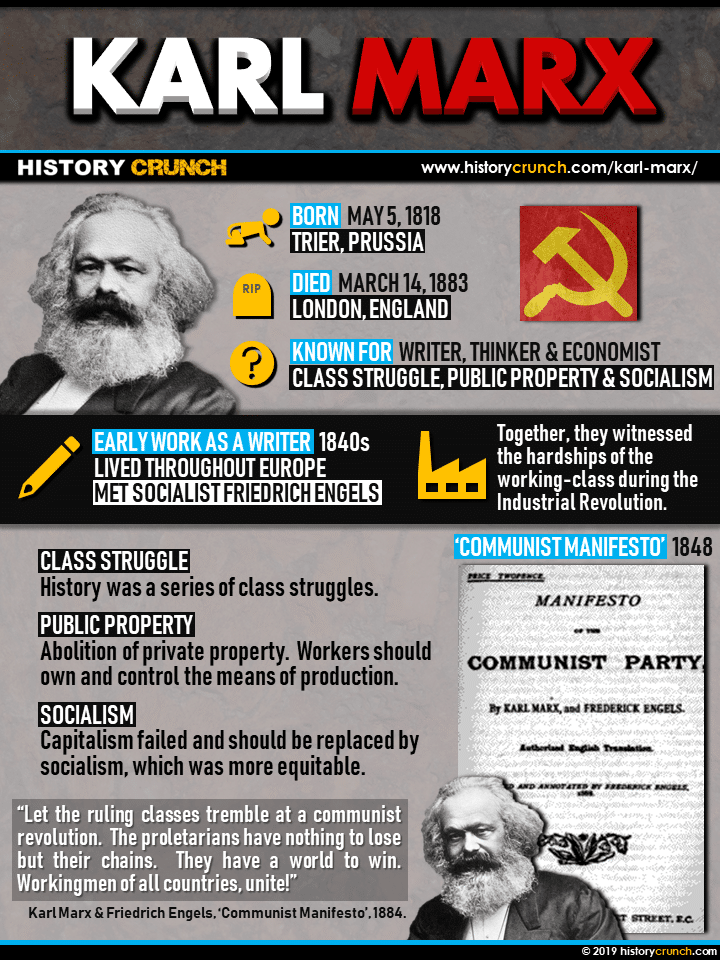
Karl Marx was one of the most influential and controversial thinkers of the 19th century. A German philosopher, economist and political theorist, Marx developed ideas about capitalism, class struggle and socialism that inspired revolutions around the world and continue to shape political thought today. This infographic was designed for students to visually summarize the key aspects of Karl Marx’s life and ideas and is based on the History Crunch article titled Karl Marx.
Karl Marx – Infographic
About This Infographic
This Karl Marx infographic was created by the History Crunch team to help students and teachers quickly understand the life and ideas of one of history’s most significant and debated political thinkers. It is designed as a visual learning and study tool, summarizing the essential information covered in our full article on Karl Marx. Teachers may use it as a classroom display, a discussion prompt, or a study aid for students preparing for assessments.
What This Infographic Covers
Karl Marx was born on May 5th, 1818 in Trier, Prussia, which is modern-day Germany. He was raised in a middle-class family and showed strong academic ability from an early age. He studied law at the University of Bonn before transferring to the University of Berlin, where he excelled and began developing his leftist political ideas. He started writing for newspapers in the early 1840s and used these platforms to express his growing socialist views.
The infographic covers the most important relationship of Marx’s professional life, his partnership with fellow German socialist Friedrich Engels. The two men met in Paris in 1844 and began collaborating on writings focused on the conditions of the working class and the growing gap between the wealthy and the poor in industrial societies. Together they developed the ideas that would come to be known as Marxism.
Their most famous collaboration is The Communist Manifesto, written in 1847 and published in 1848. The infographic highlights the core ideas of this work, which centered on the struggle between the proletariat, the industrial working class, and the bourgeoisie, the wealthy owners of factories and businesses. Marx and Engels argued that capitalism would eventually be overthrown through a workers revolution, leading to a socialist society in which property and production were owned collectively rather than by individuals.
The infographic also covers Das Kapital, Marx’s other major work, first published in 1867. In this three-volume text Marx examined the foundations of capitalist economies in depth and argued that capitalism would ultimately lead to socialism. He was critical of the ideas of earlier economic thinkers such as Adam Smith and challenged the principles of classical liberalism that dominated economic thought during the Industrial Revolution.
Finally the infographic covers Marx’s death and legacy. He died on March 14th, 1883 in London. Although many of the reforms he sought were not achieved during his lifetime, his ideas spread widely and inspired major political movements and revolutions around the world, most notably the Russian Revolution of 1917. His writings remain among the most studied and debated in the fields of economics, political theory and history.
How to Use This Infographic in the Classroom
This infographic works well as a visual introduction to Karl Marx before students read the full biography article. It can also be used as a review tool before an assessment, or as a discussion prompt asking students to consider whether Marx’s criticisms of capitalism were justified given the conditions of the Industrial Revolution. Teachers may also use it alongside related articles on socialism, communism, the Industrial Revolution and the Russian Revolution to help students understand the broader impact of Marx’s ideas on world history.
Related Articles
To learn more about the topics covered in this infographic, visit the following History Crunch articles: