Philip II of France, also known as Philip Augustus, was one of the most important kings in the history of medieval France. He ruled France from 1180 to 1223 CE and transformed the country from a small and weak kingdom into the most powerful state in western Europe. He is best known for his conflicts with the English kings and his participation in the Third Crusade.
Philip II of France – Early Life
Philip II of France was born on August 21st, 1165 CE in Gonesse, France. His father was King Louis VII of France and his mother was Adela of Champagne. Philip was the only son of Louis VII and was nicknamed Dieudonne, meaning God-given, because he was born late in his father’s life after Louis had long struggled to father a male heir. As the only son and heir to the throne, Philip was prepared from a young age to take over the kingdom and strengthen royal authority.
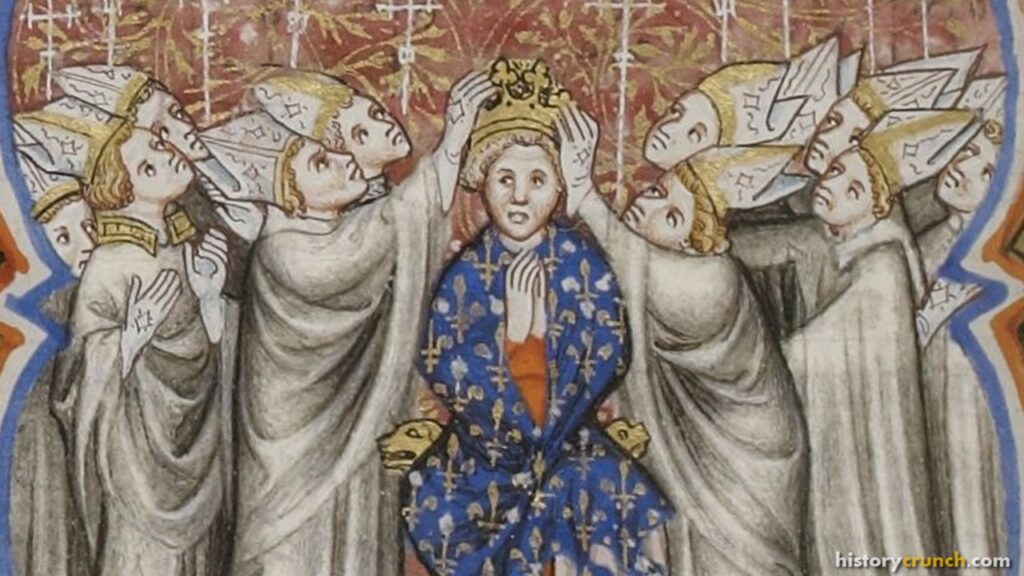
When Philip was fourteen years old, his father fell seriously ill and was no longer able to govern effectively. Philip was crowned as junior king of France at Reims on November 1st, 1179 CE. Louis VII died on September 18th, 1180 CE, making Philip the sole ruler of France at the age of fifteen. As such, Philip came to the throne very young and immediately faced significant political challenges.
Philip II of France – King
When Philip became king, France was not a unified country. It was a collection of feudal territories controlled by powerful nobles who often acted independently of the crown. As well, the kings of England controlled large parts of what is now France, including Normandy, Anjou, and Aquitaine, through the Angevin Empire. In fact, at the start of Philip’s reign, the king of England controlled more of French territory than the king of France himself. Philip’s main goal throughout his reign was to strengthen the power of the French monarchy and take back the French territories held by England.
Philip was a skilled and determined ruler. He worked to reduce the power of the great nobles and built alliances with the towns of France, granting them privileges and charters in exchange for their financial and military support. As well, he reorganized the government of France, appointing salaried royal officials called bailiffs to administer the outlying regions of the kingdom on his behalf. These reforms made the French government more efficient and gave the king much greater control over his kingdom. As such, Philip II is credited by historians with laying the foundations of the modern French state.
Philip II of France – Struggle Against English Kings
Much of Philip’s reign was defined by his long struggle against the English kings of the Angevin dynasty. Philip was a skilled political operator who used the conflicts within the English royal family to his own advantage. For instance, he formed alliances with the sons of King Henry II of England, including Richard and John, encouraging them to rebel against their father. In 1189 CE, Philip and Richard joined forces and drove Henry II to accept humiliating peace terms. Henry II died just days later.
Following Henry II’s death, Richard became King of England as Richard I, known as Richard the Lionheart. The relationship between Philip and Richard was complicated. They set out together on the Third Crusade in 1190 CE but soon began to quarrel. After the capture of Acre in July of 1191 CE, Philip decided he had done enough crusading and returned to France. He then used Richard’s absence on crusade to try to seize his French territories. For instance, he allied with Richard’s brother John and attempted to take control of Normandy. As such, Philip’s early return from the Third Crusade, while criticized by many at the time, proved to be a very effective political decision.
When Richard returned from captivity in 1194 CE, he and Philip fought a series of wars over the English territories in France. The conflict ended only when Richard was killed in a minor siege in 1199 CE. Philip then turned his attention to Richard’s brother, who had become King John of England. John proved to be a much weaker opponent. For instance, in 1202 CE, Philip declared John’s French lands forfeit and launched a military campaign to seize them. By 1204 CE, Philip had conquered Normandy, Maine, Anjou, Touraine and much of Poitou. This was one of the most significant military and political achievements of the Middle Ages and more than doubled the size of the French royal domain.
Philip II of France – Battle of Bouvines
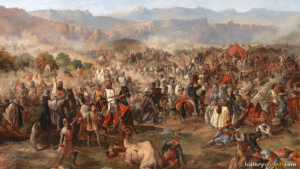
The final and most decisive conflict of Philip’s wars against England came at the Battle of Bouvines on July 27th, 1214 CE. King John of England had formed a large coalition against Philip, including the Holy Roman Emperor Otto IV, the Count of Flanders and several other powerful rulers. Philip met this coalition on the field at Bouvines in northern France. The battle was a complete victory for Philip. The coalition was routed and several of its leaders were captured. For instance, John was so weakened by the defeat that his own barons forced him to sign the Magna Carta the following year.
The Battle of Bouvines was one of the most important battles of the Middle Ages. It secured Philip’s conquests in France and firmly established the French monarchy as the most powerful in western Europe. For instance, historians estimate that by the end of his reign, Philip had more than tripled the size of the royal domain. As such, the Battle of Bouvines was the crowning achievement of Philip’s long reign and confirmed his status as one of the greatest kings in French history.
Philip II of France – Third Crusade
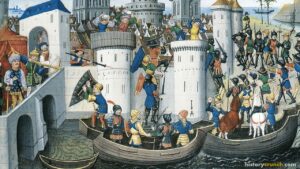
Philip’s participation in the Third Crusade was an important but relatively brief part of his reign. The Third Crusade was launched in response to the capture of Jerusalem by the Muslim leader Saladin in 1187 CE. Philip joined the crusade alongside King Richard I of England and Holy Roman Emperor Frederick Barbarossa. Philip and Richard met at Vezelay in France on July 4th, 1190 CE and set out together toward the Holy Land.
The two kings arrived near the city of Acre in 1191 CE and combined their forces with the crusaders already besieging the city. Acre fell on July 12th, 1191 CE. With that said, Philip and Richard quarreled frequently during the crusade over a range of political and personal disagreements. Following the capture of Acre, Philip decided to return to France, citing poor health. He left the crusading forces in August of 1191 CE and returned home. As such, Philip’s role in the Third Crusade was relatively limited compared to that of Richard the Lionheart, who continued to lead the crusading forces in the Holy Land for another year.
Philip II of France – Death and Legacy
Philip II of France died on July 14th, 1223 CE at Mantes-la-Jolie, France, while returning to Paris after a short illness. He was fifty-seven years old. He was succeeded by his son, Louis VIII. Philip left France as the most powerful and prosperous kingdom in western Europe. In fact, at the start of his reign France had been a small and weak kingdom dominated by the English Angevin Empire. By the time of his death, Philip had tripled the size of the royal domain and made France the dominant power in Europe.
Philip II is remembered as one of the greatest kings in the history of France and the Middle Ages. He earned the nickname Augustus from his biographer Rigord, who compared him to the great Roman emperors because of the way he had expanded and strengthened the French kingdom. As such, Philip II of France was one of the most significant rulers of the Middle Ages and his reign shaped the political history of France and Europe in lasting and important ways.