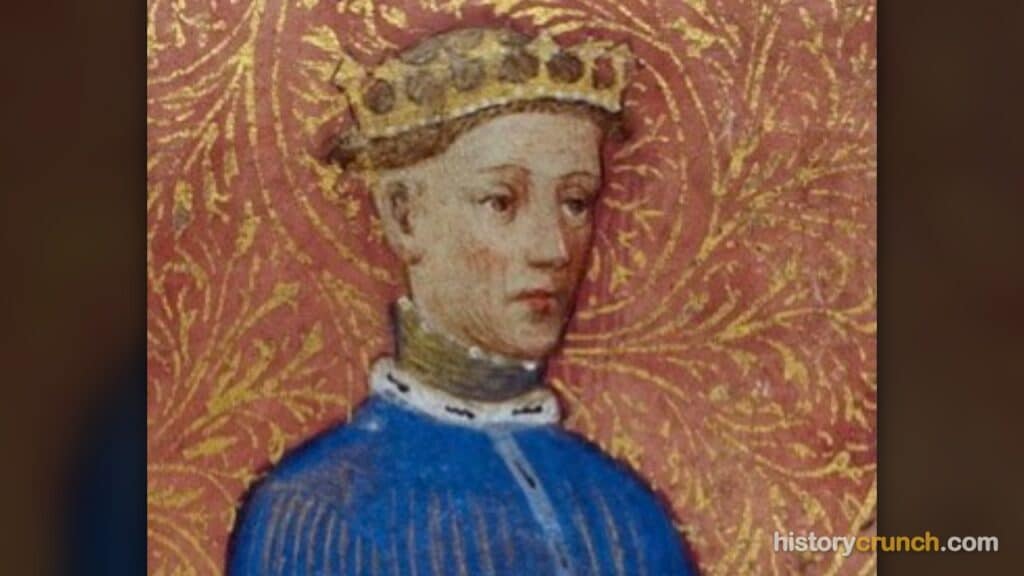
Henry V is remembered as one of the most celebrated kings in English history, a warrior monarch whose short reign left a lasting mark on both England and France. He ruled England from 1413 until his death in 1422, and during those nine years he revived England’s claim to the French throne and won a stunning victory over the French at the Battle of Agincourt. His campaigns brought much of northern France under English control and, for a brief moment, seemed to unite the crowns of England and France under a single ruler.
Henry V belonged to the House of Lancaster, the royal family that had taken the English throne in 1399. His reign fell during the later stages of the Hundred Years War, a long series of conflicts fought between England and France from 1337 to 1453 over who had the right to rule France. His fame comes from both his personal courage in battle and the way he turned England’s fortunes in that war around during his lifetime.
Early Life and Background
Henry was born in the autumn of 1386 at Monmouth Castle, near the border between England and Wales. Because of his birthplace he was often called Henry of Monmouth in his youth. His father was Henry Bolingbroke, a powerful noble who would later become King Henry IV, and his mother was Mary de Bohun.
Young Henry’s life changed dramatically in 1399. In that year his father deposed his cousin, King Richard II, and seized the English throne for himself. As a result, the thirteen-year-old Henry suddenly became the heir to the kingdom and was given the title Prince of Wales.
As Prince of Wales, Henry spent much of the next decade at war. More specifically, he led armies against the Welsh rebel Owain Glyndwr, who had risen up against English rule and even claimed the title Prince of Wales for himself. These campaigns lasted for years and taught the young prince how to command soldiers, manage supplies, and lead a long and difficult war.
Henry also learned about battle firsthand at a very young age. In 1403, at the age of sixteen, he fought beside his father at the Battle of Shrewsbury against the rebel Henry “Hotspur” Percy. During the fighting Henry was struck in the face by an arrow, and only survived because a surgeon managed to remove the arrowhead in a dangerous operation. Later stories described Henry as a wild and reckless young prince, but there is little firm evidence that he behaved this way.
Rise to Power
Henry IV died in 1413, and his son took the throne as Henry V at the age of twenty-six. The new king inherited a country that was still uneasy about the way his family had come to power, since his father had taken the crown by force rather than by right of birth. Proving that the House of Lancaster deserved to rule became one of Henry’s main goals.
Early in his reign Henry faced threats at home. In fact, in 1415 he uncovered a plot to remove him from the throne and replace him with a rival claimant. Henry acted quickly and had the leading plotters executed, showing that he would not tolerate any challenge to his rule.
With England secured, Henry turned his attention to France. He revived the old English claim to the French throne, first pressed by his great-grandfather Edward III at the start of the Hundred Years War. France at this time was weakened by the mental illness of its king, Charles VI, and by a bitter feud between two noble factions, the Armagnacs and the Burgundians. Henry saw this division as his chance to win lands and glory across the English Channel.
Major Achievements
In August of 1415 Henry crossed the English Channel with an army of around 11,000 men and landed in Normandy. His first target was the port town of Harfleur, which he placed under siege. The town surrendered after about five weeks, but the long siege and the spread of disease cost Henry roughly half of his soldiers.
With winter approaching and his army weakened, Henry decided to march north to the English-held port of Calais. As he marched, a much larger French army moved to block his path near the village of Agincourt. On October 25th, 1415, the two forces met in what became the most famous battle of Henry’s career.
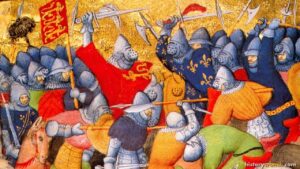
The Battle of Agincourt was a stunning English victory against seemingly impossible odds. Henry’s tired and outnumbered soldiers took up a strong position on a narrow, muddy field surrounded by woods. The heavily armored French knights struggled to advance through the deep mud, while English and Welsh archers armed with the longbow poured arrows into the crowded French ranks. By the end of the battle thousands of French soldiers, including many of the kingdom’s greatest nobles, had been killed, while English losses were small.
The victory made Henry a national hero and greatly strengthened his position both at home and abroad. He did not stop there, however. Over the next few years Henry returned to France and set about conquering Normandy piece by piece, capturing town after town. By 1419 nearly all of Normandy was in English hands, and Henry then moved to threaten Paris itself.
These victories forced the French to negotiate. In 1420 Henry and the French court agreed to the Treaty of Troyes, one of the most remarkable agreements of the entire war. Under its terms, the disinherited son of Charles VI, known as the Dauphin, was set aside, and Henry was named heir to the French throne and regent of France. To seal the agreement, Henry married Catherine of Valois, the daughter of Charles VI.
Later Life
The Treaty of Troyes seemed to place Henry at the height of his power. If it held, he and his descendants would one day rule both England and France as a single royal family. In December of 1421 Catherine gave birth to a son, also named Henry, who stood to inherit this double crown.
Yet the Dauphin and his supporters refused to accept the treaty, and fighting continued in the parts of France that still resisted English rule. Henry returned to France to press his advantage and laid siege to the town of Meaux, which held out for several months through the cold winter of 1421 and 1422. The long and difficult siege took a heavy toll on the king’s health.
During the campaign Henry fell seriously ill, most likely from dysentery, a disease spread by dirty water and unclean conditions in army camps. He grew so weak that he could no longer ride and had to be carried to the castle of Vincennes near Paris. Henry V died there on August 31st, 1422, at just thirty-five years of age.
His death came at the worst possible moment for his dynasty. Charles VI of France died only about two months later, which meant that Henry’s infant son inherited the claim to both thrones as Henry VI. Because the new king was still a baby, he was far too young to defend the great inheritance his father had won.
Significance of Henry V
Henry V is significant because he came closer than any other English king to uniting the crowns of England and France. In just nine years he restored English confidence, won a legendary victory at Agincourt, conquered Normandy, and had himself recognized as heir to the French throne. These achievements made him enormously popular during his own lifetime and turned him into a symbol of English strength and success.
His triumphs, however, did not last. Because Henry died so young and left an infant heir, the English position in France soon began to crumble. Within a few years the French rallied around the Dauphin, and a young woman named Joan of Arc helped inspire them to drive the English back. By 1453 the Hundred Years War had ended in French victory, and England held only the port of Calais.
Henry’s reputation has also been shaped by later writers and playwrights, who portrayed him as the ideal warrior king. As stated above, he became a lasting symbol of courage, leadership, and national pride. In reality he was also a demanding and sometimes ruthless commander, but his place among the most admired rulers in English history has never truly faded.
Frequently Asked Questions
Why is Henry V famous?
Henry V is most famous for leading England to victory over a much larger French army at the Battle of Agincourt in 1415. He is also remembered for conquering Normandy and for being named heir to the French throne, achievements that made him a hero in England and one of its best-known medieval kings.
How did Henry V die?
Henry V died of illness, most likely dysentery, on August 31st, 1422. He became sick while directing the long siege of Meaux in France and grew so weak that he had to be carried to the castle of Vincennes, where he died at the age of thirty-five.
What was the Treaty of Troyes?
The Treaty of Troyes was an agreement signed in 1420 that named Henry V as the heir and regent of France. It set aside the son of the French king, Charles VI, and arranged for Henry to marry the French princess Catherine of Valois, which briefly linked the crowns of England and France.
Who was Henry V’s father?
Henry V’s father was King Henry IV of England, who was born Henry Bolingbroke. He seized the English throne in 1399 by overthrowing his cousin, King Richard II, which made him the first king of the House of Lancaster and made his son the heir to the throne.
Who became king after Henry V?
Henry V was succeeded by his son, Henry VI, who was less than a year old when his father died. Because Charles VI of France died shortly afterward, the infant Henry VI inherited the claim to both the English and French thrones, though he was far too young to defend his father’s conquests.
Cite This Article
To cite this article as a source, use one of the formats below.
MLA: Millar, B. “Henry V: A Detailed Biography.” HistoryCrunch, 26 July 2026, https://historycrunch.com/henry-v/.
APA: Millar, B. (2026). Henry V: A Detailed Biography. HistoryCrunch. https://historycrunch.com/henry-v/
Chicago: Millar, B. “Henry V: A Detailed Biography.” HistoryCrunch. July 26, 2026. https://historycrunch.com/henry-v/
Sources
- Jerry Bentley & Herbert Ziegler, Traditions & Encounters: A Global Perspective on the Past.
- J.M. Roberts & Odd Arne Westad, The Penguin History of the World.